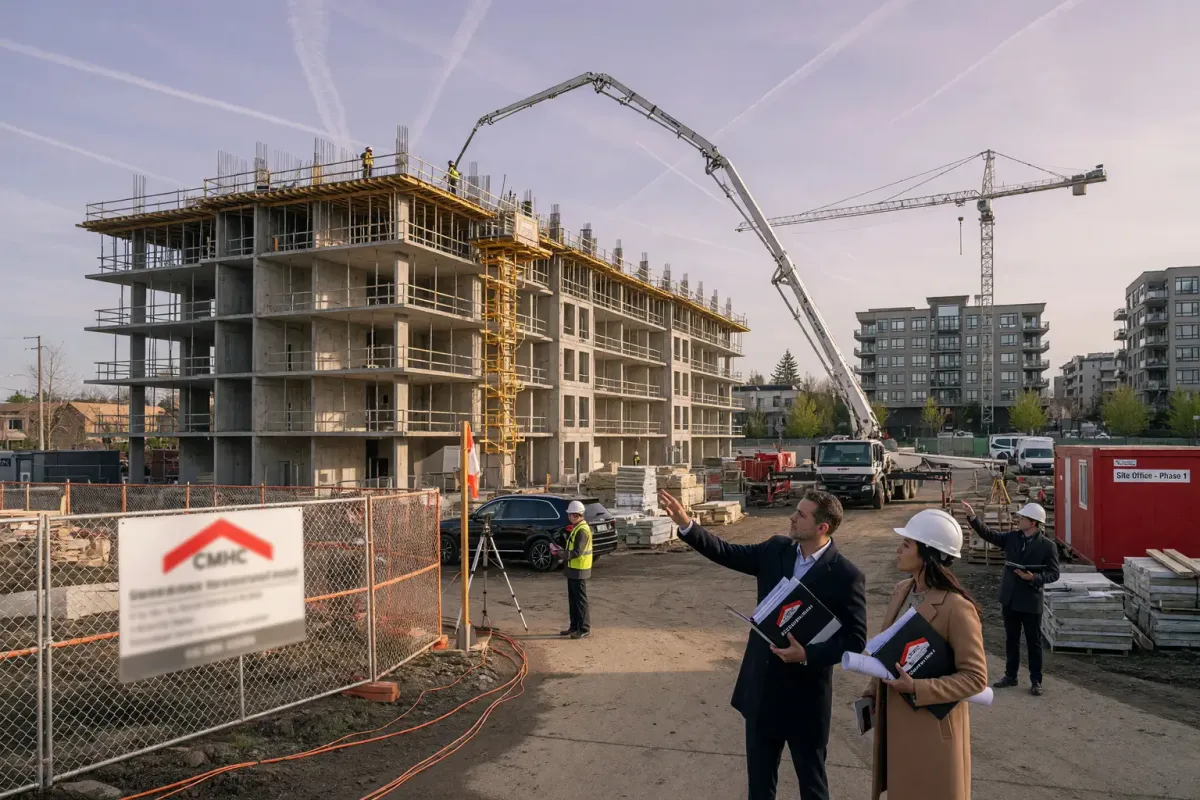
CMHC ACLP financing helps developers build purpose-built rental with high LTC construction dollars and a clear path to CMHC MLI Select takeout. Talk to a CMHC construction specialist — book a construction financing call.
Book construction financing call
ACLP is a federal mortgage insurance program designed specifically for developers building purpose-built rental housing in Canada. The program was significantly expanded in late 2023 and again in Budget 2024 — now totaling $55 billion (up from the original $40 billion) with a goal of supporting 131,000+ new rental homes by 2031–32. As of June 2025, CMHC reports $24.9 billion has been committed across projects supporting more than 63,500 rental homes. November 2024 reforms further eased access for builders, including raising the maximum loan-to-cost to 100% on qualifying projects.
ACLP provides low-cost construction financing during the building phase and guaranteed conversion to CMHC MLI Select financing once the project is stabilized. Run takeout numbers on the MLI max-loan calculator before you break ground.
What Is CMHC’s Apartment Construction Loan Program (ACLP)?
ACLP is a two-part financing solution: a construction-period loan that provides low-interest-rate capital during building, plus a pre-approved path to permanent financing through CMHC MLI Select.
Think of it as the federal government saying, “We want you to build rental housing. We’ll finance the construction phase affordably, and we guarantee you have permanent financing waiting when you finish.”
The program covers up to 100% loan-to-cost (LTC) on the construction phase following November 2024 reforms — significantly higher than traditional bank construction financing, which typically maxes out at 70-75% LTC. The higher LTC means you need less cash on the ground to start the project.
Here’s what makes ACLP different from conventional construction financing:
- Federal backing - CMHC insures the loan, giving lenders confidence in the program
- Low construction-period rates - Typically 1-2% lower than private construction financing
- Guaranteed permanent takeout - Conversion to MLI Select at pre-agreed terms
- Purpose-built rental focus - Program explicitly designed for the housing shortage
- Faster underwriting - CMHC streamlined approval process
- Flexible draw schedules - Works with realistic construction timelines
ACLP addresses a real problem in Canadian apartment development: the financing cliff. You finish construction, but permanent financing falls through, or the permanent lender demands terms so unfavorable that your project economics collapse. ACLP eliminates that risk with a pre-committed takeout.
Why ACLP Matters for Developers
Before ACLP existed, developers faced a dangerous gap. They’d secure construction financing based on one set of assumptions. Then, 18-24 months later, market conditions shifted, rates changed, or property valuations moved. Permanent financing suddenly came at rates or terms that made the entire project unprofitable.
ACLP solves this three ways.
First, certainty. When you close on ACLP construction financing, the permanent financing terms are locked in. You know exactly what your takeout will cost—interest rate, LTV, amortization, DSCR requirement. No surprises at the end. This certainty lets you model project economics with confidence.
Second, lower rates. CMHC-insured construction financing costs less than conventional bank or private construction lending. Over an 18-month construction period on an $8 million project, those rate savings compound into hundreds of thousands of dollars. That capital comes back into your project—more units, better amenities, faster lease-up.
Third, larger projects. The up to 100% LTC allows you to build bigger with the same equity. A project that would require $2 million equity at 70% LTC might require minimal cash equity at 95-100% LTC. That equity can go toward additional properties in your portfolio instead of sitting in a single project.
For developers scaling from smaller projects to larger multi-family development, ACLP is the financing tool that unlocks growth. You stop being constrained by available equity and start being constrained by land, zoning, and market opportunity. Explore our development mortgage financing options for a broader view of construction programs, and compare permanent-phase commercial mortgage rates once your ACLP takeout converts to MLI Select.
Before you commit to any mortgage product, it helps to get a second opinion — book a free strategy call with LendCity to see which options actually fit your financial picture.
If this approach is on your radar, our multi-family mortgage financing guide walks through how LendCity structures these deals.
ACLP Eligibility Requirements
ACLP isn’t available to everyone. CMHC built specific gates into the program to ensure responsible lending and guarantee housing quality.
Purpose-Built Rental Housing - This is non-negotiable. ACLP is only available for buildings where units are held as rental properties. If you’re building a condo project for sale, ACLP doesn’t apply. The program’s mission is to increase rental housing supply, not to finance condo developments. If you’re considering converting to condos later, ACLP isn’t your tool—you’ll need conventional construction financing instead.
Minimum Unit Count - Projects must have at least five units. CMHC considers anything below that residential rather than commercial development. That said, anything at five units or more qualifies, from a modest six-unit apartment to a large 200-unit complex. There’s no upper limit.
Canadian Location - The property must be in Canada. ACLP financing is only available for Canadian projects. If you’re developing in the US or internationally, you’ll need conventional financing.
CMHC Approved Lender - Your lender must be a CMHC-approved financial institution. Most major banks qualify, as do many credit unions and alternative lenders. Your mortgage broker can confirm which lenders offer ACLP.
Development Team Qualifications - CMHC evaluates your team’s experience. You don’t need to be a seasoned developer, but your contractor, architect, and project manager should have relevant multifamily experience. A first-time developer can get ACLP approval if partnered with experienced professionals.
Financial Strength - You need personal liquidity and net worth appropriate to the project size. CMHC typically wants to see minimum net worth of $500,000-$1 million depending on project scale. They also want to see liquid reserves sufficient to cover contingencies.
Market Feasibility - The proposed rental rates must be achievable in the market. CMHC won’t finance a luxury 50-unit apartment complex in a market that only supports mid-range rents. Your appraisal and market study need to support the project’s financial viability.
Title and Zoning - The land must be clear title with appropriate zoning for the intended use. You need either owned land or a locked-in purchase agreement. The property must be zoned for residential multifamily development.
Meeting these requirements isn’t difficult for legitimate developers. The bar is designed to separate serious operators from speculators. If you have real experience, a solid team, adequate capital, and a realistic project, ACLP eligibility is achievable.
How ACLP Works with MLI Select
ACLP is a partnership between two programs: the construction phase (ACLP) and the permanent financing phase (MLI Select).
Understanding how these connect is crucial to ACLP strategy.
Construction Phase (ACLP) - Your lender provides an ACLP construction loan covering up to 100% LTC on qualifying projects (post-November 2024 reforms). The program offers minimum $1M loans with fixed-rate terms and amortization up to 50 years. You pay interest-only on drawn funds throughout the construction period. CMHC insures the construction loan, guaranteeing the lender will be repaid even if the project fails. This insurance is why construction-period interest rates are competitive.
Permanent Phase (MLI Select) - Once construction is complete, your property is stabilized (typically 80-95% occupancy), and the permanent financing commitment kicks in. The ACLP construction loan is paid off with the new MLI Select mortgage. MLI Select allows 95% LTV, 50-year amortization, and flexible DSCR requirements (typically 1.10x minimum at 100 points). Your interest rate on the permanent mortgage is locked in from the ACLP commitment stage.
The beauty of this structure: you know your permanent financing rate before breaking ground. Market rates could skyrocket during construction—it doesn’t matter. Your takeout is locked. For more on MLI Select terms and flexibility, see our CMHC MLI Select multifamily mortgage insurance guide.
Here’s what that looks like in a real scenario:
- Day 1 of ACLP: You close on construction loan at prime + 0.5%, with permanent MLI Select commitment at prime + 2.0%
- Month 18 of construction: Market rates have jumped. Prime + 2.0% permanent financing isn’t available anymore. Doesn’t matter—your takeout is locked
- Closing on permanent: You deploy the MLI Select mortgage at the committed rate, pay off the construction loan, and start collecting rent at your projected cash flows
This certainty is worth money. You can model project ROI with real confidence instead of crossing your fingers and hoping permanent financing materializes.
Every borrower’s situation is different, and the wrong mortgage structure can cost you thousands — schedule a free strategy session with us to make sure you’re set up properly.
ACLP vs Traditional Construction Financing
Let’s be specific about how ACLP compares to conventional options.
| Factor | ACLP | Bank Construction | Private Construction |
|---|---|---|---|
| LTC | Up to 100% | 70-75% | 60-75% |
| Construction Rate | Fixed rate (CMHC-insured) | Prime + 1.5% to 2.5% | Prime + 3% to 5% |
| Permanent Rate | Locked at close | Market rate at maturity | Uncertain until maturity |
| Permanent Lender | CMHC MLI Select | Unknown/competitive | Unknown |
| DSCR Flexibility | 1.10x minimum (100 pts) | 1.35x minimum | 1.25-1.40x minimum |
| Max LTV (Permanent) | 95% | 80-85% | 70-75% |
| Takeout Certainty | Guaranteed | Conditional | Uncertain |
| Approval Timeline | 4-6 weeks | 6-8 weeks | 2-3 weeks |
| Recourse | Full recourse | Possible recourse | Full recourse typical |
| Purpose | Rental only | Rental or sale | Any |
Let me walk through what these differences mean for a real $8 million apartment project:
Equity Required:
- ACLP at 95-100% LTC (post-Nov 2024 reforms): $400K-$800K equity needed
- Bank at 75% LTC: $2 million equity needed
- You save up to $1.5 million in capital requirements
Construction Costs:
- ACLP fixed rate (CMHC-insured, typically below prime): On $7.6 million financed over 18 months, materially lower interest cost than conventional
- Bank at prime + 2% (currently ~6.45%): On $6 million financed (lower LTC) over 18 months, approx. $360,000 in interest
- ACLP rate stability and lower premium produce significant savings versus conventional
Permanent Financing Certainty:
- ACLP: You know permanent financing rate at Day 1. No surprises.
- Bank: At month 18, rates could be 2-3% higher, crushing project economics
- This is the real value. ACLP’s rate lock is worth a percentage point of interest savings plus the certainty premium
Permanent Flexibility:
- ACLP (MLI Select): 95% LTV allowed, 1.10x DSCR minimum at 100 points, 50-year amortization
- Bank: 85% LTV, 1.35x DSCR minimum, 25-year amortization
- On an $8 million project, the extra 10% LTV means $800,000 in additional proceeds available for holdback, reserves, or additional equity invested elsewhere
The Trade-Off: ACLP requires purpose-built rental housing exclusively. You can’t build with an exit strategy of converting to condos or selling units individually. If flexibility on exit strategy matters to your business model, conventional financing may be worth the extra cost.
For developers committed to the rental housing business, ACLP is almost always the superior choice. If you want to compare ACLP’s permanent takeout structure to other programs, review our guide on private lending versus CMHC apartment financing.
The ACLP Application Process
Getting approved for ACLP requires planning and documentation. This isn’t a two-day approval process. You need to be organized.
Phase 1: Pre-Consultation
Before formally applying, have a conversation with a CMHC-approved lender about your project. Bring:
- Land ownership documents or purchase agreement
- Preliminary architectural drawings
- High-level budget estimate
- Your development team’s experience summaries
This conversation clarifies whether your project fits ACLP. The lender will tell you if anything is disqualifying or if they see red flags that need addressing before formal application.
Phase 2: Formal Application
Submit a complete ACLP application including:
- Detailed architectural and engineering drawings
- Comprehensive construction budget with contingencies
- Detailed construction timeline
- Architect’s and engineer’s seals
- Land appraisal or purchase documentation
- Personal financial statements and tax returns (typically last three years)
- Project team résumés showing relevant experience
- Market study showing demand for the proposed units
- Pro forma income statement showing stabilized operations
The lender will order a formal appraisal and may commission independent construction cost reviews.
Phase 3: Underwriting and Approval
CMHC’s underwriting team evaluates the complete package. This is where they assess project viability, team qualifications, and financial strength.
Typical underwriting timeline: 4-6 weeks.
During underwriting, you’ll typically be asked questions like:
- Explain the team’s multifamily development experience
- Walk us through your market demand analysis
- How is the architectural team qualified?
- What’s your contingency plan if leasing is slower than projected?
- What’s your exit strategy if permanent rates move against you?
Respond thoroughly and directly. Vague answers get conditional approvals requiring additional clarification.
Phase 4: Commitment Letter
Assuming underwriting is successful, you receive a commitment letter specifying:
- Construction loan amount and LTC
- Construction loan interest rate
- Interest-only payment terms
- Permanent loan amount and terms
- Permanent loan interest rate
- Permanent loan max LTV and amortization
- Permanent loan DSCR requirements
- Any conditions that must be satisfied before construction funding
This commitment letter is valid for a specific term (typically 90-180 days). It’s your guarantee of permanent financing.
Phase 5: Construction Monitoring and Draws
Once you start construction, the lender sends inspectors to verify work quality and completion before releasing each draw. Typical draw schedule aligns with construction phases:
- Initial draw (10-15% upon foundation completion)
- Subsequent draws (10-15% at framing, rough-in, drywall, finishes)
- Final draws (upon completion and occupancy)
You submit draw requests with supporting documentation. The lender’s inspector verifies the work. Once verified, draws typically fund within 5-10 business days.
Phase 6: Conversion to Permanent Financing
Once your building is substantially complete (typically 95%+ occupancy or minimum 12 months operational), you convert to permanent MLI Select financing. The application process is simpler than initial ACLP approval because CMHC already knows the project—they’ve been monitoring it throughout construction.
Typical approval timeline for permanent conversion: 2-3 weeks.
The entire process from initial consultation to breaking ground typically takes 4-6 months. Budget time accordingly.
Real Example: A 30-Unit Apartment Development Using ACLP
Let me walk through a realistic scenario to show how ACLP finances an actual project.
Project Overview:
- 30-unit apartment building in a mid-sized Canadian market
- Mix of one- and two-bedroom units
- Total development cost: $8 million
- Land already owned (no acquisition cost within development budget)
- Construction timeline: 18 months
ACLP Construction Financing:
- LTC: 95% (post-November 2024 reforms; up to 100% on qualifying social-outcome projects)
- Total construction loan: $7.6 million
- Required developer equity: $400,000
- Interest rate: CMHC-insured fixed rate (typically below conventional construction rates)
- Term: 18 months plus 6-month conversion period
- Payments: Interest-only during construction
Construction Phase Costs:
- Estimated interest during 18-month construction: $357,000
- Draw-down assumes 50% funded at month 6, 100% by month 12
- Monthly interest-only payment (average): ~$19,000
Stabilization and Permanent Conversion:
- Target occupancy at closeout: 90%
- Average rent: $1,800/month per unit
- Gross rental income (stabilized): $388,800/month
- Operating expenses (estimated): 35% of gross = $136,080/month
- Net Operating Income: $252,720/month or $3,032,640/annually
MLI Select Permanent Financing:
- Property appraisal (at stabilization): $9.2 million
- Permanent loan amount: $9.2M × 95% LTV = $8.74 million
- Available to pay off construction loan: $8.74M
- Excess proceeds available: $8.74M - $6.8M = $1.94 million
This excess capital typically covers:
- Accumulated interest during construction ($357K)
- Lease-up reserves ($500K)
- Capital reserves for reserves ($300K)
- Net developer proceeds ($783K)
Permanent Financing Terms:
- Interest rate: Prime + 2.0% (locked at ACLP commitment, approximately 8.5% in current market)
- Monthly payment on $8.74M at 8.5% over 50 years: ~$62,000/month
- Cash-on-cash return: ~$191,000/month (after debt service)
Return on Investment:
- Initial equity: $1.2 million
- Proceeds from permanent financing: $783,000
- Net capital deployed: $417,000
- Stabilized cash flow: $191,000/month or $2.29M annually
- Cash-on-cash return: 550% in year one (this normalizes in year two once you’ve held the asset a full year)
This example shows why ACLP enables scaling developers to grow their portfolios. The higher LTV and locked permanent financing create a financial machine that generates excess capital from appreciation and permanent financing proceeds. Many developers combine ACLP with strategies outlined in our multifamily investment tax structuring guide to optimize long-term returns.
Tips for a Successful ACLP Application
Getting ACLP approval isn’t guaranteed. Lenders reject applications regularly. Here’s how to improve your odds.
Build Your Team First
Don’t apply as a solo developer. Partner with:
- A contractor with direct multifamily development experience
- An architect experienced in residential multifamily
- A project manager with a track record
- A lender experienced with ACLP (not all CMHC-approved lenders do ACLP regularly)
CMHC wants to see that talent surrounding you. Your personal inexperience is offset by team expertise. This team approach mirrors what’s covered in detail in our comprehensive guide to construction financing for apartments, where developer team composition directly impacts lender confidence.
Get the Market Analysis Right
Your market study should show:
- Demographic trends supporting rental demand
- Current rental rates in the submarket
- Absorption rates for similar properties
- Lease-up timelines for recent comparable projects
- Why your project will succeed where others have or would struggle
Don’t guess. Hire a professional market analyst. A weak market study kills applications.
Budget Conservatively
Construction cost estimates should come from a quantity surveyor or cost estimator, not back-of-napkin math. Include:
- Hard costs (actual construction): With 10% contingency built in
- Soft costs (design, permits, insurance): Often 15-20% of hard costs
- Financing costs (interest, lender fees): During construction period
- Lease-up costs (marketing, leasing commissions): During stabilization
If you’re off by 10% on costs, the project still works. If you’re optimistic by 25%, you’re underwater.
Lock In Your Construction Timeline
Present a realistic timeline. Most 30-unit apartment buildings take 16-22 months to build. Don’t claim you’ll do it in 12 months unless you have a specific reason (modular construction, simplified design).
CMHC reviews your timeline. If it’s unrealistic, they’ll extend the loan term, which increases your interest costs and extends the construction-to-permanent period.
Develop Pre-Leasing Strategy
Show that you have a leasing strategy. Outline:
- Your target tenant profile
- Your marketing channels
- Your competitive advantages
- Your pricing strategy
Many successful developers pre-lease 20-30% of units before breaking ground. This de-risks the project and improves permanent financing terms.
Demonstrate Personal Financial Strength
You need to show:
- Net worth of at least $500,000 (more for larger projects)
- Liquid reserves of $150,000-$300,000 minimum
- Three years of clean tax returns
- Manageable personal debt (CMHC looks at your total debt-to-income ratio)
- No recent bankruptcies, foreclosures, or major credit problems
CMHC understands that development projects sometimes struggle. If your personal finances are weak, they see you as a flight risk if the project gets difficult.
Work with a Mortgage Broker Experienced in ACLP
Not all mortgage brokers have ACLP experience. Find one who has successfully placed ACLP loans before. They’ll navigate CMHC’s requirements, avoid application mistakes, and improve your odds of approval.
Key Takeaways:
- What Is CMHC’s Apartment Construction Loan Program (ACLP)?
- Why ACLP Matters for Developers
- ACLP Eligibility Requirements
- How ACLP Works with MLI Select
- ACLP vs Traditional Construction Financing
Frequently Asked Questions
What's the difference between ACLP and CMHC MLI Select?
Can I use ACLP if I'm converting an existing building to apartments?
What happens to ACLP if the project fails during construction?
Is ACLP available for condominiums?
What's the minimum DSCR I need on the permanent mortgage?
Can I use ACLP for a mixed-use project with apartments and retail?
What interest rate should I expect on ACLP construction financing?
Moving Forward with ACLP
ACLP represents a fundamental shift in Canadian apartment development financing. Instead of playing financial roulette—building a project hoping permanent financing materializes at acceptable terms—you start your project with permanent financing locked in.
For developers ready to scale beyond single-family investment into multifamily development, ACLP is the difference between feasible projects and pie-in-the-sky ideas.
The program works. CMHC has successfully financed hundreds of millions of dollars in apartment development across Canada. The challenge isn’t whether ACLP works—it’s whether your project, team, and capital stack are solid enough to qualify.
If you’re seriously considering an apartment development project and want to explore ACLP, don’t wait until you’ve spent months planning. Talk to a mortgage broker or lender now. Understand what they need to see, assess your readiness, and use their feedback to strengthen your application.
The largest limitation most developers face with ACLP isn’t access to the program—it’s having a development-ready project and the capital to deploy. For new construction projects incorporating energy efficiency, you can also layer in CMHC green financing incentives to further improve project economics through premium refunds and extended amortization.
If you’re ready to move forward with multifamily development, start your financing application with our team to discuss your project and how ACLP fits your plans.
Free download
MLI Select document checklist
Appraisals, rent rolls, environmental reports, and the CMHC package lenders expect before they underwrite.
By submitting, you agree to receive occasional emails from LendCity. You can unsubscribe at any time.
4.8/5 (116 Google reviews)
Disclaimer: LendCity Mortgages is a licensed mortgage brokerage. Content on this page is for educational purposes only and does not constitute legal, tax, investment, securities, or financial-planning advice. Rates, premiums, program terms, and regulations referenced are as of the page's last updated date and are subject to change. Any investment returns, rental yields, tax savings, or case-study figures shown are illustrative only — they are not guaranteed, not typical, and individual results will vary. Consult a licensed lawyer, Chartered Professional Accountant, or registered dealer before acting on any information above. Editorial standards.

Written by
Scott Dillingham
Published
February 26, 2026
· Updated August 11, 2026Reading time
16 min read
CMHC Insurance
Mortgage default insurance from Canada Mortgage and Housing Corporation. For 1-4 unit investment properties, investors must put 20%+ down (no insurance available). However, CMHC offers MLI Select for 5+ unit multifamily properties, and house hackers can access insured mortgages with 5-10% down.
Construction Loan
Short-term financing used to fund building a new property. Funds are released in stages (draws) as construction milestones are completed, and interest is charged only on drawn amounts. Construction loans typically convert to permanent financing upon project completion.
Takeout Financing
Permanent long-term mortgage financing that replaces a short-term construction loan after a development project is completed and stabilized. Securing a takeout commitment before construction begins reduces project risk.
CMHC MLI Select
A CMHC program offering reduced mortgage insurance premiums and extended amortization (up to 50 years) for multifamily properties with 5+ units that meet energy efficiency or accessibility standards. Popular among investors scaling into larger apartment buildings.
LTV
Loan-to-Value ratio - the mortgage amount expressed as a percentage of the property's appraised value or purchase price (whichever is lower). An 80% LTV means you're borrowing 80% and putting 20% [down](/glossary/down-payment/). Lower LTV generally means better [interest rates](/glossary/interest-rate/) and terms. See also [Equity](/glossary/equity/) and [Leverage](/glossary/leverage/).
DSCR
Debt Service Coverage Ratio — a metric that compares a property's [net operating income](/glossary/noi/) to its mortgage payments. A DSCR of 1.25 means the property generates 25% more income than needed to cover the debt. Lenders typically require a minimum DSCR of 1.0 to 1.25 for investment property loans (including [DSCR loans](/glossary/dscr-loan/)). See also [Cap Rate](/glossary/cap-rate/) and [Cash Flow](/glossary/cash-flow/).
Multifamily
Properties with multiple dwelling units, from duplexes to large apartment buildings. Often offer better cash flow and economies of scale.
Lease-Up Period
The time between when a new or renovated property is ready for tenants and when it reaches stabilized occupancy. During lease-up, the property generates below-target income while carrying full expenses, requiring adequate cash reserves.
Draw Schedule
A plan specifying when and how much of a construction loan's funds will be released as building milestones are reached. An inspector verifies work completion before each draw is disbursed.
Loan-to-Cost Ratio
The percentage of a development project's total cost that a lender will finance. Unlike LTV which compares loan to appraised value, LTC compares loan to actual project costs including land, construction, and soft costs.
Hover over terms to see definitions. View the full glossary for all terms.