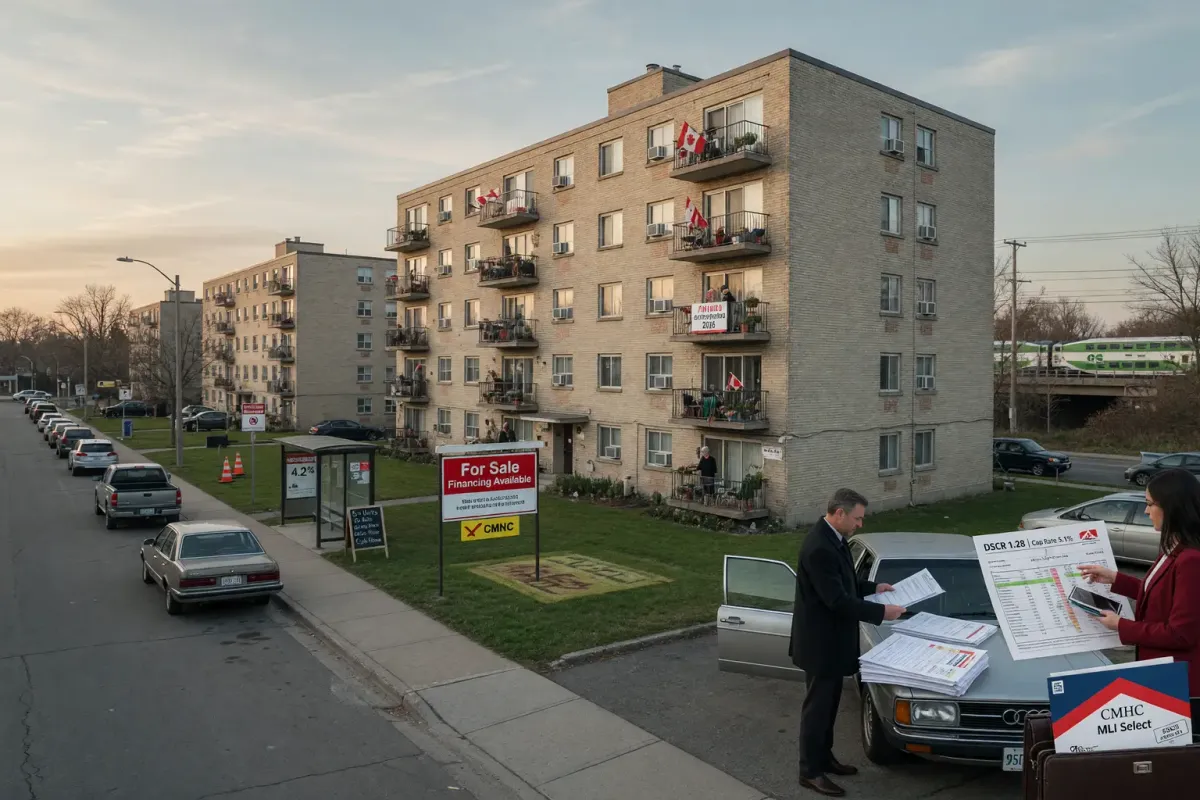
Ontario is Canada’s largest and most active multifamily real estate market. Toronto’s market alone rivals entire countries in transaction volume, and secondary markets from Ottawa to Hamilton to London are seeing explosive rental demand driven by immigration and population growth.
But Ontario multifamily investing comes with complexities that don’t exist in other provinces. Rent control rules, double land transfer taxes in Toronto, higher property values, and tighter cap rates change how deals work. Understanding Ontario’s specific financing environment, regulatory landscape, and market opportunities helps you navigate the largest multifamily opportunity in Canada.
This guide walks through how to finance apartment buildings across Ontario—from the competitive GTA to emerging secondary markets where the numbers actually work.
Ontario’s Multifamily Landscape: Why It Matters
Ontario is home to 40% of Canada’s multifamily rental stock. Toronto alone has over 2.5 million residents in the greater metro area, with another 2 million in surrounding regions. That’s not just a big market—it’s one of North America’s most important cities for residential real estate.
Here’s what drives Ontario’s multifamily opportunity:
Immigration Gateway: Ontario receives roughly 40% of Canada’s newcomers annually. New immigrants rent initially before accumulating down payment capital. That creates unrelenting rental demand across all price points.
Economic Diversity: Toronto is a global financial hub. Coupled with Ottawa’s government employment, Hamilton’s manufacturing and healthcare sectors, and London’s university presence, Ontario’s economy is more resilient than single-industry provinces.
Population Growth: Ontario is growing faster than any other province, adding roughly 100,000+ residents annually. That’s new tenant households for rental properties.
Immigration-Driven Affordability Challenges: Rental demand outpaces supply in most Ontario markets, keeping vacancy rates low and rents rising. This sounds good for landlords until you realize it also affects your financing costs and DSCR underwriting.
The combination of strong demand fundamentals with regulatory complexity creates a market where success requires understanding both the opportunity and the constraints.
Understanding Ontario Rent Control: The Rules Change Everything
Ontario’s rent control regime is the single most important regulatory factor for multifamily financing. It directly affects property valuation, income projections, and financing qualification.
What Rent Control Actually Covers
Ontario’s Residential Tenancies Act applies rent control to residential properties built before November 15, 2018. This means:
Controlled Units: Properties occupied by tenants before November 2018 are subject to annual rent increase guidelines. In 2026, the guideline is 2.1%, meaning landlords can typically increase rent by 2.1% annually for existing tenants (unless above-guideline increases are approved for substantial repairs).
New Construction Exemption: This is crucial—units in buildings first occupied after November 15, 2018 are NOT subject to rent control. New construction apartments can reset to market rents between every tenancy. This exemption makes new purpose-built rental projects dramatically more valuable than acquiring older rent-controlled stock.
Between-Tenancy Reset: Even on controlled properties, when a tenant moves out, you can reset to market rent for the next tenant. This means your rent growth is gated by tenant turnover, not inflation.
Why This Matters for Financing
Rent control fundamentally changes DSCR (Debt Service Coverage Ratio) calculations. Lenders project income based on long-term stabilized rent, accounting for rent control constraints. A 10-unit building with 8 rent-controlled units can’t project the same income as a 10-unit building with zero controlled units, even if both are located identically.
Example: A stabilized 20-unit building with 15 controlled units from 2012 might project conservative 2.1% annual increases (2026 guideline). A newly constructed 20-unit building can project market rent recovery between tenancies, potentially 3-5% annual growth. Same physical product, dramatically different financing qualification.
Lenders underwrite this conservatively. Your income projections for acquisition of rent-controlled stock will be lower than new construction, making deal underwriting tougher.
The New Construction Advantage
Building new multifamily with CMHC MLI Select creates tremendous advantages:
- No rent control burden—rent resets with every tenancy
- 95% financing available at maximum points
- 50-year amortization improves DSCR dramatically
- New construction commands premium rents ($2,000+ for 2-bedroom units in major Ontario markets)
- Affordability commitments for MLI Select are often achievable at market rates in Ontario’s competitive rental environment
For Ontario specifically, if you’re considering acquisitions versus development, understand that rent control makes new construction projects finance at better terms than comparable acquisitions.
Mortgage rules change frequently, so what worked last year might not apply today — book a free strategy call with LendCity to get current, personalized guidance.
The GTA: High Values, Compressed Yields
The Greater Toronto Area—including Toronto proper, Mississauga, Brampton, Vaughan, Markham, and surrounding regions—represents the highest-priced multifamily market in Canada. It’s also where margins are tightest.
GTA Market Fundamentals
Toronto’s core and inner suburbs have property values that reflect global city status:
- 4-6 unit building in central Toronto: $2.5M–$4.5M
- 12-unit apartment in Midtown Toronto: $5M–$8M
- 20-unit building in suburban Toronto (Etobicoke, Scarborough): $8M–$12M
- Newer purpose-built rental buildings: $300,000–$350,000 per unit in core areas
These values compress cap rates significantly. Here’s why that matters:
Cap Rate Reality: GTA multifamily cap rates typically range 3.8%–5.0% depending on location and property condition. Toronto’s purpose-built rental vacancy reached approximately 3.0% per CMHC’s October 2025 report (avg rent ~$1,917) — part of the national trend where vacancy rose to 3.1% from 2.2% the year before, with new supply meeting softening immigration-driven demand. Toronto’s benchmark home price was $929,900 in March 2026 (-7.3% YoY); GTA average $1,017,796. In comparison, Alberta multifamily cap rates often trade at 5%–7%. That cap rate compression means the same financing and operating costs consume a larger portion of rent at GTA valuations.
DSCR Challenges: High property values plus compressed cap rates make DSCR underwriting tight. A $10M acquisition with $8M in financing needs approximately $450,000+ in annual NOI (Net Operating Income) to hit 1.25x DSCR. With rent control limiting growth on existing buildings, reaching those NOI targets becomes the financing bottleneck. When evaluating multi-family mortgage financing options, DSCR is typically the constraint in GTA transactions.
Entry Point Barriers: Fewer investors can accumulate the capital needed for GTA acquisitions. A 20% down payment on a $10M property is $2M. A 25% down payment is $2.5M. These capital requirements naturally limit the buyer pool.
Appreciation Offset: Historically, GTA properties have appreciated significantly—4%–6% annually over long hold periods. This appreciation partially offsets tight current cash flow, but relying on appreciation is a strategy, not a guarantee.
Where GTA Opportunities Hide
Despite tight overall fundamentals, GTA opportunities exist:
Value-Add in Rent-Controlled Stock: Older buildings with deferred maintenance sometimes trade at discounts reflecting their condition. Renovating key building systems (HVAC, roof, windows), improving common areas, and repositioning units for modern tenants can justify rent increases. Lenders finance these upgrades more readily than they finance raw acquisitions. This is where MLI Select points system scoring can add value if you’re incorporating energy efficiency upgrades.
Emerging Neighborhoods: Areas like Etobicoke Waterfront, North York Industrial-to-Residential transitions, and newer Vaughan locations sometimes offer better cap rates than established neighborhoods while benefiting from transit investment and demographic shifts. Many successful GTA investors have built substantial portfolios using these strategies—learn how to analyze rental properties systematically to identify undervalued opportunities.
New Purpose-Built Rental: New construction in GTA suburbs (Mississauga, Brampton, Vaughan) often delivers better economics than acquisitions because there’s no rent control burden and construction costs are more predictable.
Multifamily Conversions: Older office or commercial buildings in transition neighborhoods can be repurposed as residential. These often qualify for tax incentives while offering better cap rates than straight acquisitions.
GTA Secondary Markets (Still GTA, Better Numbers)
Toronto proper commands premiums that don’t extend everywhere in the Greater Toronto Area:
- Mississauga, Brampton: Cap rates 4%–5.5%, better than Toronto core but still compressed
- Vaughan, Markham, Richmond Hill: Similar to Mississauga—good fundamentals but less appreciation history
- Durham Region (Oshawa, Ajax): Cap rates 4.5%–5.5%, further out with more inventory
These communities have strong population growth and immigration absorption, just without Toronto’s global city premium.
Secondary Markets: Where Numbers Start Working
Beyond the GTA, Ontario’s secondary markets deliver fundamentally different economics. These cities have strong population growth, improving employment, but substantially lower entry costs and better cap rates.
Ottawa: Government Anchor + Tech Growth
Ottawa benefits from federal government employment (stable tenant base) combined with growing tech sector presence (attracts younger, higher-income renters).
Market Profile:
- Population: 1.4M metro area
- Cap rates: 4.5%–6%
- Entry point: 8-unit buildings $2.4M–$3M
- Rent levels: 1-bedroom $1,300–$1,600, 2-bedroom $1,600–$2,000
- Benchmark home price: $617,700 in March 2026 (-2.1% YoY)
- Demographic: Government workers, tech professionals, young families
Financing Advantage: Ottawa’s DSCR underwriting is easier than GTA at comparable building quality. Better cap rates plus lower absolute values make it simpler to hit 1.25x DSCR thresholds.
Growth Driver: National Capital expansion continues. Transit investment (Confederation Line expansion into Barrhaven) supports values in growth corridors.
Hamilton: Industrial Renaissance + Healthcare Hub
Hamilton is experiencing revival driven by healthcare employment (McMaster University Medical School, regional health facilities) and industrial diversification.
Market Profile:
- Population: 750K metro area
- Cap rates: 5%–7% (best in Ontario)
- Entry point: 12-unit buildings $2.2M–$3.2M
- Rent levels: 1-bedroom $1,200–$1,500, 2-bedroom $1,500–$1,850
- Benchmark home price: $736,500 in March 2026 (-7.9% YoY)
- Demographic: Healthcare workers, young professionals, families
Financing Advantage: Hamilton’s cap rates allow better cash flow than GTA markets. A 20-unit building generating 6% cap rate at $3.6M value produces $216,000 in NOI—often enough to hit DSCR targets more comfortably than equivalent GTA properties.
Growth Drivers: Healthcare employment growth (McMaster expansion), waterfront redevelopment, commuter appeal for workers priced out of Toronto.
London: University Town + Regional Hub
London’s economy is anchored by Western University plus regional healthcare and service employment. It’s smaller than Ottawa or Hamilton but offers similar or better cap rates with lower absolute prices.
Market Profile:
- Population: 400K metro area
- Cap rates: 5%–7%
- Entry point: 12-unit buildings $2M–$3M
- Rent levels: 1-bedroom $1,200–$1,400, 2-bedroom $1,400–$1,700
- Demographic: Students, young professionals, retirees
Financing Advantage: London real estate investing benefits from strong student/young professional rental demand. University presence creates predictable tenant pipeline.
Economic Stability: University anchor (Western, Fanshawe College) provides employment stability that buffers economic downturns.
Emerging Opportunities: Kitchener-Waterloo, Windsor, Barrie
Tier-3 Ontario markets offer even better cap rates with corresponding challenges:
Kitchener-Waterloo:
- Cap rates: 5.5%–7.5%
- Tech hub growth (Google, Shopify offices)
- Lower rent levels ($1,100–$1,500 for 1-bedroom)
Windsor:
- Cap rates: 6%–8%
- Auto sector presence (Stellantis manufacturing)
- Lowest absolute prices in Ontario; average sale price ~$257,954 (March 2026)
- Rent levels: $1,000–$1,300 for 1-bedroom
Barrie:
- Cap rates: 5%–6.5%
- Highest growth rate in Ontario (population +8% over past 3 years)
- Regional hub between Toronto and Northern Ontario
- Rents: $1,300–$1,600 for 1-bedroom
The trade-off is clear: secondary markets offer better financing parameters (higher cap rates, lower absolute values) but less appreciation history and smaller tenant pools. They’re excellent markets for cash-flow-focused investors willing to sacrifice some upside appreciation.
Choosing the wrong lender or term can quietly erode your returns — schedule a free strategy session with us and we’ll walk you through the numbers.
Financing Options for Ontario Multifamily
Ontario’s multifamily investors have several financing paths. Choosing the right path depends on property type, experience, and capital available.
CMHC MLI Select: Maximum Leverage, New Construction Bias
CMHC MLI Select is designed specifically for multifamily. It offers:
- Up to 95% loan-to-cost financing
- 50-year amortization (dramatically improving DSCR)
- Limited recourse (personal liability is capped)
- Points-based qualification (affordability, energy efficiency, accessibility)
Ontario-Specific Consideration: MLI Select affordability thresholds are BELOW market in many GTA locations. This is critical.
For example, CMHC’s “Affordable Rent” threshold in Toronto for a 1-bedroom might be $1,400/month. Market rents are $1,600–$1,800. This means earning affordability points requires committing units to rents BELOW what you could charge. In secondary markets like Hamilton, CMHC thresholds are closer to market, making affordability points achievable without sacrificing economics.
This makes MLI Select particularly effective for secondary Ontario markets where affordability thresholds align better with achievable rents.
Borrowers comparing options often continue with How to Finance Your First Multifamily Building in Canada before booking a strategy call.
CMHC MLI Standard: Simpler Qualification, Existing Buildings
MLI Standard (non-Select) offers:
- Up to 85% loan-to-cost
- 40-year amortization
- Full recourse
- No points requirement
- Faster approval (4-8 weeks vs 12-16 weeks for MLI Select)
MLI Standard works well for stabilized acquisitions where 85% LTV is sufficient. Many GTA investors use MLI Standard for existing building acquisitions because retrofitting for MLI Select points isn’t economical.
Conventional Lending (Non-CMHC)
Conventional lenders (banks, mortgage investment companies) typically offer:
- 70–80% LTV (some up to 85% with strong DSCR)
- 25–35 year amortization
- Rates typically 0.5%–1.5% above CMHC programs
- Faster qualification for experienced borrowers
- More flexible on non-standard properties
Conventional lending works well if you have strong DSCR and don’t need high leverage. Secondary markets with better cap rates often qualify for conventional financing, bypassing CMHC complexity.
Private Lending: Bridge or Specialized Situations
Private lenders provide:
- 60–75% LTV typically
- 12–24 month terms
- Higher rates (8%–12%+)
- Fast closing
- Flexibility on property condition or borrower profile
Private lending is excellent for bridge financing during development or value-add projects, with permanent CMHC takeout planned after improvements.
Ontario-Specific Financing Considerations
Beyond national CMHC programs, Ontario has specific costs and regulations affecting multifamily deals.
Toronto Land Transfer Tax (Double Taxation)
This is an often-overlooked cost that materially impacts Toronto deal economics:
Toronto’s municipal land transfer tax is approximately 4.25% on purchases over $55,000. This is ON TOP of Ontario’s provincial Land Transfer Tax (roughly 1.15% for most transactions).
On a $5M acquisition:
- Provincial LTT: ~$57,500
- City of Toronto LTT: ~$212,500
- Total: ~$270,000 just in transfer taxes
Other Ontario cities (Ottawa, Hamilton, London) use only the provincial LTT, making land costs lower. This 2-3% difference materially affects deal economics in Toronto versus secondary markets.
In underwriting, factor this into total acquisition costs. It impacts LTV calculation and down payment requirements.
Development Charges and Municipal Levies
New construction in Ontario faces significant development charges (DCs)—fees municipalities charge to cover infrastructure costs supporting new units.
Toronto DCs for residential can reach $50,000–$80,000 per unit depending on location and timing. Hamilton and Ottawa are lower but still significant ($15,000–$35,000 per unit).
These are built into project cost for new development, increasing total capitalization requirements.
Environmental Assessments
Acquiring industrial sites for conversion to residential triggers Phase 1 and potentially Phase 2 environmental assessments. These cost $2,000–$15,000+ depending on site history. Contamination discoveries can make projects unfeasible.
Zoning and Intensification
Ontario’s zoning varies dramatically by municipality. Toronto is aggressively moving toward upzoning and intensification (allowing more density). Some Toronto neighborhoods now allow 6-story buildings as-of-right. Others remain restricted to 3-4 stories.
Secondary markets are slower to intensify, meaning less competition from new supply but also slower appreciation from zoning expansion.
Lenders consider zoning when evaluating collateral. More flexible zoning (Toronto, Ottawa) increases property values; more restrictive zoning (some Hamilton, London neighborhoods) might limit future development value.
How to Get Started: Decision Framework
Financing an Ontario apartment building successfully requires a systematic approach.
1. Market Selection
First, decide where in Ontario you’re investing:
GTA (Toronto, Mississauga, etc.):
- Pros: Appreciation potential, diverse tenant pool, economic stability, employment opportunities
- Cons: High entry costs, tight cap rates, rent control on older stock, competitive environment
- Best for: Investors with capital and appreciation tolerance
Secondary Markets (Ottawa, Hamilton, London, etc.):
- Pros: Better cap rates, lower entry costs, manageable cash flow, emerging growth
- Cons: Less appreciation history, smaller tenant pools, lower liquidity
- Best for: Investors seeking cash flow and regional diversification
Tier-3 Markets (Kitchener, Windsor, Barrie, etc.):
- Pros: Best cap rates, lowest entry barriers, emerging growth opportunities
- Cons: Limited liquidity, higher concentration risk, less sophisticated local market
- Best for: Experienced investors comfortable with concentrated bets
2. Property Type and Strategy
Decide what you’re buying:
Existing Stabilized Buildings:
- Use MLI Standard or conventional financing
- Lower risk, faster underwriting
- Rent control limits growth on older stock
- Best for: Experienced investors with capital
New Construction (MLI Select):
- Higher complexity, longer timeline (18–36 months)
- No rent control, premium rents
- Requires experienced team and substantial pre-project capital
- Best for: Developers or experienced operators with team in place
Value-Add Acquisitions:
- Older buildings with improvement opportunities (renovations, repositioning, management)
- Bridge with private lending during improvements, refinance to permanent
- Moderate complexity and risk
- Best for: Operators comfortable with construction management
3. Financing Strategy
Once you’ve identified property and market, select your financing:
If buying stabilized in GTA or secondary markets: CMHC MLI Standard or conventional lending. Assess DSCR carefully—tight cap rates mean income qualification is the constraint.
If building new (development project): CMHC MLI Select if you can achieve 100+ points. Work with experienced development partner. Plan 18–24 month pre-close timeline.
If doing value-add improvements: Consider private bridge during construction phase, refinance to CMHC or conventional permanent after stabilization and improvements.
4. Team Building
Ontario multifamily success depends on expert advisors:
Mortgage Broker/Lender: Find someone with MLI experience (if selecting) or conventional commercial lending expertise. Ask: “Have you successfully financed multifamily in Ontario in the past 12 months?”
Property Management: Critical for Ontario. Rent control compliance, tenant relations, and regional market knowledge matter. Don’t underestimate this cost—factor 8–10% of rent roll into budgets.
Local Market Expertise: Either build personal expertise in your target market or partner with local operators who have it. Toronto isn’t Ottawa isn’t Hamilton.
Accountant/Tax Advisor: Ontario rental properties have specific tax considerations (rent control impacts, development cost allocation). Work with someone who understands multi-unit residential.
If developing: Architect, general contractor, engineer, energy consultant, and project manager experienced with residential multifamily. The right team reduces timeline and cost risk dramatically.
Key Takeaways:
- Ontario’s Multifamily Landscape: Why It Matters
- Understanding Ontario Rent Control: The Rules Change Everything
- The GTA: High Values, Compressed Yields
- Secondary Markets: Where Numbers Start Working
- Financing Options for Ontario Multifamily
Frequently Asked Questions
What's the difference between new construction and acquisition financing in Ontario?
How does Ontario rent control affect property value?
Can I get 95% financing on a GTA apartment building acquisition?
Which Ontario market is best for cash flow?
Do all Ontario landlords have to comply with rent control?
How much of a down payment do I need for an Ontario apartment building?
What's a reasonable cap rate to target in Ontario?
Is it better to invest in Toronto or secondary Ontario markets?
How does CMHC MLI Select work differently for Ontario projects?
What's the difference between DSCR and cap rate, and why do both matter?
Are there tax benefits to investing in Ontario apartment buildings?
How long does it take to close on an Ontario apartment building?
Getting Professional Guidance
Ontario multifamily financing is complex. Market selection, rent control rules, development vs acquisition decisions, and program qualification all require expertise.
This is where professionals matter. The right mortgage broker can structure financing that makes marginal deals work. The right property management company prevents problems that eat profits. The right market strategy accelerates returns.
LendCity works with Ontario multifamily investors across all market segments—from GTA acquisitions to secondary market development projects to cross-border diversification.
If you’re evaluating Ontario opportunities or want to understand how your specific deal qualifies for financing, schedule a free strategy call. We’ll review your market, property type, and capital situation to help you understand your financing options and build your action plan.
Ontario’s multifamily market is the largest in Canada. Understanding how to navigate its unique financing environment, regulatory landscape, and market opportunities puts you in position to capitalize on that opportunity.
Sources
Rates and program rules are subject to change. Verify current figures with primary sources:
- Bank of Canada — policy interest rate
- CMHC — multifamily and mortgage insurance programs
- OSFI — mortgage underwriting guidelines
Free download
MLI Select document checklist
Appraisals, rent rolls, environmental reports, and the CMHC package lenders expect before they underwrite.
By submitting, you agree to receive occasional emails from LendCity. You can unsubscribe at any time.
4.8/5 (116 Google reviews)
Disclaimer: LendCity Mortgages is a licensed mortgage brokerage. Content on this page is for educational purposes only and does not constitute legal, tax, investment, securities, or financial-planning advice. Rates, premiums, program terms, and regulations referenced are as of the page's last updated date and are subject to change. Any investment returns, rental yields, tax savings, or case-study figures shown are illustrative only — they are not guaranteed, not typical, and individual results will vary. Consult a licensed lawyer, Chartered Professional Accountant, or registered dealer before acting on any information above. Editorial standards.

Written by
Scott Dillingham
Reviewed by Christine Traynor
Published
February 26, 2026
· Updated June 29, 2026Reading time
17 min read
CMHC MLI Select
A CMHC program offering reduced mortgage insurance premiums and extended amortization (up to 50 years) for multifamily properties with 5+ units that meet energy efficiency or accessibility standards. Popular among investors scaling into larger apartment buildings.
Multifamily
Properties with multiple dwelling units, from duplexes to large apartment buildings. Often offer better cash flow and economies of scale.
Cash Flow
The money left over after collecting rent and paying all expenses including mortgage, taxes, insurance, maintenance, and property management. Positive cash flow is the primary goal of buy-and-hold investors. See also [NOI](/glossary/noi/), [Cash-on-Cash Return](/glossary/cash-on-cash-return/), and [Vacancy Rate](/glossary/vacancy-rate/).
DSCR
Debt Service Coverage Ratio — a metric that compares a property's [net operating income](/glossary/noi/) to its mortgage payments. A DSCR of 1.25 means the property generates 25% more income than needed to cover the debt. Lenders typically require a minimum DSCR of 1.0 to 1.25 for investment property loans (including [DSCR loans](/glossary/dscr-loan/)). See also [Cap Rate](/glossary/cap-rate/) and [Cash Flow](/glossary/cash-flow/).
LTV
Loan-to-Value ratio - the mortgage amount expressed as a percentage of the property's appraised value or purchase price (whichever is lower). An 80% LTV means you're borrowing 80% and putting 20% [down](/glossary/down-payment/). Lower LTV generally means better [interest rates](/glossary/interest-rate/) and terms. See also [Equity](/glossary/equity/) and [Leverage](/glossary/leverage/).
Cap Rate
Capitalization Rate - the ratio of a property's [net operating income (NOI)](/glossary/noi/) to its current market value or purchase price. A 6% cap rate means the property generates $60,000 NOI annually on a $1,000,000 value. Used to compare investment properties regardless of financing. See also [DSCR](/glossary/dscr/) and [Cash-on-Cash Return](/glossary/cash-on-cash-return/).
NOI
Net Operating Income - the total income a property generates minus all operating expenses, but before mortgage payments and income taxes. Calculated as gross rental income minus [vacancies](/glossary/vacancy-rate/), property taxes, insurance, maintenance, and property management fees. NOI is used to calculate both [Cap Rate](/glossary/cap-rate/) and [DSCR](/glossary/dscr/).
Rent Control
Provincial regulations that limit how much a landlord can increase rent annually for existing tenants. Rules vary by province - Ontario caps increases at a government-set guideline, while Alberta has no rent control. Rent control directly impacts investment cash flow projections.
Vacancy Rate
The percentage of rental units that are unoccupied over a given period. A critical factor in [cash flow](/glossary/cash-flow/) analysis, typically estimated at 4-8% for conservative projections. Vacancy directly reduces [NOI](/glossary/noi/).
Rental Income
Revenue generated from tenants paying rent on an investment property. Gross rental income is the total collected before expenses, while net rental income subtracts operating costs to show actual profitability.
Hover over terms to see definitions. View the full glossary for all terms.