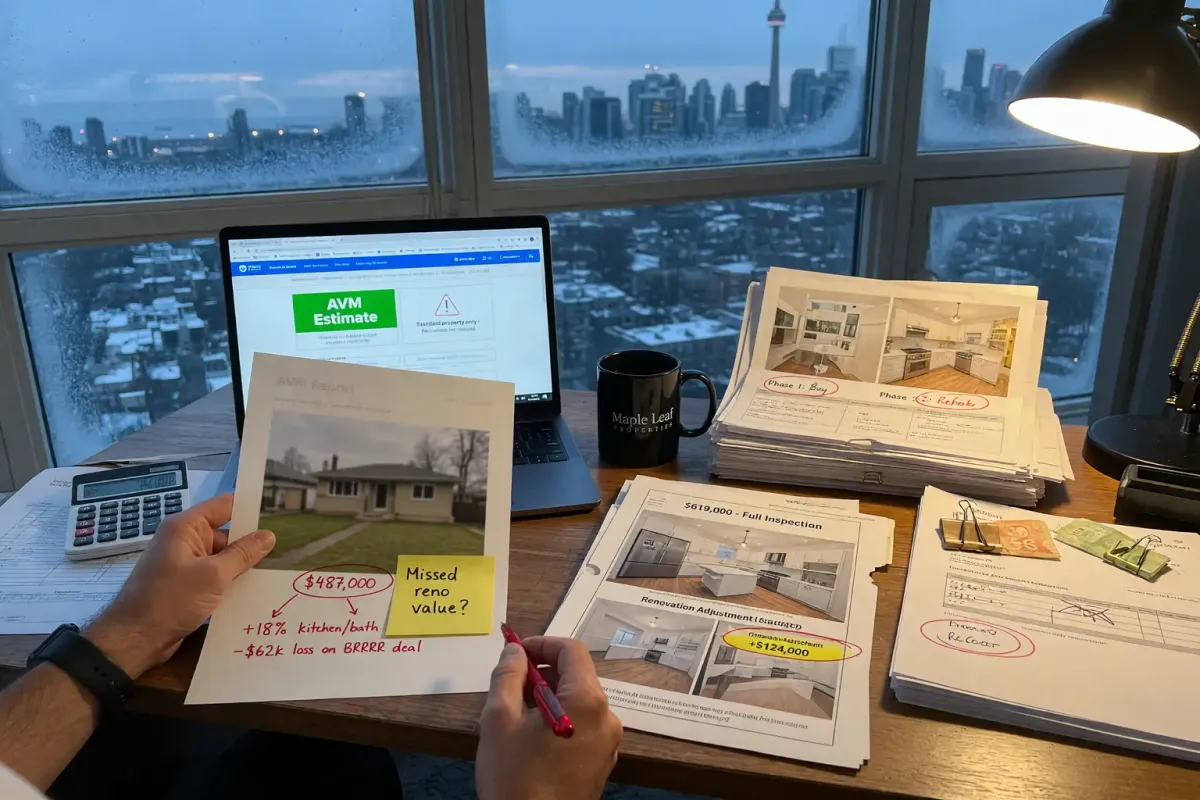
Automated property appraisals have changed how lenders assess value. Instead of waiting weeks for an appraiser to show up, take measurements, and write a report, lenders can get instant value estimates from computer algorithms.
For investors, this means faster closings and lower costs on many transactions. But there’s a catch—and if you don’t understand it, automated appraisals might cost you money in ways you don’t expect.
How Automated Appraisals Work
Automated valuation models (AVMs) crunch vast databases of property information—recent sales, property characteristics, tax assessments, market trends—to estimate what a property is worth. They do this in seconds rather than weeks.
The technology has gotten remarkably accurate for certain property types. Major lenders increasingly rely on AVMs for qualifying transactions because they’re faster, cheaper, and reduce friction in the lending process.
| Appraisal Type | Timeline | Cost | Captures Renovations? |
|---|---|---|---|
| Automated (AVM) | Instant | Lower | No |
| Desktop appraisal | Days | Moderate | Limited |
| Traditional full | 1-2 weeks | Higher | Yes |
When Automated Appraisals Make Sense
AVMs work best for standard properties in areas with lots of recent sales data.
Think of a typical single-family home in an established subdivision where houses sell regularly. The algorithm has plenty of comparable sales to analyze. The properties are similar enough that adjustments for differences are straightforward. In these conditions, AVMs produce reliable estimates.
Good candidates for automated appraisals:
- Standard single-family homes in suburban areas
- Properties in original or typical condition
- Areas with regular transaction activity
- Straightforward purchase transactions
Benefits you get:
- Instant value estimates (know immediately if numbers work)
- Lower Appraisal costs (often a few hundred less than traditional)
- Faster closing timelines (no waiting for appraiser scheduling)
For straightforward purchases of properties that haven’t been renovated, automated appraisals deliver speed and cost savings without significant accuracy tradeoffs.
If you are planning a straightforward purchase where an AVM could save you hundreds of dollars and two weeks of waiting, book a free strategy call with LendCity and we will confirm the right appraisal path for your deal.
Real estate investing is a team sport, and your mortgage strategy is the foundation — book a free strategy call with LendCity to make sure yours is solid.
If this approach is on your radar, our flip mortgage financing guide walks through how LendCity structures these deals.
The Catch: Renovations Don’t Count
Here’s where automated appraisals fall apart for investors: they can’t see renovations.
An AVM pulls data from public records, tax assessments, and comparable sales. It knows your property has three bedrooms and 1,500 square feet built in 1985. What it doesn’t know is that you just spent $40,000 on a complete kitchen renovation, new bathrooms, and refinished hardwood floors.
That beautiful renovation that added real market value? The computer doesn’t see it. The algorithm values your property based on what the records show—the original construction characteristics—not the improvements you’ve made.
This matters enormously for BRRRR investors. The whole BRRRR method investing strategy depends on this. You buy distressed, renovate to add value, then refinance to pull out your capital. But if the refinance uses an automated appraisal that can’t see your improvements, you won’t capture the value you created. Working with lenders who specialize in flip mortgage financing ensures the right appraisal methods are used to reflect your renovation work.
For US investment properties, our free DSCR qualification tool helps you determine qualification based on rental income, which works regardless of appraisal method.
When You Need a Full Appraisal
For any transaction where capturing renovation value matters, you need a traditional appraisal with a licensed appraiser who physically inspects the property.
Get full appraisals when:
- You’ve completed significant renovations
- You’re refinancing to extract equity from improvements
- The property has unique features AVMs won’t recognize
- You’re in a rural area with limited comparable sales
- The property is unusual for the area
Yes, full appraisals cost more and take longer. But the additional value captured from properly assessing your improvements typically far exceeds the incremental cost. If a full appraisal captures $25,000 more value than an AVM, paying an extra $300-400 for that appraisal is an obvious win.
If you have completed renovations and need a full appraisal to capture that forced appreciation on your BRRRR refinance, book a free strategy call with us so we can connect you with lenders who use the right valuation method.
Refinancing at the wrong time or with the wrong lender can leave equity trapped — schedule a free strategy session with us to make sure your refinance actually moves you forward.
Cost-Benefit Math
Before choosing appraisal type (when you have a choice), run the numbers.
Scenario 1: Standard Purchase You’re buying a property in original condition. AVM saves $350 and two weeks. The value estimate will be similar to a full appraisal. Take the savings.
Scenario 2: Post-Renovation Refinance You’ve added $40,000 in value through renovations. AVM can’t see it. Full appraisal captures the improvements. The extra $350 gives you access to $32,000 more equity (at 80% LTV). Easy decision—get the full appraisal.
Scenario 3: Minor Updates You’ve made some cosmetic improvements but nothing dramatic. AVM might undervalue slightly, but the difference may not justify full appraisal cost. Calculate whether the potential equity difference exceeds the cost differential.
What Lenders Actually Do
Not all lenders offer automated appraisals, and those that do may restrict their use to specific transaction types. Working with an experienced mortgage broker can help you navigate these options. Many lenders use AVMs behind the scenes even when ordering traditional appraisals—as screening tools, risk monitors, or checks against potentially inflated appraisals.
Ask your lender early in the process:
- Do you offer automated appraisal options for this transaction?
- Can I choose between automated and traditional?
- What happens if the automated value comes in low?
Some lenders allow full appraisals after automated valuations prove insufficient. Others may have more restrictive policies. Understanding your options before committing helps you plan accordingly.
Using Multiple Valuation Sources
Smart investors don’t rely on any single valuation source.
Combine information from:
- Automated valuations from multiple providers
- Comparative market analysis from your agent
- Your own assessment based on recent sales you’ve tracked
- Professional appraisals when warranted
When valuations diverge significantly, investigate why. AVMs might miss recent improvements. Agent analyses might reflect optimistic assumptions. Understanding each method’s strengths and limitations helps you interpret what the numbers actually mean.
Automated Appraisals in Canada vs the United States
Lender adoption of automated valuation models varies significantly between Canadian and US markets, affecting investor options and costs.
AVM Adoption Rates:
- Canada: Canadian banks have been slower to adopt AVMs for refinancing compared to US lenders. Traditional appraisals remain standard for most investment property transactions. Desktop appraisals (appraiser reviews data without site visit) are becoming more common for lower-risk refinances.
- United States: AVMs are widely accepted by US lenders, particularly for conforming loans and refinances on properties without recent renovations. Fannie Mae and Freddie Mac actively promote AVM usage to reduce costs and speed closings.
Regulatory Oversight:
- Canada: OSFI (Office of the Superintendent of Financial Institutions) requires lenders to demonstrate valuation accuracy. This conservative regulatory approach means lenders often default to traditional appraisals for investment properties.
- United States: Appraisal waivers are permitted on many conforming loans below certain LTV thresholds. Less regulatory resistance to AVM adoption for routine transactions.
Cost Differences:
- Canada: Traditional appraisals typically cost $300-$600 for single-family/duplex properties, $600-$1,200 for small multifamily. Desktop appraisals might save $100-$200. AVMs when available are often bundled into lender fees.
- United States: Traditional appraisals run $400-$800 depending on market and property type. AVMs significantly cheaper—often $50-$150 or included in processing fees. The cost advantage drives higher US adoption.
BRRRR Strategy Impact:
- Canada: Investors doing BRRRR should expect traditional appraisals since lenders need to verify renovation value for cash-out refinancing. Request full appraisals explicitly rather than accepting desktop valuations.
- United States: Similar caution needed. Even though AVMs are more common, DSCR lenders will often require traditional appraisals for cash-out refinances on renovated properties. Specify traditional appraisal in refinance applications.
Frequently Asked Questions
Are automated appraisals as accurate as traditional ones?
Can I request an automated appraisal instead of full?
What if the automated appraisal comes in low?
Do automated appraisals work for investment properties?
How do I know if renovations will be captured?
Why do automated appraisals matter for BRRRR investors specifically?
How much money can choosing the wrong appraisal type cost me?
Key Takeaways:
- How Automated Appraisals Work
- When Automated Appraisals Make Sense
- The Catch: Renovations Don’t Count
- When You Need a Full Appraisal
- Cost-Benefit Math
The Bottom Line
Automated appraisals are tools—useful in some situations, problematic in others.
For standard purchases of properties in original condition, they offer genuine speed and cost advantages. Take them when they make sense.
For refinances after renovation, unique properties, or any situation where capturing property-specific value matters, full appraisals are worth the extra cost and time. The technology can’t replace human eyes and professional judgment in these cases.
Know when each tool fits. Use the right one for your situation. That’s how you get the benefits of automated appraisals without falling into the trap of leaving money on the table.
Weekly Investor Insight
Sunday financing notes for investors
Market updates, rate moves, and deal structures — once a week. Unsubscribe anytime.
By submitting, you agree to receive occasional emails from LendCity. You can unsubscribe at any time.
Disclaimer: LendCity Mortgages is a licensed mortgage brokerage. Content on this page is for educational purposes only and does not constitute legal, tax, investment, securities, or financial-planning advice. Rates, premiums, program terms, and regulations referenced are as of the page's last updated date and are subject to change. Any investment returns, rental yields, tax savings, or case-study figures shown are illustrative only — they are not guaranteed, not typical, and individual results will vary. Consult a licensed lawyer, Chartered Professional Accountant, or registered dealer before acting on any information above. Editorial standards.

Written by
Scott Dillingham
Published
January 26, 2026
· Updated June 29, 2026Reading time
8 min read
Appraisal
A professional assessment of a property's market value, required by lenders to ensure the property is worth the loan amount.
Appreciation
The increase in a property's value over time, which builds [equity](/glossary/equity/) and wealth for the owner through market growth or [forced improvements](/glossary/forced-appreciation/).
BRRRR
Buy, Rehab, Rent, Refinance, Repeat - a real estate investment strategy where you purchase a property below market value, renovate it to increase its [ARV](/glossary/after-repair-value-arv/), rent it out, [refinance](/glossary/refinancing/) to pull out your initial investment, and repeat the process with the recovered capital. Success depends on [forced appreciation](/glossary/forced-appreciation/) and strong [cash flow](/glossary/cash-flow/).
Equity
The difference between a property's current market value and the remaining mortgage balance. If your home is worth $500,000 and you owe $300,000, you have $200,000 in equity. Equity builds through mortgage payments, [appreciation](/glossary/appreciation/), and [forced appreciation](/glossary/forced-appreciation/). See also [LTV](/glossary/ltv/) and [Refinancing](/glossary/refinancing/).
LTV
Loan-to-Value ratio - the mortgage amount expressed as a percentage of the property's appraised value or purchase price (whichever is lower). An 80% LTV means you're borrowing 80% and putting 20% [down](/glossary/down-payment/). Lower LTV generally means better [interest rates](/glossary/interest-rate/) and terms. See also [Equity](/glossary/equity/) and [Leverage](/glossary/leverage/).
Market Value
The estimated price a property would sell for on the open market under normal conditions. Determined by comparable sales, location, condition, and market demand.
Refinance
Replacing an existing mortgage with a new one, typically to access equity, get a better rate, or change terms. Investors commonly refinance to pull out capital for purchasing additional properties (cash-out refinance) while retaining ownership of the original property.
Single Family
A detached home designed for one household, the most common property type for beginner real estate investors.
Mortgage Broker
A licensed professional who shops multiple lenders to find the best mortgage rates and terms for borrowers. Unlike banks, brokers have access to dozens of lending options.
Comparable Properties
Similar properties in the same market area used to establish fair market value or rental rates through comparison of features, location, condition, and recent sale or rental prices. Analyzing comps is essential when determining offer prices and setting competitive rents.
Forced Appreciation
An increase in property value driven by the owner's actions rather than general market conditions. Strategies include renovations, increasing rents, reducing [vacancies](/glossary/vacancy-rate/), or cutting operating expenses. In commercial real estate, raising [NOI](/glossary/noi/) directly increases the property's income-based appraised value. Key to the [BRRRR strategy](/glossary/brrrr/) and improving [ARV](/glossary/after-repair-value-arv/).
AVM
Automated Valuation Model - a technology-driven tool that estimates a property's market value using algorithms, public records, comparable sales data, and market trends. Some lenders accept AVMs instead of full appraisals for lower-risk transactions, which saves borrowers the $300-500 appraisal fee and speeds up the approval process.
Hover over terms to see definitions. View the full glossary for all terms.