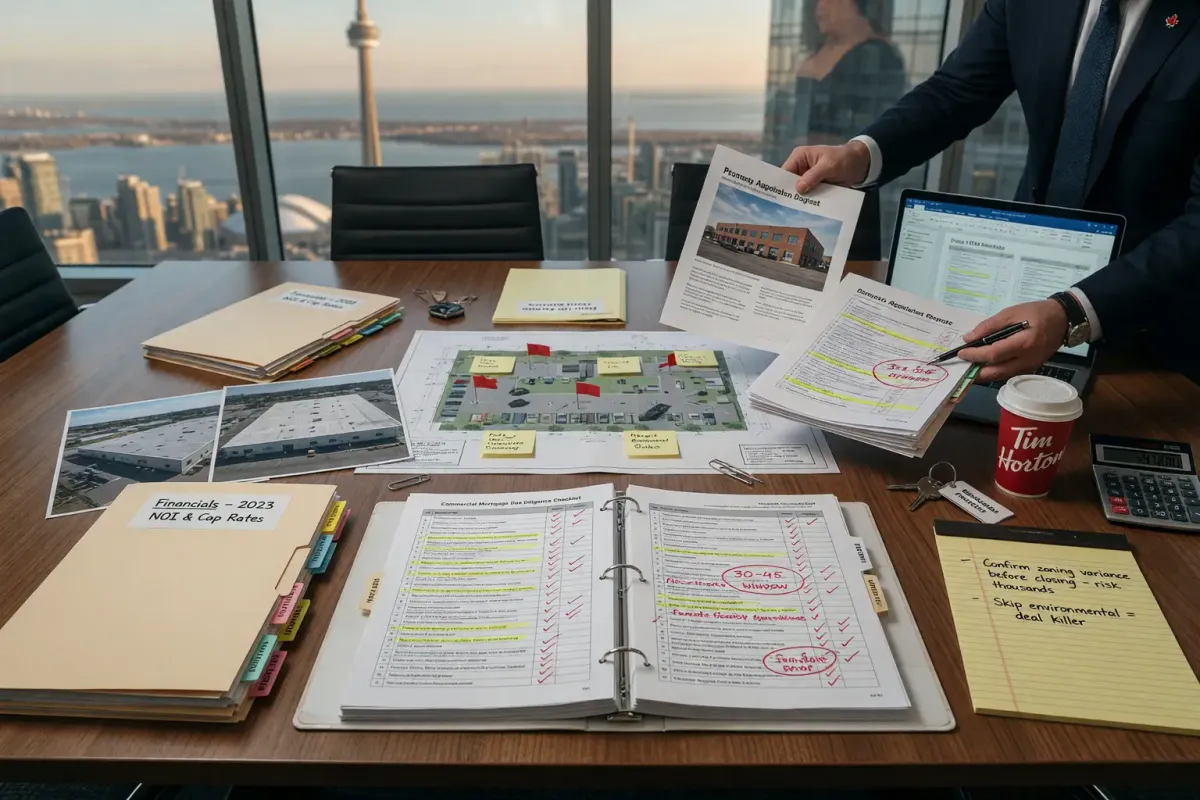
Buying a commercial property is nothing like buying a house. The stakes are different. The paperwork is different. And the cost of missing something? Completely different scale.
A missed clause in a commercial lease can saddle you with $200,000 in tenant improvement obligations you never saw coming. An undiscovered environmental issue can make your property worth less than the mortgage on it. A deferred maintenance backlog can turn a 6% cap rate into a 3% cap rate the moment you start paying the real bills.
I’ve seen investors walk into commercial deals thinking they did their homework — and walk out six months later wondering what hit them. Every single time, the problem traces back to skipped or rushed due diligence.
Institutional lenders know this, which is why they require extensive documentation before they’ll fund a commercial mortgage. This checklist covers every major due diligence category — financial, physical, legal, and operational — and maps requirements to different lender types so you know exactly what’s coming.
How to Use This Checklist
Work through each section systematically during your due diligence period. For a typical commercial acquisition with a 30–45 day window, here’s how to pace it:
| Week | Priority Activities |
|---|---|
| Week 1 | Order Phase 1 ESA, engage building inspector, collect financial documents from vendor |
| Week 2 | Review leases, review financials, order title search, confirm appraisal is ordered |
| Week 3 | Review Phase 1 results, complete building inspection, appraisal site visit |
| Week 4 | Compile findings, negotiate price adjustments if needed, confirm lender conditions |
| Weeks 4–5 | Remove conditions — or extend if issues need further investigation |
Not every item here applies to every deal. A single-tenant industrial building with a long-term net lease is a very different animal than a 24-unit multi-family complex. Use your judgment about what’s material to your specific transaction.
1. Financial Due Diligence
This is where you validate the income and expense profile of the property. Sellers present optimistic figures — your job is to reconstruct what the actual, sustainable cash flow really looks like.
Rent Roll Verification
- Obtain the current rent roll from the vendor (tenant name, unit/suite, size, lease start and end, base rent, additional rent/TMI, renewal options)
- Verify the rent roll against actual lease documents — confirm rent, term, and renewal options for every tenant
- Identify any rent-free periods, abatements, or stepped rents buried in existing leases
- Flag any leases expiring within 12–24 months of acquisition — that’s your rollover risk
- Confirm which tenants are on gross leases vs. net leases (this determines who pays which expenses)
- Review percentage rent clauses in any retail leases
- Check for rent deferrals or payment arrears — request an aged receivables report
- Confirm security deposits held and whether they’re refundable at lease end
Operating Expense Audit
- Obtain 2–3 years of operating expense statements from the vendor
- Reconcile vendor-reported expenses against actual property tax bills, insurance invoices, and utility bills
- Identify non-recurring expenses to exclude from stabilized NOI
- Look for below-market or missing expenses — management fees below the market rate of 3–5%, no capital reserve, or suspiciously low maintenance numbers
- Calculate management fees at market rate even if the current owner self-manages
- Verify property tax assessments and check whether a tax appeal is pending — this can shift future tax levels significantly
- Review utility cost trends and flag any major year-over-year variances
Historical Financial Statements
- Collect T776 rental income schedules from the vendor’s personal or corporate tax returns for the last 3 years
- Collect financial statements (compiled, reviewed, or audited depending on property size) for the last 3 years
- Compare tax-reported income to the vendor’s operating statement — any material discrepancy needs a real explanation
- Review for one-time capital recoveries or insurance proceeds that have been included in income
Reconstructed NOI
Build your own net operating income model from scratch. Don’t use the vendor’s numbers as your starting point.
- Use actual in-place rents or market rents — whichever is more conservative
- Apply a market vacancy rate (typically 3–8% for residential; varies for commercial depending on local market conditions)
- Apply a capital reserve appropriate for the building’s age and condition (minimum $0.15–$0.50/sq ft/year)
- Use management fees at market rate
- Compare your NOI to the appraiser’s NOI — understand any material differences before you close
Your lender’s requirements depend entirely on the property type and financing program — and they’ll make or break your deal timeline. book a free strategy call with LendCity and we’ll map out exactly what CMHC, conventional lenders, or private funding requires for your specific acquisition.
2. Physical Due Diligence
Physical due diligence tells you what the building actually costs to own. The goal is to identify immediate capital requirements and estimate the deferred maintenance you’ll be paying for over your hold period.
Building Condition Assessment
- Engage a qualified building inspector or engineering firm with real commercial experience
- Get a written Building Condition Assessment (BCA) report — a verbal walk-through is not good enough
- Verify age and condition of: roof (remaining useful life), HVAC systems, electrical service and panels, plumbing type and condition, elevator if applicable, parking lot, and exterior cladding/building envelope
- Pull and review any permits on the building — confirm all permit work was completed and properly closed
- Identify deferred maintenance items and get contractor quotes or professional estimates for anything material
- Assess building code compliance, especially for older buildings undergoing a change of use or renovation
Environmental Assessment
- Commission a Phase 1 Environmental Site Assessment (ESA) under CSA Z768
- Review the Phase 1 for any Recognized Environmental Conditions (RECs) or data gaps
- If RECs are identified, commission a Phase 2 ESA immediately — do not remove conditions until Phase 2 comes back clean
- Confirm the environmental consultant is a Qualified Person under the applicable provincial regulation
- Verify the Phase 1 will be issued with reliance language in favour of both the buyer and the lender
Designated Substances (Pre-1990 Buildings)
- Commission a Designated Substance Survey (DSS) for any building built or renovated before 1990
- The DSS covers asbestos-containing materials, lead paint, PCBs in electrical equipment, vermiculite insulation, and other designated substances
- If asbestos is identified, get an abatement cost estimate and assess whether the material is friable or non-friable
- Confirm the DSS report is required before any renovation or demolition permits can be issued
Fire and Life Safety
- Confirm a fire suppression system (sprinklers) is present and up to code
- Review the most recent fire inspection report
- Confirm the fire alarm system is functional and compliant
- Verify fire exit compliance and emergency lighting
Accessibility Compliance
- Review the building’s accessibility compliance for Ontario (AODA) or BC Accessibility Act requirements, depending on province
- Identify any deferred accessibility improvements that may be required under provincial legislation — these become your problem after closing
3. Legal Due Diligence
Legal due diligence protects you from title defects, zoning problems, and lease obligations that could impair your ownership or kill your financing.
Title Search
- Engage a commercial real estate lawyer to conduct a title search through Teranet or the applicable provincial land registry
- Review title for: registered mortgages to be discharged on closing, encroachments, easements, rights-of-way, and restrictive covenants
- Confirm title insurance is being obtained — most institutional lenders require it
- Review any Notice of Lien or construction lien registered against the property
- Confirm the property’s legal description matches exactly what you’re purchasing, especially in multi-parcel transactions
Zoning Compliance
- Confirm the current use is a permitted use under the applicable zoning designation
- Identify whether the current use is legal non-conforming (grandfathered) — this affects your rebuilding rights if the structure is ever destroyed
- Verify any proposed new use is permitted by right or requires a conditional use permit or minor variance
- Review any outstanding heritage designation or conservation easement
- Confirm lot coverage, setbacks, and permitted building height for the parcel
Lease Review
Do this for every material lease in the building. Don’t skim.
- Confirm term and renewal options, including any unilateral options already exercised or pending
- Confirm rent, rent escalation schedule, and any rent abatement obligations
- Review outstanding tenant improvement (TI) allowance obligations — these can be significant
- Identify any demolition or redevelopment clauses that allow the tenant to terminate
- Identify any co-tenancy clauses — common in retail leases, these trigger if an anchor tenant vacates
- Confirm assignment restrictions: can the lease be assigned without tenant consent when the property sells?
- Review termination rights and any early termination clauses
- Identify any first right of refusal or purchase option held by existing tenants
- Confirm the lease structure for each tenant: NNN, modified gross, or full gross
- Review personal guarantee provisions on every lease
Other Legal Items
- Confirm status certificates from the condo corporation, if applicable
- Review any reciprocal easement agreements (REAs) with adjacent properties
- Identify any vendor representations regarding ongoing litigation or disputes
- Confirm the HST status of the transaction — commercial real estate is typically HST-applicable unless it qualifies as a going concern
- Confirm that any ROFR or ROFO holders have been properly notified
If you’re building your reconstructed NOI and the numbers are coming in significantly different from the vendor’s statement, that gap tells you something. schedule a free strategy session with us and we’ll help you stress-test those numbers against what lenders will actually qualify.
4. Operational Due Diligence
This section reviews how the property is currently being managed and what obligations transfer to you as the new owner.
Tenant Estoppel Certificates
- Request estoppel certificates from all tenants, especially major or anchor tenants
- Estoppels confirm: the lease is in force, rent amount is as stated, no landlord defaults exist, security deposit amount is accurate, and no side agreements have been omitted
- Most institutional lenders require estoppels from tenants representing at least 75% of gross revenue
- Read every estoppel response carefully — any disclosures, qualifications, or disputes raised by tenants are red flags worth investigating
Property Management Review
- Obtain a copy of the existing property management agreement
- Confirm whether the existing management company will continue post-closing or if a change is planned
- Review the management fee structure — is it competitive? Are there penalty provisions for early termination?
- Review the management company’s track record and request references from other properties under their management
Service Contracts
- Obtain a full schedule of all service contracts: HVAC maintenance, elevator service, landscaping, snow removal, cleaning, pest control, and security
- Review contract terms — confirm which contracts terminate on sale and which transfer to the new owner
- Flag any above-market or long-term contracts that will inflate your operating costs
Insurance
- Review the current property insurance policy — confirm coverage type, coverage amount, and deductibles
- Confirm coverage is based on replacement cost, not just market value
- Identify any open claims or notable insurance history
- Get your own insurance quote as a new owner — confirm the property is insurable at a reasonable cost
- Note any designated substance or environmental conditions that could affect insurance cost or availability
5. Lender-Specific Requirements
Different lenders have different requirements. Know what your lender needs before you’re three weeks into due diligence.
CMHC-Insured Multi-Family
CMHC insured financing — including the MLI Select program — is available for residential rental properties with 5+ units. Here’s what they require:
For a closer look at the same decision, 5 Mortgage Deal Killers and How to Fix Them breaks down how LendCity approaches it.
Related reading: Mezzanine Financing for Commercial Real Estate in Canada: Complete Guide covers the practical angles we see on similar files.
| CMHC Requirement | Detail |
|---|---|
| Phase 1 ESA | Required for all applications |
| Phase 2 ESA | Required if RECs are identified |
| AACI Appraisal | Must comply with CMHC’s appraisal standards and use CMHC forms |
| Reserve Fund Study | Required for strata or condo properties |
| Rent Roll | Must be independently verified |
| Building Condition Assessment | Typically required — scope varies by program |
| Energy Efficiency Assessment | Required for MLI Select applications claiming energy efficiency points |
One thing to know: CMHC underwriting is conservative. Their prescribed NOI methodology and benchmark cap rates often produce a lower loan calculation than conventional underwriting. Don’t be surprised by the gap.
Conventional Institutional Lenders (Banks, Credit Unions, Trust Companies)
| Conventional Requirement | Detail |
|---|---|
| Phase 1 ESA | Required for most commercial property types |
| AACI Appraisal | Required — appraiser must be on the lender’s approved list |
| Environmental Review | Some lenders conduct internal environmental review beyond the Phase 1 |
| Lease Abstracts | Summary of all leases above a threshold (typically 5% of gross leasable area) |
| Estoppel Certificates | Required from major tenants — typically tenants representing 50–75% of revenue |
| Audited Financials | May be required for transactions over $5M |
| Building Inspection | Required at lender’s discretion — common for older properties |
Conventional lenders have more flexibility than CMHC in some situations, but they price risk explicitly into their rate and structure.
Private Lenders
Private mortgage lenders — MICs, individual lenders, private debt funds — typically have more streamlined requirements. But don’t mistake “streamlined” for “no standards.”
| Private Lender Consideration | Notes |
|---|---|
| Phase 1 ESA | Good private lenders still require Phase 1 for industrial and commercial sites |
| Appraisal | Often accepted from any AACI appraiser — no approved list required |
| Financials | May accept 1 year of tax returns or a simplified operating statement |
| Legal | Title insurance is required; full lease review is often left to the borrower |
| Rate premium | Private lending rates run 2–4% above institutional rates — factor this into your deal economics |
Private lending is a bridge, not a destination. Use it strategically for deals that don’t qualify for conventional financing today but have a clear path to refinancing within 12–24 months.
What Does Commercial Due Diligence Cost?
Professional due diligence is not cheap. For a mid-size commercial acquisition in the $3–15M range, here’s what to budget:
| Due Diligence Item | Typical Cost (CAD) |
|---|---|
| Phase 1 ESA | $3,500 – $6,000 |
| Building Condition Assessment | $2,500 – $6,000 |
| Commercial Appraisal | $5,000 – $12,000 |
| Legal (review through closing) | $5,000 – $15,000+ |
| Designated Substance Survey (if required) | $1,500 – $4,000 |
| Title Insurance | $1,000 – $3,000 |
| Total | ~$20,000 – $45,000 |
These costs are real and largely non-refundable once you’ve ordered them. Factor them into your acquisition budget from day one.
Here’s the way to think about it: on a $5M purchase, $30,000 in due diligence is 0.6% of the deal. That’s cheap insurance against discovering post-close that the property is materially different from what the vendor represented.
Don’t cut corners here. The investors who skip due diligence costs to save money almost always end up spending far more on the problems they didn’t find.
Key Takeaways:
- How to Use This Checklist
- Financial Due Diligence
- Physical Due Diligence
- Legal Due Diligence
- Operational Due Diligence
Frequently Asked Questions
How long does commercial due diligence typically take in Canada?
Most commercial transactions allow 30–60 days for due diligence, with 45 days being the most common for mid-size assets. Complex properties — multiple tenants, environmental concerns, or significant deferred maintenance — often need 60–90 days. The biggest timeline extenders are Phase 2 ESA requirements (add 4–6 weeks), CMHC processing, and delays getting leases or financial statements out of the vendor.
What are the most commonly missed items in commercial due diligence?
Here’s what experienced buyers still get wrong: (1) verifying rents against the rent roll summary instead of the actual lease documents; (2) accepting the vendor’s NOI without normalizing for management fees and capital reserve; (3) overlooking co-tenancy clauses in retail leases; (4) not pulling building permits and confirming all permit work is properly closed; (5) skipping the Designated Substance Survey on older buildings; and (6) not obtaining estoppel certificates before closing. Any one of these can cost you significantly.
What is a tenant estoppel certificate and why does it matter?
An estoppel certificate is a signed document from a tenant confirming the key facts of their lease: the lease is in force, the rent and term are as stated, there are no landlord defaults, and there are no side agreements that weren’t disclosed. It prevents tenants from later claiming different terms than what the lease says — and it gives you and your lender confidence that no disputes or claims are being concealed.
What is a capital reserve, and how much should I budget?
A capital reserve is an annual allocation for replacing major building components as they reach end of life — roof, HVAC, parking lot, and so on. You need to include it in your NOI calculation for both lender underwriting and your own investment analysis, even if you don’t literally set aside cash each year. Industry benchmarks run from $0.10–$0.20/sq ft/year for newer industrial or retail properties up to $0.30–$0.50/sq ft/year for older multi-family buildings. CMHC’s MLI program uses specific reserve benchmarks by building type and age.
What happens if significant deficiencies are found during due diligence?
You have real options. You can renegotiate the purchase price to reflect the cost to cure. You can require the vendor to repair deficiencies before closing. You can negotiate a price holdback — funds held in trust pending completion of remediation. Or you can walk away if the deficiencies are material and the vendor won’t adjust. For environmental deficiencies identified in a Phase 2 ESA, most institutional lenders won’t proceed until you have clean results. You cannot close with unresolved environmental contamination on institutional financing — full stop.
Do I need a lawyer for commercial due diligence?
Yes. Commercial real estate law is complex — lease review, title search, HST structuring, adjustment statements, and closing mechanics all require a qualified commercial real estate lawyer. This is not the place to cut costs. Your lawyer works alongside your mortgage broker, environmental consultant, and building inspector as a core member of your transaction team. Trying to navigate commercial due diligence without legal counsel is one of the most expensive mistakes you can make.
What is the difference between a compiled and an audited financial statement?
A compiled financial statement is prepared by an accountant based on information provided by management — no independent verification of the numbers. A reviewed statement involves limited procedures to assess whether the numbers are plausible. An audited statement involves independent verification of financial data to provide the highest level of assurance. For larger commercial transactions — typically over $5–10M — lenders may require reviewed or audited financials. For smaller deals, T776 schedules from tax returns combined with compiled operating statements are usually sufficient.
What does a commercial mortgage broker do during due diligence?
A good commercial mortgage broker doesn’t disappear after you submit your application. They coordinate the pieces of due diligence that affect your financing — making sure the appraisal is ordered through the right channel, confirming the environmental consultant’s report will be accepted by your specific lender, flagging potential underwriting issues before they delay your commitment, and managing information flow between you, the appraiser, and the lender. If your broker only shows up at application and at closing, you have the wrong broker.
Free download
MLI Select document checklist
Appraisals, rent rolls, environmental reports, and the CMHC package lenders expect before they underwrite.
By submitting, you agree to receive occasional emails from LendCity. You can unsubscribe at any time.
4.8/5 (116 Google reviews)
Disclaimer: LendCity Mortgages is a licensed mortgage brokerage. Content on this page is for educational purposes only and does not constitute legal, tax, investment, securities, or financial-planning advice. Rates, premiums, program terms, and regulations referenced are as of the page's last updated date and are subject to change. Any investment returns, rental yields, tax savings, or case-study figures shown are illustrative only — they are not guaranteed, not typical, and individual results will vary. Consult a licensed lawyer, Chartered Professional Accountant, or registered dealer before acting on any information above. Editorial standards.

Written by
Scott Dillingham
Published
March 9, 2026
· Updated June 29, 2026Reading time
15 min read
Anchor Tenant
A major tenant in a commercial property, typically a well-known retailer or business, that draws customers and other tenants to the location. Anchor tenants provide stability and are a key factor in commercial property valuation.
Appraisal
A professional assessment of a property's market value, required by lenders to ensure the property is worth the loan amount.
Building Permit
Official municipal approval required before conducting certain types of construction or renovation work, ensuring compliance with building codes and safety regulations. Unpermitted work on investment properties can result in fines, required demolition, difficulty selling, and voided insurance claims.
Cap Rate
Capitalization Rate - the ratio of a property's [net operating income (NOI)](/glossary/noi/) to its current market value or purchase price. A 6% cap rate means the property generates $60,000 NOI annually on a $1,000,000 value. Used to compare investment properties regardless of financing. See also [DSCR](/glossary/dscr/) and [Cash-on-Cash Return](/glossary/cash-on-cash-return/).
Cash Flow
The money left over after collecting rent and paying all expenses including mortgage, taxes, insurance, maintenance, and property management. Positive cash flow is the primary goal of buy-and-hold investors. See also [NOI](/glossary/noi/), [Cash-on-Cash Return](/glossary/cash-on-cash-return/), and [Vacancy Rate](/glossary/vacancy-rate/).
CMHC
CMHC (Canada Mortgage and Housing Corporation) is a federal Crown corporation that provides mortgage loan insurance to lenders when borrowers have less than a 20% down payment, enabling Canadians to purchase homes with as little as 5% down. For real estate investors, CMHC insurance is available on owner-occupied properties of up to four units, but is generally not available for non-owner-occupied investment properties, meaning investors typically need at least 20% down and must seek conventional financing.
Commercial Mortgage
Financing for commercial properties like retail, office, or multifamily buildings with 5+ units, with different qualification criteria than residential mortgages.
Contractor
A licensed professional hired to perform construction, renovation, or repair work on investment properties. Using licensed and insured contractors is essential for permitted work, as unlicensed contractors can result in voided insurance, property liens, and liability for injuries.
Covenant
A binding agreement or promise in a property deed or loan document. Restrictive covenants limit property use, while loan covenants set conditions borrowers must maintain, such as minimum debt coverage ratios.
Credit Union
A member-owned financial cooperative that provides banking services including mortgage lending. Credit unions often have more flexible lending policies for real estate investors than major banks, particularly for borrowers who have exceeded conventional lending limits.
Hover over terms to see definitions. View the full glossary for all terms.