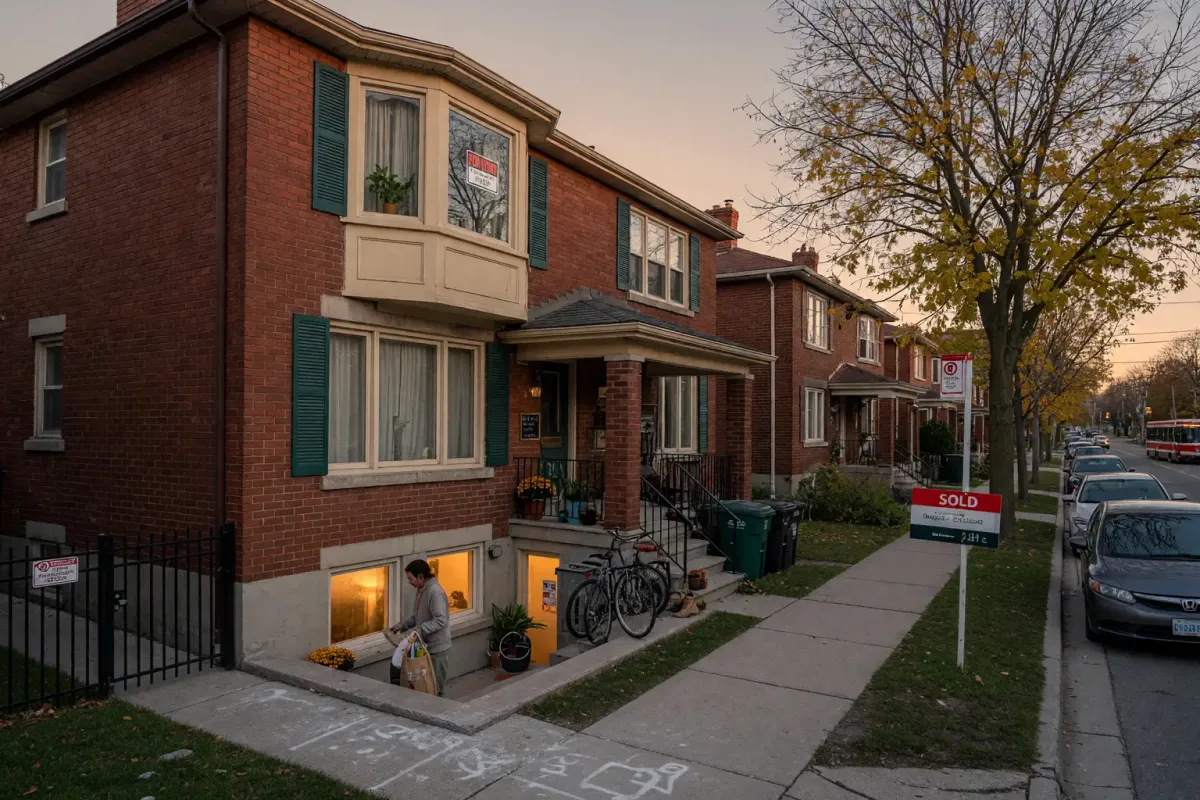
Everyone says you can’t make money investing in Toronto real estate. The prices are too high. The properties don’t cash flow. You’d be crazy to try.
But what if that’s completely wrong?
Ming Lim, president of Volition Properties, has built his entire business around proving Toronto can work for investors. Not only that—he argues Toronto is actually less risky than cheaper markets.
Why Most Real Estate Investors Burn Out
Ming started investing at 21, right after university. Like many people, he read Rich Dad Poor Dad and got hooked on the idea of passive income.
He bought 21 properties in Waterloo. And he hated every minute of it.
His evenings and weekends disappeared into property maintenance. He’d drag whoever he was dating to help paint rooms and fix broken doors. It was exhausting, unsustainable, and nothing like the passive income dream he’d signed up for.
After years of this, Ming wanted out completely. But before quitting, he made one smart decision: someone must have figured out how to do this properly.
The Networking That Changed Everything
Ming searched meetup.com for every real estate investment group within a two-hour drive. He attended every single one. He met as many experienced investors as possible.
Through this process, he had a huge realization: he wasn’t being strategic. His method was way too simple—if a property cash flowed on paper, he’d buy it. He wasn’t analyzing rental properties with proper cash flow and due diligence. He wasn’t thinking about scale, operational efficiency, or building proper systems.
He met his now-business partner Matt during this networking phase. Together, they made a surprising choice: they consolidated their portfolios in Toronto.
Despite the higher purchase prices, they were getting better returns in Toronto. Securing the right residential mortgage financing for their investment properties was part of what made it work. The business was more sustainable. They weren’t driving hours to deal with tenant problems. And they were making better money.
The Three Principles That Make Toronto Work
Principle #1: Be an Expert in Your Market
Ming’s mother once called to say she was buying semiconductors. He asked what a semiconductor was. She didn’t know.
His response? “What business do you have investing in something you don’t understand?”
The same applies to real estate. If you don’t know the difference between High Park, Victoria Park, and Moss Park—and you think they’re all just parks—you shouldn’t invest in Toronto.
You need to understand neighborhoods at a street-by-street level. You need a team that can fill your knowledge gaps. You need to stay current with regulatory changes (like the recent garden suite angular plane rules that affect second-floor sizing).
Don’t chase opportunities in markets you don’t understand. Choose depth over breadth.
Principle #2: Put Risk Management First
Ming worked in finance after his stint at Research in Motion. In that world, nobody makes moves without extensive risk analysis—frameworks, SWOT analyses, multiple layers of due diligence.
But in real estate? People use napkin math. “Oh, it cash flows. Great. Buy.”
Ming did this himself early on—literally writing calculations on a napkin at a diner, doing five lines of basic math, and calling that due diligence.
That approach doesn’t work for long-term success.
Volition developed the TIME framework to assess every investment:
- T – Tenant: Who will rent this property?
- I – Investor: What are the client’s goals and situation?
- M – Market: What’s happening in this specific area?
- E – Estate: What’s the property condition and potential?
They don’t buy properties that cash flow on paper and hope to find good tenants. They identify where the best tenants live, then buy properties there.
Principle #3: Match Your Strategy to Your Market
You can’t take a strategy that works in Sarnia and expect it to work in Toronto.
Toronto is more sophisticated. It requires more sophisticated approaches. The tenant expectations, property types, and operational requirements are completely different.
Success means adapting your business model to match the market you’re in.
Using the TIME framework to assess tenant, investor, market, and estate factors is smart, but your financing matters just as much — book a free strategy call with LendCity to make sure your numbers actually work.
The numbers on a rental property only work if your financing is structured correctly — book a free strategy call with LendCity and we’ll help you run the real numbers before you commit.
The right financing product can change the math on this entirely — explore our real estate investing guide for the options most investors use.
The Tenant-First Strategy That Changes Everything
Here’s how most investors operate:
- Find a property that seems to Cash Flow
- Buy it
- Cross their fingers and hope for good tenants
Volition flips this completely:
- Identify the ideal tenant profile
- Find out where these tenants prefer to live
- Buy properties in those specific locations
- Design the offering to meet these tenants’ needs
Who Are These Ideal Tenants?
Volition targets young professionals, ages 25-35, earning $65,000-85,000 annually. They’ve graduated from university, they don’t own cars, and they commute to work or work hybrid.
They prefer neighborhoods like Little Italy, Little Portugal, and East York.
Here’s the key insight: 60-70% of this group lives in condos. But that means 30-40% actively choose not to.
Since COVID, this percentage has grown. People working from home don’t want to live in 400 square feet. They want outdoor space they can actually use. They want an extra bedroom for an office.
In condos, these features are hard to find at prices young professionals can afford. That’s the niche Volition fills.
Why Condos Are a Trap for New Investors
New investors love condos. They’re low maintenance, everything’s new, and they seem simple.
The problem shows up 2-3 years later when maintenance fees start climbing. The building needs a new roof. Major repairs are required. Your condo fees jump.
You have zero control over this. And if you have rent control, you can’t raise rent to match your increased expenses.
By 2025-2026, this has become even more acute. A wave of pre-construction condos purchased in 2021-2022 completed construction and flooded the market simultaneously. CMHC’s October 2025 survey put overall Toronto vacancy at 3.0% — the highest level since 2021 — with newer condo buildings seeing vacancy rates well above the city average and landlords offering one to two months of free rent just to attract tenants. Ming has been anti-condo for years—and current market conditions have validated that position.
Think about it like this: why would you keep investing in a business where the bigger it got, the more money it lost? That’s exactly what happens when you scale a condo portfolio with negative cash flow.
If rising condo fees and rent control have you rethinking your approach, you’re not alone — book a free strategy call with us and we’ll help you compare duplex versus condo numbers side by side.
Cash flow projections mean nothing if your mortgage eats into your returns — schedule a free strategy session with us to make sure your financing supports your investment thesis.
Strategies That Actually Work in Toronto
The Duplex Strategy
For someone who needs a place to live and is considering a condo, Ming often recommends a duplex instead.
Here’s how it works:
- Buy a duplex using favorable insured lending programs
- Live in the basement unit yourself
- Rent out the upstairs unit
- Your monthly costs are less than owning a condo
- You’re building Equity in a property with more potential
Yes, you’re living in a basement. But financially, you’re way ahead of where you’d be with a condo.
Financing Without High Income
You don’t need a massive income to invest in Toronto. There are two approval approaches:
Approach #1: Income-BasedThe lender looks at your employment income plus the rental income, factors in expenses, and approves based on debt ratios.
Approach #2: Property-BasedThis is more like commercial lending. If the property covers its own expenses and debt service, you can get maximum financing regardless of your personal income. Learn more about qualifying for mortgages based on property cash flow.
The Real Reason Toronto Prices Are High
Nobody looks at an expensive stock and dismisses it just because the price is high. With stocks, when something is cheaper, investors often get worried about risk.
Real estate works the same way. Toronto prices are high because the risk is lower. Properties in cheaper markets cost less partly because there’s more risk involved.
Starting Your Toronto Investment Journey
Volition doesn’t just help people buy properties. They start with financial planning questions:
- Why are you looking at real estate?
- What are you trying to accomplish?
- What are your short and long-term goals?
- What’s your current financial situation?
Based on these answers, they develop a plan tailored to each person’s unique circumstances.
Their services range from turnkey triplexes that are already cash-flow positive, to duplexes with various strategies, to advanced development projects.
For a broader look at market fundamentals, see our Toronto real estate investing guide. The key is this: Toronto isn’t too expensive to work. It just requires a different approach than cheaper markets. When you combine market expertise, proper risk management, and tenant-first thinking, Toronto can be one of the best places to build a real estate portfolio.
You just need to stop doing napkin math and start thinking strategically.
Key Takeaways:
- Why Most Real Estate Investors Burn Out
- The Three Principles That Make Toronto Work
- The Tenant-First Strategy That Changes Everything
- Why Condos Are a Trap for New Investors
- Strategies That Actually Work in Toronto
Frequently Asked Questions
Can you really cash flow on Toronto rental properties?
What's the tenant-first investment strategy?
Why should new investors avoid Toronto condos?
What's the duplex strategy for Toronto investors?
Do I need high income to invest in Toronto real estate?
What neighborhoods work best for Toronto rental investments?
What's the TIME framework for Toronto real estate?
Why is market expertise so important for Toronto investing?
Free download
MLI Select document checklist
Appraisals, rent rolls, environmental reports, and the CMHC package lenders expect before they underwrite.
By submitting, you agree to receive occasional emails from LendCity. You can unsubscribe at any time.
4.8/5 (116 Google reviews)
Disclaimer: LendCity Mortgages is a licensed mortgage brokerage. Content on this page is for educational purposes only and does not constitute legal, tax, investment, securities, or financial-planning advice. Rates, premiums, program terms, and regulations referenced are as of the page's last updated date and are subject to change. Any investment returns, rental yields, tax savings, or case-study figures shown are illustrative only — they are not guaranteed, not typical, and individual results will vary. Consult a licensed lawyer, Chartered Professional Accountant, or registered dealer before acting on any information above. Editorial standards.

Written by
Scott Dillingham
Published
December 22, 2025
· Updated June 29, 2026Reading time
9 min read
CMHC Insurance
Mortgage default insurance from Canada Mortgage and Housing Corporation. For 1-4 unit investment properties, investors must put 20%+ down (no insurance available). However, CMHC offers MLI Select for 5+ unit multifamily properties, and house hackers can access insured mortgages with 5-10% down.
Cash Flow
The money left over after collecting rent and paying all expenses including mortgage, taxes, insurance, maintenance, and property management. Positive cash flow is the primary goal of buy-and-hold investors. See also [NOI](/glossary/noi/), [Cash-on-Cash Return](/glossary/cash-on-cash-return/), and [Vacancy Rate](/glossary/vacancy-rate/).
Equity
The difference between a property's current market value and the remaining mortgage balance. If your home is worth $500,000 and you owe $300,000, you have $200,000 in equity. Equity builds through mortgage payments, [appreciation](/glossary/appreciation/), and [forced appreciation](/glossary/forced-appreciation/). See also [LTV](/glossary/ltv/) and [Refinancing](/glossary/refinancing/).
Vacancy Rate
The percentage of rental units that are unoccupied over a given period. A critical factor in [cash flow](/glossary/cash-flow/) analysis, typically estimated at 4-8% for conservative projections. Vacancy directly reduces [NOI](/glossary/noi/).
Property Management
The operation, control, and oversight of real estate by a third party. Property managers handle tenant screening, rent collection, maintenance, and day-to-day operations.
Due Diligence
The comprehensive investigation and analysis of a property before purchase, including financial review, physical inspection, title search, and market analysis.
Commercial Lending
Financing for commercial real estate or business purposes, typically qualified based on property income (NOI) rather than personal income. Includes mortgages for multifamily buildings (5+ units), retail, office, and industrial properties.
Leverage
Using borrowed money (mortgage) to control a larger asset, amplifying both potential returns and risks on your investment. A higher [LTV](/glossary/ltv/) means more leverage. See also [Down Payment](/glossary/down-payment/) and [Equity](/glossary/equity/).
Multifamily
Properties with multiple dwelling units, from duplexes to large apartment buildings. Often offer better cash flow and economies of scale.
Turnkey Property
An investment property that's fully renovated and often already tenanted, ready to generate income immediately after purchase.
Passive Income
Earnings from rental properties or investments that require minimal day-to-day involvement. The goal of most real estate investors seeking financial freedom.
Rental Income
Revenue generated from tenants paying rent on an investment property. Gross rental income is the total collected before expenses, while net rental income subtracts operating costs to show actual profitability.
Duplex
A residential property containing two separate dwelling units, either side-by-side or stacked. Duplexes are popular among beginner investors because they can house-hack by living in one unit while renting the other to offset mortgage costs.
Condo Fees
Monthly fees paid by condo owners to cover building maintenance, insurance, common area utilities, reserve fund contributions, and amenities. Also known as strata fees or maintenance fees, these directly reduce cash flow and are a critical consideration when analyzing condo investment opportunities.
Condominium
A type of property ownership where an individual owns a specific unit within a larger building or complex, sharing ownership of common areas with other unit owners. Condos offer lower entry prices but come with monthly fees and potential rental restrictions that affect investment returns.
Laneway House
A small detached dwelling built on an existing residential lot, typically facing a rear lane or alley. Also called garden suites or coach houses, laneway homes increase rental income and property value using existing land and infrastructure.
Rent Control
Provincial regulations that limit how much a landlord can increase rent annually for existing tenants. Rules vary by province - Ontario caps increases at a government-set guideline, while Alberta has no rent control. Rent control directly impacts investment cash flow projections.
Roof Replacement
A major capital expenditure involving the complete removal and installation of a new roofing system. Roof age and condition are critical factors in property inspections, insurance eligibility, and financing approvals, with typical costs ranging from $5,000 to $30,000+ depending on property size.
Secondary Suite
A self-contained rental unit within or attached to a single-family home, such as a basement apartment, laneway house, or garden suite. Secondary suites help investors generate additional rental income from one property and can qualify for rental offset programs that improve mortgage qualification.
Hover over terms to see definitions. View the full glossary for all terms.