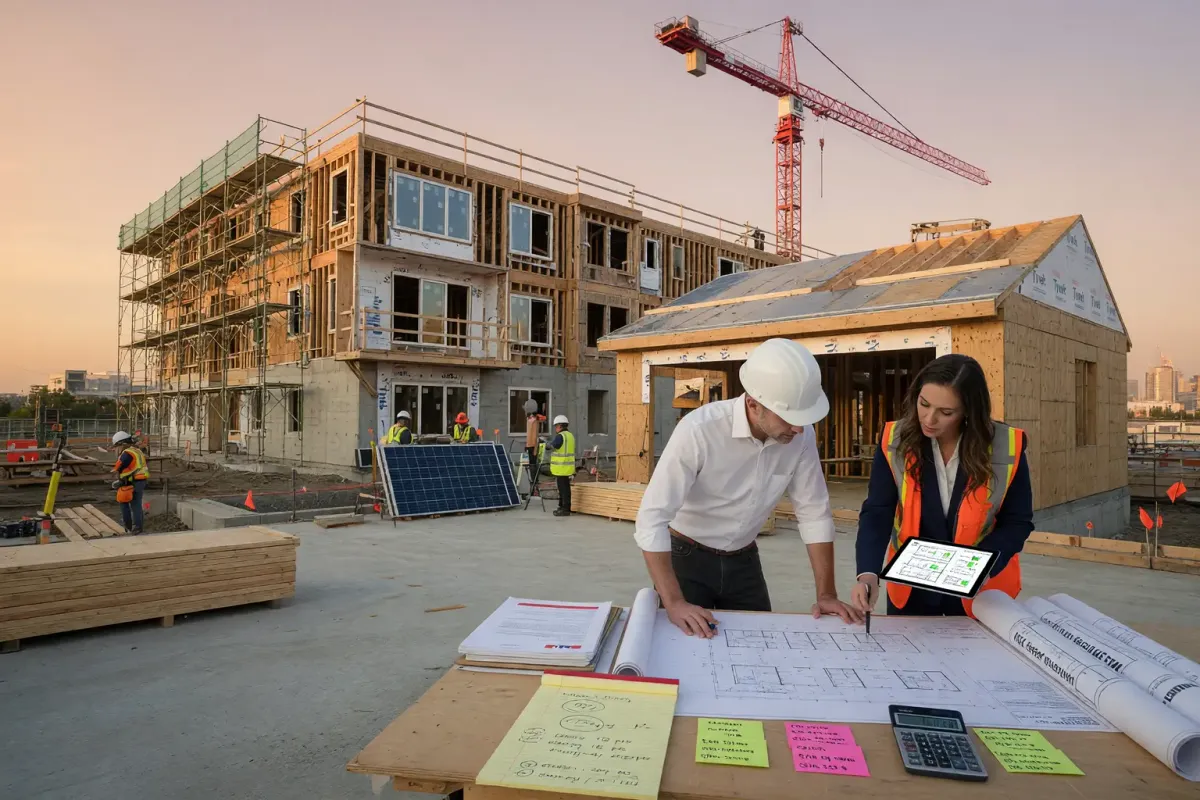
New apartment construction represents one of the most compelling uses of CMHC MLI Select financing. Unlike retrofitting existing buildings or acquiring stabilized properties, new construction lets you design affordability, energy efficiency, and accessibility into the building from day one — earning points that unlock extraordinary multi-family mortgage financing leverage with minimal equity outlay.
This guide walks through how successful developers use MLI Select to finance new construction projects, from conceptual design through lease-up and permanent financing. We’ll cover real project economics, the approval timeline, construction financing strategies, and common pitfalls that kill applications.
Why New Construction Is the Sweet Spot for MLI Select
New construction projects outperform retrofits and acquisitions for MLI Select qualification. Understanding why shapes your development strategy.
Points Are Built Into Design, Not Bolted On
The fundamental advantage of new construction is architectural integration. When you design a building specifically for MLI Select, affordability, energy efficiency, and accessibility features are embedded into the project from schematic design forward. This generates points more cost-effectively than retrofitting existing buildings.
Compare these two scenarios:
Scenario A: New 20-Unit Building
- Design integrated with affordability targets (8 units at below MMR)
- Mechanical systems specified for 15%+ NECB exceedance from day one
- Accessible units planned (2 barrier-free, 6 adaptable) during design phase
- Total incremental cost: $400,000–$600,000 to hit 100+ points
- Points achieved: 105–120 points
- Result: 95% LTC financing at $8.6M on $9.1M cost
Scenario B: 20-Unit Retrofit of 25-Year-Old Building
- Purchase price: $6.5M (stabilized property)
- HVAC replacement for energy efficiency: $800,000
- Window/insulation retrofits: $400,000
- Accessibility upgrades (bathrooms, entries, grab bars): $600,000
- Total retrofit cost: $1.8M
- Points achieved: 60–75 points (retrofit cap is lower)
- Result: 75–80% LTV financing only (not 95%), plus existing structure limits achievable improvements
- Net outcome: Retrofit costs nearly 3x more, achieves fewer points, and still doesn’t unlock 95% financing
New construction wins decisively. Points that cost $25,000–$30,000 per point to retrofit cost only $4,000–$6,000 per point to integrate during design.
Design Flexibility Creates Higher Point Multipliers
CMHC’s points system rewards projects where affordability, energy, and accessibility features are genuine design commitments rather than afterthoughts. New construction demonstrates this commitment because:
- Architects design floor plans around accessible entries, wider doorways, and adaptable layouts
- Mechanical engineers specify heat pumps, ERV/HRV systems, and high-efficiency equipment from the start
- Affordable units are distributed throughout the building (not concentrated in less desirable locations)
- Energy modeling occurs during schematic design, allowing design optimization before construction drawings lock in costs
Retrofitting an existing building, by contrast, forces energy consultants to work within fixed structural limitations. Adding insulation to a 30-year-old building shell is inherently less efficient than designing a new envelope from scratch. CMHC’s underwriters recognize this and cap retrofit projects at lower point multipliers. Understanding the MLI Select points system scoring guide helps you optimize each category during design.
Cost Efficiency: The Real Math
Let’s quantify the cost difference. A 20-unit new construction project targeting 100+ points across all three categories:
Energy Efficiency Costs (New Construction)
- Heat pump system: ~$20,000 (designed in as baseline HVAC)
- High-performance windows: +$8,000 vs standard windows
- Enhanced insulation: +$5,000 (R-30 walls, R-50 attic)
- ERV/HRV system: +$3,000
- Incremental subtotal: $36,000 for 20 units = $1,800 total
Energy Efficiency Costs (Retrofit)
- HVAC replacement for 20 units: $800,000 (mechanically replacing existing systems)
- Window replacement (all units): $400,000
- Exterior insulation (if feasible): $200,000
- Subtotal: $1.4M
Accessibility Costs (New Construction)
- 2 barrier-free units (built to full standards): $40,000 extra per unit = $80,000
- 6 adaptable units (reinforced walls, blocked plumbing): $8,000 extra per unit = $48,000
- Subtotal: $128,000 for 20 units
Accessibility Costs (Retrofit)
- Barrier-free conversion of existing units (structural): $35,000–$50,000 per unit
- Bathroom accessibility retrofits: $25,000–$40,000 per unit
- Entry ramp/zero-step modifications: $10,000–$20,000 per unit
- Subtotal: $200,000+ for 8 units (retrofit feasibility is lower)
Total Incremental Cost
- New construction: ~$500,000 to hit 100+ points
- Retrofit: ~$1.6M+ for similar points (and lower multiplier)
New construction is 3x more cost-efficient at earning points. This efficiency difference justifies developer confidence in designing specifically for MLI Select.
Designing Your Building for Maximum Points
Maximizing points starts during schematic design—before architectural drawings are finalized. Waiting until construction documents phase to optimize for MLI Select is a critical error that costs time and money.
The Three-Category Scoring Framework
CMHC MLI Select awards points across three tightly integrated categories:
Affordability — Committing percentage of units to below-market rents for 10–20 year terms. In growing markets like Edmonton and Calgary, affordability commitments often align with natural market positioning anyway, making this category the easiest points source.
Energy Efficiency — Building 10-20% above the National Energy Code for Buildings (NECB) baseline, verified by EnerGuide rating. New construction naturally exceeds NECB because modern building codes require it; the question is how much above baseline you design.
Accessibility — Committing percentage of units to barrier-free (full accessibility) or adaptable (easily retrofitted) standards. Like affordability, accessibility expands your tenant pool and is increasingly expected by renters.
Designing for Affordability Points
Affordability points are the easiest to secure in new construction because market rents in many Canadian markets naturally fall at or below CMHC thresholds.
How CMHC Affordability Works
CMHC publishes “Median Market Rent” (MMR) thresholds for every city, updated annually. Affordable rents are set at 80% of the MMR. For example:
- Edmonton 1-bedroom MMR: ~$2,080/month → 80% threshold = $1,665/month
- Calgary 1-bedroom MMR: ~$1,950/month → 80% threshold = $1,560/month
- Vancouver 1-bedroom MMR: ~$2,500/month → 80% threshold = $2,000/month
Scoring Mechanics
You earn affordability points by committing a percentage of units to rents at or below these thresholds for a defined period (typically 10 or 20 years):
- Commit 25% of units to affordable rents for 10 years: 30 points
- Commit 25% of units to affordable rents for 20 years: 45 points
- Commit 50% of units to affordable rents for 20 years: 60+ points
Real Project Example: 20-Unit Edmonton Building
Let’s say you’re developing 20 units in Edmonton:
- 8 × 1-bedroom units (can rent at $1,800–$2,000 market rate)
- 12 × 2-bedroom units (can rent at $2,200–$2,400 market rate)
MLI Select Affordability Strategy:
- Commit 6 of the 8 × 1-bedrooms to $1,665/month (80% of MMR) for 20 years = 30% of units at affordable rent = 45+ points
- Market rent the 2 × 1-bedrooms and all 12 × 2-bedrooms at full rates
- Net rental income: (6 × $1,665) + (2 × $1,900) + (12 × $2,300) = $39,930/month
- Even with 30% of units at affordable rents, monthly income is strong and cash flow is healthy
This is why affordability points work so well in growth markets—market conditions naturally position many units at or below affordability thresholds without requiring forced discounts. You’re not sacrificing much (or any) cash flow to earn the points. For a detailed comparison of how MLI Select stacks up against standard CMHC programs, MLI Select vs MLI Standard offers a head-to-head breakdown of leverage, timelines, and qualification requirements.
Designing for Energy Efficiency Points
Energy efficiency points require documented building performance exceeding NECB. New construction makes this straightforward because mechanical and envelope specifications are set during design.
NECB Baseline and Exceedance Target
The National Energy Code for Buildings establishes a baseline energy performance standard. New construction must meet NECB; MLI Select rewards exceeding it by 10%, 15%, 20%, or higher, depending on complexity.
How to Calculate Exceeding NECB
Your energy consultant models the building in NECB-compliant baseline condition, then models your actual design with specified improvements. The comparison generates an EnerGuide rating showing percentage improvement.
Example baseline model (20-unit building):
- Standard R-20 wall insulation
- Double-pane windows (U-value 0.30)
- Natural gas furnaces + hot water heating
- Standard ventilation (no ERV)
- Estimated EnerGuide rating: 80 (baseline)
Your improved design:
- R-30 wall insulation + R-50 attic
- Triple-pane windows (U-value 0.18)
- Air-source heat pump (electric heating + cooling)
- ERV/HRV system for ventilation recovery
- LED throughout
- Estimated EnerGuide rating: 92 (15% improvement above NECB)
This 15% improvement generates 35+ energy efficiency points.
Design Specifications for Maximum Points
To hit 15–20% above NECB on a new apartment building:
Envelope
- Wall insulation: R-28 minimum (R-30–R-32 preferred)
- Attic/roof: R-50 minimum
- Foundation/basement: R-24 minimum
- Windows: U-value 0.18–0.20 (triple-pane or high-performance)
- Air sealing: Blower door test, <3 air changes/hour at 50 Pa pressure
Heating & Cooling
- Air-source heat pump (increasingly essential for CMHC)
- Electric resistance heating backup
- Avoid natural gas furnaces (CMHC disfavors fossil fuels)
- Radiant floor heating (if budget allows; improves comfort and efficiency)
Ventilation & Moisture Control
- ERV (Energy Recovery Ventilator) or HRV with ≥80% efficiency
- Continuous ventilation with humidity control
- Duct sealing and testing
Lighting & Appliances
- LED throughout (common areas, units, exterior)
- ENERGY STAR appliances in all units
- Smart thermostats and occupancy sensors
Water & Waste
- Low-flow fixtures (1.5 GPM showerheads, 0.5 GPM faucets)
- On-demand water heating (if feasible)
- Heat pump water heater
Renewable Energy (Optional)
- Solar-ready design (roof reinforced for future panels)
- Install solar PV if budget allows (10–15 kW system on 20-unit building)
- Battery storage (rarely justified economically but increasingly desirable)
Typical Incremental Cost A 20-unit new construction achieving 15% above NECB (60+ energy points):
- Heat pump system (vs standard furnace): +$150,000 total
- High-performance windows (vs standard): +$160,000
- Enhanced insulation + air sealing: +$80,000
- ERV/HRV system: +$60,000
- LED + EnerGuide modeling: +$30,000
- Total: ~$480,000 incremental cost
For a $9.1M project, this is 5.3% cost increase. The resulting energy efficiency points, combined with affordability and accessibility, unlock 95% financing—saving roughly $1 million in required equity. The investment pays for itself several times over.
Designing for Accessibility Points
Accessibility points reward barrier-free (full compliance) and adaptable (easily retrofit-able) units. These features expand your tenant pool while earning points.
Barrier-Free Units (Full Accessibility Compliance)
Barrier-free units meet full accessibility standards suitable for residents with disabilities. Requirements include:
- Zero-step entry (level with building grade or ramp)
- Interior doorways: 36”+ width
- Bathroom: Accessible shower (roll-in or transfer), grab bars, accessible sink height
- Kitchen: Lowered counters (30–36” accessible height), accessible appliances
- Accessible parking: 1 accessible spot per 25 units minimum
- Bedroom layout: Clear floor space for wheelchair maneuvering (60” clearance minimum)
Cost Impact A fully accessible unit costs approximately 3–7% more to construct than standard:
- Zero-step entry: $5,000–$10,000
- Accessible bathroom (roll-in shower, grab bars, fixtures): $8,000–$15,000
- Kitchen adaptations: $3,000–$5,000
- Accessible parking slot (if applicable): $2,000–$5,000
- Total: $18,000–$35,000 per unit
For a 20-unit building committing 2 barrier-free units: $36,000–$70,000 incremental cost.
Adaptable Units (Universal Design)
Adaptable units aren’t fully accessible initially but are designed for future retrofit without major structural work. Features include:
- Level entry (no step; achievable through standard site design)
- Doorway blocking in walls (future grab bar installation)
- Reinforced walls in bathroom (future accessibility upgrades)
- Open floor plan (easier navigation for mobility devices)
- Accessible kitchen design (good spatial layout, reachable appliances)
Cost Impact Adaptable units cost only 1–2% more than standard construction:
- Reinforced walls: $2,000
- Doorway planning: $500
- Open floor plan (no structural cost): design choice
- Total: $2,500–$5,000 per unit
Scoring Strategy for 20-Unit Building
Commit:
- 2 barrier-free units (10% of total): Full accessibility compliance from day one
- 6 adaptable units (30% of total): Designed for easy future retrofit
- 12 standard units (60% of total): Market-standard design
Points Generated
- 2 barrier-free units: 25–30 points
- 6 adaptable units: 20–25 points
- Total accessibility: 45–55 points
Incremental Cost
- 2 barrier-free: $36,000–$70,000
- 6 adaptable: $15,000–$30,000
- Total: $51,000–$100,000 for 20 units
Integrated Design Example: 20-Unit Edmonton Project
Here’s how affordability, energy, and accessibility integrate into a single project:
Site & Units
- 20-unit purpose-built rental apartment
- Mixed 1-bedroom and 2-bedroom units
- Edmonton location (strong MMR-aligned affordability points)
Affordability Points Strategy
- 6 × 1-bedroom at $1,665/month (affordable tier) for 20 years: 45 points
- 2 × 1-bedroom at market rate: market flexibility
- 12 × 2-bedroom at market rate: $2,300–$2,400/month range
Energy Efficiency Points Strategy
- Heat pump heating/cooling (electric)
- R-30 walls, R-50 attic, triple-pane windows
- ERV/HRV ventilation, LED lighting
- EnerGuide modeling targets 15% above NECB: 60 points
Accessibility Points Strategy
- 2 barrier-free units (10% of total): 25 points
- 6 adaptable units (30% of total): 20 points
Total Points Estimate: 150 points (well above 100-point threshold)
Incremental Design Costs
- Affordability: $0 (market rents already align)
- Energy efficiency: $480,000
- Accessibility: $75,000
- Total: $555,000 on $9.1M cost = 6.1% premium
Financing Outcome
- At 150 points, approved for 95% LTC financing
- Loan amount: $8.645M
- Equity required: $455,000 (5%)
- Premium: $1.2M (can be financed into loan)
- 50-year amortization available
- Limited recourse (capped liability)
Return on Integration Investment The $555,000 design investment generates:
- 95% vs 85% financing (10% LTC improvement) = $910,000 equity savings
- 50-year vs 40-year amortization = ~$120,000 annual cash flow improvement
- Limited recourse protection = ~$500,000 liability reduction (not quantified directly, but valuable)
The design premium is recovered many times over through financing benefits.
Your debt ratios, income type, and property plans all affect what you qualify for — book a free strategy call with LendCity so we can map out a strategy that works for your goals.
If this approach is on your radar, our multi-family mortgage financing guide walks through how LendCity structures these deals.
The New Construction MLI Select Timeline
Understanding realistic timelines prevents costly delays and unrealistic expectations.
Complete Development Timeline: Concept to Permanent Financing
Phase 1: Pre-Development (Months 1–4)
- Site acquisition/option
- Preliminary feasibility analysis
- Architect engagement and schematic design
- Energy consultant engagement
- Preliminary point calculations
Phase 2: Design & Pre-Qualification (Months 4–10)
- Detailed architectural design through construction documents
- Energy modeling and EnerGuide rating
- Accessibility design validation
- Affordability rent schedule finalization
- Financial pro-forma and underwriting
- CMHC pre-qualification letter from approved lender
- Total timeline: 6–8 weeks for pre-qualification
Phase 3: Formal MLI Select Application (Months 9–11)
- Complete formal CMHC application package
- Submit to CMHC designated reviewer
- Expected CMHC review time: 6–12 weeks
Phase 4: CMHC Review & Commitment (Months 11–15)
- CMHC reviews application
- Requests clarifications or additional documentation (common)
- CMHC issues Commitment Letter specifying:
- Maximum loan amount
- Confirmed point score
- Term of commitment (typically 12–18 months)
- Conditions and monitoring requirements
Phase 5: Construction Financing Setup (Months 14–16)
- Close construction loan (if separate from permanent financing)
- Establish draw schedule with lender
- Finalize contractor agreements
- Order long-lead materials
Phase 6: Construction & Monitoring (Months 16–40)
- Construction progress on schedule
- Quarterly CMHC reporting
- Lender advance/draw requests as construction progresses
- No major design changes (requires CMHC approval)
- Timeline: 18–24 months typical for 20-unit building
Phase 7: Lease-Up & Rent Achievement (Months 35–52)
- Market and lease units (6–12 months before construction completion)
- Achieve rental income targets confirmed in application
- Document lease achievements to CMHC
- Maintain affordability rent compliance (critical)
Phase 8: Permanent Financing Conversion (Months 48–52)
- Submit final documentation to lender
- CMHC issues permanent mortgage commitment
- Close permanent financing
- Transition to stabilized operations
Total Timeline Reality
Best-case scenario (smooth approvals, no delays): 24–28 months
- Pre-development: 3 months
- Design + pre-qual: 6 months
- Formal application: 3 months (including CMHC review)
- Construction: 18 months
- Lease-up: 6 months (overlaps with final construction)
- Permanent close: 1 month
Realistic timeline (typical complications): 30–36 months
- CMHC review often requires 8–12 weeks + 4 weeks of clarifications
- Construction delays common: weather, supply chain, labor
- Lease-up takes longer than projected
- Design changes mid-project can trigger CMHC re-review
Worst-case timeline (significant issues): 36–48 months
- Incomplete application requiring major revisions
- Energy model doesn’t hit NECB target, necessitating design modifications
- Construction cost overruns and timeline slips
- Market softness affects lease-up velocity
- Changes to affordability commitments trigger CMHC review
Timeline Dependency: What Delays What
Several critical dependencies exist:
- Design → Energy modeling: Can’t run energy model until schematic design is finalized
- Energy model results → CMHC pre-qualification: Energy consultant must confirm NECB exceedance before lender pre-qualifies
- CMHC pre-qualification → Formal application: Lender won’t submit formal application without internal pre-qual confidence
- Formal application → Commitment letter: Entire project is contingent on CMHC commitment (most critical single milestone)
- Commitment → Construction financing: Can’t close construction loan without CMHC commitment
- Construction timeline → Permanent financing: Project can’t convert to permanent until construction is complete, occupancy achieved, and rents stabilized
Delaying any single milestone cascades through the entire timeline. This is why experienced developers start design work early and engage lenders/energy consultants during schematic phase rather than waiting.
Financing the Construction Phase
Construction loans and permanent MLI Select takeout financing serve distinct purposes. Understanding how they interact shapes your financing structure.
ACLP (Apartment Construction Loan Program) for Construction Bridge
The Apartment Construction Loan Program (ACLP) is CMHC’s construction-specific program designed to bridge new apartment projects until permanent financing closes. For comprehensive details on ACLP mechanics, terms, and when to use it, the apartment construction loan program guide covers draw schedules, interest structures, and conversion to permanent financing.
How ACLP Works
ACLP provides interim construction financing based on:
- Loan-to-Cost Ratio: Up to 85% LTC (vs 95% for MLI Select permanent)
- Interest Rate: Prime + 1.5–2.5% (interest-only during construction, accrues to loan balance)
- Draw Schedule: Advanced as construction progresses (typically 5–6 draw periods during 18–24 month construction)
- Term: 12–24 months (matches construction timeline + lease-up buffer)
- Takeout Requirement: Must refinance to permanent financing (MLI Select or conventional) before ACLP matures
ACLP Application Process
ACLP is simpler than MLI Select (no points calculation required):
- Submit detailed cost estimate and construction timeline
- Submit site plans and architectural drawings
- Contractor qualifications and bonding
- Borrower financial statements
- Appraisal (typically Land Value Appraisal for construction projects)
- Timeline: 4–8 weeks to approval
Draw Schedule During Construction
Typical draw structure for a 20-unit project over 20 months:
| Draw Period | Timeline | % of Cost | Amount | Purpose |
|---|---|---|---|---|
| 1 | Month 2 | 10% | $910,000 | Site prep, foundation |
| 2 | Month 6 | 20% | $1.82M | Framing, exterior |
| 3 | Month 10 | 25% | $2.27M | Roof, mechanical rough-in |
| 4 | Month 14 | 20% | $1.82M | Interior, finishes |
| 5 | Month 18 | 15% | $1.36M | Final finishes, final inspection |
| 6 | Month 22 | 10% | $910,000 | Holdback pending lease-up |
Each draw is advanced upon submission of:
- Architect’s certification of construction progress
- Photos of work completed
- Lender site inspection (for large draws)
- Invoice verification from contractor
MLI Select Construction + Permanent Hybrid Structure
Some developers use MLI Select as both construction and permanent financing:
- CMHC MLI Select Commitment Letter issued (covers both construction and permanent)
- Construction phase: Operate as interest-only construction loan, advances by draw schedule
- Conversion upon completion: Interest becomes principal, amortization begins over 50 years
This structure simplifies the process (one lender, one approval process) but requires:
- CMHC approval for construction financing (some lenders prefer ACLP)
- Higher interest rate during construction phase
- Careful draw management to keep construction on budget
Interest-Only Costs During Construction
During construction, the developer pays interest only (no principal reduction). This cost must be budgeted as part of project development cost.
Example: 20-Unit Project
- ACLP loan amount: $7.73M (85% LTC on $9.1M cost)
- Average loan outstanding during 20-month construction: $5.2M (ramps up over time)
- Interest rate: Prime (4.45%) + 2% = 6.45% (based on Bank of Canada prime as of April 2026)
- Monthly interest: $5.2M × 6.45% ÷ 12 = $27,950/month
- Total construction-phase interest: 20 months × $27,950 = $559,000
This $559,000 is either:
- Capitalized into the loan balance (added to principal, repaid over permanent term)
- Paid in cash (requires additional equity)
Most developers capitalize interest (add to loan balance), increasing permanent loan amount to $8.29M.
Managing Draw Timing and Burn Rate
Critical issue: Construction timelines often slip, causing draw timing to miss projections. Developers must manage cash carefully.
If your construction timeline extends:
- Draws become delayed
- Loan balance sits at lower amount than projected
- Interest costs can exceed original budget (more draws outstanding longer)
- Contingency reserve becomes critical
Recommendation: Build 10–15% contingency into budget and maintain cash reserves for:
- Contractor invoices ahead of draw advances
- Unexpected cost overruns
- Extended timeline impacts
Conversion to Permanent MLI Select Mortgage
Upon construction completion and lease-up, the ACLP construction loan converts to permanent MLI Select financing:
Conversion Requirements
- Construction completion: Final inspections passed, occupancy permit issued
- Rent achievement: Documentation of leased units, actual rents vs projections
- Lease agreements: 12-month lease copies for representative sample of units
- Property insurance: Completed building insured for full replacement value
- Final certification: Architect/engineer sign-off on construction completion
Permanent Financing Terms
- Principal amount: CMHC reassesses LTC based on actual costs vs projections
- Interest rate: Permanent mortgage rate (typically lower than construction rate)
- Amortization: 50 years (if 100+ points confirmed)
- Payment structure: Converts to principal + interest amortizing payments
- Premium/insurance: CMHC mortgage insurance integrated into loan (already paid during construction)
Example Conversion
Original projection (ACLP):
- Cost estimate: $9.1M
- ACLP 85% LTC: $7.73M loan
Borrowers comparing options often continue with ACLP: CMHC Apartment Construction Loan Program (2026) before booking a strategy call.
Related reading: MLI Select Points System: Maximize Your Score covers the practical angles we see on similar files.
Actual cost + completion:
- Actual cost: $8.95M (under budget)
- Actual rent roll: $4,100/month average × 20 units = $820,000 annual NOI at stabilization
- CMHC permanent 95% LTC: $8.50M loan (higher LTC because project performed)
Conversion:
- ACLP loan paid off: $7.73M + accrued interest
- MLI Select permanent issued: $8.50M
- Net proceeds to developer: $8.50M - $7.73M = $770,000 (refinance benefit)
- Permanent amortization: 50 years at 4.75% = $43,400/month principal + interest
This refinance benefit (when project comes in under budget or exceeds rent projections) is one of the compelling reasons developers use this structure.
Multifamily financing has different rules than residential — schedule a free strategy session with us and we’ll show you exactly what you qualify for under CMHC or conventional programs.
Real Project Walkthrough: 16-Unit in Edmonton
Let’s walk through a complete MLI Select new construction project with real numbers.
Project Specifications
Property Details
- Location: Inner-city Edmonton neighborhood (established, accessible location)
- Unit count: 16 units (2 barrier-free, 4 adaptable, 10 standard)
- Unit mix: 6 × 1-bedroom, 10 × 2-bedroom
- Parking: 1.2 spaces per unit = 20 stalls (shared + visitor)
- Amenities: Common lounge, fitness room, bike storage, accessible outdoor space
- Construction timeline: 18 months from groundbreaking
Development Cost Breakdown
| Cost Category | Amount | % of Total |
|---|---|---|
| Land acquisition | $800,000 | 18% |
| Soft costs (architecture, engineering, permits) | $450,000 | 10% |
| Construction hard costs | $2,700,000 | 60% |
| Contingency (10%) | $295,000 | 7% |
| Financing costs (CMHC insurance, legal, appraisals) | $105,000 | 2.3% |
| Leasing & marketing (pre-lease during construction) | $100,000 | 2.2% |
| Total Development Cost | $4,450,000 | 100% |
MLI Select Points Calculation
Affordability Points
- Edmonton 1-bedroom MMR: $2,080/month
- Affordable threshold (80% MMR): $1,665/month
- Commitment: 4 × 1-bedroom units at $1,665 for 20 years (25% of total)
- Points: 45 points
Energy Efficiency Points
- Design target: 15% above NECB baseline
- Features: Heat pump, R-30 walls, R-50 attic, triple-pane windows, ERV/HRV
- EnerGuide rating: 92 (baseline 80)
- Points: 60 points
Accessibility Points
- 2 barrier-free units: 25 points
- 4 adaptable units: 20 points
- Total accessibility: 45 points
Total Points: 150 points (well above 100-point threshold)
Financing Structure
ACLP Construction Loan
- LTC: 85%
- Loan amount: $3.78M (85% × $4.45M)
- Interest rate: Prime (4.45%) + 2.0% = 6.45% (based on Bank of Canada prime as of April 2026)
- Term: 24 months
- Equity required: $665,000 (15% of cost)
Construction-Phase Interest Cost
- Average outstanding balance: $2.55M
- 24 months × monthly interest: 24 × ($2.55M × 6.45% ÷ 12) = $328,725
- Capitalized into permanent loan
Permanent MLI Select Mortgage (Upon Completion)
Once lease-up is achieved and construction complete:
- Loan amount: $4.227M (95% LTC on actual $4.45M cost)
- Interest rate: 4.85% (April 2026 MLI Select range 4.25-5.00%)
- Amortization: 50 years (with 0.25% per-5-yr surcharge above 25 yrs under risk-based pricing — full 1.25% surcharge baked into premium)
- Monthly P&I payment: $22,180
- Annual debt service: $266,160
The permanent conversion depends on achieving your rent targets. Understanding debt service coverage ratio requirements helps you model realistic DSCR during stabilization and lease-up phases.
Annual NOI Calculation at Stabilization
Rental income (year 1, fully leased):
- 4 × 1-bedroom at $1,665: $79,920/year
- 2 × 1-bedroom at market $2,000: $48,000/year
- 10 × 2-bedroom at $2,350: $282,000/year
- Gross rental income: $409,920
Operating expenses (estimated):
- Property management (8%): $32,794
- Maintenance & repairs (8%): $32,794
- Property tax: $35,000 (typical Edmonton)
- Insurance: $12,000
- Utilities (common areas): $18,000
- Condo reserve (5%): $20,496
- Total operating expenses: $151,084
Net Operating Income (NOI): $258,836
Debt Service Coverage Ratio (DSCR): $258,836 ÷ $266,160 = 0.97
Note: DSCR just below 1.0 indicates tight cash flow in year 1. This is common in new construction with partial affordability commitments. DSCR improves in years 2+ as rents increase (market units) while affordable rents are fixed by commitment. By year 5, DSCR typically exceeds 1.15+.
Developer Returns
Initial Equity Requirement
- Down payment: $665,000 (15% of $4.45M)
- Additional reserves/contingency: $100,000
- Total developer capital: $765,000
Return Analysis (5-Year Hold)
Assumptions:
- Rents increase 2.5% annually (market units only)
- Property appreciates 3% annually
- DSCR improves to 1.12 by year 5 (as market rents increase)
Year 1–5 cash flow:
| Year | Rental Income | Operating Expenses | Debt Service | Cash Flow |
|---|---|---|---|---|
| 1 | $409,920 | $151,084 | $266,160 | -$7,324 |
| 2 | $420,060 | $154,616 | $266,160 | -$716 |
| 3 | $430,562 | $158,230 | $266,160 | $6,172 |
| 4 | $441,425 | $161,935 | $266,160 | $13,330 |
| 5 | $452,661 | $165,732 | $266,160 | $20,769 |
Year 5 property value (3% annual appreciation):
- Year 1 value: $4.45M
- Year 5 value: $4.45M × 1.03^5 = $5.16M
Mortgage balance remaining after 5 years (50-year amortization):
- Original: $4.227M
- Principal paid down: ~$180,000
- Remaining balance: ~$4.047M
Equity position at year 5
- Property value: $5.16M
- Mortgage balance: $4.047M
- Equity: $1.113M
- Appreciation gain: $1.113M - $665,000 = $448,000 over 5 years
- Cash flow over 5 years: $33,000 (break-even to slightly positive)
Total 5-year return: $481,000 (69% return on $765,000 invested)
This assumes moderate appreciation and rent growth. Strong market performance (5%+ annual appreciation, 3.5%+ rent growth) would significantly exceed these projections.
Key Project Insights
-
Leverage is powerful: 95% financing on 16 units with only $665,000 down is extraordinary leverage. A conventional lender would require $1.2M+ down (20% LTC).
-
MLI Select premium pays: The incremental design costs ($200,000 for energy + accessibility) generated 95% vs 85% financing worth $535,000 in equity savings. ROI on design investment is 2.7x in year 1.
-
Affordability + energy + accessibility work together: The project hit 150 points through diversified scoring, not over-relying on one category. This diversification improves CMHC’s comfort level and approval odds.
-
Cash flow is tight initially: Many new construction MLI Select projects break even or run slightly negative in year 1. This is expected and accepted by lenders. Cash flow strengthens as market rents increase while affordable rents are fixed.
-
Appreciation is the real return driver: In this example, appreciation ($448,000) significantly exceeds cash flow ($33,000) over the 5-year period. This is typical—new construction is an appreciation play as much as a cash flow play.
Common Development Pitfalls
Understanding what kills projects helps you avoid them.
Pitfall 1: Cost Overruns on Construction
The Problem Construction costs exceed original budget by 10–20%, forcing:
- Equity injection to cover overruns
- Timeline extension (more carrying costs, delayed rent achievement)
- Potential reduction in amenities or finishes (affects lease-up velocity)
Why It Happens
- Incomplete cost estimates (missing contingencies for labor, materials)
- Contractor change orders (design changes, site conditions, supply chain issues)
- Inflation (material and labor costs increasing during construction)
- Underestimated soft costs (permitting delays, inspections, engineering revisions)
Prevention Strategy
- Include 12–15% contingency in original budget (not 5–8%)
- Lock in long-lead material prices before construction starts
- Use fixed-price contracts with contractors (not cost-plus)
- Budget for design contingencies during schematic phase
- Maintain cash reserves separate from project contingency
Pitfall 2: Not Achieving Rental Income Targets
The Problem Market rents come in below projections, or lease-up takes 12+ months instead of projected 6. This triggers:
- Lower NOI, reduced DSCR
- Concerns from permanent lender (may not fund permanent at expected terms)
- Reduced cash flow, potential cash flow negative
- Project doesn’t meet projected IRR
Why It Happens
- Market softness (economic downturn, oversupply in local market)
- Competition from other new projects (race to bottom on rents)
- Unit mix mismatch (too many 2-bedrooms when market prefers 1-bedrooms)
- Lease-up timeline underestimated (pre-leasing harder than anticipated)
- Affordability units cannibalize market-rate demand (if not marketed separately)
Prevention Strategy
- Run market analysis during design phase (not after construction starts)
- Conservative rent projections (use 85–90% of market comps)
- Diversified unit mix (don’t over-commit to one bedroom size)
- Early pre-leasing (start 6–12 months before completion)
- Professional property management on lease-up (not developer-managed)
- Market units separately from affordable units (avoid perception that “affordable” is inferior)
Pitfall 3: Energy Model Failures During CMHC Review
The Problem Energy consultant’s preliminary model shows 18% above NECB, but when CMHC reviews the detailed model (post-design), it only achieves 12%. This triggers:
- Point score reduction (60 points → 45 points)
- Potential LTC reduction (95% → 85%)
- Equity requirement increase ($450,000 → $890,000)
- Project may no longer be economically viable
Why It Happens
- Preliminary energy model optimistic (uses assumptions that don’t hold in final design)
- Design changes mid-process degrade energy performance
- Construction specifications not matching design assumptions
- Final EnerGuide rating (actual post-construction) differs from preliminary model
Prevention Strategy
- Engage energy consultant during schematic design (not after)
- Run detailed energy model on near-final design (not preliminary sketch)
- Specify all mechanical/envelope details in contract documents (no allowances)
- Build energy contingency (target 18% above NECB, accept 15% minimum)
- Have contractor confirm all energy-related specs in construction documents
- Plan for post-occupancy energy audit (required by CMHC anyway)
Pitfall 4: Timeline Delays Extending Carrying Costs
The Problem Construction delays (weather, labor, permitting) extend timeline by 6+ months. Each month of delay costs:
- Construction financing interest: $25,000–$40,000/month
- Property taxes (before occupancy): $3,000–$5,000/month
- Utilities (under construction): $1,000–$2,000/month
- Management/overhead: $5,000–$10,000/month
- Total carrying cost: $34,000–$57,000/month
6-month delay = $200,000–$340,000 in additional costs, reducing developer return by 25%+.
Prevention Strategy
- Build realistic timelines (18 months minimum for 20-unit project)
- Include schedule contingency (add 2–3 months buffer)
- Fixed-schedule incentives for contractor (bonus for early completion)
- Penalties for delay (lowers contractor incentive to stretch timeline)
- Clear weather/site condition protocols (what happens if delays occur)
Pitfall 5: Not Achieving Affordability Commitment Compliance
The Problem MLI Select application commits to 25–30% of units at below-MMR rents for 10–20 years. If you don’t maintain this:
- CMHC can impose penalties or demand equity claw-back
- Loan becomes full-recourse (loses “limited recourse” protection)
- If violation occurs mid-loan, refinance may not be available
Why It Happens
- Tenant turnover and new leases at market rates (breaking commitment)
- Marketing strategy inadvertently leases affordable units at market rates
- Accounting/documentation failures (forgot to track which units are affordable)
- Market softness forcing discounts on all units (including “affordable” tier)
Prevention Strategy
- Create formal affordable unit policy (part of lease-up manual)
- Segregate affordable units physically or by number (e.g., “Units 1–6 are affordable units”)
- Track all leases in spreadsheet (unit number, lease start, lease rate, term)
- Brief all leasing staff on affordability commitment (training)
- Annual CMHC reporting (confirm compliance)
- Review affordability portfolio annually (make sure affordable units remain occupied, rents maintained)
Pitfall 6: Design Changes Mid-Construction Breaking Points
The Problem Value engineering or design changes mid-construction alter:
- Building envelope (affects energy efficiency points)
- Accessibility features (affects accessibility points)
- Unit mix (affects affordability calculations)
- CMHC requires re-review and may reduce points or revoke commitment
Why It Happens
- Cost overruns forcing value engineering (remove solar, downgrade windows, skip ERV)
- Contractor suggesting “easier” approach (saves cost but breaks design intent)
- Design errors discovered during construction (structural, mechanical)
Prevention Strategy
- All design decisions locked in contract documents (no design changes without architect approval)
- Contractor change orders require lender + CMHC approval if material
- Value engineering prohibited for energy/accessibility features (contractual requirement)
- Monthly design review meetings (architect, developer, contractor, lender)
- CMHC pre-approval of any material changes (proactive, not reactive)
Building Your Development Team
MLI Select projects are complex and require specialized expertise. Assembling the right team is critical to success.
Core Team Members and Vetting Criteria
1. Mortgage Broker or Commercial Lender (Essential)
Role: Guides application process, manages CMHC relationship, coordinates financing.
What to look for:
- MLI Select track record: Have they closed 3+ MLI Select projects in past 12 months?
- CMHC relationship: Are they a CMHC-approved lender or work with one directly?
- Development experience: Do they understand construction timelines, ACLP bridge financing, and permanent takeout?
- References: Can they provide names of 2–3 successful projects they’ve financed?
Red flags:
- “We’ve done CMHC insured mortgages” (residential is different from multi-family MLI Select)
- Can’t articulate how points system works
- Haven’t closed an MLI Select deal in 18+ months
2. Architect with Multi-Family + CMHC Experience (Essential)
Role: Designs building for maximum MLI Select points (affordability, energy, accessibility).
What to look for:
- Multi-family portfolio: Do they have 5+ apartment/rental projects?
- CMHC projects: Have they designed buildings for CMHC MLI Select or ACLP?
- Energy design: Can they explain how to exceed NECB and achieve EnerGuide targets?
- Accessibility design: Do they understand barrier-free and adaptable unit standards?
Red flags:
- “We’ll design it, then figure out CMHC requirements” (backward approach)
- Can’t articulate accessibility standards
- Limited apartment experience (mostly single-family)
3. Energy Consultant (Essential)
Role: Models building performance, certifies NECB exceedance, provides EnerGuide rating.
What to look for:
- CMHC experience: Have they provided energy certifications for MLI Select projects?
- EnerGuide rating authority: Are they certified to issue EnerGuide ratings?
- Local knowledge: Do they understand Alberta/Canadian building codes and climate considerations?
Red flags:
- “We’ll do the energy model after the design is done” (should be during schematic)
- Limited CMHC project experience
- Can’t explain NECB requirements
4. Contractor (Essential)
Role: Builds the project on time and budget.
What to look for:
- Multi-family experience: Do they have 3+ apartment/rental building projects?
- Bonding capacity: Can they bond a project of your size?
- References: Can they provide 2–3 client references with contact info?
- Fixed-price experience: Have they successfully delivered fixed-price (not cost-plus) contracts?
Red flags:
- Limited apartment experience (mostly single-family or light commercial)
- Can’t provide bonding estimates
- Vague references (“we know people”)
- Cost-plus only (no fixed-price capability)
5. Accountant/Financial Analyst (Essential)
Role: Models project economics, manages budgets, prepares financial statements for CMHC.
What to look for:
- Real estate development experience: Have they worked on 3+ development projects?
- CMHC familiarity: Understand DSCR, LTC, and CMHC underwriting standards?
- Tax planning: Can advise on corporate structure (corp vs partnership) for optimal tax treatment?
6. Property Manager (Important but Can Wait)
Role: Manages lease-up, maintains building, handles tenant issues.
What to look for:
- Apartment management experience: Have they managed 50+ unit portfolios?
- Lease-up expertise: Have they handled pre-lease and lease-up for new construction?
- Affordable housing experience: Ideally, experience managing mixed-rent portfolios (market + affordable)
Note: You can hire property manager during lease-up phase (not during design). Early engagement helps with lease-up planning but isn’t critical during development.
Team Assembly Strategy
Stage 1: Concept (Months 1–3)
- Hire: Architect (for schematic design), Mortgage broker (for pre-qualification guidance)
- Outcome: Pre-qualification letter indicating project is fundable
Stage 2: Design (Months 3–8)
- Add: Energy consultant, Accountant (for financial modeling)
- Outcome: Completed design, energy model, financial pro-forma, points calculation
Stage 3: Pre-Qualification (Months 8–10)
- Formalize: CMHC pre-qualification from lender
- Outcome: Lender letter indicating CMHC approval is likely
Stage 4: Formal Application (Months 10–12)
- Add: Contractor (for detailed cost estimate, if not already engaged)
- Outcome: Formal CMHC application submitted
Stage 5: Post-Commitment (Months 15+)
- Add: Property manager (for lease-up planning)
- Begin: Construction under ACLP or MLI Select construction loan
Communication and Governance
Regular team meetings are essential:
- Monthly: Full team + developer (design status, budget, schedule, CMHC updates)
- As-needed: Architect + energy consultant (design optimization, CMHC clarifications)
- Quarterly: Lender + developer (application status, financial updates, risk management)
- Weekly (during construction): Contractor + developer + lender (progress, draws, issues)
FAQ: MLI Select New Construction
How much equity do I need for a new construction MLI Select project?
What's the difference between MLI Select new construction and ACLP?
How long does the CMHC approval process take for new construction?
Can I use MLI Select for a renovation or adaptive reuse project?
What happens if I don't achieve my affordable rent targets?
How do I calculate my MLI Select points for new construction?
What's the minimum project size for MLI Select new construction?
Key Takeaways:
- Why New Construction Is the Sweet Spot for MLI Select
- Designing Your Building for Maximum Points
- The New Construction MLI Select Timeline
- Financing the Construction Phase
- Real Project Walkthrough: 16-Unit in Edmonton
Conclusion
MLI Select new construction represents a powerful financing tool for Canadian developers. Our detailed MLI Select mortgage financing guide explains how designing affordability, energy efficiency, and accessibility into buildings from schematic design forward allows developers to unlock 95% financing, 50-year amortizations, and limited recourse protection—terms impossible through conventional lending.
New construction outperforms retrofits and acquisitions because points are embedded into design at the lowest cost. A project designed specifically for MLI Select qualification can capture $500K–$1M in financing benefits by investing only $400K–$600K in incremental design features. As you scale your development portfolio, tax structuring through HoldCo/OpCo entities becomes critical for optimizing taxes across multiple properties and protecting each project through legal separation. For comprehensive guidance on multifamily financing strategies and programs beyond MLI Select, explore our multifamily mortgage financing service page.
The timeline is realistic but requires planning: 6–10 months for CMHC approval, 18–24 months for construction, 6–12 months for lease-up, then permanent financing conversion. Success hinges on assembling the right team—a mortgage broker with MLI Select experience, architects familiar with CMHC design requirements, energy consultants, and experienced contractors.
Common pitfalls (cost overruns, timeline delays, rental shortfalls, energy model failures) are preventable with upfront planning, realistic budgeting, conservative rent projections, and early engagement of specialized advisors.
For scaling investors and developers ready to build multi-family housing in growing Canadian markets, MLI Select new construction is a game-changing financing tool. The 95% leverage transforms project economics and makes high-leverage development possible. Developers building ground-up projects can also explore our development mortgage financing programs for construction loan options from land acquisition through project completion.
Free download
MLI Select document checklist
Appraisals, rent rolls, environmental reports, and the CMHC package lenders expect before they underwrite.
By submitting, you agree to receive occasional emails from LendCity. You can unsubscribe at any time.
4.8/5 (116 Google reviews)
Disclaimer: LendCity Mortgages is a licensed mortgage brokerage. Content on this page is for educational purposes only and does not constitute legal, tax, investment, securities, or financial-planning advice. Rates, premiums, program terms, and regulations referenced are as of the page's last updated date and are subject to change. Any investment returns, rental yields, tax savings, or case-study figures shown are illustrative only — they are not guaranteed, not typical, and individual results will vary. Consult a licensed lawyer, Chartered Professional Accountant, or registered dealer before acting on any information above. Editorial standards.

Written by
Scott Dillingham
Published
February 26, 2026
· Updated June 9, 2026Reading time
26 min read
CMHC MLI Select
A CMHC program offering reduced mortgage insurance premiums and extended amortization (up to 50 years) for multifamily properties with 5+ units that meet energy efficiency or accessibility standards. Popular among investors scaling into larger apartment buildings.
Construction Loan
Short-term financing used to fund building a new property. Funds are released in stages (draws) as construction milestones are completed, and interest is charged only on drawn amounts. Construction loans typically convert to permanent financing upon project completion.
Takeout Financing
Permanent long-term mortgage financing that replaces a short-term construction loan after a development project is completed and stabilized. Securing a takeout commitment before construction begins reduces project risk.
LTV
Loan-to-Value ratio - the mortgage amount expressed as a percentage of the property's appraised value or purchase price (whichever is lower). An 80% LTV means you're borrowing 80% and putting 20% [down](/glossary/down-payment/). Lower LTV generally means better [interest rates](/glossary/interest-rate/) and terms. See also [Equity](/glossary/equity/) and [Leverage](/glossary/leverage/).
DSCR
Debt Service Coverage Ratio — a metric that compares a property's [net operating income](/glossary/noi/) to its mortgage payments. A DSCR of 1.25 means the property generates 25% more income than needed to cover the debt. Lenders typically require a minimum DSCR of 1.0 to 1.25 for investment property loans (including [DSCR loans](/glossary/dscr-loan/)). See also [Cap Rate](/glossary/cap-rate/) and [Cash Flow](/glossary/cash-flow/).
Multifamily
Properties with multiple dwelling units, from duplexes to large apartment buildings. Often offer better cash flow and economies of scale.
Energy Efficiency
The effectiveness with which a property uses energy for heating, cooling, lighting, and other functions. Energy-efficient upgrades to rental properties reduce operating costs, increase NOI, and can add significant property value while qualifying for government rebates.
Draw Schedule
A plan specifying when and how much of a construction loan's funds will be released as building milestones are reached. An inspector verifies work completion before each draw is disbursed.
Loan-to-Cost Ratio
The percentage of a development project's total cost that a lender will finance. Unlike LTV which compares loan to appraised value, LTC compares loan to actual project costs including land, construction, and soft costs.
Hover over terms to see definitions. View the full glossary for all terms.