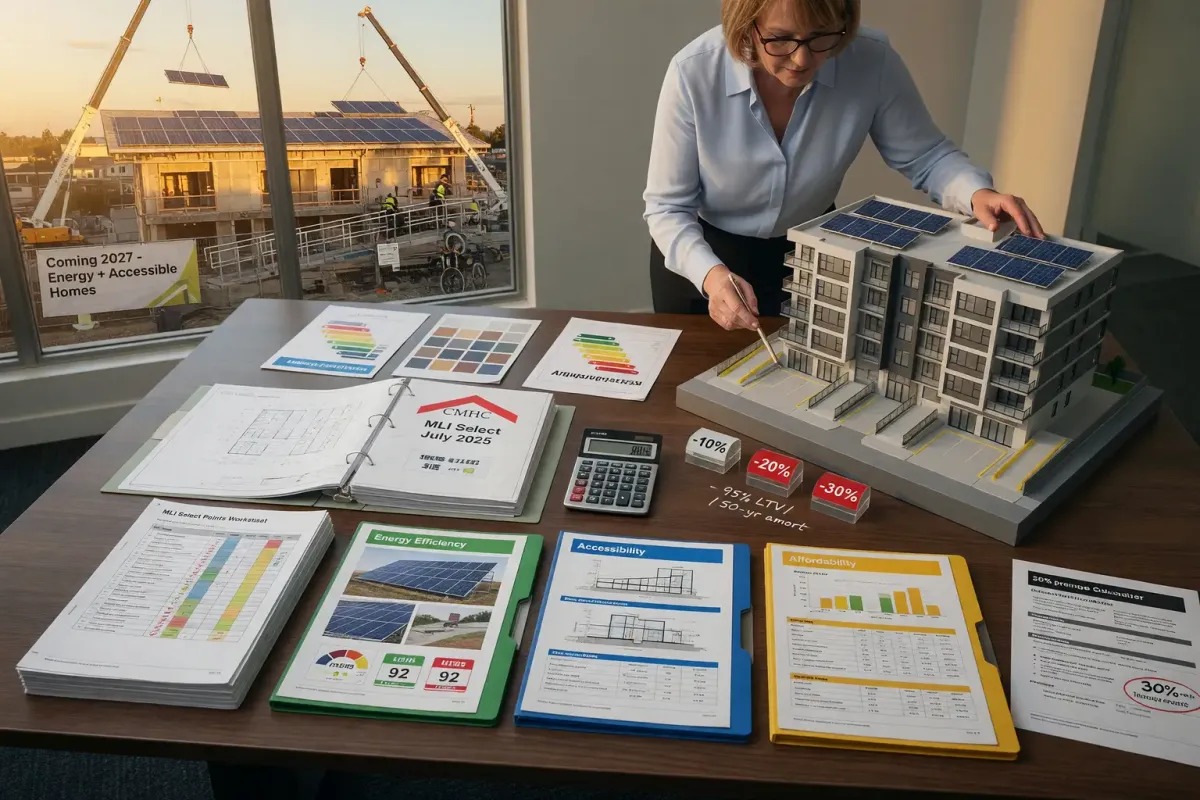
The CMHC MLI Select points system is one of the most powerful—and misunderstood—tools in Canadian multifamily financing. Your score directly determines your financing benefits: 50 points unlocks baseline benefits, 70 points gives you better terms, and 100 points unlocks maximum benefits worth hundreds of thousands of dollars across a project.
The challenge? Most lenders won’t explain how the system works. They’ll tell you “you need points” but leave you guessing at the actual mechanics. This guide breaks down every scoring category, shows you real numbers, and walks you through strategies to hit 100 points.
Note: CMHC updated the MLI Select program on July 14, 2025 with a new risk-based pricing model that aligns with OSFI MICAT rules (full effect 2026). The minimum required score is now 50 points (up from the former 12-point threshold). Premium discounts and financing tiers are set at the 50-, 70-, and 100-point levels. A 0.25% premium surcharge applies for every 5-year amortization extension beyond 25 years (so a 50-year amortization adds 1.25% to the base premium).
Why the Points System Matters: The Real Numbers
Let’s be direct: the difference between 50 and 100 points on a $10 million multifamily project isn’t academic. Here’s what changes:
| Benefit | 50 Points | 70 Points | 100 Points |
|---|---|---|---|
| Max LTV | 85% | 90% | 95% |
| Max Amortization | 40 years | 45 years | 50 years |
| Recourse | Full | Reduced | Limited |
| Premium Discount | 10% | 20% | 30% |
| Min DSCR | 1.10 | 1.10 | 1.10 |
On a $10 million project with an 80% LTV, the mortgage amount is $8 million. A 30% insurance premium discount versus 10% saves you roughly $160,000 to $180,000 in mortgage insurance costs alone. That’s before we even talk about the lower amortization cost and the reduced recourse implications.
The 50-year amortization at 100 points can drop your annual debt service by 8–12% compared to 40 years, which matters significantly when lenders scrutinize your debt service coverage ratio (DSCR).
This is why the points system is a financing superpower.
The Three Scoring Categories: 300 Points Available
MLI Select gives you three buckets to score points from:
- Affordability — up to 100 points
- Energy Efficiency — up to 100 points
- Accessibility — up to 100 points
You don’t have to max out all three. You can get 100 total points by scoring 40 in affordability, 40 in energy efficiency, and 20 in accessibility. Or 70 affordability + 30 energy. The flexibility is intentional—different projects have different strengths.
Mortgage rules change frequently, so what worked last year might not apply today — book a free strategy call with LendCity to get current, personalized guidance.
Category 1: Affordability Scoring (Up to 100 Points)
Affordability points are earned by committing a percentage of your units to rent below the Median Market Rent (MMR) threshold for a defined period.
Understanding Median Market Rent (MMR)
CMHC publishes Median Market Rent data annually for every Canadian market. This is the 50th percentile rent for a two-bedroom apartment. The “affordable” threshold is typically 80% of MMR.
Here’s the critical insight many developers miss: in some markets, the affordable threshold is AT or ABOVE actual market rents.
Affordability Points Breakdown
| Commitment Level | Duration | Approximate Points |
|---|---|---|
| 20% of units at ≤80% MMR | 10 years | 20–30 points |
| 40% of units at ≤80% MMR | 10 years | 40–50 points |
| 60% of units at ≤80% MMR | 20 years | 70–100 points |
| Additional points | Longer duration | +5–15 points |
Real Market Examples (2025–2026 Approximate)
| Market | MMR (2-Bed) | 80% Threshold | Reality Check |
|---|---|---|---|
| Edmonton | $2,080 | $1,665 | Threshold is AT or ABOVE actual market rents. Free points. |
| Calgary | $1,950 | $1,560 | Close to market. Minimal rent sacrifice. |
| Winnipeg | $1,650 | $1,320 | Below market but manageable. |
| Toronto | $2,800 | $2,240 | Meaningful rent sacrifice (20–30% below market). |
| Vancouver | $3,100 | $2,480 | Significant below-market commitment required. |
| Windsor | $1,500 | $1,200 | Threshold well below market. Real cost to project economics. |
Why this matters: In Alberta (Edmonton, Calgary), the threshold is often at or above what you’d actually charge. This means you can commit 40–60% of units to “affordable” rent and not actually sacrifice income because the threshold IS the market rate. This is why Alberta has become the dominant market for MLI Select projects.
Affordability Strategy: How to Score Points Here
If your market MMR is $2,000 and the 80% threshold is $1,600:
- If you’d market-rent units at $1,800: you’re already beating the affordable threshold. Commit those units and earn points without any economic sacrifice.
- If you’d market-rent units at $1,200: you’re naturally below the threshold. Commit those units for points.
- If you’d market-rent units at $2,200: you face a choice—sacrifice $600/month per unit for 10 years, or focus affordability points elsewhere.
Most successful projects use a blended approach: commit the units that fall naturally below or at the threshold, and earn your remaining points from energy efficiency and accessibility.
Category 2: Energy Efficiency Scoring (Up to 100 Points)
Energy efficiency points are based on your building’s energy performance improvement over the National Energy Code for Buildings (NECB) reference standard.
For new construction, you’re measured on percentage improvement. For existing building retrofits, you’re measured on demonstrated energy reduction.
Energy Efficiency Points Breakdown
| Performance Level | NECB Improvement | Typical Points |
|---|---|---|
| Basic efficiency | 10–15% better | 10–20 points |
| Above average | 25–35% better | 30–50 points |
| High performance | 40–50% better | 60–80 points |
| Near net-zero | 60%+ better | 80–100 points |
Common Features and Their Point Impact
Here are the features that move the needle on energy scoring:
Heat Pumps (air-source or ground-source): 15–25 point impact
- These are heavyweight point-earners. A full air-source heat pump system (heating + domestic hot water) can shift your score by 20+ points alone.
- Ground-source is even better but significantly more expensive.
Triple-Pane Windows: 10–15 point impact
- Triple panes vs. standard double-pane makes a measurable difference in energy modelling.
- Cost impact: roughly $30–50 per window premium.
Wall and Attic Insulation (R-30+ walls, R-50+ attic): 10–20 point impact
- Better insulation = lower heating/cooling demand = points.
- Often bundled with other upgrades, so the incremental cost is lower than standalone.
Heat/Energy Recovery Ventilators (HRV/ERV): 5–10 point impact
- Capture heat from outgoing air and transfer to incoming air. Good points for lower cost than heat pumps.
Solar Readiness or Solar Installation: 5–15 point impact
- Solar ready (roofing/electrical prepared for future panels): 5–8 points
- Actual solar installation: 10–15 points, but requires ongoing maintenance considerations
LED Lighting Throughout: 3–5 point impact
- Almost standard now, but still counts. Easy low-cost points.
Smart Building Controls: 3–5 point impact
- Smart thermostats, demand-controlled ventilation, smart lighting. Emerging category with growing point value.
The Energy Modelling Process
To earn energy points, you’ll need:
-
Energy Modelling During Design — $3,000 to $8,000
- Consultant uses energy simulation software to compare your design vs. NECB reference building
- Creates a detailed report showing % improvement and point estimate
-
Post-Construction Energy Assessment (for existing retrofits) — $500 to $2,000
- Utility data analysis, thermal imaging, air-tightness testing
- Proves energy reduction vs. baseline
-
Construction Cost Impact — typically 3–8% of build cost
- The actual cost of better insulation, heat pumps, windows, etc.
- Varies widely by market and project scope
Key insight: A $5,000 energy modelling investment that unlocks 20–30 additional energy points can be worth $200,000–$400,000 in better financing terms. The ROI is exceptional.
Energy Strategy: How to Score Points Here
For new construction:
- Engage an energy consultant early (during schematic design, not after)
- Design for points from day one—it’s cheaper to build efficiently than retrofit
- Prioritize high-impact features: heat pumps, insulation, windows
- Model multiple scenarios to find the cost-effective sweet spot (40–50 points is often the efficient frontier; 60+ points gets expensive)
For existing building retrofits:
- Prioritize envelope improvements: insulation, windows, air-sealing (low cost, high impact)
- Add heat pump heating/cooling and hot water systems (major point mover)
- Bundle with other upgrades to spread engineering/design costs
Choosing the wrong lender or term can quietly erode your returns — schedule a free strategy session with us and we’ll walk you through the numbers.
Category 3: Accessibility Scoring (Up to 100 Points)
Accessibility points are earned by committing a percentage of your units to meet accessibility standards (typically CSA B651 or local building code accessibility requirements).
Accessibility Points Breakdown
| Commitment Level | Approximate Points |
|---|---|
| 10% barrier-free units | 15–20 points |
| 20% barrier-free units | 30–40 points |
| 30% barrier-free + accessible common areas | 50–70 points |
| Full universal design (50%+ units) | 80–100 points |
What Makes a Unit “Barrier-Free”?
- Doorways: 36”+ throughout the unit (not 32” standard)
- Entry: Zero-step entry, no thresholds
- Bathroom: Roll-in shower or accessible tub with grab bars
- Kitchen: Lower countertop sections, accessible under-sink clearance
- Electrical: Accessible outlet and switch heights
- Visual Alarms: Fire and safety alarms with visual components
Cost Impact of Accessibility
- Barrier-free units: add roughly 3–8% to per-unit construction cost
- Adaptable units (designed to be easily modifiable): add 1–2% to cost
- Common area accessibility (accessible lobby, fitness center, etc.): 2–5% of common area cost
For a deeper look at the financing angle behind this topic, see our guide to Multi-Family Mortgage Financing.
The key is that a 10% commitment is usually very low-cost—you’re looking at maybe 1–2% project cost premium for 15–20 points. This is often the highest ROI category.
Scoring Strategies: How to Hit 100 Points
You have flexibility in how you mix points across the three categories. Here are four common strategies:
Strategy 1: All-In on Affordability (Alberta Projects)
Best for: Edmonton, Calgary, and other markets where affordability threshold ≈ market rate
- Commit 60%+ of units to 80% MMR for 20 years: 70–100 points
- Minimal energy upgrades (10–15% NECB improvement): 10–15 points
- Total: 80–115 points
Cost: Minimal—you’re renting at-or-near market rate anyway.
Why it works: In Alberta, you’re not sacrificing income to earn affordability points. The “affordable” threshold is the market. This is a free 70+ points if you structure correctly.
Strategy 2: Energy + Affordability Mix (Most Common)
Best for: Most Canadian markets
- 30–40% of units at 80% MMR (10 years): 30–40 points
- High-efficiency building design (35–45% NECB improvement): 40–50 points
- Basic accessibility (10% barrier-free): 15–20 points
- Total: 85–110 points
Cost: ~$100K–$200K in energy upgrades + ~$50K–$100K in accessibility upgrades on a typical project.
Why it works: You’re spreading the load across categories. Energy is cost-effective to model early. Accessibility at 10% is cheap. Modest affordability commitment is manageable.
Strategy 3: Balanced Three-Category Approach (New Construction)
Best for: Purpose-built projects where all three categories are intentional
- Moderate affordability (25–35% units at threshold): 25–35 points
- Good energy efficiency (40–50% NECB improvement): 40–50 points
- Meaningful accessibility (25–30% barrier-free): 30–40 points
- Total: 95–125 points
Cost: Higher upfront, but spreads risk. If one category underperforms, others carry you.
Why it works: Diversified points portfolio. No single category is carrying the entire load. Good for projects with long hold periods or investor alignment around accessibility/sustainability.
Strategy 4: Energy-Led Strategy (Retrofit Projects)
Best for: Existing building retrofits
- Major energy retrofit (50–60% NECB improvement): 50–80 points
- Modest accessibility upgrades (15–20% barrier-free): 15–20 points
- Minimal affordability commitment (10–20% units): 10–20 points
- Total: 75–120 points
Why it works: Retrofits naturally lend themselves to energy focus. Energy modelling on an existing building is straightforward. Accessibility retrofits are often easier than new construction.
Pre-Scoring Your Project: A Practical Worksheet
Before you formally apply for MLI Select, run through this worksheet to estimate your points:
Step 1: Affordability
- Look up your market’s current MMR on the CMHC website
- Calculate 80% of that number
- Ask: What % of my units could rent at or below that threshold?
- Multiply by the points table above
- Estimated affordability points: ___
Step 2: Energy Efficiency
- Engage an energy consultant for a preliminary review of your building design/condition
- Ask them: “What % improvement over NECB are we likely to achieve?”
- Cross-reference with the points table
- Factor in cost of upgrades (heat pump: $X, insulation: $Y, windows: $Z)
- Estimated energy points: ___
Step 3: Accessibility
- Count how many units you could realistically convert to barrier-free with minimal cost
- At 10% barrier-free, you’re looking at 15–20 points reliably
- Estimated accessibility points: ___
Step 4: Total and Gap
- Add your three estimates
- If under 100, identify the lowest-cost path to close the gap
- Usually that’s: get better energy modelling, commit slightly more to affordability, or expand accessibility to 15–20%
This 20-minute exercise will save you months of confusion and tens of thousands in design costs.
Common Scoring Mistakes (And How to Avoid Them)
Mistake 1: Thinking You Need All Points from One Category
You don’t. Stop trying to max affordability. A balanced portfolio works better and costs less overall.
Mistake 2: Not Checking MMR Thresholds Before Committing
This is costly. Know your market’s MMR before you set your business plan. In Toronto, sacrificing $600/month per unit for affordability points might not make economic sense. In Calgary, it’s free.
Mistake 3: Skipping Energy Modelling
Developers often say, “We’ll do basic upgrades and see if we get points.” This is backwards. A $5,000 energy model at design stage costs $500K–$1M less than retrofitting energy into a built project. Model first, design second.
Mistake 4: Treating Accessibility as “Too Expensive”
10% barrier-free units is not expensive. It’s 1–2% project cost for 15–20 points. Pass.
Mistake 5: Designing the Building First, Then Trying to Earn Points
This is the most common mistake. You finish the design, show it to a lender, they say “you need 100 points,” and now you’re scrambling to retrofit. Instead, design the points into the project from day one. It’s orders of magnitude cheaper.
FAQs: Your Remaining Questions Answered
Can I earn more than 100 points? What happens if I exceed 100?
Yes, you can exceed 100 points. You might score 70 affordability + 50 energy + 40 accessibility = 160 points. CMHC caps the financing benefits at the 100-point level, so 100 and 160 get the same financing terms. Excess points don’t hurt you; they just don’t provide additional benefit. However, they do provide a buffer—if one category underperforms during construction, you still hit your target.
How often does CMHC update the MMR thresholds?
CMHC publishes updated MMR data annually, typically in Q1. If you’re planning an affordability commitment, pull the most current data from CMHC’s website. Market rents shift, so a 2024 MMR might be outdated by 2026.
Do I need third-party verification for my points?
Yes. CMHC requires certified energy modelling reports (from Professional Engineers or accredited energy consultants) and third-party accessibility verification. This is standard; factor $3,000–$8,000 into your budget for these certifications.
Can I change my points commitment after approval?
Changing affordability or accessibility commitments post-approval can trigger a full re-underwriting. Energy performance is typically locked at construction completion (you can’t reduce insulation after the fact). Build your points conservatively so you can hit them during construction, not scramble at the end.
What if affordable rents in my market don't cover my costs?
Then affordability isn’t your path. Shift to energy + accessibility instead. A mixed portfolio (40 energy + 40 accessibility + 20 affordability) still hits 100 points without over-committing to below-market rents.
Are there consultants who specialize in MLI Select scoring?
Yes. Look for energy consultants (BEECs, Professional Engineers), accessibility design firms, and lenders with MLI Select expertise. Many major Canadian lenders have internal MLI Select specialists. Starting conversations early (6–12 months before application) gives you time to model scenarios.
How do points interact with CMHC's premium discount schedule?
The premium discount is applied to your mortgage insurance premium at underwriting. A 25% discount at 100 points means you pay 75% of the standard CMHC insurance premium. This is compounded with other discounts (volume, credit profile, DSCR strength). A strong DSCR + 100 points + solid credit can yield cumulative discounts of 30–40%.
Key Takeaways:
- Why the Points System Matters: The Real Numbers
- The Three Scoring Categories: 300 Points Available
- Category 1: Affordability Scoring (Up to 100 Points)
- Category 2: Energy Efficiency Scoring (Up to 100 Points)
- Category 3: Accessibility Scoring (Up to 100 Points)
The Bottom Line
The MLI Select points system rewards intentionality. Projects that design for points from day one—energy modelling at schematic stage, accessibility integrated into planning, affordability baked into the business plan—close with better terms and lower costs.
You have 300 total points available across three categories. You only need 100 to unlock maximum benefits. That gives you flexibility to play to your project’s strengths.
If you’re in Alberta with affordable threshold ≈ market rate, lean into affordability. If you’re retrofitting an older building, energy is your lane. If you’re building new, balanced is your safest path.
One final thought: the biggest difference between deals that hit 100 points and deals that stall at 60–70 points is usually engagement with the right advisors at the right time. A 20-minute conversation with an energy consultant at design stage can be worth six figures in better financing.
Let us help you score your project for maximum MLI Select benefits. Our team specializes in unlocking points across all three categories. We’ll walk you through the numbers, identify your strongest opportunities, and connect you with the right energy modelling and accessibility consultants.
Learn More
- CMHC MLI Select Multifamily Guide — Full program overview and eligibility requirements
- CMHC Green Financing: Energy Efficient Mortgage Rebates — Complementary energy financing tools
- MLI Max Loan Calculator — Model your financing scenarios
- Multifamily Mortgage Financing — Comprehensive multifamily lending guide
Have questions about your specific project’s MLI Select strategy? Reach out to our mortgage specialists. We’ve helped dozens of developers optimize their points and close multifamily deals across Canada.
Free download
MLI Select document checklist
Appraisals, rent rolls, environmental reports, and the CMHC package lenders expect before they underwrite.
By submitting, you agree to receive occasional emails from LendCity. You can unsubscribe at any time.
4.8/5 (116 Google reviews)
Disclaimer: LendCity Mortgages is a licensed mortgage brokerage. Content on this page is for educational purposes only and does not constitute legal, tax, investment, securities, or financial-planning advice. Rates, premiums, program terms, and regulations referenced are as of the page's last updated date and are subject to change. Any investment returns, rental yields, tax savings, or case-study figures shown are illustrative only — they are not guaranteed, not typical, and individual results will vary. Consult a licensed lawyer, Chartered Professional Accountant, or registered dealer before acting on any information above. Editorial standards.

Written by
Scott Dillingham
Published
February 26, 2026
· Updated June 9, 2026Reading time
13 min read
CMHC MLI Select
A CMHC program offering reduced mortgage insurance premiums and extended amortization (up to 50 years) for multifamily properties with 5+ units that meet energy efficiency or accessibility standards. Popular among investors scaling into larger apartment buildings.
LTV
Loan-to-Value ratio - the mortgage amount expressed as a percentage of the property's appraised value or purchase price (whichever is lower). An 80% LTV means you're borrowing 80% and putting 20% [down](/glossary/down-payment/). Lower LTV generally means better [interest rates](/glossary/interest-rate/) and terms. See also [Equity](/glossary/equity/) and [Leverage](/glossary/leverage/).
Amortization
The period over which a mortgage is scheduled to be fully paid off through regular payments of principal and [interest](/glossary/interest-rate/). In Canada, common amortization periods are 25 or 30 years, though the mortgage term (when you renegotiate) is typically 1-5 years. A longer amortization lowers monthly payments, improving [cash flow](/glossary/cash-flow/) but increasing total interest paid.
DSCR
Debt Service Coverage Ratio — a metric that compares a property's [net operating income](/glossary/noi/) to its mortgage payments. A DSCR of 1.25 means the property generates 25% more income than needed to cover the debt. Lenders typically require a minimum DSCR of 1.0 to 1.25 for investment property loans (including [DSCR loans](/glossary/dscr-loan/)). See also [Cap Rate](/glossary/cap-rate/) and [Cash Flow](/glossary/cash-flow/).
Energy Efficiency
The effectiveness with which a property uses energy for heating, cooling, lighting, and other functions. Energy-efficient upgrades to rental properties reduce operating costs, increase NOI, and can add significant property value while qualifying for government rebates.
Heat Pump
An electric heating and cooling system that transfers heat between indoor and outdoor air. Cold-climate heat pumps can reduce operating expenses compared to natural gas furnaces depending on local electricity and gas rates, climate, and the specific equipment. Savings vary by property and jurisdiction — run the numbers for your own situation.
Insulation
Material installed in walls, attics, and floors to resist heat flow, measured by R-value. Upgrading insulation in older properties reduces heating and cooling costs, improves tenant comfort, and can qualify for government energy rebates.
Multifamily
Properties with multiple dwelling units, from duplexes to large apartment buildings. Often offer better cash flow and economies of scale.
Mortgage Insurance Premium
The fee charged by CMHC or other insurers for mortgage default insurance on high-ratio mortgages. The premium is calculated as a percentage of the loan amount and can be added to the mortgage balance or paid upfront.
Hover over terms to see definitions. View the full glossary for all terms.