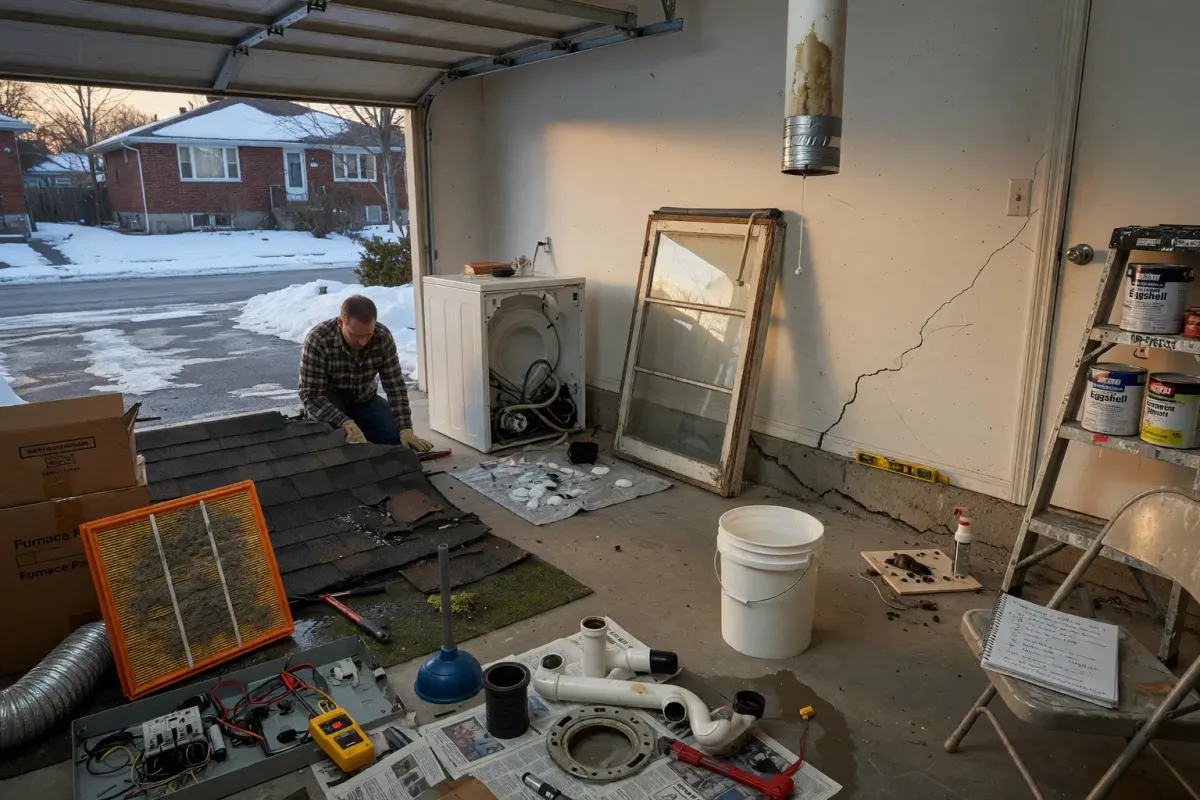
As a property owner, sometimes you need to roll up your sleeves and fix up your property. Even if you find the most well behaved and careful tenants, wear and tear is bound to happen. Since property maintenance is a normal part of life as an investor, having access to investor resources and tools means it is important you are ready for whatever may come your way. So, here is a list of ten common home repairs you should be prepared for.
However, before we get started, if you want to learn more about how you can draw out Equity from your investments to finance your home repair projects today, click the link below to book a free strategy call with our team today.
1. Water Leaks and Drips
If water is leaking from your pipes and faucets, you need to take care of it as soon as possible. Not only can water damage quickly lead to mold and mildew buildup, but a consistent drip from your plumbing can end up costing you hundreds of dollars each year on your water bill.
Leaks typically occur in one of two places: the supply line, or the drain. To determine where your leak is coming from, try running the water and check to see where the water comes from. Usually leaks occur when the pipes do not fit together properly, or the seal has worn down. So, once you have found the source, you can either make the repair yourself or learn what investors need to know about plumbing if you do not have the experience.
2. Weatherproofing
The weatherproofing on your property is like a safety barrier between your investment and harsh weather outside. If the weatherproofing begins to wear, you may find that water will find its way into the property, or the heating and cooling system will have to work harder to maintain a comfortable climate in the home.
Typically you will notice this when water appears under windows, or your ceiling begins to leak. In this case, you should hire a roofer or contractor to come by and make the necessary home repairs.
If water damage and worn-out seals are already eating into your returns, it might be time to look at your financing options — book a free strategy call with LendCity to see if refinancing can fund those overdue repairs.
Real estate investing is a team sport, and your mortgage strategy is the foundation — book a free strategy call with LendCity to make sure yours is solid.
The right financing product can change the math on this entirely — explore our real estate investing guide for the options most investors use.
3. Lack of Hot Water
If the hot water in your property is not running, there is usually a problem with your hot water heater. Sometimes, this can be caused by the heating element wearing down, while other times you may need to completely replace the heater. To properly figure out the source of the problem and complete the home repairs, it is recommended that you hire a plumber.
4. Broken Appliances
If your rental property comes with appliances such as a fridge, oven, or dishwasher, you may get a call from your tenants to report that they are broken. In this case you should immediately find a skilled technician to look to see what caused the problem and if they can be repaired. A practical rule of thumb: if the repair costs more than about half the price of a comparable new unit, replacement usually makes more sense. If they are not able to be restored back to working order, you will need to replace these as quickly as possible to minimize the inconvenience and discomfort it will cause for your tenant.
Beyond addressing individual repairs, consistent yearly upkeep safeguards a property’s value for future financing moves. Canadian investors who complete essential annual tasks like rent reviews insurance audits and inspections keep equity accessible and returns optimized.
Whether it is a broken fridge or a full appliance replacement, knowing how to tap your equity makes covering those costs much easier — book a free strategy call with us and we will walk you through it.
Refinancing at the wrong time or with the wrong lender can leave equity trapped — schedule a free strategy session with us to make sure your refinance actually moves you forward.
5. Heating and Cooling
Another urgent home repair you may need to respond to is a problem with the heating and cooling system. Depending on the time of year, a failure in your heating and cooling system can cause serious health concerns. If you are having problems with your heating and cooling system, you should call a professional straight away for the sake of your renter’s health and comfort. Annual HVAC service plans often catch failing components before they become after-hours emergencies.
6. Pest Problems
Pest control is easily one of the most annoying home repair tasks for a property owner to take care of because most of the time, the problem is the tenant’s fault. Regardless of which mess or open entryway allowed the pests into the home, it is still your job to deal with the home repairs and take care of the infestation.
If you find that your property has any bugs or rodents crawling around, you should hire a pest control professional to come and remove them. At the same time, make sure that any holes or cracks in the property are filled in and repaired so that you do not have to worry about the pests coming back. As well, if you have a pest issue, take the time to educate your tenant on how to prevent pests from entering the property. Sometimes, if the damages are proven to be the tenant’s fault, you may be able to make them pay for part or all the home repair expenses.
For a closer look at the same decision, 3 Home Staging Tips to Sell Your Property Fast breaks down how LendCity approaches it.
7. Electrical Concerns
Faulty wiring, blown breakers and frequent shortages are all electrical problems that can frustrate both your tenants and you. For the sake of safety and efficiency, you should always call a reliable electrician to handle these types of home repair scenarios. These trained eyes are also more likely to spot underlying issues and hidden problems.
8. Drywall Repairs
If your drywall has holes or cracks, whether it is from water damage, bathroom renovations that add value, or another source, you should have it patched and filled. Fortunately, drywall is easy to patch and can be done yourself quickly and cost effectively. This is one of those home repair tasks that is quite simple to do, but can go a long way to make your property look more valuable.
9. Smoke Detectors
For the safety of your tenants, you should always have fully functional smoke detectors in your properties. Understanding smart insurance strategies for real estate investors can also protect you from liability. If a detector begins chirping, that is often a sign it needs to be repaired, replaced or it requires new batteries. So, make sure that whenever your tenants tells you that their alarm has begun to chirp, you come by to replace the batteries or the entire detector.
10. Garbage Disposals
This home repair task is not as common as the others. While not all properties have a garbage disposal, it can still be valuable to know what to do in the event one breaks in case you ever get one. The leading cause of a broken disposal is improper use, so start by making sure your tenants know what can and cannot go into the disposal.
Usually, a broken disposal is caused by one of two things. Either it is stuck and simply needs to be unclogged and freed to spin again (many units have a reset button on the bottom and an Allen-wrench slot to free jammed blades), or the motor has burnt out and the entire disposal needs to be replaced by a professional.
Spotting Water Damage Before It Becomes a CapEx Crisis
Water problems are often present before a tenant reports a leak. During inspections or acquisitions, use more than a quick visual scan:
- Smell: Persistent musty or mildew odours, especially in basements and bathrooms, usually mean active moisture—not just old history.
- Sight: Ceiling stains, bubbling paint, peeling wallpaper, isolated fresh paint or new flooring that may be covering damage, and white mineral deposits (efflorescence) on masonry that prove water is moving through materials.
- Touch: Soft flooring, damp drywall, and cool damp baseboards near plumbing or windows.
- Plumbing checks: Look under sinks, behind toilets, and at supply connections for staining, mineral buildup, or corrosion. With all fixtures off, a moving water meter can reveal hidden leaks.
- Exterior drivers: Missing shingles, failed flashing, clogged gutters, poor grading, and failed window/door caulking often explain interior staining.
Minor surface fixes do not replace finding the source. Undiscovered water intrusion can turn into mold remediation, structural repairs, insurance friction, and lost rent—budget accordingly and bring in a qualified inspector when indicators stack up.
Building a Maintenance Reserve
Beyond the 1–4% of property value guideline many investors use, some landlords also plan roughly $1 per square foot per year and adjust for age, climate, and deferred work. Keep funds liquid so emergencies do not force high-interest borrowing or delayed habitability repairs.
Refinancing For Home Repair
Did you know that one of the easiest ways to finance your home repair projects is by using equity from the property itself? Fortunately for you, our team at LendCity can help you draw out that equity so you can get your home repair projects started. For single-family and small multi-unit rental properties, residential rental financing includes refinancing options that let you access built-up equity without selling. For larger renovation projects on fix-and-flip acquisitions, consider Fix & Flip Mortgage Financing.
If you would like to learn more about the world of real estate investing or are interested in securing financing for your next real estate investment, contact us at LendCity. Our team will gladly answer any questions you may have. To reach us you can call 226-783-1640 or you can visit us online at LendCity.ca
Alternatively, click the link below for a free strategy call with our team at LendCity.
Key Takeaways:
- Water Leaks and Drips
- Weatherproofing
- Lack of Hot Water
- Broken Appliances
- Heating and Cooling
Frequently Asked Questions
How often should I inspect my rental property for maintenance issues?
What home repairs am I legally required to make as a landlord?
Should I hire professionals or do home repairs myself?
How can I budget for unexpected home repairs on my rental property?
Can I charge tenants for repairs caused by their negligence?
How quickly do I need to respond to emergency repair requests?
What preventive maintenance can reduce my long-term repair costs?
Should I get a home warranty for my investment property?
How do I find reliable contractors for home repairs?
Can I deduct home repair costs on my rental property taxes?
What are early signs of water damage during a property inspection?
Weekly Investor Insight
Sunday financing notes for investors
Market updates, rate moves, and deal structures — once a week. Unsubscribe anytime.
By submitting, you agree to receive occasional emails from LendCity. You can unsubscribe at any time.
Disclaimer: LendCity Mortgages is a licensed mortgage brokerage. Content on this page is for educational purposes only and does not constitute legal, tax, investment, securities, or financial-planning advice. Rates, premiums, program terms, and regulations referenced are as of the page's last updated date and are subject to change. Any investment returns, rental yields, tax savings, or case-study figures shown are illustrative only — they are not guaranteed, not typical, and individual results will vary. Consult a licensed lawyer, Chartered Professional Accountant, or registered dealer before acting on any information above. Editorial standards.

Written by
Scott Dillingham
Published
December 22, 2025
· Updated August 16, 2026Reading time
11 min read
Equity
The difference between a property's current market value and the remaining mortgage balance. If your home is worth $500,000 and you owe $300,000, you have $200,000 in equity. Equity builds through mortgage payments, [appreciation](/glossary/appreciation/), and [forced appreciation](/glossary/forced-appreciation/). See also [LTV](/glossary/ltv/) and [Refinancing](/glossary/refinancing/).
Refinance
Replacing an existing mortgage with a new one, typically to access equity, get a better rate, or change terms. Investors commonly refinance to pull out capital for purchasing additional properties (cash-out refinance) while retaining ownership of the original property.
Property Management
The operation, control, and oversight of real estate by a third party. Property managers handle tenant screening, rent collection, maintenance, and day-to-day operations.
Cash Flow
The money left over after collecting rent and paying all expenses including mortgage, taxes, insurance, maintenance, and property management. Positive cash flow is the primary goal of buy-and-hold investors. See also [NOI](/glossary/noi/), [Cash-on-Cash Return](/glossary/cash-on-cash-return/), and [Vacancy Rate](/glossary/vacancy-rate/).
Lease Agreement
A legally binding contract between a landlord and tenant specifying rental terms including monthly rent, lease duration, responsibilities, rules, and termination conditions. Well-drafted lease agreements protect landlords' interests while complying with provincial residential tenancy legislation.
Turnover
The process and cost of preparing a rental unit for a new tenant after the previous tenant moves out, including cleaning, repairs, marketing, and vacancy time. High turnover rates significantly reduce profitability through lost rent and preparation expenses.
Contractor
A licensed professional hired to perform construction, renovation, or repair work on investment properties. Using licensed and insured contractors is essential for permitted work, as unlicensed contractors can result in voided insurance, property liens, and liability for injuries.
HVAC
Heating, Ventilation, and Air Conditioning systems that control temperature and air quality in buildings. HVAC is often one of the largest energy expenses in rental properties, and upgrading to high-efficiency systems can significantly reduce operating costs and increase NOI.
Reserve Fund
Money set aside by a condo corporation or property owner for future major repairs and capital expenditures like roof replacement, building envelope repairs, or mechanical system upgrades. A well-funded reserve indicates responsible financial management and reduces the risk of special assessments.
Cash Reserve
Liquid funds set aside by a property investor to cover unexpected expenses such as repairs, vacancy periods, or mortgage payments during tenant turnover. Lenders may require proof of cash reserves as part of mortgage qualification.
Plumbing
The system of pipes, drains, fixtures, and fittings in a building that distributes water and removes waste. Plumbing issues are among the most costly repairs in rental properties, and older galvanized or polybutylene pipes often need replacement during renovations.
Roof Replacement
A major capital expenditure involving the complete removal and installation of a new roofing system. Roof age and condition are critical factors in property inspections, insurance eligibility, and financing approvals, with typical costs ranging from $5,000 to $30,000+ depending on property size.
Hover over terms to see definitions. View the full glossary for all terms.