What would you do if you lost both parents, your job, your marriage, and your business all within 18 months? Most people would give up. Chris Ramotar didn’t.
Chris is a Windsor-based realtor who went from owing $126,000 in collections to buying his own home in just 10 months. His story shows what’s possible when you refuse to make excuses and take action despite your circumstances.
The Perfect Storm
Between December 2007 and May 2009, Chris’s life fell apart piece by piece.
First, his father passed away on the day he was supposed to move closer to family. Just 14 months later, his mother died from an infection she picked up on a trip to Guyana. Four months after that, Chris got laid off from his job. One month later, his marriage ended.
But wait, there’s more.
Chris and his ex-wife had been running a trucking company. A truck crashed. A driver quit. Clients stopped paying on time. Within three to four months, the business collapsed completely.
The damage? Over $126,000 in debt and collections. They had to sell their house, which had a $40,000 lien on it. After everything was settled, Chris walked away with just $10,000.
The Strategic Comeback
Here’s where most people would declare bankruptcy and start over in seven years. Chris took a different path.
He contacted every single creditor personally. He was brutally honest about his situation and made them an offer: “This is what I can afford. Either yes or no.”
It worked. Through settlements, he reduced that $126,000 debt to roughly $40,000-$50,000. Chris’s settlement results reflect his specific circumstances; creditor willingness to negotiate varies case by case. He got release letters for everything he negotiated.
Rebuilding Credit Fast
Chris knew he wanted to buy a home, which meant he needed to rebuild his credit quickly. His strategy was simple but required discipline:
- He took out a $5,000 car loan at 30% interest (yes, you read that right) — understanding the difference between A lenders and B lenders is critical when you’re rebuilding
- He got a Capital One credit card with a $500 limit
- He paid both on time, every single month, no exceptions. Learn more about how to build and improve your credit score fast and how your credit score affects your ability to buy a home
- He saved over $20,000 while working at the University of Windsor
- He had about $15,000 in retirement savings from his previous job at FedEx
The high interest rate on that car loan sounds crazy, but Chris understood something important: he needed to establish a payment history, and the loan amount was small enough to manage. It was a calculated sacrifice.
If you’re rebuilding your credit and wondering whether you could qualify for a mortgage with just 5% down like Chris did, book a free strategy call with LendCity and we’ll review your situation honestly.
Every successful investor started with one deal and the right team behind them — book a free strategy call with LendCity and let’s figure out what your first or next deal looks like.
When you’re ready to structure the mortgage side of this strategy, our real estate investing guide covers the programs that typically fit.
Buying a Home While Broke
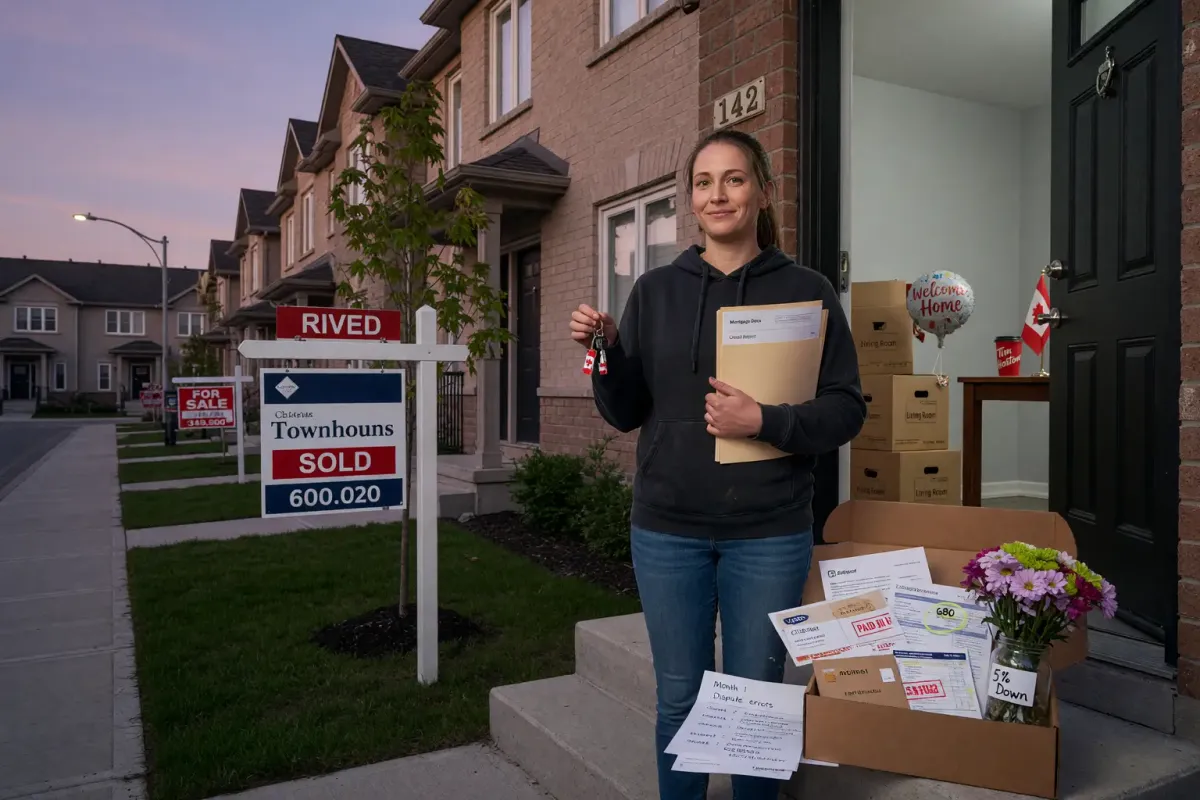
In 2010, just 10 months after being essentially bankrupt, Chris walked into a bank with his savings, his rebuilt credit history, and his Down Payment ready.
He got approved for a $197,000 mortgage with only 5% down through Canadian mortgage financing. The interest rate was around 4-5%, which was reasonable for the time. He bought a townhome in East Windsor. Chris’s approval terms reflected his specific credit rebuild timeline and income situation in 2010; mortgage qualification criteria vary by lender and market conditions.
As a single father on a single income with recent credit problems, this shouldn’t have been possible. But he made it work.
The Reality Nobody Talks About
Chris didn’t suddenly become rich after buying that house. He lived in the townhome with his two brothers, his two young daughters, and a nanny. Four adults and two kids in one townhome.
He lived paycheck to paycheck for a long time. But he made an important distinction: “If I am broke and I know where my money is going, that’s okay. Whereas if I am broke and I don’t know where my money is going, then something’s wrong.”
He was building equity instead of paying rent. That made the struggle worth it.
From Truck Driver to Realtor
Chris never planned to become a realtor. He actually wanted to be a police officer.
But in 2016, while at the gym, a friend mentioned he was going to sign up for real estate courses. Chris went home and signed up immediately. His friend never followed through, but Chris did.
That spontaneous decision changed everything.
A Different Approach to Real Estate
Chris doesn’t just list homes and hope they sell. He treats every client’s property like it’s his own and their money like it’s his own money.
For him, real estate isn’t about closing one transaction. It’s about starting a relationship. He tells clients: “I’m going to hold your hands from here till this transaction’s over and then when your family’s ready, I’m gonna still be here to hold your hands. This is just the starting of our relationship. You’re stuck with me. You can’t get rid of me.”
His goal is to eventually sell homes to his clients’ children and grandchildren.
For a deeper look at the financing angle behind this topic, see our guide to Real Estate Investor Resources & Education.
Whether you’re dealing with collections, settling debts, or just starting to rebuild, book a free strategy call with us and we’ll assess your current mortgage eligibility and options.
The investors who build real wealth don’t do it alone — schedule a free strategy session with us to get the same kind of financing guidance that helped them scale.
Marketing That Actually Works
Chris goes beyond the basics. Every listing gets:
- Professional photography
- Drone shots to show off the neighborhood
- Professional video production
- 3D virtual tours
- Targeted social media advertising
But here’s what makes his approach different: he doesn’t just sell the house. He sells the entire neighborhood and lifestyle.
Families with kids need to know about local schools. Young professionals want to know about the community vibe. Retirees care about different amenities. Chris creates specific campaigns for each property’s ideal buyer.
First-Time Buyers Are His Specialty
Chris found his niche working with first-time home buyers who feel overwhelmed by the process.
He starts by making sure they get fully underwritten for a mortgage. He wants to speak directly with their mortgage agent or banker and see a letter of commitment before moving forward.
Then he walks them through every single step. He recently told a client to give him her hand, and when she did, he said: “I’m gonna hold your hands from here till this transaction’s over.”
That’s his style. Personal. Direct. Committed.
After the Sale Matters Most
Chris doesn’t disappear after closing. He gives clients a complete list of service providers they might need as homeowners: plumbers, electricians, insurance providers, mechanics, and more.
Clients call him for recommendations on everything, even when it’s not about real estate. He checks in regularly just to ask how they and their families are doing.
Why? Because Chris remembers what it felt like when realtors disappeared on him after he bought properties. One realtor he worked with never contacted him again after closing. That stuck with him.
He built his business on doing the opposite.
Giving Back to the Community
Now that Chris is financially stable, he’s passionate about giving back.
For the past two years, he’s awarded a $500 bursary to a graduating student at his daughters’ high schools who’s heading to post-secondary education. He plans to continue this forever.
He also sponsors a local cricket team in Windsor. Cricket is huge in Guyanese culture, and Chris grew up with the sport. Now that he can afford to support it, he does, with no expectations of anything in return.
Key Lessons From Chris’s Story
Chris’s journey offers some powerful lessons for anyone facing financial hardship or thinking they can’t afford to buy property:
Negotiation Works
Creditors will often settle for less if you’re honest about your situation and propose a realistic payment plan. Chris reduced his debt by more than 60% through settlements — though settlement outcomes depend on each creditor and individual circumstances.
Credit Rebuilds Faster Than You Think
With the right approach, you can go from declined to approved in under a year. Chris proved it, and he’s not alone—read how a government worker built a real estate empire starting from a modest position, or how one investor built a $12M portfolio from scratch.
Stop Making Excuses
Chris’s advice is simple: “Don’t wait. Just do it and you’ll find a way of getting where you wanna be.”
He had every reason to give up. Instead, he got to work.
Know Where Your Money Goes
Being broke isn’t the problem. Being broke and not knowing where your money goes is the problem. Chris lived paycheck to paycheck for years, but every dollar had a purpose.
Support Systems Matter
Chris’s brothers let him live with them while he got back on his feet. That safety net allowed him to take the risk of buying a home while financially vulnerable.
The Bottom Line
Chris went from losing everything to owning property in 10 months. He went from bankruptcy-level debt to running a successful real estate business.
None of it was easy. All of it was worth it. For another inspiring comeback story, read about a burned-out professional who became a business owner, or learn about Scott Dillingham’s journey to building wealth.
If you’re struggling financially or think you can’t afford to buy property, Chris’s story proves that with the right strategy, determination, and support, you can turn things around faster than you think. Explore investor resources and tools to get started on your own path.
The question isn’t whether it’s possible. The question is whether you’re willing to do what it takes.
Key Takeaways:
- The Perfect Storm
- The Strategic Comeback
- Buying a Home While Broke
- From Truck Driver to Realtor
- Marketing That Actually Works
Frequently Asked Questions
Can you really rebuild credit in less than a year after major financial problems?
How much can you reduce debt through settlement negotiations?
Can you buy a home with only 5% down after having serious credit issues?
Should you buy a home if you're living paycheck to paycheck?
What's the best way to work with a realtor as a first-time buyer?
How important is mortgage pre-approval before house hunting?
What matters more when buying a home: the house or the neighborhood?
How quickly can you bounce back financially after losing everything?
Disclaimer: This case study is presented for educational purposes only. Some details may have been adjusted for clarity and readability. Individual investment outcomes vary — past results do not guarantee future performance. LendCity Mortgages provides mortgage financing services for real estate investors and does not offer investment, legal, or tax advice.
Free download
MLI Select document checklist
Appraisals, rent rolls, environmental reports, and the CMHC package lenders expect before they underwrite.
By submitting, you agree to receive occasional emails from LendCity. You can unsubscribe at any time.
4.8/5 (116 Google reviews)
Disclaimer: LendCity Mortgages is a licensed mortgage brokerage. Content on this page is for educational purposes only and does not constitute legal, tax, investment, securities, or financial-planning advice. Rates, premiums, program terms, and regulations referenced are as of the page's last updated date and are subject to change. Any investment returns, rental yields, tax savings, or case-study figures shown are illustrative only — they are not guaranteed, not typical, and individual results will vary. Consult a licensed lawyer, Chartered Professional Accountant, or registered dealer before acting on any information above. Editorial standards.

Written by
Scott Dillingham
Published
December 22, 2025
· Updated June 29, 2026Reading time
10 min read
CMHC Insurance
Mortgage default insurance from Canada Mortgage and Housing Corporation. For 1-4 unit investment properties, investors must put 20%+ down (no insurance available). However, CMHC offers MLI Select for 5+ unit multifamily properties, and house hackers can access insured mortgages with 5-10% down.
Down Payment
The upfront cash payment when purchasing a property. For 1-4 unit investment properties, minimum 20% down is required. 5+ unit multifamily can use CMHC MLI Select with lower down payments, and house hackers can put as little as 5% down on owner-occupied 2-4 plexes. Your down payment directly affects your [LTV](/glossary/ltv/) and the amount of [leverage](/glossary/leverage/) you use.
Equity
The difference between a property's current market value and the remaining mortgage balance. If your home is worth $500,000 and you owe $300,000, you have $200,000 in equity. Equity builds through mortgage payments, [appreciation](/glossary/appreciation/), and [forced appreciation](/glossary/forced-appreciation/). See also [LTV](/glossary/ltv/) and [Refinancing](/glossary/refinancing/).
Interest Rate
The cost of borrowing money, expressed as a percentage. It determines how much you pay on top of the principal borrowed. Interest rates directly affect monthly payments, [cash flow](/glossary/cash-flow/), and [DSCR](/glossary/dscr/). See also [Amortization](/glossary/amortization/).
Pre-Approval
A conditional commitment from a lender stating your borrowing capacity, valid for 90-120 days. For investors, getting pre-approved helps you move quickly on deals and shows sellers you're a serious buyer with financing in place.
Credit Score
A numerical rating (300-900 in Canada) that represents your creditworthiness, affecting mortgage rates and approval. 680+ is typically needed for best rates.
Bankruptcy
A legal process where an individual or business declares inability to repay debts. Bankruptcy severely impacts credit scores and mortgage qualification for years, though recovery and re-entry into real estate investing is possible with time and rebuilt credit.
Townhouse
A multi-story residential unit that shares one or more walls with adjacent units but has its own entrance. Townhouses offer a middle ground between condos and detached homes, often with lower purchase prices and condo-like fee structures.
Lien
A legal claim against a property used as security for a debt. Liens arise from unpaid mortgages, property taxes, contractor work, or court judgments. Undiscovered liens can eliminate an apparent purchase discount on distressed properties.
Real Estate Agent
A licensed professional who represents buyers or sellers in real estate transactions, providing market expertise, negotiation skills, and access to the MLS. Working with an investor-friendly agent who understands rental property analysis and financing strategies can significantly impact deal quality.
Hover over terms to see definitions. View the full glossary for all terms.