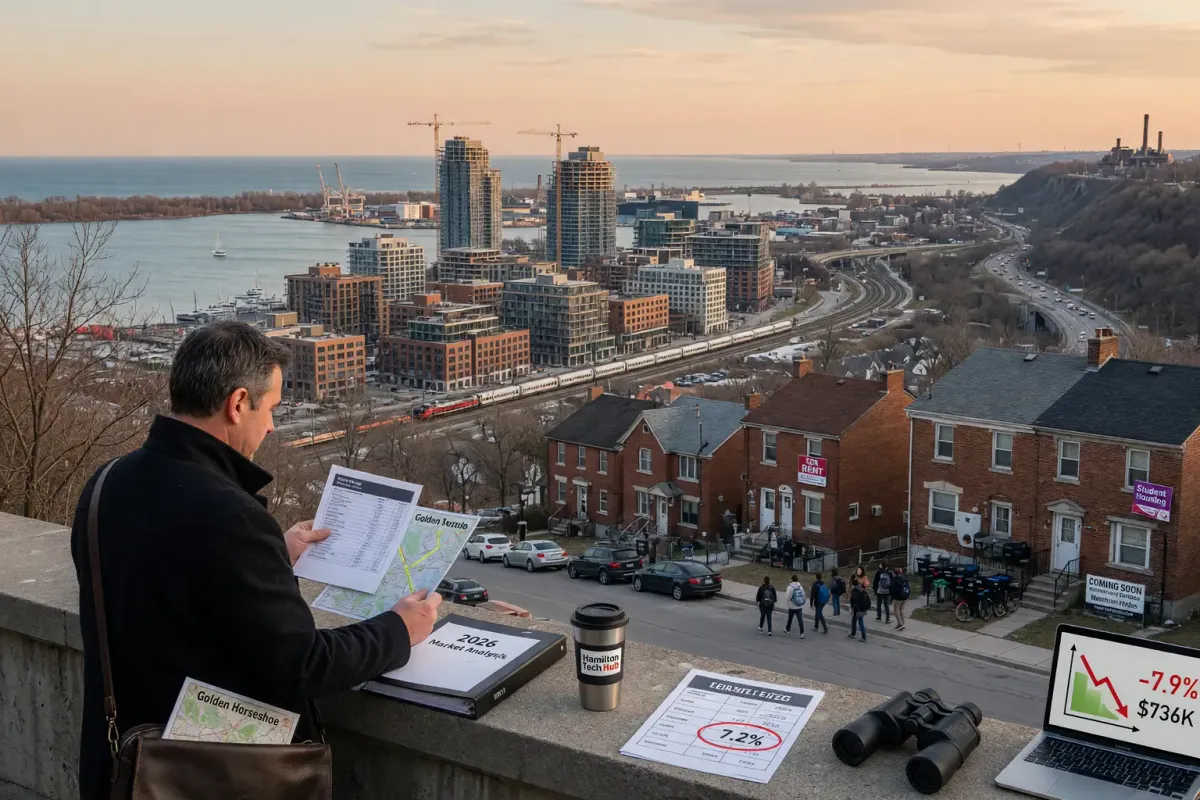
Hamilton stands as one of Canada’s most compelling real estate markets. Positioned at the geographic center of the Golden Horseshoe and experiencing transformation that creates exceptional opportunity, this waterfront city combines industrial heritage with emerging technology sectors in ways that forward-thinking investors can’t ignore.
With over 750,000 residents and growing, Hamilton offers investment accessibility that more expensive neighboring markets simply can’t match.
Let me show you why this market deserves your attention.
The Location Advantage
Few Canadian cities can match Hamilton’s geographic positioning.
Golden Horseshoe Centrality
Hamilton occupies the center of Canada’s Greater Golden Horseshoe—the industrialized region containing more than half of Ontario’s population and roughly 20% of all Canadians. One in three immigrants to Canada settles somewhere in this region.
That’s sustained population growth supporting housing demand and appreciation for the foreseeable future. Other Golden Horseshoe markets like Barrie offer equally compelling investment opportunities with GO Transit connectivity and tourism demand.
| Hamilton Advantage | What It Means |
|---|---|
| Golden Horseshoe center | Participation in regional growth |
| One hour from Toronto | Access to commuter tenants |
| US border proximity | Trade-related employment |
| Transportation hub | Distribution business demand |
Unlike Gateway Cities
Hamilton isn’t just a transit point—it’s a destination. Major employers maintain operations here rather than passing through. Workers live locally rather than commuting from elsewhere.
That creates stable employment supporting genuine housing demand.
The Economic Transformation
Hamilton’s economy has evolved dramatically from its industrial past into something diversified and modern.
Technology Sector Explosion
The past five years have brought tremendous technology growth. The city now hosts nearly 20,000 tech jobs—over 53% growth—the fastest rate among mid-sized Canadian cities.
Why? Technology companies are seeking alternatives to expensive Toronto office space while maintaining access to regional talent pools.
Research shows mid-sized markets like Hamilton gather momentum because they offer greater office space availability, operational cost savings, and untapped talent. Hamilton’s Toronto proximity supports continued growth as the sector expands beyond expensive urban cores.
Municipal Business Support
Hamilton provides numerous programs deferring costs for business expansion, renovation, and new construction. Major corporations including Amazon, IBM, and Nokia have invested here—signaling confidence in the market’s economic future.
As businesses establish operations, demand for both commercial space and worker housing continues expanding.
The difference between a good deal and a great one often comes down to how it’s financed — book a free strategy call with LendCity and let’s look at the numbers together.
When you’re ready to structure the mortgage side of this strategy, our real estate investing guide covers the programs that typically fit.
Population Dynamics
Consistent Growth
As Toronto housing costs climb, Hamilton has experienced steady population growth of approximately 3.1% annually. This reflects both domestic migration from expensive neighboring markets and immigration.
This consistency provides stability. You can plan with reasonable confidence that population trends will continue supporting demand.
For a deeper look at the financing angle behind this topic, see our guide to St. Catharines Property Investment: Opportunities and Strategies.
Diversity and Youth
A quarter of city residents were born in other countries, bringing entrepreneurial energy and international connections. Young people are leaving Toronto for lower rents and emerging nightlife, shifting demographics toward younger residents.
Young renters prioritize urban locations with lifestyle amenities—something Hamilton increasingly provides.
The Accessibility Factor
Comparative Affordability
The MLS® benchmark home price in Hamilton-Burlington was approximately $736,500 (Feb 2026, down 7.9% year-over-year), compared to Toronto’s average of roughly $1,018,000 (March 2026).
For a closer look at the same decision, Barrie Real Estate Investing: Golden Horseshoe Guide breaks down how LendCity approaches it.
That’s half the cost while accessing the same regional growth dynamics.
This extends portfolio purchasing power—you could acquire multiple Hamilton properties for capital that might purchase one Toronto property. Diversification benefits and cash flow often favor this distributed approach.
Better Cash Flow Math
Hamilton’s lower prices support better rent-to-price ratios. Investors prioritizing current income often find Hamilton properties outperform expensive alternatives on cash flow metrics.
Accessible Entry for New Investors
Lower capital requirements reduce barriers for newer investors building initial portfolios. You get genuine investment experience and exposure to growth dynamics without Toronto-level commitments.
Whether you’re buying your first rental or your tenth, having the right mortgage structure matters — schedule a free strategy session with us to build a plan that scales with you.
Investment Strategies
Residential Focus
Properties serving young professionals, families seeking Toronto alternatives, and immigrant populations all find ready tenant pools. Look for transit access, lifestyle amenities, and employment proximity.
As Hamilton’s desirability increases, properties in emerging neighborhoods offer appreciation potential alongside current cash flow.
Commercial Consideration
Growing business activity creates commercial opportunities. Industrial properties benefit from transportation connectivity. Retail and office serve expanding local activity.
The technology sector creates specific demand for modern office space suitable for tech operations.
Frequently Asked Questions
Why choose Hamilton over Toronto?
What tenant populations should I target?
Is the technology sector growth sustainable?
What areas offer the best potential?
Looking to capitalize on Hamilton’s Golden Horseshoe positioning? Book a free strategy call with LendCity and we’ll help you identify the right neighborhoods and financing approach for your Hamilton investment.
How do I start?
How does Hamilton's industrial past affect property investment today?
What role does immigration play in Hamilton's rental market?
Key Takeaways:
- The Location Advantage
- The Economic Transformation
- Population Dynamics
- The Accessibility Factor
- Investment Strategies
The Bottom Line
Hamilton offers what many Canadian investors seek: Golden Horseshoe exposure at accessible prices, economic transformation creating genuine opportunity, and population dynamics supporting long-term demand.
You’re not gambling on a speculative market. You’re investing in a city with clear fundamentals and demonstrated trajectory.
For investors priced out of the Toronto real estate market but wanting Ontario’s growth dynamics, Hamilton deserves serious consideration.
Free download
MLI Select document checklist
Appraisals, rent rolls, environmental reports, and the CMHC package lenders expect before they underwrite.
By submitting, you agree to receive occasional emails from LendCity. You can unsubscribe at any time.
4.8/5 (116 Google reviews)
Disclaimer: LendCity Mortgages is a licensed mortgage brokerage. Content on this page is for educational purposes only and does not constitute legal, tax, investment, securities, or financial-planning advice. Rates, premiums, program terms, and regulations referenced are as of the page's last updated date and are subject to change. Any investment returns, rental yields, tax savings, or case-study figures shown are illustrative only — they are not guaranteed, not typical, and individual results will vary. Consult a licensed lawyer, Chartered Professional Accountant, or registered dealer before acting on any information above. Editorial standards.

Written by
Scott Dillingham
Published
February 15, 2026
· Updated June 29, 2026Reading time
5 min read
Cash Flow
The money left over after collecting rent and paying all expenses including mortgage, taxes, insurance, maintenance, and property management. Positive cash flow is the primary goal of buy-and-hold investors. See also [NOI](/glossary/noi/), [Cash-on-Cash Return](/glossary/cash-on-cash-return/), and [Vacancy Rate](/glossary/vacancy-rate/).
Appreciation
The increase in a property's value over time, which builds [equity](/glossary/equity/) and wealth for the owner through market growth or [forced improvements](/glossary/forced-appreciation/).
Mixed-Use Property
A building that combines residential and commercial uses, such as retail on the ground floor with apartments above. Mixed-use properties can diversify income streams and may qualify for commercial financing terms.
Rent-to-Price Ratio
A metric comparing monthly rental income to a property's purchase price, expressed as a percentage. A higher ratio indicates stronger cash flow potential. Used to quickly screen properties and markets for investment viability.
Hover over terms to see definitions. View the full glossary for all terms.