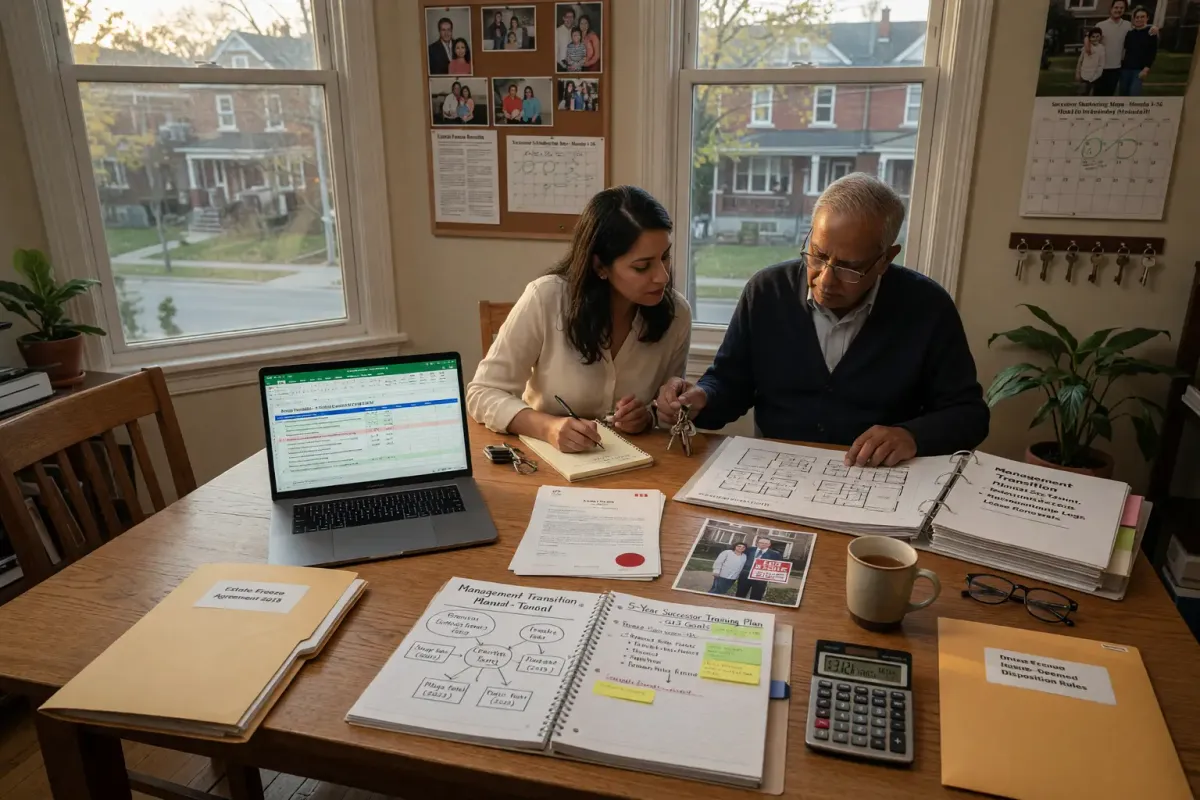
There is an old saying in wealth management: “The first generation builds it, the second generation enjoys it, and the third generation destroys it.”
In the world of real estate, this cycle is remarkably common but often avoidable. I recently spoke with a family where the father had spent 40 years acquiring commercial plazas and multi-family buildings. He was a master of his craft, but he had kept “all the keys in his pocket.”
He knew every tenant, every quirk of the boilers, and every banker in town by their first name. But when he fell ill, his children were paralyzed. They had inherited millions in equity, but zero operational wisdom. They didn’t know how to screen a tenant or how to analyze a refinance deal. Within two years, they were forced to sell off-market at a significant discount just to stop the bleeding of management errors.
Building wealth is a financial act. Leaving a legacy is an educational one.
This article serves as the handbook for Canadian families who want to ensure their real estate portfolio doesn’t just survive the transition, but thrives for generations.
The Three Pillars of the Legacy Transition
To successfully transfer a real estate business, you must address three distinct areas. If you only focus on the numbers, you will fail the people.
1. Equity: The Financial Backbone
This is the technical side of the transition. It involves the use of Family Trusts, Holding Companies, and Estate Freezes to move title and value without triggering massive CRA bills. For a thorough comparison of these ownership structures, see our guide on structuring your real estate holdings. It is also worth understanding how reverse mortgages affect inheritance for Canadian families, especially since the no-negative-equity guarantee means heirs never owe more than the home is worth. The goal here is to preserve the “corpus” of the wealth so that it isn’t eaten by deemed disposition taxes or probate fees.
2. Management: The Operational Wisdom
This is the “Step-Ladder” of responsibility. You cannot expect a child who has never seen a rent roll to suddenly manage a 50-door portfolio. Transitioning management requires a multi-year apprenticeship where the next generation moves from Observer to Participant to Primary Decision Maker.
3. Values: The Strategic Alignment
Why did you start investing? If your children think real estate is just an “ATM” for their lifestyle, they will liquidate the portfolio as soon as you’re gone. You must transfer the why—the commitment to quality housing, the pride of ownership, and the discipline of long-term growth.
The Management Transition: A 5-Year Roadmap
Transitioning the “job” of real estate is best done gradually. I recommend a “Leveled” approach over five years:
| Phase | Duration | Next Gen’s Role | Key Learning |
|---|---|---|---|
| Observer | Year 1 | Shadows site visits and broker meetings | Understanding the “players” |
| Task Lead | Year 2 | Manages one turnover or one small reno | Developing grit and problem solving |
| Operation Lead | Year 3-4 | Handles tenant relations for one property | Mastering the human element |
| Director | Year 5+ | Involved in acquisition and financing decisions | Thinking like a CEO |
During these phases, ensure they understand how to use PropTech tools like the best property management software for Canadian investors to maintain efficiency. The modern investor doesn’t have to be on-site, but they must be “in-tune.”
Building wealth starts with knowing your options — book a free strategy call with LendCity and find out what’s possible for your situation.
If this approach is on your radar, our real estate investing guide walks through how LendCity structures these deals.
Creating a “Family Investment Council”
As your portfolio scales, it is helpful to treat the family real estate holdings like a board of directors. A Family Investment Council is a formal meeting (held quarterly or semi-annually) where the family discusses the business.
What the Council Decides:
- Capital Allocation: Should we refinance Property A to buy Property B?
- Risk Tolerance: What is our maximum acceptable LTV across the portfolio?
- The Family Constitution: A written set of rules. For example: “No family member can become a Trustee until they have completed a Real Estate Investment course or worked outside the family business for 3 years.”
- Dispute Resolution: How do we handle it if one child wants out but the others want to stay in? Establishing a “Buy-Sell” agreement within the family corp is essential for long-term peace.
The Role of External Management (Yield vs. Work)
You must face a hard truth: Your children may not want to be landlords.
If they are interested in the wealth but not the work, your legacy plan must include transitioning to Professional Third-Party Management long before you retire. This turns the portfolio into an institutional-grade investment that generates “Yield” without requiring “Work.” Our guide on investing in real estate when you’re too busy covers how to build these systems.
This ensures that the legacy continues as a passive family fund rather than a job they eventually resent. Our investor resources page offers tools and guides that help families model the yield from a professionally managed portfolio.
The investors who succeed are the ones who take that first step — schedule a free strategy session with us and let’s map out your path forward.
The Legacy Toolbox: The “If I Disappear tomorrow” Folder
Every legacy investor should have a digital “Master Folder” that contains the following:
- The Power Team Directory: Names and personal cell numbers for your trusted mortgage broker, your tax lawyer, and your general contractor. See our guide on building a real estate team for who belongs on this list.
- The “Deal logic” Memo: A short note for each property explaining why you bought it, its current quirks, and your vision for its exit.
- Digital Access: Login credentials for all banking, property management software, and utility providers.
- The Values Letter: A personal letter to your children explaining the history of the business and your hopes for its future.
Building a Future for Your Family
We don't just find you the best rates; we help you structure your portfolio for long-term multi-generational success. Let's discuss your family's financing roadmap today.
Book A Strategy CallKey Takeaways:
- The Three Pillars of the Legacy Transition
- The Management Transition: A 5-Year Roadmap
- Creating a “Family Investment Council”
- The Role of External Management (Yield vs. Work)
- The Legacy Toolbox: The “If I Disappear tomorrow” Folder
Frequently Asked Questions
Should I give my children equity while I am still alive?
How do I handle children with different interest levels in real estate?
What is the "21-Year Rule" for Family Trusts?
Can a Family Trust own real estate in multiple provinces?
The Final Word
Your real estate legacy is not measured by your final door count. It is measured by the stability and wisdom of the people you leave behind. Explore our investor resources for planning tools and guides that help you document the knowledge your family will need to carry the portfolio forward. By being as intentional about the transfer of your business as you were about the building of it, you ensure that your work becomes a lasting blessing for your family.
Disclaimer: Real estate succession involve complex legal and tax frameworks. This guide is for informational purposes. Always consult with a qualified estate lawyer and tax specialist to build a plan tailored to your family.
Weekly Investor Insight
Sunday financing notes for investors
Market updates, rate moves, and deal structures — once a week. Unsubscribe anytime.
By submitting, you agree to receive occasional emails from LendCity. You can unsubscribe at any time.
Disclaimer: LendCity Mortgages is a licensed mortgage brokerage. Content on this page is for educational purposes only and does not constitute legal, tax, investment, securities, or financial-planning advice. Rates, premiums, program terms, and regulations referenced are as of the page's last updated date and are subject to change. Any investment returns, rental yields, tax savings, or case-study figures shown are illustrative only — they are not guaranteed, not typical, and individual results will vary. Consult a licensed lawyer, Chartered Professional Accountant, or registered dealer before acting on any information above. Editorial standards.

Written by
Scott Dillingham
Published
February 16, 2026
· Updated June 29, 2026Reading time
7 min read
ADU
Accessory Dwelling Unit - a secondary residential unit on a single-family property, such as a basement suite, laneway house, garden suite, or in-law suite. ADUs increase rental income and property value while leveraging existing land and infrastructure.
Contractor
A licensed professional hired to perform construction, renovation, or repair work on investment properties. Using licensed and insured contractors is essential for permitted work, as unlicensed contractors can result in voided insurance, property liens, and liability for injuries.
Deemed Disposition
A tax event recognized by CRA where property is treated as if sold at fair market value even though no actual sale occurred. Triggered by death, emigration from Canada, or conversion of property use, creating a capital gains tax liability.
Equity
The difference between a property's current market value and the remaining mortgage balance. If your home is worth $500,000 and you owe $300,000, you have $200,000 in equity. Equity builds through mortgage payments, [appreciation](/glossary/appreciation/), and [forced appreciation](/glossary/forced-appreciation/). See also [LTV](/glossary/ltv/) and [Refinancing](/glossary/refinancing/).
Estate Freeze
A tax planning strategy that locks in the current value of assets for the original owner while transferring future growth to the next generation, minimizing capital gains tax triggered at death.
Estate Planning
The process of anticipating and arranging for the management and disposal of a person's estate during their life and after death, with the goal of minimizing taxes and ensuring a smooth transition for heirs.
Family Trust
A legal entity that holds assets on behalf of family members. Family trusts are sometimes used for estate planning and certain tax-deferred transfers (for example, qualifying spousal or alter-ego trusts) — but transfers to a trust generally occur at fair market value and trigger a disposition, and trusts face their own rules including a 21-year deemed disposition. Income-splitting is also restricted by the Tax on Split Income (TOSI) rules. Most lenders are reluctant to finance properties held in family trusts. Trust planning has significant legal and tax consequences — retain a trusts/estate lawyer and a CPA before setting one up.
Holding Company
A corporation created to own shares of other corporations or hold assets like investment properties. In real estate, a holding company sits above property-specific corporations, providing liability isolation and tax planning flexibility.
IRD
Interest Rate Differential - a mortgage penalty calculation based on the difference between your rate and current rates for the remaining term.
Land Transfer Tax
A provincial tax paid when purchasing property, calculated as a percentage of the purchase price. Some cities like Toronto add additional municipal tax.
Hover over terms to see definitions. View the full glossary for all terms.