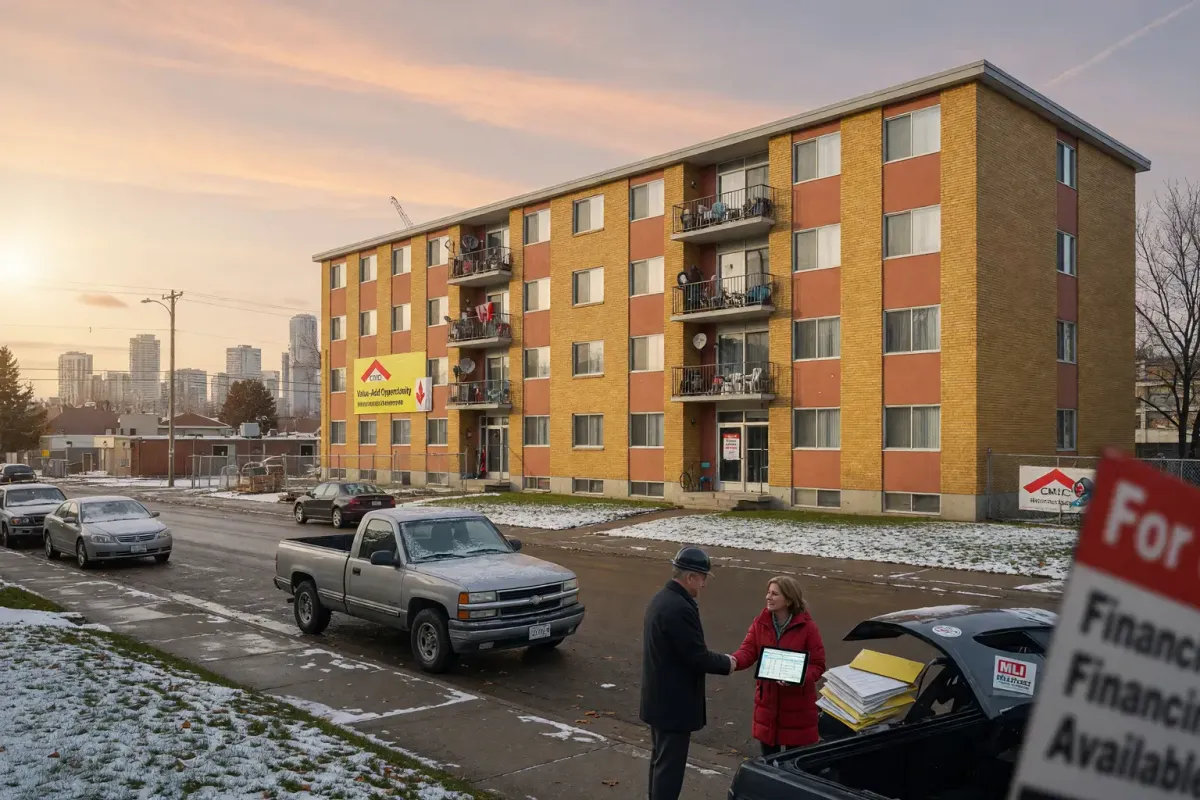
Alberta has quietly become Canada’s most attractive market for multifamily investors. While British Columbia and Ontario dominate headlines, Edmonton and Calgary are delivering stronger cap rates, faster population growth, no provincial rent control, and financing opportunities that are simply unavailable in coastal provinces.
If you’re considering apartment buildings as your next investment, Alberta offers a rare combination: market fundamentals that rival any Canadian market, coupled with government-backed financing programs (CMHC MLI Select) that make 95% leverage possible for qualifying projects. This guide shows you why Alberta works, what current market conditions look like, and exactly how to finance your first or next deal.
Why Alberta Is Canada’s Multifamily Sweet Spot
Alberta’s multifamily market has several unique competitive advantages that make it distinctly attractive compared to other Canadian provinces.
Population Growth Driving Rental Demand
Alberta is experiencing one of Canada’s fastest population growth rates. Edmonton is projected to grow from approximately 1.5 million (metro) today to over 2 million by 2035. Calgary’s metro area, currently around 1.6 million, is expected to reach nearly 2 million over the same timeframe. These growth rates outpace most Canadian markets and translate directly into rental demand.
Growing populations mean:
- Increased demand for rental housing as new residents need places to live
- Limited supply because developers have historically underbuilt apartments relative to population growth
- Expanding tenant pools reducing vacancy risk
- Sustainable rental rate growth as demand outpaces supply
No Provincial Rent Control
This single factor fundamentally changes Alberta’s multifamily economics compared to BC, Ontario, and other provinces with rent control legislation.
In BC, Ontario, and some Atlantic provinces, once you sign a tenant, your annual rent increases are capped (typically 2-3% regardless of inflation or market conditions). This constraint limits your ability to grow rental income, reducing your property’s value and cash flow over time.
Alberta has no rent control. You can adjust rents to market rate when units turn over. If inflation rises or market rents increase 5-7% annually, your rental income can increase at that rate—not a government-mandated 2-3%.
This freedom dramatically impacts long-term returns:
- Year 1–5: Modest rent growth due to abundant supply
- Year 5–10: Accelerating rent growth as supply tightens and demand accelerates
- Year 10+: Significant rent expansion as population growth compounds
A $200,000 annual net operating income (NOI) can grow to $280,000–$300,000 over 10 years in Alberta without regulatory constraints. The same building in Ontario faces artificial rent caps limiting NOI growth.
Affordability Relative to Vancouver and Toronto
Alberta multifamily properties cost substantially less to acquire than equivalent properties in BC or Ontario. This cost advantage has two effects:
Lower Capital Requirements - You need less equity to finance a deal. A $4M apartment building in Edmonton requires less capital than a $3M building in Vancouver.
Better Cap Rates - Alberta rents are lower than Vancouver or Toronto, but property prices are even lower. This creates better capitalization rates (NOI/Purchase Price). Where Vancouver might trade at 3-4% caps, Edmonton trades at 5-7% caps.
Higher caps mean better cash flow today while you wait for long-term appreciation.
Development-Friendly Provincial Environment
Alberta’s government actively encourages residential development through:
- Streamlined zoning making residential rezoning faster and more predictable
- Reduced red tape compared to BC municipalities
- Supportive lending relationships with major banks and CMHC
- Tax incentives for certain housing development
These factors accelerate project timelines and reduce development friction compared to more restrictive jurisdictions.
Edmonton: The MLI Select Capital
Edmonton represents the optimal market for CMHC MLI Select financing. The city’s rental market dynamics make it uniquely suited for government-backed programs designed to support affordable rental housing.
Why CMHC Affordability Thresholds Align with Market Reality
Here’s where Edmonton becomes special for MLI Select projects: CMHC’s “affordable rent” thresholds are at or near current market rent for 1- and 2-bedroom units.
CMHC publishes annual “Median Market Rent” (MMR) thresholds for every Canadian city. Developers earn affordability points by renting units at or below 80% of the local MMR. This “affordability” commitment must be maintained for a 10- or 20-year period.
Edmonton’s advantage:
The local MMR for 1-bedroom apartments is approximately $2,080/month (2025-2026). The 80% affordability threshold is roughly $1,665/month. Today’s market rent for a standard 1-bedroom in Edmonton is $1,650–$1,750/month.
This means: A developer can commit units to “affordable” rents at $1,665/month—which is exactly what market conditions support anyway. You earn affordability points for something you’d do naturally without the program.
Contrast this with higher-cost cities:
- Vancouver: MMR ~$2,400/month; 80% threshold ~$1,920; current market ~$2,200–$2,500 (commitment requires taking below-market rents)
- Toronto: MMR ~$2,150/month; 80% threshold ~$1,720; current market ~$2,000–$2,300 (modest undermarket)
In Edmonton, you get free affordability points because market rent already fits within program thresholds. This dramatically improves your ability to reach the 100+ points required for maximum MLI Select benefits (95% financing, 50-year amortization).
Strong Capital Rates and Cash Flow
Current Edmonton market fundamentals (2025-2026):
| Metric | Edmonton | Calgary | Vancouver |
|---|---|---|---|
| Average 1-BR Rent | $1,480 | $1,531 | $2,400 |
| Average 2-BR Rent | $1,900 | $1,844 | $3,355 |
| Typical Cap Rate | 5.5%–7% | 4.5%–6% | 3%–4% |
| Vacancy Rate | ~3.8% | ~3.3% | ~3.7% |
| Population Growth (5-yr avg) | 2.1% | 2.3% | 1.2% |
Edmonton’s 5.5–7% cap rates provide strong current cash flow. A $5M property generating $300,000 annual NOI yields $300,000/$5,000,000 = 6% cap rate. With 95% CMHC MLI Select financing ($4.75M), your cash-on-cash return on the remaining $250K equity is excellent from day one.
Diversifying Economy Beyond Oil and Gas
Historically, Edmonton’s economy was heavily dependent on oil and gas—a perception that created tenant and lender hesitation. That’s changing rapidly.
Edmonton is actively diversifying into:
- Technology and software (major engineering software companies headquartered here)
- Healthcare and medical research (University of Alberta medical programs, clinical research)
- Advanced manufacturing and food processing
- Finance and corporate services (regional headquarters for major Canadian firms)
Employment diversification reduces the risk that an oil price crash will trigger mass layoffs and rental demand collapse. The 2015–2016 oil downturn did impact Edmonton, but the impact was less severe than commonly assumed—and the economy has since recovered and diversified.
For multifamily investors, this diversification supports long-term tenant stability and wage growth.
Choosing the wrong lender or term can quietly erode your returns — book a free strategy call with LendCity and we’ll walk you through the numbers.
For a deeper look at the financing angle behind this topic, see our multi-family mortgage financing guide.
Calgary: Growth Engine for Apartment Investors
Calgary’s multifamily story is slightly different from Edmonton’s. While Edmonton offers lower entry costs, Calgary offers stronger growth dynamics and tech sector momentum.
Population Boom and Tech Sector Acceleration
Calgary is growing faster than Edmonton (2.3% vs. 2.1% annually) due to:
Tech Industry Migration - Thousands of tech workers have migrated from expensive Vancouver and Toronto to Calgary over the past 5 years. Major companies like Benevity, Symend, and Helcim have scaled operations here. Average tech salaries in Calgary are now $95,000–$130,000 annually—comparable to Canadian averages but with 40% lower living costs than Vancouver.
Entrepreneurship and VC Activity - Calgary has become a hotbed for startup activity. The city’s tech ecosystem, supported by venture capital flowing in from Toronto and BC, has generated dozens of successful exits and scaling companies.
Young Demographics - Calgary has a younger population profile than many Canadian cities, supporting higher rental demand for 1-bedroom and small 2-bedroom units that early-career workers prefer.
Higher Rents with Strong Fundamentals
Calgary’s rents are 10–15% higher than Edmonton across most unit types:
- 1-bedroom: $1,531/month average (vs. Edmonton’s $1,480; both softened in 2025-26)
- 2-bedroom: $1,844/month average (vs. Edmonton’s ~$1,900)
- 3-bedroom: $2,600–$2,900/month average
These higher rents support stronger cash flow on multifamily investments. A 20-unit building yielding $310,000 annual NOI has a 6.2% cap rate—better than Edmonton’s conservative 5.5% baseline for comparable buildings.
Higher rents also mean CLI Select affordability commitments (80% of MMR ~$1,520 for 1-bedrooms in Calgary) represent a slightly larger discount to market. This requires developers to take more modest affordability commitments to maximize cash flow—but it’s still economically viable.
Condo Market Softness Driving Apartment Investment
Calgary’s condo market has struggled over the past 5 years (oversupply, investor caution, slower appreciation). This has shifted capital and developer focus toward purpose-built apartment buildings.
Developers with capital are choosing apartments over condos because:
- Operating income is more reliable than land appreciation or condo sales volume
- Institutional capital flows into rentals (real estate pension funds, institutional investors)
- Regulatory tailwinds with government programs favoring rentals
This supply-side shift benefits apartment investors and should support long-term rent growth as supply remains constrained while demand (from population growth) accelerates.
Alberta’s Unique Advantage for MLI Select
If you’re specifically evaluating MLI Select financing for a multifamily project, Alberta’s combination of no rent control, favorable affordability thresholds, and strong fundamentals makes it the optimal Canadian market for the program.
No Rent Control = No Program Constraint Risk
MLI Select requires affordability commitments for 10 or 20 years. After that, your rents are free to grow with market.
If you’re in British Columbia or Ontario with provincial rent control, your post-commitment rent growth is still restricted by government. This reduces the long-term value of the affordable commitment period and creates regulatory risk (governments could expand rent control scope).
In Alberta, after your affordability commitment expires (year 10 or 20), you have full pricing freedom. Rents can grow at market rates indefinitely.
Affordability Thresholds = Free Points
As discussed above, Edmonton’s CMHC affordability threshold aligns with market reality. You earn substantial affordability points by simply building at market rates.
Higher-cost markets (Vancouver, Toronto) require taking below-market rents to earn comparable points. This reduces the financial viability of the affordability commitment and makes projects less fundable.
In Alberta, the alignment is near-perfect. This dramatically improves qualification odds and makes 100+ points achievable without sacrificing cash flow.
New Construction Pipeline
Alberta (particularly Edmonton and Calgary) has a significant pipeline of new multifamily development. This creates:
Supply of Deals - Multiple opportunities mean you’re not competing for one golden project. Developers actively offering MLI Select opportunities gives you selection.
Institutional Validation - When multiple institutional investors are active in a market, it confirms the fundamentals are attractive. Institutional capital doesn’t chase speculative or marginal opportunities.
Financing Competition - More deals means more lenders competing for business, resulting in better terms and faster closings.
Your debt ratios, income type, and property plans all affect what you qualify for — schedule a free strategy session with us so we can map out a strategy that works for your goals.
Financing Options for Alberta Multifamily
Alberta multifamily deals can be financed through several pathways. Understanding your options helps you choose the most capital-efficient structure.
CMHC MLI Select: Maximum Leverage for Qualifying Projects
Program: Government-backed financing up to 95% loan-to-cost with 50-year amortization
Best for: New construction or major value-add projects where you can accumulate 100+ points through affordability, energy efficiency, and accessibility features
Current Terms (April 2026):
- Loan-to-cost: Up to 95% (only 5% equity required)
- Amortization: Up to 50 years
- Recourse: Limited (capped personal liability)
- Rates: ~4.25–5.00% (varies by lender; risk-based pricing under July 14, 2025 framework with 0.25% surcharge per 5-yr amortization above 25 yrs and 10–30% premium discounts for social outcomes)
- Timeline: 4–6 months for approval and closing
Equity Required (100+ points projects):
- 8-unit project @ $2.2M: ~$110K (5% of cost)
- 20-unit project @ $9.1M: ~$455K (5% of cost)
The extraordinary leverage transforms returns. With 95% financing, your 5% down payment controls a much larger asset, magnifying cash-on-cash returns.
Point categories:
- Affordability: Commit percentage of units to below-MMR rents for 10–20 years
- Energy Efficiency: Build to 15–20% above National Energy Code baseline
- Accessibility: Include barrier-free and adaptable units per CMHC standards
Read our comprehensive guide to CMHC MLI Select for detailed points mechanics and qualification steps. For a deeper dive into how the scoring works, check out our MLI Select points system guide. You can also use the CMHC MLI Max Loan Calculator to model financing scenarios and estimate your maximum loan amount.
CMHC MLI Standard: Simpler Qualification, Lower Leverage
Program: Government-backed financing up to 85% LTV with 40-year amortization (no points required)
Best for: Acquiring existing, stabilized multifamily properties or projects that don’t easily reach 100 MLI Select points
Current Terms (April 2026):
- Loan-to-value: Up to 85%
- Amortization: Up to 40 years
- Recourse: Full recourse
- Rates: ~4.50–5.25%
- Timeline: 4–6 weeks for approval
Capital Efficiency: For a $4M acquisition, 85% LTV requires $600K equity. Less leverage than MLI Select, but simpler underwriting and faster closing.
For a closer look at the same decision, Multifamily Investment BC: Vancouver & Victoria 2026 breaks down how LendCity approaches it.
MLI Standard is ideal for stabilized acquisitions where energy retrofits or accessibility improvements aren’t part of your strategy.
Conventional Bank Financing: Speed and Flexibility
Program: Traditional commercial lending from CIBC, RBC, TD, BMO, National Bank, etc.
Best for: Borrowers with strong credit, established track record, or projects that don’t fit government program criteria
Current Terms (April 2026):
- Loan-to-value: 75–80% typically
- Amortization: Up to 25 years (some extend to 35 years)
- Rates: ~5.00–6.50% (credit unions: 4.95–6.25%)
- Timeline: 2–4 weeks for approval
- Recourse: Full recourse (personal guarantee typical)
Advantages: Faster approval, more flexible structure, direct relationship with lender
Disadvantages: Lower leverage (75–80% vs. 95%), shorter amortizations, higher rates, higher personal liability
Conventional financing makes sense for:
- Experienced operators with strong track records
- Acquisitions where bank appraisal supports valuation
- Borrowers uncomfortable with government program complexity
Private and Alternative Lending
Program: Non-bank lenders (private equity, lending trusts, alternative mortgage providers)
Best for: Builders needing interim bridge financing, projects between closing and CMHC takeout, or borrowers with credit/documentation challenges
Current Terms (April 2026):
- Loan-to-value: 60–75%
- Rates: 7–12% bridge / 6.50–8.50% B-lender commercial (higher cost for speed/flexibility)
- Timeline: 1–2 weeks for approval
- Recourse: Usually full
Typical Use Case: A developer closes an acquisition using private financing ($2.5M property, 60% LTV = $1.5M), then refinances to CMHC MLI Select permanent financing after achieving required points and occupancy targets.
Comparison Table: Financing Options for Alberta Multifamily
| Feature | MLI Select | MLI Standard | Conventional | Private |
|---|---|---|---|---|
| Max LTV/LTC | 95% | 85% | 75–80% | 60–75% |
| Amortization | 50 years | 40 years | 25–35 years | 2–5 years |
| Rates (Apr 2026) | 4.25–5.00% | 4.50–5.25% | 5.00–6.50% | 7–12% |
| Points Required | 100+ | None | None | None |
| Approval Timeline | 4–6 months | 4–6 weeks | 2–4 weeks | 1–2 weeks |
| Recourse | Limited | Full | Full | Full |
| Best For | New construction, value-add | Existing acquisitions | Experienced operators | Bridge financing |
| Equity Required (example) | 5% (~$110K on $2.2M) | 15% (~$330K) | 20–25% | 25–40% |
For a new construction or major renovation in Edmonton or Calgary, CMHC MLI Select almost always delivers the best economics if your project qualifies. The 95% financing, 50-year amortization, and limited recourse are unmatched by other lenders.
Current Market Conditions in Edmonton and Calgary
Understanding current market fundamentals helps you evaluate deal viability and returns.
Rent Ranges and Growth Trends
Edmonton (2025–2026):
- 1-bedroom: $1,237–$1,480/month (furnished avg: $1,480; unfurnished avg: $1,237)
- 2-bedroom: $1,800–$2,050/month
- 3-bedroom: $2,300–$2,600/month
- Rent growth (YoY): ~2–4% (market has cooled; soft demand for 1BR in particular)
Calgary (2025–2026):
- 1-bedroom: $1,531/month average (down 3.3% YoY)
- 2-bedroom: $1,844/month average (down 3.9% YoY)
- 3-bedroom: $2,600–$2,900/month
- Rent growth (YoY): ~-3 to -4% (as record supply absorbed; expected to stabilize)
Rent growth in both cities is outpacing inflation, driven by population inflows and constrained new supply completion.
Capitalization Rates
Purpose-built rental apartment buildings in Alberta are trading at:
Edmonton:
- Strong performing buildings: 5.5–6.5% cap rate
- Class A (newer, well-managed): 5.0–5.8%
- Class B (mid-age, stable): 5.8–6.8%
Calgary:
- Strong performing buildings: 4.5–5.8% cap rate
- Class A: 4.2–5.0%
- Class B: 5.0–6.2%
These cap rates reflect:
- Strong rental fundamentals and growth
- Stable management and established cash flows
- Institutional investor demand driving prices upward
- Population growth reducing risk profile
Vacancy Rates
Current vacancy rates provide important context for rent growth assumptions:
Edmonton: approximately 3.8% overall vacancy (CMHC October 2025 Rental Market Report). Edmonton benchmark home price was $426,000 in March 2026 (-2.9% YoY).
- Purpose-built rental: ~3.8%
- Rental condos: ~1.7% (strong demand for newer units)
Calgary: approximately 3.3% overall vacancy (CMHC October 2025; up from 2.2% national average in 2024 — national vacancy now 3.1%). Calgary benchmark home price was $565,600 in March 2026 (-4.2% YoY); average sale price ~$641,844.
- Record rental supply completions drove vacancy higher through 2025
- Calgary and Edmonton had the highest purpose-built vacancy among major Canadian markets in 2025
Rising vacancy has shifted some pricing power to tenants, particularly for new leases. Both cities remain below historical oversupply thresholds and are expected to stabilize as the construction pipeline slows after 2026.
Construction Activity and Supply Pipeline
Edmonton:
- ~1,200–1,500 new apartment units under construction (2025–2026)
- Expected completion rate: 1,200–1,400 units/year
- Net absorption (demand minus new supply): ~300–400 units/year
- Implication: Supply constrained relative to demand; rents will continue growing
Calgary:
- Record rental construction starts in 2025 — highest among Canadian cities
- Purpose-built rental starts grew ~18% year-over-year in 2025
- Vacancy moderated to ~3.3% by October 2025 as the market absorbed new supply
- Implication: Short-term lease-up competition easing; longer-term market expected to tighten once the construction pipeline recedes after 2026
Both cities saw strong construction activity in 2025. Supply should moderate by 2027, at which point tighter vacancy is expected to resume as population growth continues to drive demand.
How to Get Started in Alberta Multifamily
If you’re considering your first or next multifamily deal in Alberta, here’s the practical roadmap.
Step 1: Find the Right Broker
Not all mortgage brokers understand CMHC MLI Select or multifamily commercial financing. Your broker selection directly impacts your deal’s success.
What to look for:
- Demonstrated experience with MLI Select projects (ask for references)
- Relationships with CMHC-approved lenders
- Understanding of Alberta’s market and municipal requirements
- Ability to discuss points calculation and strategy
Questions to ask:
- “Have you closed MLI Select projects in the past 12 months?”
- “How many multifamily deals have you financed in Edmonton or Calgary?”
- “Can you walk me through the points system and how my project might qualify?”
- “What are your typical approval timelines for MLI Select?”
Your broker is your partner through the entire process. Picking the right one accelerates timelines and improves your odds of approval.
Step 2: Analyze Deals with DSCR in Mind
DSCR (Debt Service Coverage Ratio) is the key underwriting metric for multifamily financing. Lenders want to see your property’s net operating income covers your mortgage payment with a safety margin.
DSCR = Annual NOI / Annual Debt Service
Lenders typically require:
- MLI Select: 1.10x DSCR minimum (updated July 2025)
- MLI Standard: 1.30x DSCR minimum
- Conventional: 1.25–1.35x DSCR (tighter requirement)
Example: A 20-unit building generating $300,000 annual NOI with a $220,000 annual mortgage payment has a DSCR of 1.36x. Most lenders would fund this comfortably.
Read our guide on DSCR requirements for multifamily properties for deeper analysis and calculation walkthroughs. You can also explore multifamily mortgage financing options for a comprehensive overview of all programs available.
When evaluating a potential acquisition, run the DSCR calculation:
- Determine market rents for each unit type
- Calculate gross rental income (units × rent × 12 months)
- Deduct vacancy (3–4% for Edmonton; 3–5% for Calgary)
- Deduct operating expenses (typically 35–45% of gross rents)
- Calculate NOI = Gross Rental Income − Vacancy Loss − Operating Expenses
- Divide NOI by your projected annual debt service (mortgage payment)
If DSCR exceeds 1.20x, the deal is fundable under most programs. For MLI Select (minimum 1.10x DSCR), deals above 1.10x may still qualify. For MLI Standard and conventional lenders (minimum 1.25–1.30x), aim for at least 1.25x. If DSCR is below 1.10x, you’ll need to negotiate a lower purchase price or restructure the deal.
Step 3: Understand Municipal Zoning and Development Requirements
Alberta’s zoning framework is more developer-friendly than BC or Ontario, but municipal requirements still matter.
Before committing capital:
- Confirm zoning permits multifamily residential development (usually “Urban Residential” or “Commercial Mixed-Use”)
- Verify parking requirements (typically 1.0–1.5 spaces per unit)
- Check height and density restrictions
- Confirm infrastructure capacity (water, sewer, roads)
- Identify municipal incentives (tax abatement, expedited permitting)
Edmonton and Calgary both have official community plans encouraging residential intensification, which favors apartment development. This is a tailwind compared to suburban municipalities that restrict density.
Step 4: Build Your Team
Successful multifamily projects require specialists:
Core Team:
- Mortgage broker: CMHC MLI Select experience (as discussed above)
- Property manager: Experience with 10+ unit buildings in Edmonton/Calgary
- Accountant: Real estate investor experience, tax structure optimization
- Lawyer: Real estate transactions, corporate structure
- Insurance broker: Commercial liability, property insurance for apartment buildings
For New Construction/Development:
- Architect: Multi-unit residential design
- General contractor: Apartment construction experience
- Structural/mechanical engineer: Building systems design
- Energy consultant: NECB compliance and EnerGuide ratings (for MLI Select)
Experienced operators often already have these relationships. If you’re new to multifamily, your broker can recommend professionals they’ve worked with successfully.
Step 5: Book a Strategy Call
Before moving forward, it’s worth having a conversation with someone experienced in Alberta multifamily deals. A good broker or advisor can help you:
- Evaluate whether MLI Select or conventional financing makes sense for your situation
- Discuss realistic equity and liquidity requirements
- Walk through returns and DSCR assumptions
- Identify municipal and regulatory considerations
- Clarify next steps and timelines
FAQ
Why are Edmonton and Calgary better for multifamily investing than Toronto or Vancouver?
What's the difference between MLI Select and MLI Standard for Alberta deals?
How much money do I need to invest in an Alberta multifamily deal?
Are Edmonton rents high enough to support good cash flow?
Can I use MLI Select for an existing apartment building purchase?
How long does the financing process take for Alberta multifamily deals?
Key Takeaways:
- Why Alberta Is Canada’s Multifamily Sweet Spot
- Edmonton: The MLI Select Capital
- Calgary: Growth Engine for Apartment Investors
- Alberta’s Unique Advantage for MLI Select
- Financing Options for Alberta Multifamily
Conclusion
Alberta’s multifamily market—particularly Edmonton and Calgary—offers Canadian investors a rare combination: strong fundamentals (population growth, rental demand, constrained supply), favorable financing programs (CMHC MLI Select with 95% leverage), and no provincial rent control limiting long-term returns.
For investors seeking multifamily exposure, Alberta delivers better cap rates, stronger rent growth potential, and simpler program mechanics than BC or Ontario. The lack of rent control means your rent growth stays tied to market conditions rather than government mandates. CMHC’s affordability thresholds align with actual market rents, making it easy to qualify for maximum financing benefits.
Whether you’re financing your first apartment building or scaling a portfolio, understanding Alberta’s market fundamentals and financing options gives you the clarity to evaluate deals confidently. The right broker, a focused deal analysis, and a strong team transform Alberta multifamily from opportunity into actual returns.
Ready to explore your first or next deal? Book Your Strategy Call
Free download
MLI Select document checklist
Appraisals, rent rolls, environmental reports, and the CMHC package lenders expect before they underwrite.
By submitting, you agree to receive occasional emails from LendCity. You can unsubscribe at any time.
4.8/5 (116 Google reviews)
Disclaimer: LendCity Mortgages is a licensed mortgage brokerage. Content on this page is for educational purposes only and does not constitute legal, tax, investment, securities, or financial-planning advice. Rates, premiums, program terms, and regulations referenced are as of the page's last updated date and are subject to change. Any investment returns, rental yields, tax savings, or case-study figures shown are illustrative only — they are not guaranteed, not typical, and individual results will vary. Consult a licensed lawyer, Chartered Professional Accountant, or registered dealer before acting on any information above. Editorial standards.

Written by
Scott Dillingham
Published
February 26, 2026
· Updated June 29, 2026Reading time
18 min read
CMHC MLI Select
A CMHC program offering reduced mortgage insurance premiums and extended amortization (up to 50 years) for multifamily properties with 5+ units that meet energy efficiency or accessibility standards. Popular among investors scaling into larger apartment buildings.
Multifamily
Properties with multiple dwelling units, from duplexes to large apartment buildings. Often offer better cash flow and economies of scale.
Cash Flow
The money left over after collecting rent and paying all expenses including mortgage, taxes, insurance, maintenance, and property management. Positive cash flow is the primary goal of buy-and-hold investors. See also [NOI](/glossary/noi/), [Cash-on-Cash Return](/glossary/cash-on-cash-return/), and [Vacancy Rate](/glossary/vacancy-rate/).
DSCR
Debt Service Coverage Ratio — a metric that compares a property's [net operating income](/glossary/noi/) to its mortgage payments. A DSCR of 1.25 means the property generates 25% more income than needed to cover the debt. Lenders typically require a minimum DSCR of 1.0 to 1.25 for investment property loans (including [DSCR loans](/glossary/dscr-loan/)). See also [Cap Rate](/glossary/cap-rate/) and [Cash Flow](/glossary/cash-flow/).
LTV
Loan-to-Value ratio - the mortgage amount expressed as a percentage of the property's appraised value or purchase price (whichever is lower). An 80% LTV means you're borrowing 80% and putting 20% [down](/glossary/down-payment/). Lower LTV generally means better [interest rates](/glossary/interest-rate/) and terms. See also [Equity](/glossary/equity/) and [Leverage](/glossary/leverage/).
Cap Rate
Capitalization Rate - the ratio of a property's [net operating income (NOI)](/glossary/noi/) to its current market value or purchase price. A 6% cap rate means the property generates $60,000 NOI annually on a $1,000,000 value. Used to compare investment properties regardless of financing. See also [DSCR](/glossary/dscr/) and [Cash-on-Cash Return](/glossary/cash-on-cash-return/).
NOI
Net Operating Income - the total income a property generates minus all operating expenses, but before mortgage payments and income taxes. Calculated as gross rental income minus [vacancies](/glossary/vacancy-rate/), property taxes, insurance, maintenance, and property management fees. NOI is used to calculate both [Cap Rate](/glossary/cap-rate/) and [DSCR](/glossary/dscr/).
Vacancy Rate
The percentage of rental units that are unoccupied over a given period. A critical factor in [cash flow](/glossary/cash-flow/) analysis, typically estimated at 4-8% for conservative projections. Vacancy directly reduces [NOI](/glossary/noi/).
Rental Income
Revenue generated from tenants paying rent on an investment property. Gross rental income is the total collected before expenses, while net rental income subtracts operating costs to show actual profitability.
Hover over terms to see definitions. View the full glossary for all terms.