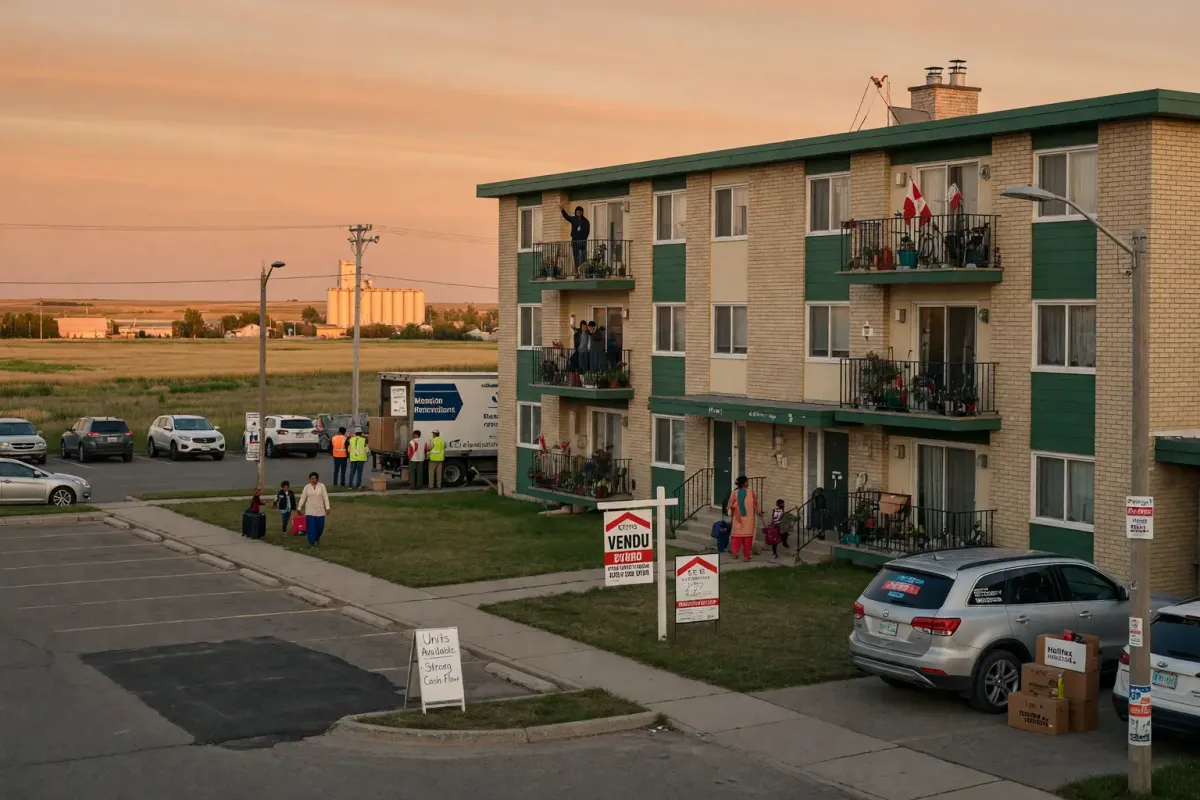
Here’s what most Canadian multifamily investors overlook: some of the strongest cash flow opportunities exist in markets they’ve never considered.
While Toronto, Vancouver, and Montreal capture investor attention, the Prairies and Atlantic Canada are experiencing dramatic demographic shifts. Immigration targets for smaller cities, interprovincial migration from higher-cost provinces, and economic development are driving rental demand in Regina, Saskatoon, Winnipeg, Halifax, Moncton, and other secondary cities.
Entry prices for multifamily buildings are 40-60% lower than central Canada. Cap rates run 6-8% instead of 3-5%. Professional competition is lighter. Properties with $2-3M price tags in Toronto would cost $800K-$1.2M in Saskatchewan or Atlantic Canada.
The real advantage? Investors willing to look beyond Toronto and Vancouver can build substantial multifamily portfolios with less capital, higher cash flow, and significant appreciation potential in growing markets.
Let me show you how.
Prairie Market Fundamentals: Saskatchewan & Manitoba
The Prairies are experiencing significant economic and demographic transformation.
Saskatchewan is positioning itself as a destination for interprovincial migration. Young professionals moving from Alberta and British Columbia seeking lower housing costs, combined with federal immigration targets (Saskatchewan receives 10% of Canada’s immigration despite 3.5% of population), create strong rental demand.
Regina and Saskatoon show exceptional strength in 2026 — Saskatchewan home prices are hitting all-time records and bucking the national trend of price softness:
- Regina benefits from government employment stability (provincial capital), renewable energy sector growth (wind/solar development), and agricultural technology companies. Benchmark price reached $336,400 in March 2026 (record high, +7% YoY). Population growth averages 1.5-2% annually.
- Saskatoon grows faster (2-3% annually) driven by potash industry jobs, tech sector development, and university-linked growth (University of Saskatchewan). Average sale price hit approximately $454,246 in March 2026 (+14% YoY, all-time record). Both cities face inventory well below normal levels, creating tight seller’s market conditions.
Manitoba and Winnipeg specifically represent Canada’s most undervalued multifamily market. Winnipeg’s average home price was approximately $383,800 in March 2026 (+3% YoY). Winnipeg offers:
- Gateway city positioning (labour market for Western Canada)
- Immigrant settlement patterns (Prairie provinces targeted by federal immigration)
- Lower cost-of-living attracting remote workers from higher-cost provinces
- Growing film and entertainment sector
- Strong professional job market
Winnipeg’s rental market remains underappreciated by national institutional investors. That creates opportunity for individual investors entering before institutional capital arrives.
Economic drivers across both provinces:
- Skilled immigration targeting secondary cities (federal programs specifically promote Prairie immigration)
- Renewable energy development (wind farms, solar projects)
- Tech sector expansion (Shopify in Saskatoon, software companies in Winnipeg)
- Agricultural value-added processing
- Lower cost-of-living attracting talent from Ontario and BC
Atlantic Canada Opportunity: New Brunswick & Nova Scotia
Atlantic Canada represents the fastest-growing multifamily opportunity zone in Canada.
Halifax, Nova Scotia has become Canada’s secondary immigrant hub after Toronto and Vancouver. The city receives disproportionate immigration relative to population. Halifax average home price reached $610,101 in March 2026 (+1.5% YoY), still well below most major Canadian markets. Combined with:
- Interprovincial migration from Ontario and Quebec (lifestyle seeking)
- Tech sector growth (Flagship startups, tech parks)
- Military-related employment stability
- University presence (Dalhousie, Saint Mary’s)
Halifax shows 2.5-3.5% annual population growth, with much of this driven by rental demand rather than homeownership.
New Brunswick offers different dynamics. Cities include:
- Moncton (fastest-growing Atlantic city, 2-3% annual growth) serves as the province’s economic hub with diverse employment base
- Saint John offers waterfront development, immigration settlement, and lower entry prices
- Fredericton (provincial capital) provides government employment stability
These markets attract investors primarily seeking cash flow rather than appreciation. Lower entry prices combined with strong rental demand create realistic 6-8% cap rate opportunities.
Maritime economic fundamentals:
- Federal immigration prioritization for Atlantic Canada (Atlantic Immigration Pilot expansion)
- Healthcare sector expansion (rural areas recruiting skilled workers)
- Tech sector development (startups locating in Halifax)
- Real estate appreciation in lifestyle categories (tourism-adjacent areas like Cape Breton attract remote workers)
- Lower cost-of-living relative to other Canadian regions
Getting your financing strategy right from the start saves you from costly mistakes down the road — book a free strategy call with LendCity before you make your next move.
The right financing product can change the math on this entirely — explore our multi-family mortgage financing guide for the options most investors use.
CMHC Financing Access Across Regions
CMHC programs serve Prairies and Atlantic Canada with the same financing options available in major markets—sometimes with additional advantage.
CMHC MLI Standard (5+ unit residential rental financing):
- 5-20% down payment available (80-95% LTV)
- DSCR requirement: 1.30x minimum for MLI Standard; 1.10x minimum for MLI Select (50+ points)
- 25-35 year amortization options
- Fixed or variable rates
Regional markets show strong lender appetite for CMHC-insured multifamily. Conservative underwriting in secondary cities (lower defaults, stable tenancy) makes these properties attractive to CMHC and lenders.
CMHC MLI Select (affordable housing, new construction):
- Up to 95% financing available
- 50-year amortizations on qualifying projects
- Priority review for projects in designated growth areas
- Reduced insurance premiums for affordability-focused developments
Prairie provinces and Atlantic Canada often have priority status in MLI Select programs due to federal housing shortage initiatives. New construction multifamily in these regions may qualify for faster approval and better terms than similar projects in major metros.
Key advantage: Smaller lender networks in secondary markets mean less competition between borrowers. Your commercial mortgage broker likely has stronger relationships with regional lenders, resulting in faster approvals and sometimes better rate offerings.
Cap Rate Analysis by Region
Understanding regional cap rate variations is essential for investment decision-making.
Winnipeg shows the strongest cap rates among Canadian markets:
- Modern multifamily (5-15 units): 6.5-7.5% cap rates
- Value-add properties (requiring renovation): 7.0-8.5% cap rates
- Prime neighbourhood properties: 5.5-6.5% cap rates
A $1.2M property generating $90K NOI yields 7.5% cap rate—impossible to find in Toronto.
Saskatchewan markets split between:
- Regina: 6.0-7.0% cap rates (government stability reduces risk)
- Saskatoon: 6.5-7.5% cap rates (growth premium applied)
Nova Scotia markets:
- Halifax: 5.5-6.5% cap rates (appreciation component recognized)
- Secondary cities: 6.5-7.5% cap rates (lower institutional competition)
New Brunswick markets:
- Moncton: 6.0-7.0% cap rates
- Saint John: 6.5-7.5% cap rates (lower tenant quality sometimes reflected in cap rates)
- Fredericton: 5.5-6.5% cap rates (government employment premium)
Important note: Higher cap rates in secondary markets sometimes reflect genuine additional risk (lower tenant quality, smaller job market, greater vacancy exposure). Don’t blindly chase cap rates. Analyze underlying fundamentals: unemployment rates, population growth, rental demand strength.
The difference between a good deal and a great one often comes down to how it’s financed — schedule a free strategy session with us and let’s look at the numbers together.
Entry Costs: Prairie & Atlantic Properties vs Central Canada
The price differential represents the most compelling advantage.
Comparison for similar 8-unit properties:
| Market | Price Range | Down Payment (20%) | Cap Rate |
|---|---|---|---|
| Toronto | $2.8-3.2M | $560-640K | 3.5-4.0% |
| Vancouver | $2.4-2.8M | $480-560K | 3.0-4.0% |
| Montreal | $1.8-2.2M | $360-440K | 4.0-5.0% |
| Calgary | $1.2-1.5M | $240-300K | 5.0-6.0% |
| Winnipeg | $0.9-1.2M | $180-240K | 6.5-7.5% |
| Regina | $0.85-1.1M | $170-220K | 6.0-7.0% |
| Halifax | $1.0-1.3M | $200-260K | 5.5-6.5% |
Same quality building, same unit count. A $500K difference in acquisition cost directly improves your cash flow and equity position.
For investors with $500K capital, here are realistic scenarios:
- Toronto/Vancouver: Single 4-unit property, limited portfolio growth, $12-18K annual cash flow
- Winnipeg: Two 8-unit properties, faster portfolio scaling, $45-60K annual cash flow
- Regina: Three 6-8 unit properties, meaningful scale, $54-72K annual cash flow
These cash flow estimates are illustrative and based on generalized market assumptions. Actual results depend on specific property performance, financing terms, and market conditions.
Capital deployment efficiency dramatically favors Prairie and Atlantic markets.
Immigration-Driven Demand Patterns
Federal immigration policy directly supports multifamily demand in Prairies and Atlantic Canada.
Federal immigration targets under the 2026 plan reflect a sharp reset:
- Permanent residents: 380,000/year (down from 485,000 prior plan)
- Temporary residents: 385,000/year (sharply reduced from peak)
- Canada’s total population declined 103,504 in 2025 (first ever annual decline) to 41,472,081 as of January 1, 2026, with non-permanent residents falling from 3.15M peak to 2.68M
- Provincial distribution still prioritizes population balance
- Atlantic Immigration Pilot expansion targets continued share to Atlantic Canada
- Prairie provinces receive additional targets through economic immigration streams
What this means for multifamily investors:
- Consistent rental demand from newcomer settlement (families and individuals need housing immediately)
- Lower rental unit competition from homebuyers (newcomers often rent first, buy later)
- Tenancy stability (newcomers seeking permanent settlement show lower turnover)
- Rent escalation potential as newcomers progress through earnings curve
Halifax specifically benefits from Atlantic Canada prioritization. The city receives more immigration per capita than any Canadian region except Toronto/Vancouver. This translates directly to sustained rental demand.
Interprovincial migration adds to immigration effects:
- Albertans relocating to Manitoba (cost of living)
- Ontarians retiring to Nova Scotia (lifestyle)
- Professionals from Toronto/Vancouver seeking affordability in Prairie cities
This creates multi-generational tenant base: young professionals establishing careers, families with school-age children, and retirees seeking retirement properties—all needing rental housing.
For a deeper look at the financing angle behind this topic, see our guide to Atlantic Canada Real Estate Investing: Nova Scotia, New Brunswick, PEI, and Newf.
Case Study 1: Regina Multifamily Acquisition & Management
Let’s walk through a realistic Prairie multifamily deal.
Property profile: 8-unit apartment building in Regina’s warehouse district (revitalizing neighbourhood). Built 1998, well-maintained but dated finishes. Current rents average $700/month, below market.
Market context: Regina shows 1.5% annual population growth, government employment stability, and tech sector expansion attracting talent.
Acquisition: Property purchased for $920K—reasonable market value for property condition and location.
Financing structure:
- Down payment: 20% ($184K)
- CMHC MLI Standard mortgage: $736K at 4.5% fixed, 40-year amortization
- Estimated monthly payment: $3,300 (including property tax, insurance, reserves)
As-is analysis:
- Gross potential income: $67,200 (8 units × $700 × 12)
- Vacancy/collection loss (5%): $3,360
- Effective gross income: $63,840
- Operating expenses (42%): $26,813
- NOI: $37,027 (4.02% cap rate)
Value-add strategy:
- Targeted unit renovations during tenant turnover (new flooring, paint, fixtures)
- Building exterior improvements: new siding, enhanced landscaping, improved entrance
- Target rent increase to $800-850/month within 18-24 months
- Regina market supports this increase (rents trending upward with immigration)
Post-renovation pro forma:
- Gross potential income: $76,800 (8 units × $800 × 12)
- Vacancy/collection loss (5%): $3,840
- Effective gross income: $72,960
- Operating expenses (40%, improved efficiency): $29,184
- NOI: $43,776 (5.76% cap rate)
Refinancing scenario:
- After 18-24 months, property appraises at $1.1M (based on improved NOI and market appreciation)
- Refinance at 75% LTV: $825K loan
- Repay original $736K mortgage, extract $89K equity (less refinancing costs)
- Repeat process on next property
Borrowers comparing options often continue with Apartment Complex Investing: The 5-12 Unit Sweet Spot before booking a strategy call.
5-year outlook:
- 2 more similar acquisitions in Regina/Saskatoon using extracted equity
- 24-unit portfolio ($2.75M value)
- $55K+ annual cash flow
- $400K+ equity extraction from three refinancing cycles
These projections are hypothetical and specific to this scenario’s assumptions. Actual results depend on market conditions, financing terms, tenant performance, and other factors. Individual outcomes will vary.
Case Study 2: Winnipeg Multifamily Development Play
Winnipeg’s growth trajectory supports development projects.
Property profile: Vacant commercial building in developing neighbourhood. 12,000 sq ft. footprint. Zoned for mixed-use or residential conversion. Purchase price: $480K (industrial land value).
Market context: Winnipeg grows 2.5%+ annually, immigration patterns supporting strong rental demand, limited new apartment construction creates supply shortage.
Development thesis: Convert to 16-unit residential apartment building. Professional development company manages construction; investor provides capital and construction financing.
Project timeline:
- Acquisition and permitting: 3 months
- Construction: 10-12 months
- Lease-up: 2-3 months
- Total: 15-17 months
Financial model:
- Land acquisition: $480K
- Construction cost: $1,800K (fully furnished, modern finishes, $112.5K per unit)
- Soft costs (permits, professional fees): $180K
- Total project cost: $2,460K
- Bridge financing at 9-10%: $2,460K (interest during construction carries forward)
Permanent financing:
- Upon completion: 16 units, projected rents $900-1,000/month
- Gross potential income: $172,800 (16 units × $900 × 12)
- NOI (40% operating expenses): $103,680
- CMHC MLI Standard financing: $1,965K at 4.5%, 40-year amortization
- Debt service: $11,760/month
Cash flow: $103,680 annual NOI / $141,120 annual debt service = modest negative cash flow year 1 (4% coverage ratio). After tenant stabilization and rent increases, targets 1.3x+ coverage ratio year 2-3.
Equity position:
- Total investment: $495K (down payment + equity in bridge)
- Property value upon completion: $2.6-2.8M (based on completed NOI)
- Equity position: $635-705K (after $1,965K financing)
Return on investment: 28-42% equity gain within 18 months, plus stabilized cash flow thereafter. These figures are based on projected assumptions for this specific scenario. Actual returns depend on construction costs, market conditions, lease-up timing, and financing terms. Individual outcomes will vary.
Professional Management Across Regions
Regional properties require strong local property management.
Why professional management matters in secondary markets:
- Tenant quality and collection can be inconsistent in smaller cities
- Maintenance emergencies require local expertise (fewer contractors available)
- Rent control and tenant law variations by province
- Vacancy management in smaller markets is competitive (strong PM makes difference)
Regional property management companies:
- Winnipeg: Multiple established PM companies with 50+ buildings under management
- Regina/Saskatoon: Smaller PM firms, but professional networks exist
- Halifax: Growing PM sector, many firms expanding with market growth
- New Brunswick: Limited PM competition, but adequate services available
Expected PM costs: 8-12% of collected rent (similar to major markets).
Professional management typically returns its costs through better rent collection, lower vacancy periods, and operational efficiency. Don’t self-manage regional properties from another province.
Economic Development & Job Growth Drivers
Understanding regional employment underpins multifamily demand.
Saskatchewan:
- Potash mining (Nutrien, BHP operations): stable, high-wage employment
- Renewable energy sector: rapid growth in wind/solar
- Agriculture technology: precision farming, equipment innovation
- Tech sector: Shopify Saskatoon, software companies
- Government (Regina): stable employment base
Manitoba:
- Aerospace and advanced manufacturing: Boeing, Magellan
- Tech sector: growing startup ecosystem, software development
- Transportation and logistics: Canada’s west-central distribution hub
- Healthcare sector: research and hospital employment
- Government (Winnipeg): stable employment base
Nova Scotia:
- Tech sector: startups, software companies, cyber security
- Military: CFB Halifax, naval operations (stable, long-term employment)
- Healthcare: expansion and research sector
- Tourism and hospitality (seasonal)
- Education: university and college sector
New Brunswick:
- Irving operations (forestry, energy): major employer
- Healthcare: workforce expansion, rural recruitment
- Tech: emerging sector, government support
- Manufacturing and food processing
Job diversification matters. Markets dependent on single employers carry higher risk (sudden closure impacts entire rental market). Winnipeg, Halifax, and Moncton show genuine employment diversity.
Risk Considerations in Secondary Markets
Higher cap rates come with trade-offs.
Tenant quality sometimes reflects lower screening in smaller markets. Invest in strong property management partners and rigorous tenant screening. Higher cap rates often justify this cost.
Liquidity is lower. Selling secondary market multifamily takes longer than Toronto properties. Plan for 6-12 month sale timelines rather than 2-3 months.
Economic sensitivity varies by market. Resource-dependent cities (oil/gas, mining) show greater sensitivity to commodity price cycles. Diversified cities (Winnipeg, Halifax) show more stability.
Appreciation potential is real but slower than major metros. Cap rate opportunities compensate for lower appreciation (6-8% cash flow partially offsets lower appreciation).
Population and employment trends matter enormously. Research 10-year employment projections before committing capital.
Interest rate environment impacts secondary market properties more significantly. Higher carrying costs on vacant units affect smaller properties more severely.
Building Your Regional Multifamily Portfolio
Strategic approach to portfolio scaling across Prairie and Atlantic markets.
Phase 1: Market selection
- Choose one region (Winnipeg, Saskatoon, Halifax, Moncton) based on employment fundamentals
- Spend 2-3 months researching neighbourhood dynamics, employment trends, rent rolls
- Establish relationships with local brokers, PM companies, lenders
Phase 2: Pilot acquisition
- Purchase first 6-8 unit property
- Implement value-add strategy
- Establish operational systems with local PM company
- Refinance after 18-24 months to extract equity
Phase 3: Portfolio expansion
- Deploy extracted equity into 2-3 additional properties
- Diversify across neighbourhoods within same city
- Target 15-20 units per year acquisition rate
Phase 4: Regional scaling
- Once established in one market, expand to adjacent city
- Replicate successful model
- Build to 40-50 unit portfolio across 2-3 cities
Frequently Asked Questions
Why are cap rates so much higher in Prairie and Atlantic Canada?
Can I access CMHC financing in smaller regional markets?
Which Prairie/Atlantic city offers the best investment opportunity?
How important is local property management in secondary markets?
What population growth rates should I target for my market selection?
How quickly can I sell secondary market multifamily if I need to exit?
Key Takeaways:
- Prairie Market Fundamentals: Saskatchewan & Manitoba
- Atlantic Canada Opportunity: New Brunswick & Nova Scotia
- CMHC Financing Access Across Regions
- Cap Rate Analysis by Region
- Entry Costs: Prairie & Atlantic Properties vs Central Canada
The Bottom Line
Prairie and Atlantic Canada multifamily markets represent genuine wealth-building opportunities—not secondary options.
Higher cap rates (6-8% vs 3-5%), lower entry prices, consistent immigration-driven demand, and less institutional competition combine to create an asymmetric opportunity set. Investors who master regional markets build substantial portfolios faster than attempting to compete in saturated central Canada markets. For comprehensive support on multifamily financing across Canada, visit our multifamily mortgage financing service page to explore CMHC programs and financing options tailored to Prairie and Atlantic regions.
The requirement: spend time understanding regional employment dynamics, commit to professional local property management, and execute disciplined acquisition and value-add strategies.
Markets like Winnipeg, Halifax, and Saskatoon will eventually attract institutional capital. Investors entering now capture superior returns before cap rates compress and purchase prices rise.
That’s where the real multifamily wealth is being built in Canada today.
Disclaimer: This case study is presented for educational purposes only. Some details may have been adjusted for clarity and readability. Individual investment outcomes vary — past results do not guarantee future performance. LendCity Mortgages provides mortgage financing services for real estate investors and does not offer investment, legal, or tax advice.
Free download
MLI Select document checklist
Appraisals, rent rolls, environmental reports, and the CMHC package lenders expect before they underwrite.
By submitting, you agree to receive occasional emails from LendCity. You can unsubscribe at any time.
4.8/5 (116 Google reviews)
Disclaimer: LendCity Mortgages is a licensed mortgage brokerage. Content on this page is for educational purposes only and does not constitute legal, tax, investment, securities, or financial-planning advice. Rates, premiums, program terms, and regulations referenced are as of the page's last updated date and are subject to change. Any investment returns, rental yields, tax savings, or case-study figures shown are illustrative only — they are not guaranteed, not typical, and individual results will vary. Consult a licensed lawyer, Chartered Professional Accountant, or registered dealer before acting on any information above. Editorial standards.

Written by
Scott Dillingham
Published
February 26, 2026
· Updated June 29, 2026Reading time
14 min read
CMHC Insurance
Mortgage default insurance from Canada Mortgage and Housing Corporation. For 1-4 unit investment properties, investors must put 20%+ down (no insurance available). However, CMHC offers MLI Select for 5+ unit multifamily properties, and house hackers can access insured mortgages with 5-10% down.
Multifamily
Properties with multiple dwelling units, from duplexes to large apartment buildings. Often offer better cash flow and economies of scale.
Cap Rate
Capitalization Rate - the ratio of a property's [net operating income (NOI)](/glossary/noi/) to its current market value or purchase price. A 6% cap rate means the property generates $60,000 NOI annually on a $1,000,000 value. Used to compare investment properties regardless of financing. See also [DSCR](/glossary/dscr/) and [Cash-on-Cash Return](/glossary/cash-on-cash-return/).
NOI
Net Operating Income - the total income a property generates minus all operating expenses, but before mortgage payments and income taxes. Calculated as gross rental income minus [vacancies](/glossary/vacancy-rate/), property taxes, insurance, maintenance, and property management fees. NOI is used to calculate both [Cap Rate](/glossary/cap-rate/) and [DSCR](/glossary/dscr/).
DSCR
Debt Service Coverage Ratio — a metric that compares a property's [net operating income](/glossary/noi/) to its mortgage payments. A DSCR of 1.25 means the property generates 25% more income than needed to cover the debt. Lenders typically require a minimum DSCR of 1.0 to 1.25 for investment property loans (including [DSCR loans](/glossary/dscr-loan/)). See also [Cap Rate](/glossary/cap-rate/) and [Cash Flow](/glossary/cash-flow/).
Commercial Mortgage
Financing for commercial properties like retail, office, or multifamily buildings with 5+ units, with different qualification criteria than residential mortgages.
Down Payment
The upfront cash payment when purchasing a property. For 1-4 unit investment properties, minimum 20% down is required. 5+ unit multifamily can use CMHC MLI Select with lower down payments, and house hackers can put as little as 5% down on owner-occupied 2-4 plexes. Your down payment directly affects your [LTV](/glossary/ltv/) and the amount of [leverage](/glossary/leverage/) you use.
Coverage Ratio
A measure of a property's ability to cover its debt payments, typically referring to DSCR. Commercial lenders often require a minimum of 1.2, meaning the property's net operating income exceeds debt payments by at least 20%.
Commercial Lending
Financing for commercial real estate or business purposes, typically qualified based on property income (NOI) rather than personal income. Includes mortgages for multifamily buildings (5+ units), retail, office, and industrial properties.
Cash Flow
The money left over after collecting rent and paying all expenses including mortgage, taxes, insurance, maintenance, and property management. Positive cash flow is the primary goal of buy-and-hold investors. See also [NOI](/glossary/noi/), [Cash-on-Cash Return](/glossary/cash-on-cash-return/), and [Vacancy Rate](/glossary/vacancy-rate/).
Equity
The difference between a property's current market value and the remaining mortgage balance. If your home is worth $500,000 and you owe $300,000, you have $200,000 in equity. Equity builds through mortgage payments, [appreciation](/glossary/appreciation/), and [forced appreciation](/glossary/forced-appreciation/). See also [LTV](/glossary/ltv/) and [Refinancing](/glossary/refinancing/).
Vacancy Rate
The percentage of rental units that are unoccupied over a given period. A critical factor in [cash flow](/glossary/cash-flow/) analysis, typically estimated at 4-8% for conservative projections. Vacancy directly reduces [NOI](/glossary/noi/).
Operating Expenses
The ongoing costs of running a rental property, including property taxes, insurance, maintenance, property management fees, utilities, and repairs. Subtracting operating expenses from gross rental income yields the net operating income.
Pro Forma
A projected financial statement for an investment property showing expected income, expenses, and returns. Pro formas are used to evaluate potential acquisitions and are required by many commercial lenders during underwriting.
Comparable Properties
Similar properties in the same market area used to establish fair market value or rental rates through comparison of features, location, condition, and recent sale or rental prices. Analyzing comps is essential when determining offer prices and setting competitive rents.
Hover over terms to see definitions. View the full glossary for all terms.