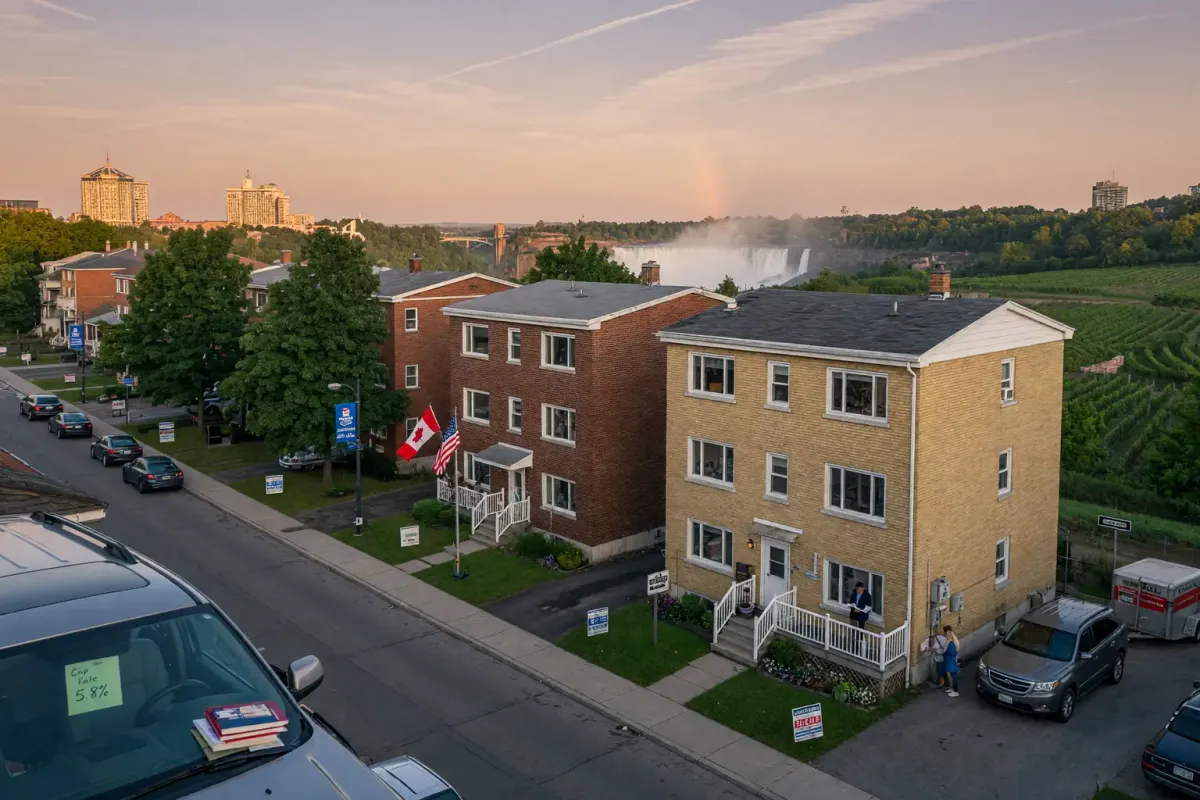
The Niagara Region is one of Ontario’s most compelling real estate investment destinations—and it’s not hard to see why. You’ve got world-famous tourism appeal paired with solid residential fundamentals, all wrapped up in a market that’s still accessible compared to the GTA madness.
This diverse region offers everything from short-term vacation rentals capitalizing on millions of annual tourists to traditional buy-and-hold investments serving a growing permanent population. Whether you’re looking to cash in on Clifton Hill’s constant foot traffic or build a portfolio of family rentals in St. Catharines, Niagara deserves your attention.
With roughly half a million residents spread across multiple municipalities, you get real market depth here. And the region’s strategic position along the U.S. border and within Ontario’s Greater Golden Horseshoe creates economic advantages that support long-term investment success.
Understanding Niagara’s Investment Appeal
| Market Factor | Niagara’s Position | Investment Implication |
|---|---|---|
| Population | 500,000+ regional | Substantial market depth |
| Tourism | World-class destination | Short-term rental potential |
| Location | U.S. border, Golden Horseshoe | Economic connectivity |
| Economy | Diversified base | Employment stability |
| Wine Industry | Premier region | Tourism and lifestyle appeal |
Regional Overview
The Regional Municipality of Niagara encompasses multiple distinct communities—Niagara Falls, St. Catharines, Welland, and numerous smaller municipalities. Each one offers different characteristics and investment profiles. A condo near the Falls plays completely differently than a duplex in Thorold.
Understanding these variations helps you target investments appropriately. You wouldn’t use the same strategy in Niagara-on-the-Lake’s wine country that you’d use in Port Colborne’s waterfront neighbourhood.
The region sits at the eastern end of Ontario’s Greater Golden Horseshoe, positioning it within the broader Toronto-area economic sphere while maintaining its own distinct identity. Nearby Hamilton Ontario real estate market offers complementary investment characteristics for Golden Horseshoe portfolio building. Best part? Pricing often comes in well below what you’d pay in the GTA core.
Border and Tourism Dynamics
Niagara’s position on the United States border creates unique economic dynamics you won’t find elsewhere in Ontario. Cross-border traffic supports commercial activity and employment, while the famous Falls attract millions of visitors annually. That tourist traffic creates short-term rental opportunities unmatched in most Canadian markets.
Tourism provides the foundation for vacation rental strategies, while the broader regional economy supports traditional residential investments. This diversity means you can run multiple strategies within a single region—something that’s harder to pull off in more one-dimensional markets.
Short-Term Rental Opportunities in Niagara
Tourism creates significant short-term rental potential here. Let’s break down what that actually looks like on the ground.
Vacation Rental Market
Niagara Falls’ global recognition draws visitors year-round, creating consistent demand for accommodation alternatives to hotels. Short-term rental properties near attractions, entertainment districts, and scenic areas can capture premium nightly rates from steady tourist traffic. Our guide to short-term rental property investing covers the operational details.
The vacation rental market benefits from both domestic and international tourism. American visitors cross the border for the Canadian side’s superior views. International tourists add Niagara to their Canadian itineraries. Wine enthusiasts book weekend getaways. Each of these groups needs somewhere to stay—and many prefer the space and value of a well-managed rental property over a hotel room.
Seasonal Patterns
While tourism happens year-round, summer months and holiday periods typically generate peak demand. Understanding these seasonal patterns helps you project income accurately and manage properties effectively through slower periods.
Here’s the good news: properties in prime tourist locations can still achieve strong annual performance despite seasonal variation. The key is calculating returns based on realistic occupancy projections across all seasons—not just the busy months when your calendar fills itself.
A property pulling 85% occupancy in July and 40% in February looks very different from one averaging 65% year-round. Both can work financially, but you need to model them correctly.
Regulatory Considerations for Short-Term Rentals
Research local regulations governing short-term rentals before committing to a vacation rental strategy. Different municipalities within Niagara have varying requirements regarding licensing, taxation, and operational restrictions.
Niagara Falls, for instance, has specific short-term rental bylaws that differ from what you’ll encounter in St. Catharines or Niagara-on-the-Lake. Some areas welcome vacation rentals while others have implemented restrictions to preserve residential character.
Compliance protects your investment and ensures sustainable operations. Regulatory landscapes can change—often with little warning—so ongoing monitoring helps you anticipate required adjustments before they become problems.
Whether you’re eyeing a vacation rental near the Falls or a buy-and-hold duplex in St. Catharines, book a free strategy call with LendCity and we’ll help you figure out how much you can finance in Niagara.
Financing a vacation rental requires a strategy that accounts for seasonal income — book a free strategy call with LendCity and we’ll help you find the right program.
For a deeper look at the financing angle behind this topic, see our PadSplit mortgage financing guide.
Residential Investment Fundamentals in Niagara
Beyond the tourism angle, Niagara offers strong residential investment characteristics that shouldn’t be overlooked.
Population Growth and GTA Migration
The Niagara Region has experienced steady population growth as residents seek affordable alternatives to eye-watering Greater Toronto Area prices. Many of these newcomers maintain reasonable commuting distance to GTA employment or work remotely—a trend that’s only accelerated since 2020.
This migration pattern directly supports housing demand and property values. New residents bring diverse housing needs: young professionals wanting urban amenities, families seeking space and good schools, retirees looking for lifestyle and healthcare access. Different communities within Niagara serve these different demographic segments.
Affordability Advantage
Niagara’s pricing typically falls well below GTA levels while offering quality lifestyle amenities—wine country, waterfront access, escarpment views, and natural beauty that rivals anything in southern Ontario. This value proposition attracts residents who might otherwise remain stuck in more expensive markets.
For investors, accessible pricing enables real portfolio building at capital levels that might not touch comparable properties in Toronto or even Hamilton. Learn more about how to find good real estate opportunities in Canadian markets. You can actually get started here without needing a seven-figure down payment.
Economic Diversification
While tourism represents a significant economic driver, Niagara’s economy spans multiple sectors: manufacturing, agriculture, education, and healthcare all contribute to the employment base. Brock University and Niagara College provide educational anchors while healthcare facilities serve regional needs.
This diversity reduces dependence on any single sector and supports stable rental demand from employed residents. When one industry slows, others typically compensate—unlike single-industry towns where a plant closure can tank an entire local market.
Wine Country Investment Potential
Niagara’s wine industry creates tourism and lifestyle appeal extending well beyond Niagara Falls itself.
Wine country tourism tends toward higher-spending visitors seeking quality accommodations. Properties meeting these elevated expectations can achieve returns exceeding general tourism markets. Think: couples celebrating anniversaries, small groups on wine tours, corporate retreats. These guests often pay premium rates for the right property.
Lifestyle Appeal and Appreciation Potential
Wine country characteristics also attract permanent residents seeking lifestyle amenities. Properties in scenic areas with vineyard views or proximity to wineries may command premiums from both buyers and renters who value the environment.
The combination of agricultural preservation (much of this land can’t be developed) and lifestyle demand creates Appreciation potential in appropriate areas. Supply constraints plus growing demand is a formula every investor should recognize.
Niagara’s wine country has supply constraints that support long-term appreciation, but the entry prices are higher — book a free strategy call with us and we’ll show you what financing options fit your price range and strategy.
Getting your financing strategy right from the start saves you from costly mistakes down the road — schedule a free strategy session with us before you make your next move.
Building Your Niagara Investment Strategy
Different approaches suit Niagara’s diverse characteristics. Your job is matching the right strategy to your goals, capital, and management capacity.
Tourism-Focused Strategies
Properties near Niagara Falls, Clifton Hill entertainment district, or wine country attractions can pursue short-term rental approaches capitalizing on tourist traffic. These strategies require active management—or excellent property managers—and a solid understanding of hospitality operations.
Tourism properties may generate higher gross income, but they demand more intensive management than traditional rentals. Guest communications, cleaning coordination, dynamic pricing, review management—it adds up. Honestly evaluate whether tourism approaches match your available time and management capabilities before diving in.
Traditional Residential Focus
Properties serving permanent residents through conventional leasing offer lower management intensity while benefiting from population growth and affordability-driven migration. Family homes in quality neighbourhoods experience stable demand regardless of tourist seasons.
Long-term tenancies reduce turnover costs and provide consistent, predictable income. Consider whether stability or potential upside better matches your investment objectives. There’s no wrong answer—just the answer that’s right for your situation.
Hybrid Portfolio Approaches
Some investors combine strategies—tourism-focused properties in prime locations alongside traditional rental portfolios in residential areas. This diversification across property types and strategies can reduce overall risk while capturing opportunities across market segments.
You might run a vacation rental near the Falls generating strong cash flow while building equity in a triplex in Welland. Different properties serving different purposes within one regional market.
Market Entry Considerations for Niagara Investors
Municipal Variations Across the Region
Different Niagara municipalities offer different characteristics. Niagara Falls emphasizes tourism. St. Catharines provides urban amenities and serves as the regional hub. Niagara-on-the-Lake combines wine country charm with historical appeal. Smaller communities like Fort Erie, Welland, and Port Colborne offer various lifestyle and investment profiles worth exploring.
Building Professional Networks
Build relationships with real estate professionals who understand Niagara specifically — our guide to Canada’s top real estate investment groups covers regional networks worth joining. Tourism property expertise differs substantially from residential rental knowledge—someone who’s great at finding vacation rentals near the Falls may not be your best resource for a value-add renovation project in Thorold.
Match your professional support to your investment approach. Property management resources also vary considerably. Short-term rental management requires different capabilities (guest relations, rapid turnover cleaning, dynamic pricing) than traditional property management. Before committing to a strategy, ensure appropriate support exists locally.
Building Your Niagara Real Estate Portfolio
Niagara presents compelling investment characteristics combining world-class tourism with strong residential fundamentals. The region’s diversity enables various approaches—from vacation rentals generating premium nightly rates to traditional residential investments building steady equity over time.
Research specific communities and strategies matching your objectives. Connect with Canadian mortgage financing supporting your chosen approach. Understand the regulatory requirements affecting your particular investment type.
Strategic investment in this renowned Ontario region positions you to benefit from both tourism appeal and residential growth. The fundamentals here are strong, the entry points remain accessible compared to nearby markets, and the diversity of opportunities means there’s likely a strategy that fits your specific goals.
The question isn’t whether Niagara offers opportunity—it’s which opportunity matches what you’re trying to build.
Key Takeaways:
- Understanding Niagara’s Investment Appeal
- Short-Term Rental Opportunities in Niagara
- Residential Investment Fundamentals in Niagara
- Wine Country Investment Potential
- Building Your Niagara Investment Strategy
Frequently Asked Questions
Is Niagara Falls a good place to invest in real estate?
What are the short-term rental regulations in Niagara?
How does Niagara real estate compare to Toronto prices?
What's the best area in Niagara for rental property investment?
Is wine country real estate a good investment?
What's the vacancy rate like in Niagara?
Should I invest in Niagara for cash flow or appreciation?
What are the risks of investing in Niagara real estate?
How do I find a property manager for Niagara vacation rentals?
Can I manage a Niagara rental property remotely from Toronto?
Weekly Investor Insight
Sunday financing notes for investors
Market updates, rate moves, and deal structures — once a week. Unsubscribe anytime.
By submitting, you agree to receive occasional emails from LendCity. You can unsubscribe at any time.
Disclaimer: LendCity Mortgages is a licensed mortgage brokerage. Content on this page is for educational purposes only and does not constitute legal, tax, investment, securities, or financial-planning advice. Rates, premiums, program terms, and regulations referenced are as of the page's last updated date and are subject to change. Any investment returns, rental yields, tax savings, or case-study figures shown are illustrative only — they are not guaranteed, not typical, and individual results will vary. Consult a licensed lawyer, Chartered Professional Accountant, or registered dealer before acting on any information above. Editorial standards.

Written by
Scott Dillingham
Published
January 23, 2026
· Updated June 29, 2026Reading time
11 min read
Appreciation
The increase in a property's value over time, which builds [equity](/glossary/equity/) and wealth for the owner through market growth or [forced improvements](/glossary/forced-appreciation/).
BRRRR
Buy, Rehab, Rent, Refinance, Repeat - a real estate investment strategy where you purchase a property below market value, renovate it to increase its [ARV](/glossary/after-repair-value-arv/), rent it out, [refinance](/glossary/refinancing/) to pull out your initial investment, and repeat the process with the recovered capital. Success depends on [forced appreciation](/glossary/forced-appreciation/) and strong [cash flow](/glossary/cash-flow/).
Cash Flow
The money left over after collecting rent and paying all expenses including mortgage, taxes, insurance, maintenance, and property management. Positive cash flow is the primary goal of buy-and-hold investors. See also [NOI](/glossary/noi/), [Cash-on-Cash Return](/glossary/cash-on-cash-return/), and [Vacancy Rate](/glossary/vacancy-rate/).
Down Payment
The upfront cash payment when purchasing a property. For 1-4 unit investment properties, minimum 20% down is required. 5+ unit multifamily can use CMHC MLI Select with lower down payments, and house hackers can put as little as 5% down on owner-occupied 2-4 plexes. Your down payment directly affects your [LTV](/glossary/ltv/) and the amount of [leverage](/glossary/leverage/) you use.
Equity
The difference between a property's current market value and the remaining mortgage balance. If your home is worth $500,000 and you owe $300,000, you have $200,000 in equity. Equity builds through mortgage payments, [appreciation](/glossary/appreciation/), and [forced appreciation](/glossary/forced-appreciation/). See also [LTV](/glossary/ltv/) and [Refinancing](/glossary/refinancing/).
Property Management
The operation, control, and oversight of real estate by a third party. Property managers handle tenant screening, rent collection, maintenance, and day-to-day operations.
Vacancy Rate
The percentage of rental units that are unoccupied over a given period. A critical factor in [cash flow](/glossary/cash-flow/) analysis, typically estimated at 4-8% for conservative projections. Vacancy directly reduces [NOI](/glossary/noi/).
Fixer-Upper
A property that needs repairs or renovations, typically priced below market value. Often targeted by investors using BRRRR or fix-and-flip strategies.
Market Value
The estimated price a property would sell for on the open market under normal conditions. Determined by comparable sales, location, condition, and market demand.
Value-Add Property
A property with potential to increase value through renovations, better management, rent increases, or adding units.
Turnover
The process and cost of preparing a rental unit for a new tenant after the previous tenant moves out, including cleaning, repairs, marketing, and vacancy time. High turnover rates significantly reduce profitability through lost rent and preparation expenses.
Duplex
A residential property containing two separate dwelling units, either side-by-side or stacked. Duplexes are popular among beginner investors because they can house-hack by living in one unit while renting the other to offset mortgage costs.
Triplex
A residential property containing three separate dwelling units. Triplexes offer higher rental income potential than duplexes while still qualifying for residential mortgage financing in most cases, making them attractive to growing investors.
Contractor
A licensed professional hired to perform construction, renovation, or repair work on investment properties. Using licensed and insured contractors is essential for permitted work, as unlicensed contractors can result in voided insurance, property liens, and liability for injuries.
Comparable Properties
Similar properties in the same market area used to establish fair market value or rental rates through comparison of features, location, condition, and recent sale or rental prices. Analyzing comps is essential when determining offer prices and setting competitive rents.
Short-Term Rental
A furnished property rented for periods shorter than 30 days through platforms like Airbnb or VRBO. Short-term rentals generate higher gross revenue but carry higher operating costs and stricter municipal regulations.
Condominium
A type of property ownership where an individual owns a specific unit within a larger building or complex, sharing ownership of common areas with other unit owners. Condos offer lower entry prices but come with monthly fees and potential rental restrictions that affect investment returns.
Dynamic Pricing
A revenue management strategy where nightly rental rates are adjusted in real time based on demand, seasonality, local events, and competitor pricing. Used by short-term rental operators to maximize revenue.
Foundation
The structural base of a building that transfers loads to the ground. Foundation issues such as cracks, settling, or water intrusion are among the most expensive repairs in real estate and can significantly impact property value and financing eligibility.
STR
Short-Term Rental - a furnished property rented for periods of less than 30 days, typically through platforms like Airbnb or VRBO. STRs can generate 2-3x the income of long-term rentals but require more active management, higher operating costs, and compliance with local short-term rental regulations.
Hover over terms to see definitions. View the full glossary for all terms.