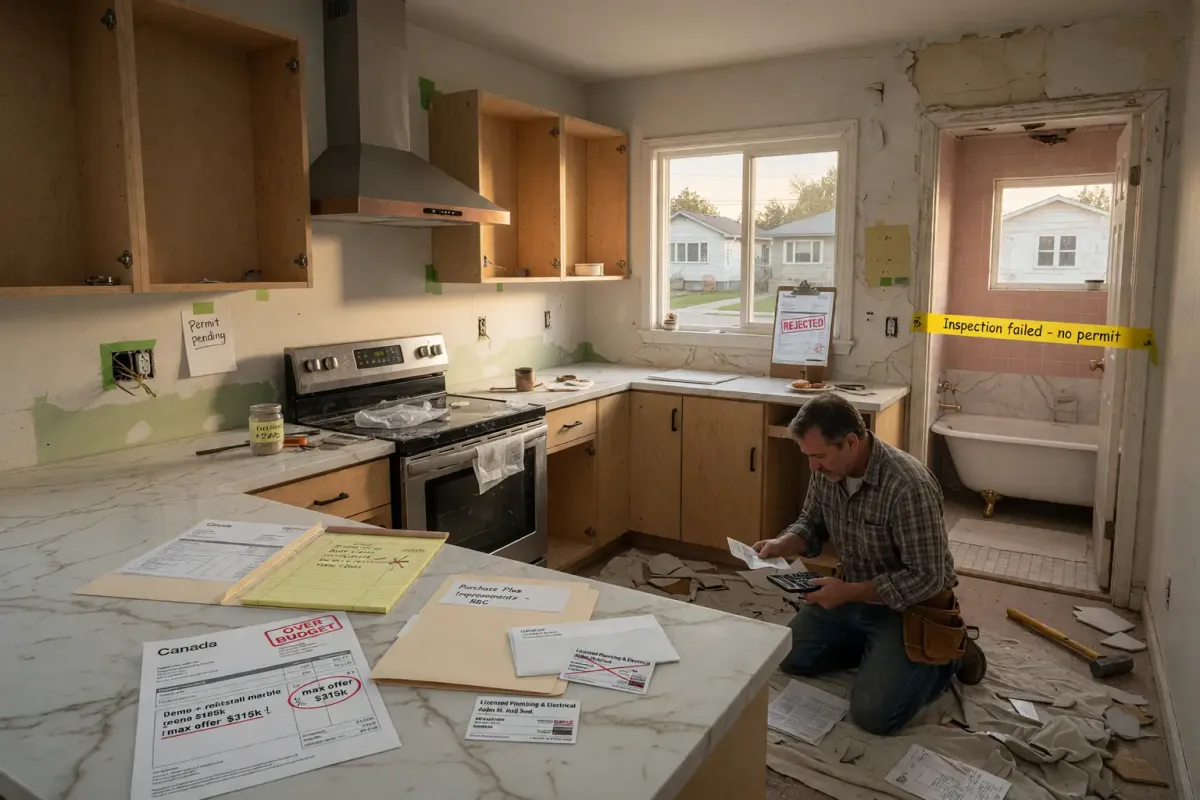
Want to know the fastest way to throw away your renovation budget? Make choices based on what you like instead of what sells.
We sat down with Nick Messina from Team Goren REMAX and Kass DiPasquale from Kass Design Studios to get the real story on what works and what doesn’t for investment property renovations.
The Biggest Mistake You Can Make
Both experts said the same thing right away: investors keep making renovation choices based on personal taste. And that’s a disaster if you want to sell or rent quickly. This is one of the biggest lessons from flipping over 30 properties—personal preference kills ROI.
Here’s the thing – when you paint that bedroom neon green because you love bright colors, you just cut your potential buyer pool in half. Maybe more.
Think about it. When someone walks into a house painted black with red paint dripping down the walls to look like blood, they’re not thinking “oh, I’ll just repaint.” They’re running for the door.
Your Home vs. Investment Property
Kass made a great point: if you’re keeping the property for yourself, go wild. Paint it hot pink. Put up your hunting trophies. Do whatever makes you happy.
But if you’re renovating to sell or rent? You need to forget what you like and focus on what the masses want.
The White Paint Strategy That Actually Works
You know what’s boring but effective? A fresh coat of white paint.
Nick swears by it. White is neutral enough that anyone can see themselves living there. It opens up possibilities in buyers’ minds instead of making them think about how much work they’ll need to do.
But here’s where it gets tricky – you don’t want the place to feel like a sterile hospital room either.
Making Neutral Feel Warm
Kass has a solution: staging and plants. You want to remove personal items so families can picture themselves there, but add enough warmth that the space feels inviting.
Plants are perfect because they add life without screaming “this is MY style.”
If neutral paint and smart staging can stretch your buyer pool, imagine what the right financing structure does for your renovation budget — book a free strategy call with LendCity to plan the numbers before you start.
Real estate investing is a team sport, and your mortgage strategy is the foundation — book a free strategy call with LendCity to make sure yours is solid.
For a deeper look at the financing angle behind this topic, see our flip mortgage financing guide.
Where to Spend Your Money
Not all renovations give you the same bang for your buck. Here’s what actually pays off:
Kitchen Renovations Return 75-100%
This is the big one. Put $10,000 to $30,000 into your kitchen and you’ll get most of it back when you sell.
But you don’t always need to rip everything out. Kass says you can save a ton by repainting or refacing cabinets instead of replacing them. A cosmetic update can look amazing without the $60,000 price tag.
Want a quick win? Add a backsplash. One appraiser told us it added $5,000 in value to a home – and backsplashes cost way less than that to install.
Bathrooms Return About 70%
Here’s Kass’s rule of thumb: if you have two bathrooms, update one completely from top to bottom. The second one can get quick cosmetic fixes. For specific ideas on what to tackle, our guide on bathroom renovations that add value walks through the highest-impact upgrades.
Nick agrees. As long as one bathroom looks really nice, buyers can deal with a less-updated second one. They think “we’ll use the nice one most of the time.”
For simple bathroom updates, focus on light fixtures and vanities. You can make a big visual impact without gutting the whole room.
How to Cut Costs Without Cutting Corners
Here’s a money-saver that actually works: use LVP (luxury vinyl plank) instead of hardwood. You’ll save about $5 per square foot.
Over a whole house, that adds up fast.
And here’s a bonus – if water gets on LVP, you can pull it up, dry underneath, and put the same pieces back down. Try doing that with hardwood.
Just keep extra material on hand because pieces cut to fit walls can’t be reused if you need to take the floor apart.
Kitchen renovations returning 75-100% are powerful, but only if your purchase plus improvements mortgage is structured to support the project — book a free strategy call with us and we’ll run through it together.
The refinance stage of BRRRR is where most investors stumble — schedule a free strategy session with us to make sure your exit financing is locked in before you start the project.
Plan Before You Swing a Hammer
Most investors get this backwards. They start renovating and then wonder if they’re making the right choices.
If you’re following the BRRRR Method: Build a Rental Portfolio Fast, planning is even more critical because your renovation budget directly affects your refinance appraisal. Do this instead:
Step 1: Create Your Vision
Use free tools like Canva and Pinterest to gather ideas. Make a mood board. Get clear on what you want to do.
This helps even if you’re working with a partner. Kass says men and women don’t think the same way, so having visual references prevents arguments and expensive mistakes.
Step 2: Make a Spreadsheet
Write down every renovation cost. Figure out how much you’re willing to spend before you sell or rent. Learning to Analyze a Rental Property: Cash Flow & Due Diligence will help you determine whether those renovation costs still leave room for profit.
Step 3: Talk to a Real Estate Agent FIRST
Before you do any work, call an agent like Nick. Ask them:
- What’s my property worth right now? Consider getting automated property appraisals for a quick baseline.
- What will it be worth after these updates?
- Do these renovations make financial sense?
You might find out that $20,000 kitchen renovation will only add $10,000 in value. Better to know that before you start.
Finance Your Renovations the Smart Way
Here’s something many investors don’t know: you can build renovation costs right into your mortgage through a purchase plus improvements program.
This means you don’t have to pay cash out of pocket. You can use other people’s money to improve your property and save your cash for buying more properties.
Real Horror Stories to Learn From
Nick told us about a beautiful house with great curb appeal. But inside? Dead trophy animals covering every wall. Moose, wolves, you name it.
His clients were terrified. They couldn’t see past the animals to appreciate the house itself. One showing and done.
The fix? Put that stuff in storage when you’re selling. Don’t cut your buyer pool in half because you want to show off your hobbies.
Another property had lime green walls, pink walls, and a bathroom that mixed three different design styles at once. Nobody could figure out what they were looking at. These are the kinds of common issues when buying distressed properties that you need to budget for upfront.
Should You Try to Stand Out?
Kass asked an interesting question: what if being memorable is good? If someone sees 15 houses in a day, maybe they remember “the one with the pink room.”
Nick’s answer was smart. It depends on who’s buying. If it’s a family moving in, bold colors are risky. They probably won’t repaint right away.
But if it’s an investor who’ll repaint anyway? Being memorable might help you.
Still, playing it safe with neutral colors is usually the better bet.
Build the Right Team
Don’t try to save money by skipping professionals. Kass saw someone try to wire their own house to save on electrician costs. They did it wrong and had to pay to rewire the entire place.
Cost them way more than hiring an electrician from the start.
Your team should include:
- A real estate agent who knows local values
- A designer who can create a cohesive vision
- Qualified contractors and trades
- A fix and flip financing specialist who can help with funding
Make sure everyone knows your goal. Are you flipping using the 70 percent rule guide? Renting? Selling as-is? Different goals need different approaches.
The Bottom Line
Stop renovating based on what you like. Start thinking about what sells.
Put your money into kitchens and bathrooms. Keep colors neutral. Use staging and plants to add warmth. And talk to professionals before you start – not after you’ve already spent the money.
Your bank account will thank you.
Renovation ROI: Canadian vs US Market Differences
While renovation fundamentals (neutral colors, quality kitchens, staged bathrooms) remain consistent, buyer expectations and ROI vary between markets.
Buyer Preferences:
- Canada: Granite or quartz countertops expected in most markets. Hardwood or engineered flooring preferred over laminate in urban areas. Stainless appliances standard. Subway tile and neutral palettes dominate.
- United States: Similar preferences in comparable price brackets, but regional variation is greater. Southern markets often expect newer, move-in-ready finishes. Northern markets more accepting of dated finishes if priced accordingly.
Renovation Financing:
- Canada: Purchase-plus-improvements mortgages offered by some traditional lenders. Private lenders provide renovation financing at 7-12%. CMHC allows some renovation costs in insured mortgages for owner-occupants.
- United States: 203(k) FHA loans bundle purchase and renovation (owner-occupied). Hard money lenders provide rehab financing at 8-12% plus points. HomeStyle renovation mortgages available through Fannie Mae.
Contractor and Labor Costs:
- Canada: Higher labor costs in major markets. Contractors in short supply. General contractor markup typically 15-25%. Skilled trades (electricians, plumbers) command premium rates.
- United States: Labor costs vary dramatically by region. Southern and Midwest markets offer significantly lower contractor rates than Canadian equivalents. This improves flip margins for Canadian investors buying US properties.
Permit and Code Requirements:
- Canada: Building codes enforced provincially. Permits required for most structural work, electrical, plumbing. Inspections add time but ensure quality. Non-permitted work can affect resale.
- United States: Code requirements vary by municipality. Some jurisdictions have more relaxed enforcement. However, unpermitted work creates title issues and financing challenges for buyers.
Staging ROI:
- Canada: Professional staging in major markets (Toronto, Vancouver, Calgary) can add 5-15% to sale price. Essential for properties above $500K.
- United States: Similar ROI in comparable markets, but staging less common in lower price brackets and secondary markets. Virtual staging increasingly accepted as alternative.
Key Takeaways:
- The Biggest Mistake You Can Make
- The White Paint Strategy That Actually Works
- Where to Spend Your Money
- How to Cut Costs Without Cutting Corners
- Plan Before You Swing a Hammer
Frequently Asked Questions
What's the biggest mistake investors make when renovating?
Which room gives the best return on investment?
Should I use hardwood or luxury vinyl plank flooring?
How many bathrooms should I fully renovate?
What colors should I paint an investment property?
Can I include renovation costs in my mortgage?
When should I talk to a real estate agent about renovations?
How do I make neutral colors feel warm instead of boring?
Free download
MLI Select document checklist
Appraisals, rent rolls, environmental reports, and the CMHC package lenders expect before they underwrite.
By submitting, you agree to receive occasional emails from LendCity. You can unsubscribe at any time.
4.8/5 (116 Google reviews)
Disclaimer: LendCity Mortgages is a licensed mortgage brokerage. Content on this page is for educational purposes only and does not constitute legal, tax, investment, securities, or financial-planning advice. Rates, premiums, program terms, and regulations referenced are as of the page's last updated date and are subject to change. Any investment returns, rental yields, tax savings, or case-study figures shown are illustrative only — they are not guaranteed, not typical, and individual results will vary. Consult a licensed lawyer, Chartered Professional Accountant, or registered dealer before acting on any information above. Editorial standards.

Written by
Scott Dillingham
Published
December 22, 2025
· Updated June 29, 2026Reading time
9 min read
ROI
Return on Investment - a measure of profitability calculated by dividing net profit by total investment. Used to compare the efficiency of different investments.
Fixer-Upper
A property that needs repairs or renovations, typically priced below market value. Often targeted by investors using BRRRR or fix-and-flip strategies.
Value-Add Property
A property with potential to increase value through renovations, better management, rent increases, or adding units.
Market Value
The estimated price a property would sell for on the open market under normal conditions. Determined by comparable sales, location, condition, and market demand.
Purchase Plus Improvements
A Canadian mortgage program that combines the purchase price with renovation costs into a single mortgage, based on the property's after-improvement value.
Curb Appeal
The visual attractiveness of a property as viewed from the street, which impacts buyer and tenant interest. Strong curb appeal can justify higher rents, reduce vacancy periods, and increase property values through relatively low-cost improvements like landscaping, fresh paint, and exterior maintenance.
Home Staging
The process of furnishing and decorating a property to maximize its appeal to potential buyers or tenants, typically using neutral colors and strategic furniture placement. Well-staged properties consistently sell faster and at higher prices while attracting better-quality tenants.
Real Estate Agent
A licensed professional who represents buyers or sellers in real estate transactions, providing market expertise, negotiation skills, and access to the MLS. Working with an investor-friendly agent who understands rental property analysis and financing strategies can significantly impact deal quality.
70% Rule
A fix-and-flip guideline stating you should pay no more than 70% of a property's after-repair value (ARV) minus renovation costs. On a home with a $300,000 ARV and $50,000 in repairs, your max purchase price would be $160,000. This margin accounts for holding costs, selling costs, and profit.
Hover over terms to see definitions. View the full glossary for all terms.