What if you could double or even triple your rental income without buying another property?
That’s exactly what additional dwelling units do. And I’ve seen investors across Canada use this strategy to completely transform their cash flow—sometimes adding $1,000 or more per month to properties they already own.
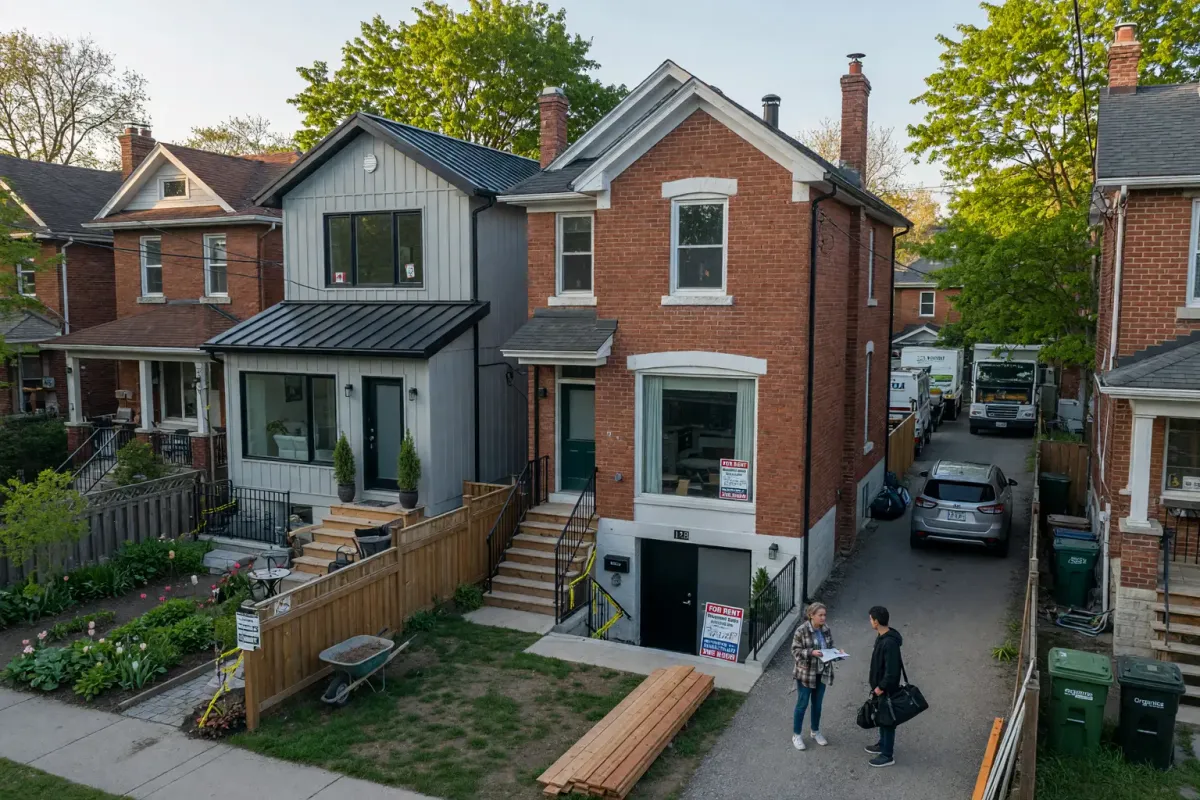
An ADU—whether it’s a basement suite, garage conversion, or backyard laneway home—turns a single-family property into a multi-income machine. You’re adding legal rental space to land you already control. No new down payment. No new mortgage qualification headaches. Just more income from the same address. Our guide to alleyway and laneway homes as an investment dives deeper into this strategy.
Here in Canada, housing shortages have pushed rents higher in almost every major market. Ontario’s Bill 23 permits up to three residential units as-of-right on most serviced residential lots, and as of 2024-2025 several Ontario municipalities (including Toronto) now allow up to four units on most residential lots. British Columbia’s Bill 44 goes further, requiring most municipalities to permit up to four units on serviced single-family lots (and up to six within 400m of frequent transit). Toronto’s Garden Suite and Laneway Suite policies have been as-of-right since the 2022 expansion. Building permits and code compliance are still required, but the zoning barrier has been removed for most properties. The federal Multigenerational Home Renovation Tax Credit (up to a $50,000 cost cap) also helps offset the cost of building a secondary suite for a qualifying senior or adult with a disability. Cities from Vancouver to Halifax have all relaxed ADU regulations to encourage more housing supply. Homeowners are adding units. Smart investors are paying close attention.
Let me show you why this strategy belongs in your toolkit—and how to execute it properly.
What Is an Additional Dwelling Unit?
An ADU is a secondary living space on a property that already has a primary residence. Think of it as a complete mini-home: kitchen, bathroom, sleeping area, and separate entrance. Just smaller and built onto (or into) your existing property.
Here’s how the main types break down:
| Type | What It Is | Typical Cost (CAD) | Best For |
|---|---|---|---|
| Basement suite | Converting existing basement to apartment | $50,000–$100,000 | Properties with 7ft+ ceiling height |
| Garage conversion | Transforming garage into living space | $60,000–$120,000 | Detached or oversized garages |
| Attic conversion | Making upper floors into separate unit | $40,000–$80,000 | Homes with suitable attic space |
| Garden suite | Detached backyard cottage | $150,000–$300,000 | Properties with adequate yard space |
| Laneway house | Home built facing back alley | $150,000–$300,000 | Properties with lane access |
The common thread? You’re creating legal, rentable living space without buying more land.
The Math That Makes ADUs Irresistible
Let me show you how this actually works with real numbers.
Say you own a single-family rental in a mid-sized Ontario city. It brings in $2,200 per month. After your mortgage, taxes, insurance, and maintenance, you’re clearing about $350 in monthly cash flow. Solid, but nothing spectacular.
Now you add a legal basement suite for $80,000. Your main unit rent drops slightly to $1,900 (since tenants no longer have exclusive use of the whole property). But your new basement suite pulls in $1,350 per month.
Total rent: $3,250.
Even with slightly higher expenses for the second unit, your cash flow jumps to $850 or $900 monthly. You just more than doubled your cash flow from a single project.
That $80,000 investment is now paying you 12–15% annually in additional cash flow. Plus, you’ve increased the property’s overall value—often by more than you spent on construction.
This is why ADUs get investors excited. The returns are exceptional. The risk is manageable. And you’re not taking on the complexity of acquiring an entirely new property.
If an $80,000 basement suite could more than double your monthly cash flow the way the example above shows, book a free strategy call with LendCity and we will help you figure out financing for the project.
Getting your financing strategy right from the start saves you from costly mistakes down the road — book a free strategy call with LendCity before you make your next move.
The right financing product can change the math on this entirely — explore our multi-family mortgage financing guide for the options most investors use.
House Hacking Your Way to Financial Freedom
If you’re living in your property, ADUs unlock serious house hacking opportunities.
Traditional house hacking means renting rooms in your home. It works, but it also means sharing your kitchen with strangers. For most people, that’s a hard pass.
ADUs solve this problem completely. You live in one unit. They live in another. Separate entrances. Separate spaces. Separate lives. You collect rent without sacrificing privacy.
For first-time investors, this setup is ideal. You’re learning landlording basics—tenant screening, rent collection, maintenance—while living on-site where you can see everything. When the furnace breaks at 11 PM, you’re right there. It’s like landlord training wheels with a built-in safety net.
The income impact can be transformative. If your mortgage payment is $2,800 and your ADU tenant pays $1,400, you’ve just cut your housing cost in half. That freed-up cash can accelerate debt paydown, fund your next investment, or simply give you breathing room.
I’ve seen young investors in Toronto and Vancouver use this exact strategy to afford neighbourhoods they never thought possible. The ADU income makes the difference between stretching thin and building wealth. For homeowners 55 and older, ADUs also support aging in place — and if construction funding is a concern, learn how reverse mortgages help Canadian seniors age in place while financing the project without monthly payments.
Turning Single-Family Into Multi-Family
Beyond house hacking, ADUs let you convert single-family investments into multi-family properties. This matters more than most investors realize.
Multiple income streams reduce your risk. If your single-family tenant moves out, you have zero income while finding a replacement. With two units, losing one tenant still leaves you with income covering most of your expenses. That’s diversification at the property level.
Smaller units expand your tenant pool. Two units renting for $1,400 each attract different tenants than one unit at $2,500. You’re reaching renters who want quality housing but can’t afford larger places. This often means faster tenant placement and less vacancy.
Multi-unit properties command better valuations. When you eventually sell, properties with established secondary income streams attract premium offers—especially from investor buyers who can immediately see the cash flow potential.
Your financing power increases. Many lenders will consider ADU income when qualifying you for future investment property mortgage options. The added rental income improves your debt service ratios, potentially letting you acquire more properties faster.
Wondering whether a HELOC or a refinance is the smarter way to fund your ADU project? Book a free strategy call with us and we will compare the costs for your specific property.
The difference between a good deal and a great one often comes down to how it’s financed — schedule a free strategy session with us and let’s look at the numbers together.
How to Handle Zoning and Permits in Canada
Here’s where ADU projects get complicated: every municipality has different rules.
Some Canadian cities have embraced ADUs and made them relatively easy to build. Ontario’s Bill 23 permits up to three units as-of-right province-wide (with several municipalities allowing four), meaning most Ontario property owners no longer need a rezoning application — just a building permit. British Columbia’s Bill 44 forces most municipalities to allow up to four units on standard residential lots. Vancouver and Edmonton have also streamlined their ADU processes. In other provinces, rules remain more variable, with some municipalities offering streamlined programs while others still have lengthy approvals and more restrictive requirements.
Before you get excited about adding an ADU, you need to understand what your specific city allows.
Answer these questions first:
Is your property zoned for ADUs? Some residential zones permit them by right. Others require special permits or variances. A few still don’t allow them at all.
What size restrictions apply? Many jurisdictions cap ADU square footage—either as absolute maximums (say, 90 square metres) or as percentages of the primary dwelling.
What setback and placement rules exist? Detached ADUs typically must maintain certain distances from property lines and the main house.
Does your city require additional parking? Some municipalities mandate extra parking spaces for ADUs. Others (like Toronto for laneway suites) have waived parking requirements to encourage development.
What building code standards apply? Ceiling heights, egress windows, fire separation, smoke detectors, soundproofing between units—all have specific requirements that affect your design and costs.
Your first move: call your local planning department. Explain what you’re considering and ask what regulations apply. This 20-minute conversation can save you from pursuing projects that aren’t permitted—or from missing requirements that will derail your plans six months in.
Picking the Right ADU Type for Your Property
Different ADU types suit different properties and budgets.
Basement suites are often the most cost-effective option. You’re working within your existing building footprint. If your basement has decent ceiling height (usually 7 feet minimum for legality, though requirements vary by province) and access to utilities, conversion can be straightforward. You’re adding walls, finishes, a kitchen, a bathroom, and a separate entrance—not building from scratch.
Garage conversions work well when you have a detached garage or can sacrifice parking. The structure already exists. You’re upgrading it to residential standards: insulation, heating, plumbing, proper windows. Costs vary wildly depending on the garage’s starting condition.
Attic conversions can be economical if your home has suitable upper-floor space. You’ll likely need dormers for adequate headroom. Access—meaning proper stairs—is often the trickiest engineering challenge.
Garden suites and laneway homes cost more because you’re building complete structures. But they offer maximum privacy separation, often command the highest rents, and can be designed specifically for rental appeal rather than working within existing constraints.
The right choice depends on your property, your budget, local regulations, and your goals. Sometimes the decision is obvious—you have a high-ceiling basement, so that’s your ADU. Other times you have options and need to run numbers on different scenarios.
Managing Your ADU Construction Project
ADU projects are construction projects. Expect the complexity that comes with them.
Get multiple contractor bids. Don’t hire the first contractor who returns your call. Get at least three bids. Check references. Verify licensing and insurance. Ask specifically about their ADU experience—these projects have unique requirements.
Budget for surprises. Construction always costs more than quoted. Plan for 15–20% contingency on top of estimates. When you open walls, you find things. Old wiring. Moisture damage. Structural issues. Budget for the unexpected.
Understand realistic timelines. Permit processing alone can take 6–12 weeks in some municipalities. Construction has its own schedule. Canadian weather affects exterior work. Don’t count on rental income until the unit is actually complete and occupied.
Plan around existing tenants. If you’re adding an ADU to an occupied property, construction will affect current tenants. Noise, workers on site, utility disruptions—these create friction. Many investors wait for natural tenant turnover before starting major ADU projects.
Financing Your ADU Project
You have several options to fund ADU construction:
Home equity line of credit (HELOC). If you have equity in your property, a HELOC gives you flexible access to funds. You only pay interest on what you draw. Many investors prefer this approach for renovation projects.
Refinance and pull equity. Refinancing to access equity can make sense — especially if you’re locking in for a longer term. Run the numbers carefully on closing costs versus HELOC fees.
Construction or renovation loans. Some lenders offer products specifically designed for refinancing your home to add a rental unit. These sometimes include draws tied to construction milestones.
Personal savings. If you have cash, using it avoids financing costs entirely. But consider whether that capital might earn better returns deployed elsewhere while you finance the ADU at relatively low rates.
Talk to a mortgage broker about which option gives you the best terms for your specific situation.
Key Takeaways:
- What Is an Additional Dwelling Unit?
- The Math That Makes ADUs Irresistible
- House Hacking Your Way to Financial Freedom
- Turning Single-Family Into Multi-Family
- How to Handle Zoning and Permits in Canada
Frequently Asked Questions
Will an ADU increase my property value?
How should I handle utilities for my ADU?
What about insurance for my ADU?
Can I manage an ADU myself?
What rents can ADUs realistically command?
How long does it take to get ADU permits?
Can I finance ADU construction through my mortgage?
Your Next Move
Additional dwelling units represent one of the smartest plays in Canadian real estate right now. You’re creating new housing without buying new property. Adding income streams to existing investments. Building equity through improvement rather than acquisition.
The work isn’t trivial. You’ll need to research regulations, manage construction, and operate multi-unit properties. But the returns can be exceptional. The risks are manageable. And you’re solving a genuine housing need in your community while building your own wealth.
If you own property with ADU potential, here’s your homework: learn how to analyze a rental property the right way. Call your local planning department this week. Get contractor estimates on what a basement suite or garden suite would actually cost.
You might discover that your next best investment isn’t buying something new—it’s maximizing what you already have.
Free tool
Build a property proforma
Fill in income and expenses, then export a Year-1 operating statement (NOI, cap rate, cash flow, DSCR).
Disclaimer: LendCity Mortgages is a licensed mortgage brokerage. Content on this page is for educational purposes only and does not constitute legal, tax, investment, securities, or financial-planning advice. Rates, premiums, program terms, and regulations referenced are as of the page's last updated date and are subject to change. Any investment returns, rental yields, tax savings, or case-study figures shown are illustrative only — they are not guaranteed, not typical, and individual results will vary. Consult a licensed lawyer, Chartered Professional Accountant, or registered dealer before acting on any information above. Editorial standards.

Written by
Scott Dillingham
Published
February 5, 2026
· Updated June 29, 2026Reading time
11 min read
ADU
Accessory Dwelling Unit - a secondary residential unit on a single-family property, such as a basement suite, laneway house, garden suite, or in-law suite. ADUs increase rental income and property value while leveraging existing land and infrastructure.
Bank of Canada
Canada's central bank that sets the overnight lending rate, which influences prime rates and mortgage costs across the country. Rate decisions directly impact variable mortgage rates and overall borrowing costs for real estate investors.
Cash Flow
The money left over after collecting rent and paying all expenses including mortgage, taxes, insurance, maintenance, and property management. Positive cash flow is the primary goal of buy-and-hold investors. See also [NOI](/glossary/noi/), [Cash-on-Cash Return](/glossary/cash-on-cash-return/), and [Vacancy Rate](/glossary/vacancy-rate/).
Closing Costs
Fees paid when completing a real estate transaction, including legal fees, land transfer tax, title insurance, appraisals, and adjustments. Closing costs affect your total cash invested and therefore your [cash-on-cash return](/glossary/cash-on-cash-return/).
Contractor
A licensed professional hired to perform construction, renovation, or repair work on investment properties. Using licensed and insured contractors is essential for permitted work, as unlicensed contractors can result in voided insurance, property liens, and liability for injuries.
Debt Service Ratio
A broad term for ratios measuring a borrower's ability to service debt. In Canadian residential lending, the key ratios are GDS and TDS. In commercial lending, the DSCR serves a similar function but focuses on property income rather than personal income.
Down Payment
The upfront cash payment when purchasing a property. For 1-4 unit investment properties, minimum 20% down is required. 5+ unit multifamily can use CMHC MLI Select with lower down payments, and house hackers can put as little as 5% down on owner-occupied 2-4 plexes. Your down payment directly affects your [LTV](/glossary/ltv/) and the amount of [leverage](/glossary/leverage/) you use.
Equity
The difference between a property's current market value and the remaining mortgage balance. If your home is worth $500,000 and you owe $300,000, you have $200,000 in equity. Equity builds through mortgage payments, [appreciation](/glossary/appreciation/), and [forced appreciation](/glossary/forced-appreciation/). See also [LTV](/glossary/ltv/) and [Refinancing](/glossary/refinancing/).
HELOC
Home Equity Line of Credit - a revolving credit line secured against your home's equity, allowing you to borrow as needed up to a set limit.
House Hacking
Living in one unit of a multi-unit property while renting out the others to offset your mortgage payments and living expenses.
Secondary Suite
A self-contained rental unit within or attached to a single-family home, such as a basement apartment, laneway house, or garden suite. Secondary suites help investors generate additional rental income from one property and can qualify for rental offset programs that improve mortgage qualification.
Construction Financing
A short-term loan that funds the building or major renovation of a property, disbursed in stages (draws) as construction milestones are completed. Once building is finished, the construction loan is typically replaced with a permanent mortgage through a process called takeout financing. Interest is charged only on the amount drawn.
Hover over terms to see definitions. View the full glossary for all terms.