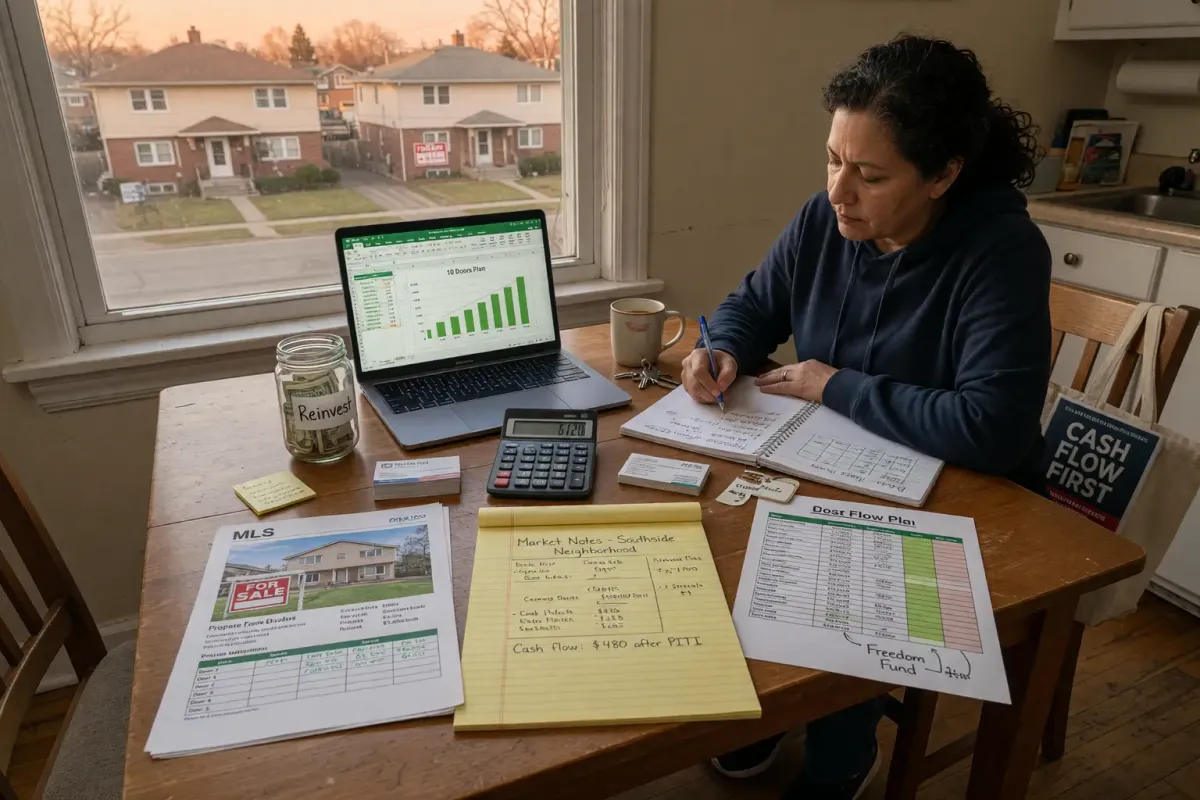
Financial freedom through real estate—living off passive income rather than trading time for money—is the goal many investors chase. But simply buying properties isn’t enough to get there.
Investment property financing is the foundation. Success requires understanding fundamentals, setting realistic expectations, and being willing to learn from those who’ve done it before you.
Let me show you how to start this journey the right way.
Set Clear Goals First
Never enter the market without a clear plan. Blindly purchasing properties without defined goals wastes time and money on investments that don’t serve your objectives.
Get Specific
What does financial freedom mean for you?
Maybe your monthly expenses are $5,000, and you want rental cash flow to cover that within seven years. Maybe you want to replace your employment income entirely within ten years so you can leave your job.
Set specific, measurable goals with timelines. Use a SMART frame—Specific, Measurable, Achievable, Relevant, and Time-bound—and stack short-term milestones (0–12 months), medium-term portfolio targets (1–5 years), and long-term freedom goals (5+ years). This creates accountability and lets you track progress objectively rather than vaguely hoping things work out. Review goals quarterly so you can adjust without constantly changing course.
Match Strategy to Market
Different markets favor different approaches:
Strong tourism areas? Short-term vacation rentals might offer exceptional returns.
Stable employment and population growth? Long-term residential rentals provide consistent cash flow. The choice between single-family vs duplex investment depends on your market and budget.
Value-add opportunities? Purchase undervalued properties, improve them, rent at higher rates or sell for profit.
The key is matching your strategy to both market conditions and your personal capabilities, resources, and risk tolerance.
Know Your Budget Before You Shop
Many new investors fall in love with properties before confirming they can afford them. Establishing your budget first prevents wasted effort on deals you can’t close.
Get Pre-Approved
One of the best early steps is getting an investment property mortgage pre-approval.
Pre-approval accomplishes:
- Tells you exactly how much financing you qualify for
- May lock in interest rates for a specified period
- Demonstrates to sellers you’re a serious, qualified buyer
| Budget Component | What to Consider |
|---|---|
| Down payment | Investment properties typically require 20-25%. See first-time investor financing options in Canada |
| Closing costs | Budget 2-5% for legal, inspection, title |
| Immediate repairs | Factor in any urgent issues |
| Cash reserves | Maintain 3-6 months of expenses |
| Carrying costs | Mortgage, insurance, taxes while vacant |
Don’t Overspend
The temptation to spend your maximum approval is understandable but dangerous. Spending at your limits leaves no margin for error.
Smart investors stay below maximum approval. This preserves cash for improvements, unexpected repairs, and future opportunities. It creates buffer room so normal fluctuations don’t create crises.
Overestimate costs on purpose. Closing costs on investment purchases often run closer to 2–5% of price when you include legal fees, land transfer tax, title insurance, inspections, and appraisals—so don’t plan on the bare minimum. For renovations, many experienced investors add about 20% contingency; a “simple” repair can uncover water damage or mould that changes the budget overnight.
Before you fall in love with a property, get pre-approved for investment financing so you know your actual buying power—book a free strategy call with LendCity and we’ll show you exactly what you qualify for and which lenders work best for your investor profile.
Real estate investing is a team sport, and your mortgage strategy is the foundation — book a free strategy call with LendCity to make sure yours is solid.
If this approach is on your radar, our multi-family mortgage financing guide walks through how LendCity structures these deals.
Practice Patience
Impatience causes many new investors to make costly mistakes.
Market Timing
Investors who panic and sell during downturns often watch the market recover shortly after—realizing losses that patience would have avoided.
Those who buy hastily during peaks expecting continued appreciation may find themselves underwater when prices correct. Understanding different strategic real estate investment approaches helps you choose the right strategy for current market conditions. For hands-off alternatives, explore our guide to real estate crowdfunding. See how a government worker built a real estate empire for inspiration.
Patient investors who study cycles and wait for favorable conditions consistently outperform those who feel compelled to act constantly.
Property Evaluation
Taking time to research neighborhoods, analyze comparables, inspect thoroughly, and negotiate terms serves you far better than rushing to close.
There are situations where speed matters. But most transactions allow adequate time for due diligence if you’re organized and prepared.
Build Your Professional Network
The value of a strong network cannot be overstated.
Real estate agents with investment experience can alert you to opportunities before they hit the public market.
Mortgage brokers specializing in investment properties understand which lenders work best for different situations. Relationships can form anywhere—see how exercise won me a $3 million mortgage client.
Contractors who’ve worked with you successfully may offer better pricing and priority scheduling.
Each relationship creates advantages that accelerate your progress. Stories like living your dreams: lessons from a cross-Canada cyclist show how goal-setting and perseverance apply equally to real estate investing.
Building the Network
This requires intentional effort:
- Attend local real estate investment meetings
- Join investor groups
- Participate in industry events
Focus on providing value to others rather than just extracting value. Help when you can, share useful information generously, and follow through on commitments consistently. Beyond agents and brokers, add a real estate lawyer, an accountant who understands rental taxation, reliable contractors, and an insurance broker who can place proper landlord coverage (not just a standard homeowner policy).
Protect the assets as you grow. Use landlord insurance (and consider an umbrella policy), require tenants to carry renters insurance where appropriate, and never skip building permits—unpermitted work can void coverage, complicate sales, and trigger expensive remediation.
Your professional network—especially a mortgage broker who understands investment properties—can be the difference between good deals and great ones, so schedule a free strategy session with us and let’s build your financing strategy alongside your investment plan.
Multifamily financing has different rules than residential — schedule a free strategy session with us and we’ll show you exactly what you qualify for under CMHC or conventional programs.
Take the First Step
The journey begins with action. Getting pre-approved for financing provides an excellent starting point—it clarifies purchasing power, educates you about the mortgage process, and positions you to move quickly when opportunities arise.
Education Plus Action
The most successful investors combine learning with doing rather than endlessly studying without making moves.
Thorough preparation matters. But paralysis by analysis prevents many would-be investors from ever getting started. At some point, you’ve learned enough to make smart choices and need to start applying that knowledge.
Your first deal will teach you more than months of additional study.
Marathon, Not Sprint
Most investors who achieve genuine financial independence do so over 10-20 years through consistent, disciplined investing—not through a few lucky deals.
Set realistic timeline expectations. Celebrate progress along the way. Trust the process even when results seem slow.
Each property you acquire, each lesson you learn, and each relationship you build contributes to a foundation that eventually supports the financial freedom you seek.
Frequently Asked Questions
How much money do I need to start?
What property should I buy first?
How do I know if a property is a good investment?
Should I quit my job to invest full-time?
How long until I achieve financial freedom?
Why is building a professional network so important for new investors?
Should I spend my maximum mortgage pre-approval amount?
Why is pacing portfolio growth important for new investors?
How much contingency should I add to renovation budgets?
Key Takeaways:
- Set Clear Goals First
- Know Your Budget Before You Shop
- Practice Patience
- Build Your Professional Network
- Take the First Step
The Bottom Line
Financial freedom through real estate is achievable—but it requires patience, education, and strategic planning.
Set clear goals. Know your budget. Be patient. Build your network. Take action.
Each property and each year of experience brings you closer to the goal. And many investors find the journey itself rewarding even before reaching complete financial independence.
Free download
MLI Select document checklist
Appraisals, rent rolls, environmental reports, and the CMHC package lenders expect before they underwrite.
By submitting, you agree to receive occasional emails from LendCity. You can unsubscribe at any time.
4.8/5 (116 Google reviews)
Disclaimer: LendCity Mortgages is a licensed mortgage brokerage. Content on this page is for educational purposes only and does not constitute legal, tax, investment, securities, or financial-planning advice. Rates, premiums, program terms, and regulations referenced are as of the page's last updated date and are subject to change. Any investment returns, rental yields, tax savings, or case-study figures shown are illustrative only — they are not guaranteed, not typical, and individual results will vary. Consult a licensed lawyer, Chartered Professional Accountant, or registered dealer before acting on any information above. Editorial standards.

Written by
Scott Dillingham
Published
February 14, 2026
· Updated August 2, 2026Reading time
8 min read
1% Rule
A quick screening formula where the monthly rent should equal at least 1% of the purchase price. A $200,000 property should rent for $2,000/month to pass the test. It's a rough filter for cash flow potential — not a substitute for full analysis, but useful for quickly eliminating poor deals.
A Lender
A major bank or institutional lender offering the most competitive mortgage rates and terms but with the strictest qualification criteria, including full income verification and stress test compliance. Most investors use A lenders for their first four to six properties.
Appreciation
The increase in a property's value over time, which builds [equity](/glossary/equity/) and wealth for the owner through market growth or [forced improvements](/glossary/forced-appreciation/).
Buying Power
Buying power refers to the maximum property value or mortgage amount a real estate investor can qualify for based on their income, credit score, existing debts, and available down payment. For Canadian investors, this determines how much property they can acquire and is directly affected by current interest rates, lending guidelines from OSFI, and stress test requirements.
Carrying Costs
The ongoing expenses of holding a property, including mortgage payments, property taxes, insurance, utilities, and maintenance. Understanding carrying costs is essential during renovation periods when the property generates no rental income.
Cash Flow
The money left over after collecting rent and paying all expenses including mortgage, taxes, insurance, maintenance, and property management. Positive cash flow is the primary goal of buy-and-hold investors. See also [NOI](/glossary/noi/), [Cash-on-Cash Return](/glossary/cash-on-cash-return/), and [Vacancy Rate](/glossary/vacancy-rate/).
Cash Reserve
Liquid funds set aside by a property investor to cover unexpected expenses such as repairs, vacancy periods, or mortgage payments during tenant turnover. Lenders may require proof of cash reserves as part of mortgage qualification.
Closing Costs
Fees paid when completing a real estate transaction, including legal fees, land transfer tax, title insurance, appraisals, and adjustments. Closing costs affect your total cash invested and therefore your [cash-on-cash return](/glossary/cash-on-cash-return/).
Contractor
A licensed professional hired to perform construction, renovation, or repair work on investment properties. Using licensed and insured contractors is essential for permitted work, as unlicensed contractors can result in voided insurance, property liens, and liability for injuries.
Down Payment
The upfront cash payment when purchasing a property. For 1-4 unit investment properties, minimum 20% down is required. 5+ unit multifamily can use CMHC MLI Select with lower down payments, and house hackers can put as little as 5% down on owner-occupied 2-4 plexes. Your down payment directly affects your [LTV](/glossary/ltv/) and the amount of [leverage](/glossary/leverage/) you use.
Hover over terms to see definitions. View the full glossary for all terms.