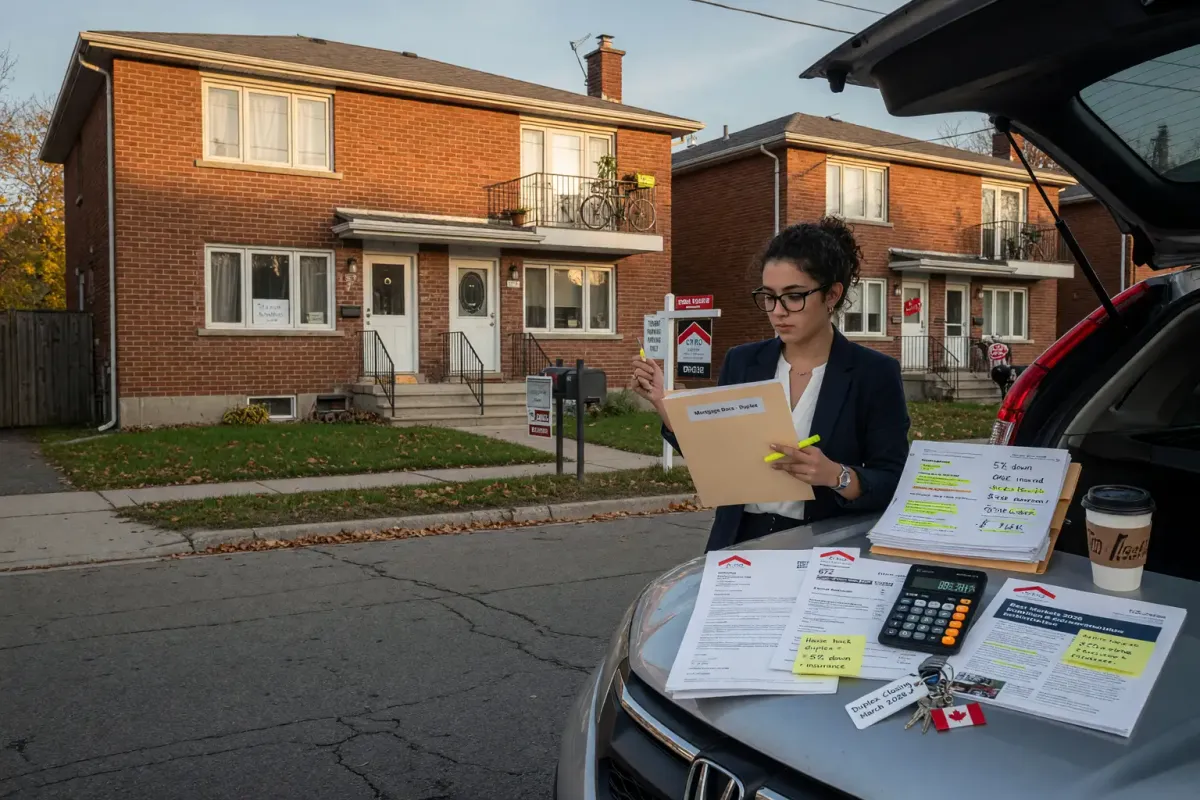
If you’re buying your first investment property in Canada and trying to figure out how to actually pull it off, this guide is built for you. I’ve worked with hundreds of first-time investors over the last 15+ years at LendCity, and almost every single one walked in with the same three questions: How much money do I really need? Will the bank actually approve me? And what should I buy first?
The answers are not as scary as the internet makes them sound. They are also not as simple as a bank’s “here’s our pre-approval calculator, good luck” pitch makes them seem. Most first-time investors quit before they buy because nobody lays out the full picture in one place. Banks won’t do it — they’ll just tell you what they offer and hope you don’t ask about alternatives.
This is the complete pillar guide. We’ll cover savings-tier-to-deal-type matching, exact down payment and closing cost math, what underwriters actually look at, how to pick your first city, owner-occupied loopholes, the 90-day pre-approval plan, stress test mechanics, and the mistakes that kill first deals. Then we’ll walk through every mortgage option in the country so you can pick the one that fits.
Not sure which path is right for your savings and timeline? Let’s review your numbers and map out the cleanest route to your first deal.
Your First Investment Property: 5 Paths From $50K to $500K Saved
The single biggest variable in your first deal isn’t credit score or income — it’s how much liquid capital you can put together. The amount you have available dictates whether you can buy a $400,000 condo or a $1.2M four-plex, whether you go owner-occupied or pure rental, and whether CMHC insurance even enters the conversation.
Here’s how I map first-time investors to realistic first deals at LendCity, based on liquid capital available (down payment + closing costs + reserves):
| Savings Tier | Realistic First Deal | Strategy | Cash Required (Estimate) |
|---|---|---|---|
| $40K-$70K | Owner-occupied duplex or triplex under $500K (smaller markets like Windsor, Sault Ste. Marie, Saint John, Moncton) | House hack with 5% down + CMHC insurance | $35K down + $8K-$12K closing + $5K-$10K reserves |
| $70K-$120K | Owner-occupied duplex or triplex up to $750K (Hamilton, London, Ottawa suburbs, Halifax) | House hack with 5/10% blended down | $55K-$85K down + $12K-$18K closing + reserves |
| $120K-$200K | Pure rental single-family or duplex in a mid-tier market ($450K-$700K) | 20-25% down with conventional A-lender financing | $90K-$170K down + closing + reserves |
| $200K-$350K | Pure rental duplex/triplex in a stronger market, or owner-occupied 4-plex up to $1.5M | Conventional rental OR 5/10% blended on owner-occupied 4-plex | $150K-$280K down + closing + reserves |
| $350K-$500K+ | Pure rental fourplex, small multi-family entry (5-6 units via CMHC MLI Select), or first deal in a major market | Conventional + portfolio thinking from day one | Larger down + commercial closing costs (3-5%) |
A few patterns to notice:
- Owner-occupied is almost always the cheapest entry. Until you have 20% saved, owner-occupied 2-4 unit is your most capital-efficient first move because CMHC insurance lets you stretch from 5% to 19.99% down on properties up to $1.5M.
- Closing costs and reserves are not optional. Most first-time investors budget down payment and stop there. Lenders want to see 1.5% of purchase price for closing costs plus 3-6 months of mortgage payments in reserves after closing.
- Smaller markets win on capital efficiency. A $400,000 triplex in Windsor cash flows in a way that a $900,000 Toronto duplex simply cannot at 5% down. That’s why we’ll talk through market selection later in this guide.
Down Payment, Closing Costs, and Reserves: What You Actually Need
The down payment is the part everyone obsesses over. It’s also the smallest part of the cash-to-close picture for most first-time investors.
Here’s the full breakdown of cash you need to assemble before closing day:
1. Down payment (the big one)
| Property Type | Owner-Occupied | Pure Rental |
|---|---|---|
| 1-unit (single-family) | 5% (under $500K), 5%+10% blended ($500K-$1.5M) | 20% minimum |
| 2-unit (duplex) | 5% (under $500K), 5%+10% blended ($500K-$1.5M) | 20% minimum |
| 3-unit (triplex) | 5% (under $500K), 5%+10% blended ($500K-$1.5M) | 20% minimum |
| 4-unit (fourplex) | 5% (under $500K), 5%+10% blended ($500K-$1.5M) | 20% minimum |
| 5+ unit (small multi) | N/A | 15% via CMHC MLI Select, 25-35% conventional |
The 5%+10% blended structure on owner-occupied 2-4 unit between $500K and $1.5M works like this: 5% on the first $500K, 10% on every dollar above. A $900,000 duplex requires $25,000 (5% of $500K) + $40,000 (10% of $400K) = $65,000, not the $180,000 a 20% rental would require.
2. CMHC / Sagen / Canada Guaranty insurance premium (only on insured deals)
This isn’t paid upfront — it’s added to your mortgage and amortized. But it’s real money. Premiums in 2026 typically run:
- 5% down → roughly 4.00% of the mortgage
- 10% down → roughly 3.10%
- 15% down → roughly 2.80%
- 20%+ down → no insurance premium
On a $400,000 mortgage at 5% down, you’re financing roughly $16,000 in insurance into the loan. PST is also charged on the premium in Ontario, Quebec, Manitoba, and Saskatchewan, and that part is due in cash at closing — usually $1,000-$2,500.
3. Closing costs (cash at closing)
| Cost Item | Typical Range |
|---|---|
| Land transfer tax | 0.5-3% of purchase price (varies by province; Toronto adds municipal LTT) |
| Legal fees (lawyer + disbursements) | $1,800-$3,500 |
| Property inspection | $400-$800 |
| Appraisal (if not covered by lender) | $400-$600 |
| Title insurance | $300-$500 |
| PST on CMHC premium (ON, QC, MB, SK) | $1,000-$2,500 |
| Property tax / utility adjustments | $500-$2,500 |
| Insurance prepayment | $1,200-$2,500 |
| Total typical range | 1.5-4% of purchase price |
First-time buyers (including first-time investors who haven’t owned before) get partial land transfer tax rebates in Ontario, BC, PEI, and Toronto — up to $4,000 in Ontario and another $4,475 in Toronto. Don’t leave that on the table.
4. Cash reserves (the part lenders quietly require)
Most A lenders want to see you walk away from closing with 3-6 months of mortgage payments still in the bank. For investment properties specifically, monoline lenders and B lenders often push that to 6-12 months. On a $2,400/month mortgage, that’s $14,000-$29,000 sitting in your account after you close.
This is the reserve number nobody talks about, and it’s why “I have my 5% down” rarely equals “I’m actually ready to close.” Build it into your plan from day one.
What Lenders Look For From First-Time Investors
When an underwriter at a Canadian lender opens a first-time investor file, they’re checking the same five buckets, in roughly the same order. If you know what’s in each bucket before you apply, you stop being a “first-timer” in the underwriter’s eyes — you become a prepared borrower, and that gets you approvals.
1. Credit score and credit depth
- 680+ unlocks the best A-lender rates and the cleanest approvals.
- 650-680 is workable at most A lenders but you’ll get tighter scrutiny on debt ratios.
- 600-650 generally pushes you into B-lender territory with rate premiums of 1-2%.
- Below 600, expect B or private lending with fees rolled in.
Depth matters too. Underwriters want to see at least 3 active trade lines with 2+ years of history. A 720 score with one credit card and one car loan is weaker than a 680 with five tradelines and a 7-year mortgage already on file.
2. Income — verifiable, consistent, and not exclusively rental-dependent
The big A lenders want T4 income, two years of T1 Generals, or for self-employed borrowers, two years of business financials with line 150 figures that support the deal. If your income is variable (commission, bonus, self-employment), expect them to use an average of the last two years. They won’t extrapolate from your best year.
If you’re self-employed and your reported income is too low because of legitimate write-offs, you’re not stuck — you’ll just want B-lender or stated-income programs through a broker.
3. Debt-service ratios (GDS and TDS)
Lenders calculate:
- GDS (Gross Debt Service): Principal + interest + property tax + heat (+ 50% of condo fees) ÷ gross income. Max 39% for most A lenders.
- TDS (Total Debt Service): GDS + all other debts (cars, loans, credit cards minimum payments, lines of credit) ÷ gross income. Max 44%.
Both are calculated at the qualifying rate, not the contract rate. That’s the stress test, which we’ll cover in detail later. The fastest way for a first-time investor to fail a TDS check is unsecured credit card balances and car loans — pay those down before you apply.
4. Down payment source and “sourcing” requirements
CMHC and the insurers require 90 days of bank statements showing the down payment didn’t appear out of nowhere. They’ll ask for explanations on any deposit over $1,000 that isn’t payroll. Gift money from immediate family is allowed but needs a signed gift letter. Borrowed funds (HELOC, line of credit) are allowed at most A lenders but get added to your TDS.
5. Property itself (the deal must qualify, not just you)
For a duplex or triplex, the appraiser confirms the units are legal (or “legal non-conforming”), the rents are at fair market value, and the property meets lender condition standards. About 1 in 8 first-time investor deals at LendCity hits a snag on the property side — usually an illegal third unit, a Knob & Tube electrical system, or a property that won’t appraise at the contract price.
Common decline reasons we see on first-time investor files:
- Stress-tested TDS over 44% (the most common — usually fixed by paying down unsecured debt)
- Down payment that can’t be sourced (recent unexplained deposit)
- Self-employed income too low after write-offs (broker B-lender fix)
- Illegal secondary unit (deal-killer until the unit is legalized or removed from the income calc)
- Property is a former grow-op, has a UFFI affidavit issue, or fails a CMHC condition
The good news: every single one of these has a fix if you start the conversation 60-90 days before you actually want to buy.
Single-Family vs Duplex vs Small Multi: Which Should You Buy First?
There is no “correct” first property type — only a correct one for your situation. Here’s how I help first-time investors decide.
Single-family detached
- Pros: Easiest to manage, broadest tenant pool, easiest to refinance/sell, lowest down payment dollar amount because price points are lower.
- Cons: Single income stream means 100% vacancy when the tenant leaves. Rarely cash flows meaningfully at current rates unless you bought right or you’re in a high-rent market.
- Best for: Investors prioritizing simplicity, appreciation markets, or a stepping stone before scaling.
Duplex (2-unit)
- Pros: Two income streams reduces vacancy risk. Qualifies for 5% down owner-occupied. Often the cash-flow sweet spot in markets like Hamilton, Kitchener-Waterloo, London, Halifax.
- Cons: Tenant management doubles. Some markets have very few legal duplexes available.
- Best for: House hackers and first-time investors who want cash flow without commercial complexity.
Triplex / Fourplex (3-4 unit)
- Pros: Best per-unit economies of scale that still qualifies as residential financing. Insurance one building, manage one roof, collect 3-4 rents. Owner-occupied 5% down still applies up to $1.5M.
- Cons: Higher purchase price means a bigger absolute down payment. Tenant churn is more constant. Property management often becomes necessary.
- Best for: First-time investors with $80K+ saved who want to skip the single-family phase entirely.
5+ unit small multi-family
- Pros: Commercial financing through CMHC MLI Select can require less equity (as low as 15%) than a 4-plex residential rental (20%). Cap-rate-based valuation creates forced-appreciation opportunities.
- Cons: Commercial closing costs, environmental reports, longer underwriting (90-120 days), and a more complex first deal than most beginners are ready for.
- Best for: First-time investors with deep capital ($250K+) or partners, willing to do a more advanced first deal.
My honest take, after a decade and a half: if you can house hack a duplex or triplex, do that. It compresses years of learning into one deal, lets you use CMHC’s 5% down loophole, and gets you cash-flowing on day one with your living expenses substantially subsidized.
Owner-Occupied vs Pure Rental: The Financing Difference You Cannot Ignore
This is the single most important financing concept for first-time investors, and almost nobody explains it properly.
Owner-occupied (you live in one unit):
- 5% down on first $500K + 10% on $500K-$1.5M portion
- CMHC, Sagen, or Canada Guaranty default insurance available
- Up to 4 units allowed in the same building
- Insurance premium financed into the mortgage
- A lender will count the rental income from the other units (typically 50-80%)
- Lowest market rates available, often 0.20-0.40% below uninsured
Pure rental (you don’t live there):
- 20% minimum down payment on 1-4 unit residential
- No default insurance available on the residential side (commercial side has CMHC MLI Select for 5+ units)
- Rates typically 0.10-0.30% above insured pricing
- Rental offset rules apply (50-80% of gross rent counted toward your income)
The loophole most first-time investors miss: you can live in one unit of a duplex, triplex, or fourplex for 12 months, then move out and convert the property to a pure rental — keeping the original mortgage at its insured rate and lower down payment. There’s no “5-year owner-occupancy” rule like some US loan programs have. Once your initial occupancy is satisfied, the property becomes a regular rental and you can repeat the strategy on your next purchase (though insured purchases on a second owner-occupied property require the prior property to no longer be owner-occupied).
That single trick — house hack, occupy 12 months, move out and rent all units — has built more first-time investor portfolios in Canada than every BRRRR strategy combined. Use it.
Market Selection: How to Pick Your First City
Where you buy matters as much as what you buy. Major Toronto and Vancouver markets, despite the population and prestige, are some of the worst markets for first-time investors to start in — price-to-rent ratios mean cash flow is structurally negative on most properties at current rates, and the down payment requirement to enter the market shuts out most beginners.
Better first-time investor markets share three characteristics: purchase prices low enough for your capital, rents high enough to cover most expenses, and population/employment trends that support rental demand.
Here’s how I rank the most common first-time investor markets in 2026:
Hamilton, ON — One of the best cash-flow-to-appreciation balance plays in Canada. Legal duplex inventory is solid, prices remain accessible relative to the GTA, and a strong tenant pool drives 1.9-2.2% vacancy. Strong commuter and McMaster student demand. Search LendCity’s Hamilton mortgage broker services for local market notes.
Windsor, ON — Canada’s lowest entry point for legal multi-unit residential. Detroit cross-border employment, the new Stellantis EV plant, and Gordie Howe Bridge spending have transformed the market over the last five years. Duplexes in the $350K-$450K range still cash flow meaningfully. This is LendCity’s home base — Scott Dillingham founded the firm here. See LendCity’s Windsor mortgage broker page for local context.
Ottawa, ON — Federal employment makes this the most recession-resistant rental market in the country, with vacancy consistently sub-2%. Higher entry prices than Hamilton or Windsor, but extremely predictable rent growth and tenant quality.
Edmonton, AB — Best cash-flow market in any major Canadian city. Lower price-to-rent ratios, no provincial sales tax, and a growing population. The trade-off is more market cyclicality tied to energy prices.
Halifax, NS — Strong population growth, a tight rental market, and prices that still beat Ontario’s tier-1 markets. Out-of-province investors have flooded in over the last three years, which has compressed cap rates somewhat.
Avoid as your first market (usually): Toronto, Vancouver, Mississauga, Burnaby — high purchase prices and structurally negative cash flow at first-time-investor capital levels. Plenty of investors do well there, but rarely on their first deal with limited capital.
Should you buy out of your home market? Generally, no, on your first deal. Property management is a learned skill, and managing remotely while learning is a recipe for stress and mistakes. Buy where you can drive in 30-45 minutes for the first property. Scale geographically once you have systems.
Building Your First Team: Broker, Lawyer, Accountant, Property Manager
You don’t need a 12-person team to buy a $400,000 duplex. You need four key people, and they should all be in place before you start writing offers.
1. Mortgage broker (the one you cannot skip)
Your broker is the architect of your financing strategy across every property you’ll ever buy. For first-time investors specifically, the broker advantage over going direct to a bank is decisive — banks have one product shelf, brokers have 30-50+ lenders. We covered this in depth in the mortgage broker vs bank pillar guide, but the short version: get a broker on your first deal.
2. Real estate lawyer (with investor experience)
A residential conveyancing lawyer can close your purchase. An investor-experienced lawyer can also handle vendor take-back drafting, dual-representation conflicts when you buy under a corporation later, joint-venture agreements, and lien searches on the income side. Ask any candidate “how many duplex/triplex closings did you handle last year” — if the number is under five, keep looking.
3. Accountant familiar with rental properties
You don’t need them until tax season, but you want them lined up before closing. They’ll help you decide on personal vs corporate ownership, set up CCA (capital cost allowance) properly, and structure your record-keeping. Most general accountants undercharge for rentals because they don’t know what they don’t know — pick one who has 20+ rental clients on the books.
4. Property manager (optional on deal #1, mandatory by deal #3)
You can self-manage your first duplex. Most investors do. But have a 1-2 property manager candidate identified before you close, so you know your numbers if you ever decide to outsource. Typical fees are 8-12% of gross rent in Canada, plus tenant placement fees of 50-100% of one month’s rent.
This is the team I’ve helped first-time investors assemble more than 500 times. If you want to see who’s behind LendCity and how we approach investor financing specifically, meet the LendCity team and Scott Dillingham’s 15+ year track record.
The 90-Day Pre-Approval Game Plan
If you want to be in a position to buy your first investment property 90 days from now, this is the calendar I run with every first-time investor at LendCity.
Days 1-15: Credit and document prep
- Pull both Equifax and TransUnion reports (Borrowell + free TransUnion access). Confirm no errors.
- Pay down unsecured debt aggressively — every $1,000 paid off your credit card increases your borrowing power by roughly $3,000-$5,000.
- Gather two years of T1 Generals, three months of payroll stubs, two years of T4s, and a current employment letter.
- Pull 90 days of bank statements showing your down payment funds.
- Get a baseline TDS calculation from a broker (we do this free at LendCity).
Days 15-45: Full underwrite pre-approval
- Submit a full application package to a broker who shops the market.
- Get a full underwrite pre-approval, not just a rate hold. Most banks issue rate holds based on what you self-report; a full underwrite means the lender has actually verified your income and debt and given you a written commitment subject only to property approval.
- Lock the rate for 90-120 days.
Days 45-75: Property search with confidence
- You now know your exact maximum purchase price for owner-occupied and pure rental.
- Search the local MLS, off-market wholesalers, and FSBO listings in your chosen market.
- Run every property through a quick underwriting check (rent x 12 ÷ all-in expenses + mortgage = cash flow). Aim for break-even or better on day one in current rate environment.
Days 75-90: Conditional offer and close
- Make offers with a 5-10 day financing condition (your broker confirms lender approval during that window).
- Once financing is firmed up, set conditions on inspection (5-7 days).
- Lawyer reviews, signs, funds — typically 30-45 days from accepted offer to close.
Investors who follow this 90-day plan have a roughly 4x higher close rate on their first deal than investors who shop first and arrange financing second. Don’t be that second group.
Stress Test Mechanics for First-Time Investors
The OSFI B-20 mortgage stress test applies to all federally regulated lenders — which is all the big banks, most monolines, and many smaller lenders. Here’s exactly how it affects you as a first-time investor in July 2026.
The qualifying rate formula:
You must qualify at the higher of:
- Your contract rate + 2.00%, or
- 5.25% (the floor)
In July 2026 with 5-year fixed insured rates around 4.04-4.49% and uninsured around 4.39-4.79%, your qualifying rate is roughly 6.04-6.79%. Banks typically round to a flat ~6.39% for calculation purposes.
What this means in dollar terms:
On a $500,000 purchase with 20% down ($100,000 down, $400,000 mortgage at 4.44% over 30-year amortization):
- Contract payment: ~$2,000/month
- Stress-test payment (at 6.44%): ~$2,500/month
Your GDS/TDS ratios are calculated against the $2,500 payment, not the $2,000 you’ll actually pay. That difference is what disqualifies most tight first-time investor files.
Rental income add-back rules under the stress test:
This is where lender choice matters enormously. The rental offset method affects your debt-service calculation as follows:
| Method | How It Works | Effective Add-Back |
|---|---|---|
| Net rental method (TD, BMO, others) | Subtract property expenses from rent; offset against PITH | 50-80% effective |
| 50% net rental | 50% of net rent offsets the property’s own expenses | 50% effective |
| Rental add-back to income | 100% of rent added to gross income, expenses to TDS | 80-100% effective |
| DSCR / cash-flow-only programs | Personal income ignored entirely | 100% (property qualifies, not you) |
Same property, same borrower, same down payment — your maximum approval can vary by $150,000-$250,000 just by switching lenders. This is the single most important conversation to have with a broker before you start house hunting.
Credit unions and the stress test escape hatch:
Provincially regulated credit unions are not bound by B-20. Several across Canada — Meridian and FirstOntario in Ontario, Servus in Alberta, Coast Capital in BC — will qualify investors at the contract rate rather than the stress-test rate. This is the legal escape hatch from the stress test for borrowers with strong cash flow and tight ratios. We can match you to those programs at LendCity. Read our deep dive on how the stress test affects your buying power as an investor for the math.
First-Time Investor Mistakes That Kill Deals
After 15+ years and hundreds of first-time investor files, the same mistakes show up over and over. Avoid these and you’re already ahead of 80% of new investors.
1. Walking into your own bank first. Your bank has one product shelf. They’ll tell you what they can do, not what’s available. About 30-40% of files declined at the big banks find approval somewhere in the broader broker channel — but you’ll never know if you never asked.
2. Underestimating closing costs and reserves. “I have my 5% down” rarely means “I have what I need to close.” Build for 8-12% total cash, not 5%.
3. Counting on rental income the lender won’t count. Just because the property rents for $3,000/month doesn’t mean the lender adds $3,000 to your income. Different lenders treat rental income wildly differently — the broker advantage on this single point can be worth $200,000 in approval power.
4. Buying out of market on deal #1. Out-of-market property management is a learned skill. Learn it close to home first.
5. Skipping the inspection to win a bidding war. Even on a strong-looking duplex, the inspection routinely catches $15,000-$40,000 of deferred maintenance the listing didn’t disclose. Never waive it on your first deal.
6. Ignoring legal-unit verification. If an existing duplex’s second unit isn’t a legal unit, the appraiser will value the property at single-family levels and the lender will only count rent from the legal unit. Confirm legality before the offer is firmed up.
7. Setting up a corporation before you’ve bought your first property. Most first-time investors don’t need a corporation on deal #1, and incorporation early can cost you 0.50-1.50% on rate and complicate CMHC insurability.
8. Not stress-testing your own deal at higher rates. Today’s contract rate is roughly 4.44%, but your renewal in 5 years could be 6%. Run the math at 6% before you commit, not after.
9. Picking the lowest rate without reading the prepayment penalty schedule. A 4.39% rate at a big bank with an IRD-style penalty calculation can cost you $30,000+ on an early refinance. A 4.49% rate at a monoline with a standard 3-month interest penalty might be the better all-in math.
10. Failing to plan for property #2 before closing on property #1. The lender choices you make on deal #1 affect your ability to qualify for deal #2. Some lenders cap you at 3-4 properties total. A broker thinking 2-3 deals ahead saves you a portfolio dead-end.
Every Mortgage Option Available for Your First Investment Property
With the strategic foundation in place, here are the six core financing tools you have access to as a first-time investor in Canada. Most beginners only know about one — their bank’s standard product. There are at least six.
Option 1: CMHC-Insured Mortgages (As Low as 5% Down)
This is the one most first-time investors start with, and for good reason. If you’re going to live in the property, you can put as little as 5% down and get a mortgage insured by CMHC (Canada Mortgage and Housing Corporation) or one of the other default insurers like Sagen or Canada Guaranty.
Here’s the catch: the property must be owner-occupied. You can’t buy a pure rental with CMHC insurance. But you absolutely can buy a property you live in that also generates rental income.
This is why house hacking is so powerful for first-time investors. You buy a duplex, triplex, or fourplex. You live in one unit. You rent the others. CMHC will insure this up to four units as long as you occupy one of them.
The insurance premium gets added to your mortgage. It ranges from 2.8% to 4.0% of the mortgage amount depending on your down payment size. On a $400,000 mortgage with 5% down, you’re looking at roughly $15,200 in insurance premiums rolled into your loan. That sounds like a lot, but it gives you access to the lowest interest rates in the market and lets you get into real estate with minimal cash.
Who this is for: First-time buyers willing to live in a multi-unit property. You need a minimum credit score of 600 (higher is better), provable income, and your debt ratios need to work.
What you need: 5-19.99% down payment, strong credit, verifiable income, the property must pass CMHC’s requirements.
Option 2: Conventional Financing (20%+ Down)
If you have 20% or more to put down, you don’t need mortgage insurance. This opens up pure rental properties — you don’t have to live there.
Conventional financing through an A lender (banks, credit unions, monoline lenders) gives you the best rates after CMHC-insured products. You’ll typically see rates 0.10-0.30% higher than insured rates, which is a small premium for the freedom to buy a dedicated rental property.
The qualification process is the same as any other A lender mortgage. You need strong credit (ideally 680+), verifiable income, and your debt service ratios need to work. The lender will stress test your income at the qualifying rate.
One thing that trips up new investors: lenders only count a portion of your rental income when calculating your ratios. Most A lenders use 50-80% of the gross rental income. So if the property rents for $2,000/month, the lender might only count $1,000-$1,600 toward your income. The exact percentage depends on the lender, which is why working with a broker matters — different lenders treat rental income very differently.
Who this is for: Investors with 20%+ down payment, good credit, and provable income who want to buy a dedicated rental property.
What you need: 20% minimum down payment, 680+ credit score (ideally), T4 or T1 income documentation, property must meet lender guidelines.
Choosing the wrong lender or term can quietly erode your returns — talk to a broker who works with investors every day and we’ll walk you through the numbers.
Option 3: B Lender Products
Now we’re getting into the options your bank will never mention. B lenders are alternative lenders that serve borrowers who don’t quite fit the A lender box. And there are a lot of reasons you might not fit that box even if you’re financially responsible.
Maybe you’re self-employed and your income looks different on paper than it does in reality. Maybe you have a bruised credit score from a past rough patch. Maybe your debt ratios are slightly over the A lender limits because you already own a property or two.
B lenders are more flexible. They’ll look at your overall financial picture rather than checking rigid boxes. The trade-off is higher rates — typically 1-2% above A lender rates — and often a lender fee of 1% of the mortgage amount.
Here’s what makes B lenders valuable for investors: many of them will use stated income programs. Instead of proving every dollar with T4s and tax returns, you state your income and the lender verifies that it’s reasonable for your occupation. This is huge for self-employed investors whose taxable income is low because they write off everything.
B lenders also tend to be more generous with how they count rental income. Some will use 100% of rental income in their calculations, compared to the 50-80% most A lenders use.
Who this is for: Self-employed investors, those with credit scores between 550-680, investors whose debt ratios are tight, anyone who doesn’t fit the A lender mold.
What you need: Typically 20% down (some programs allow less), income verification varies by program, reasonable credit history.
Option 4: Private Lending
Private lenders are individuals or companies that lend their own money secured against real estate. They don’t care about your income. They don’t care about your credit score (much). What they care about is the property itself and the equity position.
Private lending is expensive. Rates typically run 8-15%, and there’s usually a lender fee of 2-3% on top. On a $300,000 mortgage, that fee alone is $6,000-$9,000. Monthly payments are often interest-only.
So why would anyone use private lending? Because sometimes it’s the only option — and sometimes it’s the smartest one.
If you find an incredible deal that needs to close in two weeks, a private lender can fund it. If you’re doing a BRRRR strategy and need short-term financing for the purchase and renovation, private lending bridges the gap until you can refinance into a conventional mortgage. If you have complicated income or credit issues, a private lender gets you in the door while you sort things out.
The key with private lending: always have an exit strategy. You should never plan to stay in a private mortgage long-term. It’s a tool, not a destination. Use it for 6-12 months, then refinance into a cheaper product.
Who this is for: Investors who need speed, have unconventional situations, or are executing BRRRR strategies that require short-term financing.
What you need: Typically 20-35% down (equity is king), a clear exit strategy, the property must have strong value.
Option 5: Vendor Take-Back (VTB) Mortgages
This is one of the most underused financing tools in Canadian real estate, and I wish more first-time investors knew about it.
A vendor take-back mortgage is when the seller finances part of the purchase price. Instead of getting all their money at closing, the seller acts as the lender for a portion. You make payments to them just like you would to a bank.
Here’s an example. You’re buying a property for $500,000. You get a first mortgage from a bank for $375,000 (75% LTV). You have $75,000 for a down payment (15%). That leaves a $50,000 gap. The seller agrees to carry a VTB second mortgage for that $50,000 at 6% interest, payable over three years.
You just bought a property with less cash out of pocket, and the seller got their asking price plus ongoing interest income. Everyone wins.
VTBs work especially well when buying from motivated sellers, landlords who are retiring and want ongoing income, or in situations where the property needs work and wouldn’t appraise high enough for a traditional mortgage to cover the full amount.
The challenge is that not every seller will agree to a VTB, and your first mortgage lender needs to approve the arrangement. Some lenders won’t allow a second mortgage behind theirs. Your broker needs to know which lenders are VTB-friendly.
Who this is for: Creative investors who are comfortable negotiating directly with sellers and want to reduce cash required at closing.
What you need: A willing seller, a first mortgage lender that permits secondary financing, a clear agreement drafted by a real estate lawyer.
Option 6: DSCR (Debt Service Coverage Ratio) Programs
DSCR programs qualify you based on the property’s income instead of your personal income. The lender looks at one simple question: does the rental income cover the mortgage payment and expenses? If the property’s net operating income covers the mortgage at the lender’s required ratio, you qualify. Your personal T4 income, your job, your other debts — none of it matters the way it does with a traditional mortgage.
This is massive for first-time investors who are self-employed, who already have tight debt ratios, or who simply earn their income in ways that don’t show up neatly on a T4. The most common Canadian use case is actually first-time cross-border investors buying US rental property — see our DSCR program details for first-time Canadian-to-US investors.
DSCR rates are higher than A lender rates — usually in the B lender range or slightly above. Down payment requirements are typically 20-25%. But the trade-off of not needing personal income verification is worth it for many investors.
Who this is for: Self-employed investors, cross-border investors, and anyone whose personal income doesn’t reflect their ability to service debt.
What you need: 20-25% down, a property with strong enough rental income to cover expenses and debt service, the DSCR ratio must meet the lender’s minimum threshold.
Wondering if your income situation calls for a B lender, DSCR program, or traditional A lender financing? We’ll assess your specific scenario and show you exactly which programs you qualify for.
Side-by-Side Comparison
Here’s every option in one table so you can compare at a glance:
| Feature | CMHC Insured | Conventional | B Lender | Private | VTB | DSCR |
|---|---|---|---|---|---|---|
| Min. Down Payment | 5% | 20% | 20% | 20-35% | Varies | 20-25% |
| Interest Rate Range | Lowest | Low | Moderate | High (8-15%) | Negotiable | Moderate-High |
| Credit Score Needed | 600+ | 680+ | 550+ | Flexible | N/A | Flexible |
| Income Verification | Full | Full | Flexible/Stated | Minimal | N/A | Property-based |
| Owner-Occupied Required | Yes | No | No | No | No | No |
| Max Property Units | 4 | 4 | 4 | No limit | No limit | Varies |
| Speed to Close | 30-45 days | 30-45 days | 2-4 weeks | 1-2 weeks | Depends on deal | 2-4 weeks |
| Best For | House hackers | Traditional investors | Self-employed | BRRRR, speed deals | Creative deals | Portfolio investors |
So Which Option Should You Pick?
Here’s my honest take, based on working with hundreds of first-time investors.
If you can house hack, start with CMHC. The 5% down payment requirement is unbeatable. Buy a duplex or triplex, live in one unit, rent the rest. You get into real estate with minimal cash, the lowest rates, and you start learning the landlord business with training wheels on. This is the single best first move for most new investors.
If you have 20% saved and strong income, go conventional. Buy a dedicated rental property with an A lender mortgage. Clean, simple, low cost. This is the bread-and-butter approach.
If your income is messy or your credit isn’t perfect, talk to a broker about B lenders. Don’t let imperfect paperwork stop you from investing. B lenders exist for exactly this situation, and the rate premium is manageable.
If you find an amazing deal that needs to close fast, consider private. But only if you have a clear exit plan to refinance within a year.
If you’re negotiating directly with a seller, bring up VTBs. It doesn’t cost anything to ask, and it can make a deal work that otherwise wouldn’t.
If you’re self-employed or buying cross-border, explore DSCR. It might be the only way to qualify without major personal income gymnastics.
And here’s the real secret: you don’t have to pick just one. The most successful investors I work with use different financing tools for different deals. Your first property might be CMHC insured. Your second might be conventional. Your third might use a VTB to bridge a gap. Being flexible with financing is what separates investors who own one or two properties from those who build real portfolios.
Your Next Step
You now know more about investment financing options than most people who already own rental properties. That’s not an exaggeration. Most investors just go to their bank and take whatever they’re offered without knowing what else exists.
Don’t be that investor. Talk to a mortgage broker who works with investors every single day. Someone who knows which lenders count rental income most favorably, which ones allow VTBs, which ones have DSCR programs, and which ones will work with your specific situation.
That’s what we do at LendCity. We’ve helped hundreds of first-time investors figure out the best financing path for their first deal. Ready to move from planning to action? Book a call and we’ll create a customized financing roadmap for your first investment property based on your exact financial situation.
Key Takeaways:
- House-hacking a 2-4 unit owner-occupied property with 5% down is the cheapest legal entry to Canadian rental investing
- Cash needed to close = down payment + 1.5-4% closing costs + 3-6 months reserves — budget all three
- Same borrower can get $150K-$250K different approvals across lenders based on rental offset treatment alone
- Best first markets balance entry price, rent, and population growth: Hamilton, Windsor, Ottawa, Edmonton, Halifax
- The stress test qualifying rate in July 2026 is roughly 6.39% — model your deal at that rate, not your contract rate
- Get a full underwrite pre-approval before house hunting, not a rate hold
- Build your team (broker, lawyer, accountant, optional property manager) before you write your first offer
Frequently Asked Questions
Can I buy my first investment property with 5% down in Canada?
How much do I really need saved for my first rental property?
Should my first investment be in my own city?
Can I use a HELOC for my first rental property down payment?
What credit score do I need as a first-time investor?
Should I buy my first rental under my personal name or a corporation?
What's the best Canadian city for first-time investors?
Can I use my RRSP for a down payment on an investment property?
How much rental income will the lender count toward my qualification?
Do I need landlord experience to get approved for my first investment property mortgage?
Can I buy an investment property with no money down?
How does the mortgage stress test apply to first-time investors?
Should I get pre-approved before looking at investment properties?
What's the difference between a mortgage broker and my bank for a first-time investor?
Rates and program rules are subject to change. Verify current figures with primary sources:
- Bank of Canada — policy interest rate
- CMHC — multifamily and mortgage insurance programs
- OSFI — mortgage underwriting guidelines
Free download
MLI Select document checklist
Appraisals, rent rolls, environmental reports, and the CMHC package lenders expect before they underwrite.
By submitting, you agree to receive occasional emails from LendCity. You can unsubscribe at any time.
4.8/5 (116 Google reviews)
Disclaimer: LendCity Mortgages is a licensed mortgage brokerage. Content on this page is for educational purposes only and does not constitute legal, tax, investment, securities, or financial-planning advice. Rates, premiums, program terms, and regulations referenced are as of the page's last updated date and are subject to change. Any investment returns, rental yields, tax savings, or case-study figures shown are illustrative only — they are not guaranteed, not typical, and individual results will vary. Consult a licensed lawyer, Chartered Professional Accountant, or registered dealer before acting on any information above. Editorial standards.

Written by
Scott Dillingham
Published
February 15, 2026
· Updated July 5, 2026Reading time
33 min read
Pre-Approval
A conditional commitment from a lender stating your borrowing capacity, valid for 90-120 days. For investors, getting pre-approved helps you move quickly on deals and shows sellers you're a serious buyer with financing in place.
Mortgage Broker
A licensed professional who shops multiple lenders to find the best mortgage rates and terms for borrowers. Unlike banks, brokers have access to dozens of lending options.
Rental Offset
Using a percentage of rental income (typically 50-80%) to help qualify for a mortgage by offsetting property carrying costs.
House Hacking
Living in one unit of a multi-unit property while renting out the others to offset your mortgage payments and living expenses.
Duplex
A residential property containing two separate dwelling units, either side-by-side or stacked. Duplexes are popular among beginner investors because they can house-hack by living in one unit while renting the other to offset mortgage costs.
Triplex
A residential property containing three separate dwelling units. Triplexes offer higher rental income potential than duplexes while still qualifying for residential mortgage financing in most cases, making them attractive to growing investors.
Fourplex
A residential property containing four separate dwelling units. Fourplexes represent the largest property type that typically qualifies for residential mortgage financing, offering strong cash flow potential while avoiding commercial lending requirements.
Down Payment
The upfront cash payment when purchasing a property. For 1-4 unit investment properties, minimum 20% down is required. 5+ unit multifamily can use CMHC MLI Select with lower down payments, and house hackers can put as little as 5% down on owner-occupied 2-4 plexes. Your down payment directly affects your [LTV](/glossary/ltv/) and the amount of [leverage](/glossary/leverage/) you use.
Closing Costs
Fees paid when completing a real estate transaction, including legal fees, land transfer tax, title insurance, appraisals, and adjustments. Closing costs affect your total cash invested and therefore your [cash-on-cash return](/glossary/cash-on-cash-return/).
LTV
Loan-to-Value ratio - the mortgage amount expressed as a percentage of the property's appraised value or purchase price (whichever is lower). An 80% LTV means you're borrowing 80% and putting 20% [down](/glossary/down-payment/). Lower LTV generally means better [interest rates](/glossary/interest-rate/) and terms. See also [Equity](/glossary/equity/) and [Leverage](/glossary/leverage/).
GDS
Gross Debt Service ratio - the percentage of gross income needed to cover housing costs (mortgage, taxes, heating). Maximum typically 39%. For investors, rental income from the property can offset these costs through rental offset calculations. See also [TDS](/glossary/tds/) and [Mortgage Stress Test](/glossary/mortgage-stress-test/).
TDS
Total Debt Service ratio - the percentage of gross income needed to cover all debt payments. Maximum typically 44%. Investors can use rental income (50-80% offset) to help qualify, making it possible to scale a portfolio despite existing debts. See also [GDS](/glossary/gds/) and [DSCR](/glossary/dscr/).
CMHC Insurance
Mortgage default insurance from Canada Mortgage and Housing Corporation. For 1-4 unit investment properties, investors must put 20%+ down (no insurance available). However, CMHC offers MLI Select for 5+ unit multifamily properties, and house hackers can access insured mortgages with 5-10% down.
B Lender
Alternative lenders that serve borrowers who don't qualify with major banks, offering slightly higher rates with more flexible criteria.
A Lender
A major bank or institutional lender offering the most competitive mortgage rates and terms but with the strictest qualification criteria, including full income verification and stress test compliance. Most investors use A lenders for their first four to six properties.
Private Mortgage
A mortgage from a private lender rather than a traditional bank, typically with higher rates but more flexible qualification requirements.
DSCR
Debt Service Coverage Ratio — a metric that compares a property's [net operating income](/glossary/noi/) to its mortgage payments. A DSCR of 1.25 means the property generates 25% more income than needed to cover the debt. Lenders typically require a minimum DSCR of 1.0 to 1.25 for investment property loans (including [DSCR loans](/glossary/dscr-loan/)). See also [Cap Rate](/glossary/cap-rate/) and [Cash Flow](/glossary/cash-flow/).
HELOC
Home Equity Line of Credit - a revolving credit line secured against your home's equity, allowing you to borrow as needed up to a set limit.
Vendor Take-Back
A Canadian term for seller financing where the vendor (seller) provides a mortgage to the buyer for part of the purchase price, often used to bridge financing gaps.
BRRRR
Buy, Rehab, Rent, Refinance, Repeat - a real estate investment strategy where you purchase a property below market value, renovate it to increase its [ARV](/glossary/after-repair-value-arv/), rent it out, [refinance](/glossary/refinancing/) to pull out your initial investment, and repeat the process with the recovered capital. Success depends on [forced appreciation](/glossary/forced-appreciation/) and strong [cash flow](/glossary/cash-flow/).
Equity
The difference between a property's current market value and the remaining mortgage balance. If your home is worth $500,000 and you owe $300,000, you have $200,000 in equity. Equity builds through mortgage payments, [appreciation](/glossary/appreciation/), and [forced appreciation](/glossary/forced-appreciation/). See also [LTV](/glossary/ltv/) and [Refinancing](/glossary/refinancing/).
Refinance
Replacing an existing mortgage with a new one, typically to access equity, get a better rate, or change terms. Investors commonly refinance to pull out capital for purchasing additional properties (cash-out refinance) while retaining ownership of the original property.
Credit Score
A numerical rating (300-900 in Canada) that represents your creditworthiness, affecting mortgage rates and approval. 680+ is typically needed for best rates.
Cash Reserve
Liquid funds set aside by a property investor to cover unexpected expenses such as repairs, vacancy periods, or mortgage payments during tenant turnover. Lenders may require proof of cash reserves as part of mortgage qualification.
Cap Rate
Capitalization Rate - the ratio of a property's [net operating income (NOI)](/glossary/noi/) to its current market value or purchase price. A 6% cap rate means the property generates $60,000 NOI annually on a $1,000,000 value. Used to compare investment properties regardless of financing. See also [DSCR](/glossary/dscr/) and [Cash-on-Cash Return](/glossary/cash-on-cash-return/).
Cash Flow
The money left over after collecting rent and paying all expenses including mortgage, taxes, insurance, maintenance, and property management. Positive cash flow is the primary goal of buy-and-hold investors. See also [NOI](/glossary/noi/), [Cash-on-Cash Return](/glossary/cash-on-cash-return/), and [Vacancy Rate](/glossary/vacancy-rate/).
Property Management
The operation, control, and oversight of real estate by a third party. Property managers handle tenant screening, rent collection, maintenance, and day-to-day operations.
Mortgage Insurance Premium
The fee charged by CMHC or other insurers for mortgage default insurance on high-ratio mortgages. The premium is calculated as a percentage of the loan amount and can be added to the mortgage balance or paid upfront.
Monoline Lender
A financial institution that exclusively originates mortgage loans without offering other banking products. Monoline lenders often provide competitive rates and more flexible investor policies than big banks, accessed through mortgage brokers.
Hover over terms to see definitions. View the full glossary for all terms.