This article is educational only. LendCity is a licensed mortgage brokerage, not a tax firm or a law firm. Cross-border entity choice, treaty positions, and CRA/IRS filings must be decided with a qualified cross-border CPA and legal counsel who have reviewed your specific situation. The commentary below on Triple C, LLC treatment, and foreign tax credits reflects one common view — it is not a prescription, and rules evolve.
More Canadians are buying rental properties in the United States. And it makes sense why. Ontario’s landlord-tenant board can take over a year to evict a problem tenant. Meanwhile, landlord-friendly states like Texas can complete the same process in about three weeks.
But jumping into U.S. real estate without the right structure can cost you thousands in unnecessary taxes. Here’s what you need to know before you buy.
Why Ontario Investors Are Looking South
Two main reasons are driving this trend:
First, the landlord-tenant board makes removing problem tenants nearly impossible. Even after winning your case, the process drags on. Police won’t help enforce evictions. You’re often stuck paying tenants to leave—which shouldn’t be how things work.
Check out our complete guide to US cross-border investing for an overview of the entire process.
Second, U.S. properties offer better entry points. You can find cash-flowing properties starting around $200,000. Compare that to the Greater Toronto Area where you need serious capital just to get started.
Start With Your Investment Goals
Before setting up any corporate structure, ask yourself: what’s your goal?
Buying one or two properties mostly for personal use with some rental income? You probably don’t need a complex structure.
Building a real estate business with multiple rental properties and planning to reinvest U.S. income? You need proper corporate setup. This protects your assets and saves you from double taxation.
Setting up a Triple C structure the right way — from your Canadian corp to the Wyoming C Corp to the LLC — takes coordination, so book a free strategy call with LendCity and we’ll walk you through each step.
DSCR loans and foreign national programs have specific requirements that most brokers miss — book a free strategy call with LendCity to work with a team that specializes in cross-border deals.
When you’re ready to structure the mortgage side of this strategy, our U.S. mortgage financing guide for Canadians covers the programs that typically fit.
The Triple C Structure Explained
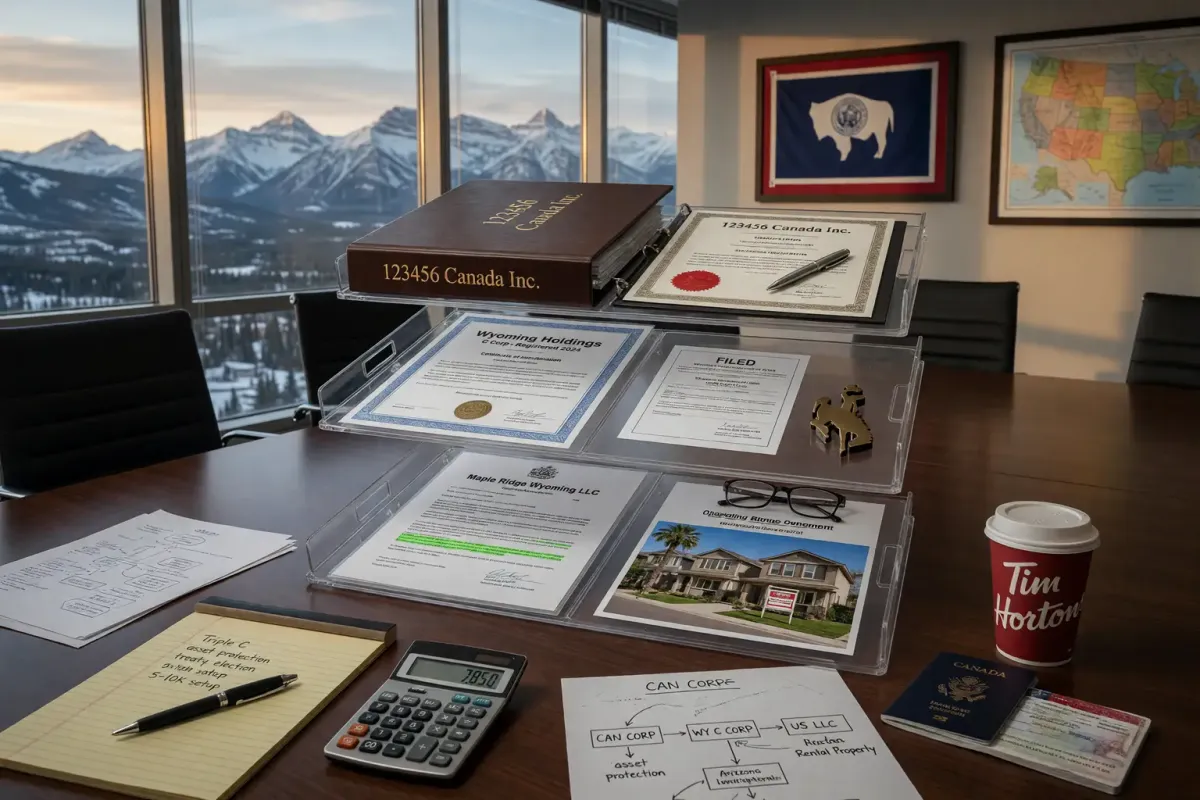
One approach — the “Triple C” structure — is one of several valid options Canadian investors consider. The correct structure for you depends on your specific cross-border tax situation and should be chosen with a cross-border tax specialist and legal counsel. Here’s how a Triple C is typically described:
Layer 1: Canadian Corporation
Start with a numbered Ontario corporation (or your home province). It doesn’t need a fancy name because nobody will see it. It’s just a holding entity. Setting this up takes about a week.
Layer 2: Wyoming C Corporation
Your Canadian corporation owns a C Corporation in Wyoming. Why Wyoming?
-
Zero corporate income tax
-
Zero personal income tax
-
Low registration fees (hundreds, not thousands)
-
Fast setup (2-3 days when things go smoothly)
-
Strong privacy protections
-
Asset protection through charging order laws
If you don’t distribute money from your Wyoming corporation, creditors can’t penetrate it to grab your assets. They can only intercept distributions when money actually leaves the company.
Layer 3: The LLC
The LLC actually holds title to your property. Your Wyoming C Corporation owns this LLC.
Buying in Florida? Set up a Florida LLC. This LLC is a “disregarded entity” that flows income to your Wyoming C Corporation. You only file one U.S. tax return—for the Wyoming corporation.
Why You Can’t Skip the C Corporation
Some investors assume they can just use an LLC and save money. This is an area where advice often goes wrong for Canadians.
CRA’s treatment of hybrid LLC entities has evolved over the years, and historically many cross-border advisors have flagged foreign-tax-credit mismatches when Canadians own US LLCs directly. Confirm the current CRA position with a cross-border accountant before you commit to any structure — don’t rely on general articles (including this one) for the final call.
Where mismatches apply, they can create double-taxation exposure. Advisors sometimes use a C Corporation layer between the Canadian owner and the LLC as one way to align the treatment — but whether that’s the right fit for you is a conversation for your cross-border CPA.
If you want to avoid the double taxation trap that catches Canadians who skip the C Corporation layer, book a free strategy call with us so we can review your entity setup before you buy.
Investing in the U.S. from Canada is a smart move, but only if your financing is structured correctly — schedule a free strategy session with us to avoid the common pitfalls.
Multiple Properties Need Multiple LLCs
You want separate LLCs to protect your assets. A lawsuit against one property shouldn’t threaten your whole portfolio.
The general rule: once properties in a single LLC total $500,000 to $1,000,000 in value, create another LLC for new acquisitions.
Ten separate single-family homes carry less risk than one ten-unit apartment building. Spreading tenants across different properties and different legal entities protects you better.
What About Different States?
You don’t need a new LLC for each state. If you have a Florida LLC and buy in Ohio, you can use the same Florida LLC. Just register it in Ohio as a “foreign corporation”—a simple process costing $100-300.
Timing Is Critical: Set Up Before You Buy
Here’s a mistake that costs investors deals: waiting to find a property before setting up entities.
The problem? You need an Employer Identification Number (EIN) from the IRS. Even with no employees, you need this number. And you can’t open a U.S. bank account without it.
How long does the IRS take? Two to three weeks normally. But during tax season (March through May)? Two to four months.
Imagine finding the perfect property but losing it because you’re waiting for the IRS. Set up your structure first if you’re committed to investing.
The timeline looks like this:
Borrowers comparing options often continue with US Estate Tax Planning for Canadians Owning US Rental Property before booking a strategy call.
-
Canadian corporation: about 1 week
-
Wyoming C Corporation and LLC: about 2 weeks
-
EIN from IRS: 2-3 weeks minimum (possibly months)
The Biggest Mistakes to Avoid
Taking Title in Your Personal Name
This is the worst mistake. Buying rental property in your personal name seems simpler, but moving it to an LLC later triggers capital gains tax.
One investor bought in a Florida growth area. One year later, the property appreciated over $100,000. Moving it to an LLC would have triggered tax on half that gain—a massive unnecessary bill.
Missing Information Returns
The U.S. system requires various information returns that don’t involve taxes but are mandatory anyway. Miss one and you might get a $10,000 demand letter from the IRS.
Even if your accountant filed everything correctly, the IRS might send automated demands anyway. Their left hand doesn’t always know what the right hand is doing.
This is why you need professionals who understand both Canadian and U.S. requirements.
Picking the Right State
Before looking at taxes or Appreciation, check one thing first: Is the state landlord-friendly?
Avoid these tenant-friendly states:
-
California
-
New York
-
New Jersey
These states mirror Ontario’s problems. Evictions take a year or more.
Popular landlord-friendly states include:
-
Texas (evictions in 3 weeks)
-
Florida
-
Georgia
What About Taxes?
Federal corporate tax is 21% everywhere. State taxes range from 0% to about 12%.
Interestingly, the highest-tax states are the same ones that are tenant-friendly. So avoiding tenant-friendly states also means avoiding high state taxes.
Why Not Wyoming for Properties?
Wyoming has zero state income tax, so why not buy properties there?
Wyoming is the least populated state in the country. There’s no demand. Limited demand means limited appreciation and difficulty selling.
Wyoming works perfectly for your holding corporation. But buy your actual rental properties where people want to live. The our guide to market selection for DSCR is a good filter for picking the right city.
Don’t Go It Alone
Setting up cross-border structures isn’t a DIY project. You need coordination between Canadian and U.S. professionals who understand both systems. The lending side gets easier once your structure is in place — most Canadian buyers ultimately fund through a foreign national DSCR program.
The cost of proper setup is tiny compared to the taxes and legal problems you’ll face without it.
As your portfolio grows, professional bookkeeping becomes essential too. Your strength is finding and funding properties. Let professionals handle the paperwork so you can focus on what you do best.
The Bottom Line
U.S. real estate offers real opportunities for Canadian investors frustrated with our tenant-friendly system. But success requires proper structure from day one.
Set up your entities before you start shopping for properties. Choose landlord-friendly states. Work with professionals who understand both tax systems. And never, ever take title in your personal name.
Get the structure right, and you can build a profitable U.S. portfolio while protecting your assets and securing US mortgage financing.
Key Takeaways:
- Why Ontario Investors Are Looking South
- Start With Your Investment Goals
- The Triple C Structure Explained
- Why You Can’t Skip the C Corporation
- Multiple Properties Need Multiple LLCs
Frequently Asked Questions
Why are Canadian real estate investors buying rental properties in the United States?
What is the Triple C corporate structure for Canadian investors buying U.S. real estate?
Why do Canadian investors need a C Corporation instead of just an LLC?
Which U.S. states are best for Canadian real estate investors?
Why should I set up my corporate structure before finding a U.S. property?
What happens if I buy U.S. rental property in my personal name?
Do I need a separate LLC for each U.S. investment property?
Weekly Investor Insight
Sunday financing notes for investors
Market updates, rate moves, and deal structures — once a week. Unsubscribe anytime.
By submitting, you agree to receive occasional emails from LendCity. You can unsubscribe at any time.
Disclaimer: LendCity Mortgages is a licensed mortgage brokerage. Content on this page is for educational purposes only and does not constitute legal, tax, investment, securities, or financial-planning advice. Rates, premiums, program terms, and regulations referenced are as of the page's last updated date and are subject to change. Any investment returns, rental yields, tax savings, or case-study figures shown are illustrative only — they are not guaranteed, not typical, and individual results will vary. Consult a licensed lawyer, Chartered Professional Accountant, or registered dealer before acting on any information above. Editorial standards.

Written by
Scott Dillingham
Published
December 22, 2025
· Updated June 29, 2026Reading time
9 min read
Appreciation
The increase in a property's value over time, which builds [equity](/glossary/equity/) and wealth for the owner through market growth or [forced improvements](/glossary/forced-appreciation/).
LLC
Limited Liability Company — a US business structure commonly used to hold US investment properties. Important caveat for Canadian residents: the CRA generally treats a US LLC as a corporation for Canadian tax purposes, which can create mismatched treatment with the IRS and double taxation; many cross-border advisors recommend a US LP (with an LLC as general partner) or direct ownership instead. Entity choice is a legal and tax decision — consult a cross-border attorney and a CPA experienced in Canada–US tax before forming one.
Single Family
A detached home designed for one household, the most common property type for beginner real estate investors.
FIRPTA
Foreign Investment in Real Property Tax Act - a US tax law requiring buyers to withhold taxes when purchasing real estate from foreign sellers. Important for Canadians selling US properties.
ITIN
Individual Taxpayer Identification Number - a US tax ID for foreign nationals, required for Canadians to invest in US real estate and file US taxes.
Property Management
The operation, control, and oversight of real estate by a third party. Property managers handle tenant screening, rent collection, maintenance, and day-to-day operations.
DSCR Loan
A loan qualified based on the property's [Debt Service Coverage Ratio](/glossary/dscr/) rather than the borrower's personal income, popular for US investment properties. The property's [NOI](/glossary/noi/) and [cash flow](/glossary/cash-flow/) determine qualification.
Eviction
The legal process of removing a tenant from a rental property for reasons such as non-payment of rent, lease violations, or property damage. Eviction laws vary by province and typically require landlords to follow specific notice periods and tribunal processes.
Landlord-Tenant Board
A provincial tribunal or administrative body that resolves disputes between landlords and tenants, handles eviction applications, and enforces residential tenancy legislation. Each Canadian province has its own board or tribunal with specific procedures and timelines.
Rental Income
Revenue generated from tenants paying rent on an investment property. Gross rental income is the total collected before expenses, while net rental income subtracts operating costs to show actual profitability.
Capital Gains Tax
Tax owed on the profit from selling an investment property, calculated as the difference between the sale price and the adjusted cost base. In Canada, 50% of capital gains are currently included in taxable income. A 2024 federal budget proposal to raise the inclusion rate to 66.67% on gains above $250,000 was deferred and has not been enacted; the 50% rate remains in effect. Tax outcomes depend on your specific situation — consult a Chartered Professional Accountant.
Hover over terms to see definitions. View the full glossary for all terms.