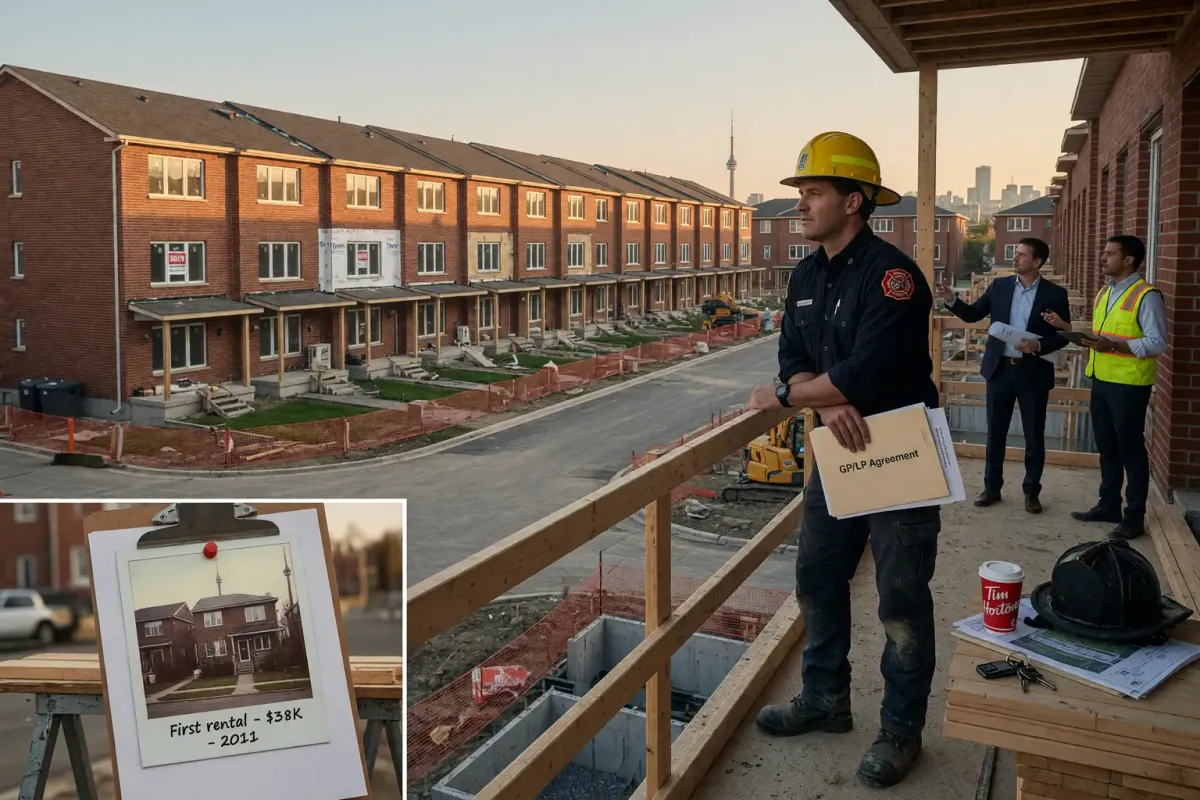
What if you could go from owning one rental property to developing 26-townhouse projects? That’s exactly what Paul D’Abruzzo did. And he started with zero financial help from his parents.
Paul’s story proves you don’t need wealthy parents or a fancy degree to build real wealth through real estate. You just need to start, work hard, and make smart decisions along the way. Paul’s results reflect his unique circumstances, market conditions, and timeline — individual investment outcomes will vary.
The Single Property That Started It All
Paul bought his first investment property in Hamilton, Ontario for $238,000. Nothing fancy. Just a regular rental property that he could afford. Like many investors, the first investment property is the hardest to buy.
From there, his portfolio grew one property at a time:
- One became two
- Two became three
- Three became four
- Eventually he hit ten properties and kept going
The lesson? Everyone starts somewhere. Even successful developers handling multi-million dollar projects began with a single rental property.
Why He Quit His Dream Job
Paul spent ten years as a firefighter with the City of Toronto. He loved it. But he was also juggling too much.
At his busiest, he was managing:
- Full-time firefighting career
- Multiple rental properties
- Active development projects
- A real estate team
- Being a husband and father to three daughters
Something had to give. So he made the tough call to retire from firefighting. He calls it “taking one step back to take three steps forward.”
This wasn’t easy. But it freed him up to focus on what would create the most long-term value for his family.
Paul went from a single $238,000 rental in Hamilton to multi-million dollar developments — if you’re looking at financing for your next property, book a free call with LendCity and we’ll help you understand your mortgage options.
At a certain point, your mortgage strategy matters more than the deal itself — book a free strategy call with LendCity to make sure your financing keeps up with your ambitions.
Return on Lifestyle: The Missing Piece
Paul learned something important about five years ago. He had accumulated plenty of assets, but his quality of life wasn’t improving. He was stressed, overworked, and barely seeing his family.
That’s when he created the concept of ROL – Return on Lifestyle.
Here’s what it means:
- Your investments should improve your life, not just your net worth
- Properties should give you more time with family, not less
- Cash flow numbers don’t matter if you’re miserable
- Everyone needs to define what ROL means for them personally
Whether you have 5 properties or 20, they should be helping you live better. That’s the whole point.
The Conference That Changed Everything
At age 23, Paul attended a conference in Toronto called “Millionaire Mind Intensive.” He was so excited about what he learned that he signed up for another conference in California – even though he was broke.
He charged it to his credit card and figured out how to pay it back later. This commitment to learning from an early age mirrors how some entrepreneurs start hustling young—from selling chips to running Canada’s largest volleyball league.
At that California conference, something clicked. During an exercise, attendees stood up by age. Paul was one of the youngest people in a room of 700-800 people.
He realized: “If I learn these strategies now, by the time I’m 30 or 32, I can really set myself up for life.”
That moment launched his real estate investment journey. He spent the next few years reading about 150 books on wealth-building and entrepreneurship.
Whether you’re buying your first rental or need financing for a development project, book a free call with LendCity and we’ll help you find the mortgage product that fits your stage.
Development financing has unique requirements that differ from standard investment loans — schedule a free strategy session with us to make sure your project is funded properly from land to completion.
From Rentals to Development Projects
Paul didn’t jump straight into development. He learned how to get money for building a rental property portfolio.
His development projects grew over time:
- Started with 6-unit developments
- Moved to 9-unit projects
- Then 18 townhouses
- Now working on 26-townhouse projects
For a deeper look at the financing angle behind this topic, see our guide to Multi-Family Mortgage Financing.
These developments create active income – money goes in, profit comes back out. Combined with his rental properties that provide passive income, he’s built a portfolio with multiple income streams. His evolution from flipping to multifamily mirrors strategies covered in building wealth from house flipping to multifamily properties.
How Regular Investors Can Get Developer Returns
Here’s where things get interesting for people who want the returns from development without becoming developers themselves.
Paul uses a GP/LP structure (General Partner/Limited Partner) for his larger projects:
How It Works
General Partners (GPs):
- Paul and his partner Drew make all the decisions
- They provide personal guarantees for construction financing
- They put their reputations and portfolios on the line
- They do all the work
Limited Partners (LPs):
- Outside investors provide capital
- They own equal shares alongside the GPs
- They’re completely passive
- They get the same profit level as the GPs
- They don’t provide personal guarantees
Why This Makes Sense
LPs get developer-level returns without the headaches. And the risk is lower than you’d think because:
- The GPs are experienced and know what they’re doing
- The GPs won’t risk their entire portfolios and reputations on a bad project
- The GPs are providing personal guarantees, so they’re extremely careful
For his larger townhouse projects, Paul typically needs about $3.3 million in total capital. Minimum investment starts around $50,000 to $100,000. Returns from development projects are not guaranteed and depend on many factors including market conditions, construction costs, and timeline.
The Seaway Mall Project
Paul’s current flagship project is a major redevelopment of the Seaway Mall parking lots in Welland, Ontario.
The details:
- About 5-6 acres of land
- 15 separate blocks carved out for development
- First phase: 26 townhomes on Block 4
- Raising about $3 million for this phase
- Second phase coming right after
Paul says the location is one of the best in all of Niagara. The municipality is pro-growth, which makes the development process smoother.
The Bonus: Learning While You Earn
Here’s something unique Paul offers his investors.
Every month, on the last Thursday, he hosts a 20-30 minute update call. Investors see exactly what’s happening with the project – the site plan process, what conditions they’re fulfilling, where things stand.
This means you’re learning the development process in real-time while your money is working for you. If you ever want to do your own small development project, you’ll understand how it works before risking your own capital.
Paul learned development this same way. He partnered with an experienced developer, provided the money, and shadowed the entire process. It became his “university course” in development.
Who Can Invest?
To invest in these GP/LP deals, you need to fit one of two categories:
- Accredited Investor Status: You meet the legal definition based on net worth or income requirements
- Previous Relationship: You have a documented personal or business relationship with Paul or his partners (prior deals together, attendance at meetings, documented communication, personal friendship)
If neither applies, you may need to establish a relationship first. Paul follows these rules strictly to stay compliant.
Key Lessons From Paul’s Journey
Start where you are. Everyone begins with one property. Don’t wait for perfect conditions.
Be willing to learn. Paul read 150 books and invested in conferences when he was broke. That education paid off.
Work hard. Paul’s immigrant grandparents taught him this. There’s no shortcut to success.
Make strategic sacrifices. Sometimes you need to give up something good to get something great.
Focus on lifestyle, not just numbers. Your investments should improve your life. If they’re not, something needs to change.
Partner with experienced people. When you invest in development, make sure the operators have skin in the game and a track record.
Getting Started
If you’re just starting out, buy that first rental property. Learn the basics. Explore investment property financing. Read everything you can.
If you’re ready for development-level returns but don’t want to become a developer, structures like Paul’s GP/LP model give you access to those profits without the work or risk of going solo.
Either way, the important thing is to start. Paul went from zero to developing multi-million dollar projects. But it took that first $238,000 property to get the ball rolling.
Your journey starts with one decision. Make it today.
Key Takeaways:
- The Single Property That Started It All
- Why He Quit His Dream Job
- Return on Lifestyle: The Missing Piece
- The Conference That Changed Everything
- From Rentals to Development Projects
Frequently Asked Questions
How much money do you need to invest in a development project?
What's the difference between a GP and LP in real estate development?
Do you need to be an accredited investor to invest in development projects?
How did Paul learn real estate development without formal education?
What is Return on Lifestyle (ROL) in real estate investing?
How long does it take to build a real estate portfolio from scratch?
What are the benefits of investing as an LP in a development project?
Should you quit your job to invest in real estate full-time?
Disclaimer: This case study is presented for educational purposes only. Some details may have been adjusted for clarity and readability. Individual investment outcomes vary — past results do not guarantee future performance. LendCity Mortgages provides mortgage financing services for real estate investors and does not offer investment, legal, or tax advice.
Weekly Investor Insight
Sunday financing notes for investors
Market updates, rate moves, and deal structures — once a week. Unsubscribe anytime.
By submitting, you agree to receive occasional emails from LendCity. You can unsubscribe at any time.
Disclaimer: LendCity Mortgages is a licensed mortgage brokerage. Content on this page is for educational purposes only and does not constitute legal, tax, investment, securities, or financial-planning advice. Rates, premiums, program terms, and regulations referenced are as of the page's last updated date and are subject to change. Any investment returns, rental yields, tax savings, or case-study figures shown are illustrative only — they are not guaranteed, not typical, and individual results will vary. Consult a licensed lawyer, Chartered Professional Accountant, or registered dealer before acting on any information above. Editorial standards.

Written by
Scott Dillingham
Published
December 22, 2025
· Updated June 29, 2026Reading time
9 min read
Cash Flow
The money left over after collecting rent and paying all expenses including mortgage, taxes, insurance, maintenance, and property management. Positive cash flow is the primary goal of buy-and-hold investors. See also [NOI](/glossary/noi/), [Cash-on-Cash Return](/glossary/cash-on-cash-return/), and [Vacancy Rate](/glossary/vacancy-rate/).
Passive Income
Earnings from rental properties or investments that require minimal day-to-day involvement. The goal of most real estate investors seeking financial freedom.
GP/LP Structure
A General Partner / Limited Partner arrangement used in real estate syndications. The GP manages the project and assumes unlimited liability, while LPs invest capital passively with liability generally limited to their investment amount. Because LPs contribute capital passively and rely on the GP's efforts, LP units are typically securities under Canadian provincial securities law (NI 45-106) and must be distributed under a valid prospectus exemption through a registered dealer. GP/LP structures have material legal and tax consequences — retain a securities lawyer before setting one up or investing in one.
Joint Venture
A partnership between two or more parties to invest in real estate, combining capital, expertise, or credit to complete a deal.
Property Management
The operation, control, and oversight of real estate by a third party. Property managers handle tenant screening, rent collection, maintenance, and day-to-day operations.
Multifamily
Properties with multiple dwelling units, from duplexes to large apartment buildings. Often offer better cash flow and economies of scale.
GP/LP Structure
A General Partner / Limited Partner arrangement used in real estate syndications. The GP manages the project and assumes unlimited liability, while LPs invest capital passively with liability generally limited to their investment amount. Because LPs contribute capital passively and rely on the GP's efforts, LP units are typically securities under Canadian provincial securities law (NI 45-106) and must be distributed under a valid prospectus exemption through a registered dealer. GP/LP structures have material legal and tax consequences — retain a securities lawyer before setting one up or investing in one.
Construction Loan
Short-term financing used to fund building a new property. Funds are released in stages (draws) as construction milestones are completed, and interest is charged only on drawn amounts. Construction loans typically convert to permanent financing upon project completion.
Townhouse
A multi-story residential unit that shares one or more walls with adjacent units but has its own entrance. Townhouses offer a middle ground between condos and detached homes, often with lower purchase prices and condo-like fee structures.
Construction Financing
A short-term loan that funds the building or major renovation of a property, disbursed in stages (draws) as construction milestones are completed. Once building is finished, the construction loan is typically replaced with a permanent mortgage through a process called takeout financing. Interest is charged only on the amount drawn.
Hover over terms to see definitions. View the full glossary for all terms.