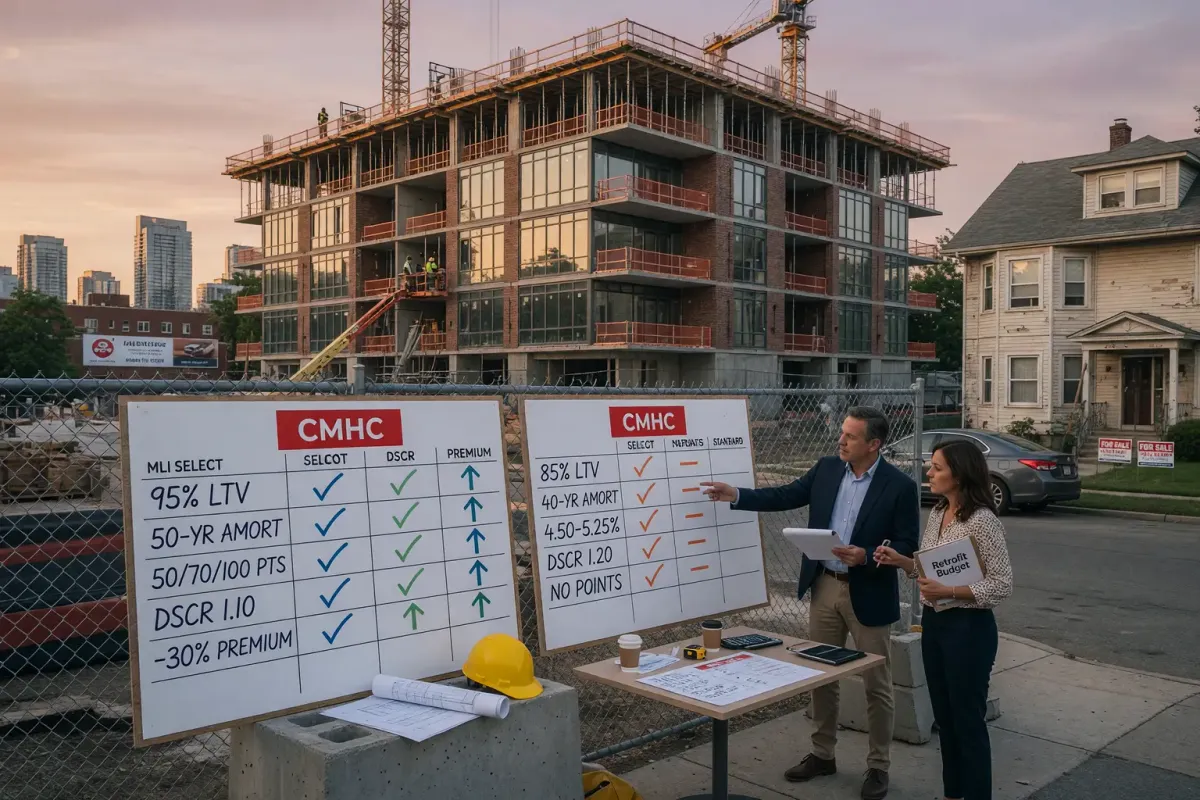
If you’re evaluating a multifamily investment in Canada, CMHC offers two mortgage insurance programs that can dramatically change your deal economics. But they’re fundamentally different—and choosing the wrong one can cost you hundreds of thousands in unnecessary cash requirements or lost leverage.
This comparison helps you cut through the complexity and pick the program that fits your specific deal. Once you’ve chosen your program, understanding how to calculate cash flow and DSCR for multifamily properties is essential for underwriting any deal.
The Two CMHC Programs Every Multifamily Investor Should Know
CMHC’s mortgage insurance programs reduce lender risk on high-leverage loans, which enables lenders to offer better terms than conventional financing. For multifamily properties with five or more units, two programs dominate the market:
MLI Standard — the straightforward option for existing, stabilized properties. Faster approval. No points system. You know exactly what you’re getting.
MLI Select — the high-leverage play for new construction and value-add projects. The comprehensive CMHC MLI Select program unlocks up to 95% financing and 50-year amortizations. But it requires points commitments (affordability, energy efficiency, accessibility) and a longer approval process.
Both reduce lender risk and enable better terms. But they work very differently and are designed for different situations.
This guide helps you choose the right one for your deal.
Head-to-Head Comparison
| Feature | MLI Standard | MLI Select (100 Points) |
|---|---|---|
| Maximum LTV | 85% | Up to 95% |
| Maximum Amortization | 40 years | Up to 50 years |
| Recourse Type | Full recourse | Limited recourse |
| Points System | None required | 50 pts min; tiers at 50/70/100 |
| Premium Discount | None | -10% at 50 pts / -20% at 70 pts / -30% at 100 pts |
| Min DSCR | 1.20 | 1.10 |
| Fee Treatment | Out of pocket | Can be financed into loan |
| Qualification Focus | Property income + borrower strength | Property + social/environmental commitments |
| Typical Timeline | 4-8 weeks | 3-6 months |
| Best For | Existing stabilized properties | New construction, value-add |
| Minimum Units | 5+ | 5+ |
| Property Types | Existing, refinance, new | Same, but designed for points-qualifying projects |
Your debt ratios, income type, and property plans all affect what you qualify for — book a free strategy call with LendCity so we can map out a strategy that works for your goals.
For a deeper look at the financing angle behind this topic, see our multi-family mortgage financing guide.
What These Differences Mean for Your Bottom Line
The comparison table tells you what’s different. But what matters is how those differences translate to actual cash requirements and monthly debt service. Let me walk through a real side-by-side example.
Scenario: 20-Unit Apartment Building, $5,000,000 Total Cost
This is a realistic project size. Let’s see what each program requires.
With MLI Standard (85% LTV):
- Mortgage amount: $4,250,000
- Your required equity: $750,000 (15%)
- Mortgage insurance premium: ~$165,750 (3.90% under risk-based pricing including 0.75% surcharge for 40-yr amortization, paid out of pocket)
- 40-year amortization at 4.85%: monthly payment ~$18,500
- Annual debt service: ~$214,200
- Total cash required upfront: $750,000 + $159,375 = $909,375
This is straightforward. You put in 15% equity, pay the insurance premium out of your cash, and the lender provides 85%.
With MLI Select at 100+ Points (95% LTV):
- Mortgage amount: $4,750,000
- Your required equity: $250,000 (5%)
- Mortgage insurance premium: ~$192,375 (~4.05% with 30% discount applied to base rate; reflects 1.25% surcharge for 50-yr amortization under risk-based pricing; financed into loan)
- 50-year amortization at 4.65%: monthly payment ~$19,650
- Annual debt service: ~$220,200
- Total cash required upfront: ~$250,000
Wait. Let that sink in. You’re borrowing an extra $500,000, your monthly payment only increases by $500, and you need $659,375 LESS in upfront cash.
The Real Comparison:
| Metric | MLI Standard | MLI Select | Difference |
|---|---|---|---|
| Loan amount | $4,250,000 | $4,750,000 | +$500,000 |
| Cash required | $909,375 | $250,000 | -$659,375 |
| Monthly payment | $17,850 | $18,350 | +$500 |
| Recourse | Full | Limited | Limited is better |
| Approval timeline | 4-8 weeks | 12-24 weeks | Longer wait |
MLI Select requires $659,375 less cash upfront. Your monthly payments are nearly identical despite borrowing significantly more. And you get limited recourse protection, meaning personal asset liability is capped.
The trade-off? You need to qualify for 100+ points (affordability, energy, accessibility commitments) and accept a longer approval process (months vs weeks).
When MLI Standard Is the Right Choice
MLI Standard works best when one or more of these conditions are true:
Buying an existing, stabilized apartment building. The property has a track record. Rents are known. Operations are proven. You don’t need to build anything or commit to long-term affordability caps. MLI Standard is purpose-built for this scenario.
The property doesn’t earn energy or accessibility points easily. A well-maintained 10-year-old building might be in decent shape, but retrofitting energy improvements (HVAC, insulation, windows) costs $1,500–$2,500 per unit just for mechanical systems. Adding accessibility retrofits costs another $5,000–$15,000 per unit. On an 8-unit building, that’s $56,000–$200,000+ in incremental costs. Sometimes those upgrades make sense for other reasons (tenant attraction, operating cost reduction). But if they don’t, MLI Standard avoids forcing you into expensive retrofits just to hit a points threshold.
You want a faster, simpler process. MLI Standard requires 4-8 weeks. Energy modeling, design validation, affordability calculations—none of that. CMHC’s underwriting is straightforward: property income, borrower strength, market comparables. Submit, approve, close. If you’re on a tight timeline, this matters.
You have 15-20% equity available. Maybe you’ve been saving. Maybe you have an existing property generating equity. If you can comfortably deploy 15% down, MLI Standard reduces complexity without sacrificing much leverage.
You don’t want ongoing compliance commitments. MLI Select commits you to maintaining affordable rents or energy performance for 10-20 years. Fail to comply, and CMHC can revoke benefits or demand penalties. If you want no strings attached—buy, improve operations, sell—MLI Standard delivers that.
Real investor example: Sarah buys a well-maintained 10-unit building in London, Ontario for $1.8 million. Built in 2010, recently updated mechanicals. Rents are $1,200–$1,500/unit, occupancy is 94%. She has $350,000 equity. She uses MLI Standard at 80% LTV, puts down $360,000, closes in 6 weeks, and owns a stabilized cash-flowing property. No retrofit costs, no points calculations, no energy modeling. Simple.
Multifamily financing has different rules than residential — schedule a free strategy session with us and we’ll show you exactly what you qualify for under CMHC or conventional programs.
When MLI Select Is the Better Play
MLI Select dominates when these conditions exist:
Building new construction. This is MLI Select’s sweet spot. You design for points from day one. Affordability commitments are already in your rent strategy. Energy efficiency features are part of the construction spec. Accessibility is built into the floor plans. You’re not retrofitting; you’re designing for value from the start. For developers, the MLI Select new construction guide walks through design optimization, timeline expectations, and team assembly.
You need maximum leverage. Only 5% down. Nowhere else in the market can you access this. If cash is your limiting factor—whether because you’re bootstrapping or allocating capital across multiple projects—MLI Select’s 95% LTC is game-changing.
Cash flow is tight, and 50-year amortization helps. On a high-leverage new construction project, that extended amortization can mean the difference between breakeven and positive cash flow in year one. For a $5M project, spreading the mortgage over 50 years vs 40 years saves roughly $300/month in debt service. Multiply that across multiple projects, and the savings compound.
The building naturally qualifies for energy and accessibility points. New construction in Alberta often hits 100+ points naturally. Why? Market rents in Edmonton and Calgary are low relative to construction costs. To hit your pro forma, you’re already designing efficiently. Affordability units at 80% of market rent are often competitive or market-rate. Accessibility features (grab bars, wider doorways, accessible bathrooms) cost 1-2% more to build. You weren’t forced into these; they’re just good development practice.
You want limited recourse protection. This is underrated. With 95% financing, if things go sideways, full recourse means the lender can come after your personal assets to cover losses. Limited recourse caps your personal liability. On a high-leverage deal, that risk protection has real value.
You’re building in a market where affordability makes economic sense. Edmonton’s median market rent is roughly $2,080/month for a 1-bedroom. CMHC’s affordability threshold is 80% of that, about $1,665/month. Many 1- and 2-bedroom units in new purpose-built rental naturally rent at or near that level. You’re not sacrificing $500/month per unit in cash flow to hit a target. You’re committing to rents you’d charge anyway. This is why MLI Select works so well in Edmonton and Calgary but struggles in Toronto or Vancouver, where market rents far exceed the affordability threshold.
Real investor example: Marcus is developing an 8-unit stacked townhome project in Edmonton for $2.4 million. He designs energy-efficient construction, commits 50% of units to rents at 80% of market (which still rent for $1,650+, competitive with market), and includes accessibility features in common areas. He qualifies for 95 points. CMHC approves 95% financing: $2.28M mortgage, only $120K required as equity. His 50-year amortization keeps monthly debt service manageable even with high leverage. And if the market softens, limited recourse caps his personal exposure. He couldn’t build this deal with conventional financing—or he’d need $400K+ in equity instead of $120K. As Marcus scales from one project to three, implementing a HoldCo/OpCo tax structure becomes increasingly valuable for tax optimization and asset isolation.
Where MLI Select Wins By City
Because MLI Select’s affordability math depends on how far market rents sit above the 80% AMR threshold, the program plays out very differently in each major Canadian market. The cities where we currently see MLI Select dominating MLI Standard on cash-required and DSCR include MLI Select for Edmonton’s prairie cash-flow market and MLI Select in Calgary’s R-CG infill market, both Alberta CMAs where affordability commitments are nearly painless. CMHC MLI Select for Toronto multi-family deals is also Select-dominant despite high market rents, because the spread to 80% AMR is the largest in Canada — capping a small slice of units still earns meaningful points. Ottawa MLI Select financing for the NCR leans toward Select for new construction along the LRT, while Halifax MLI Select for Atlantic Canada’s tightest market and MLI Select financing in Hamilton’s ARU-friendly market are where small-bay infill and 4-unit-as-of-right zoning create unusually clean MLI Select pathways. In any of these markets, MLI Standard remains the right answer when you’re buying older stabilized stock — but on new construction, Select is almost always the better play. For the full program breakdown, calculators, and real deal case studies, see our CMHC MLI Select financing hub.
Can You Switch Between Programs?
Yes, but with caveats.
Refinance from MLI Standard to MLI Select: Possible if you complete qualifying upgrades. Example: You bought with MLI Standard, then did energy retrofits and committed units to affordability. After 12-24 months, you refi to MLI Select to access better terms and additional leverage. This happens, but it requires that the property naturally qualifies after the upgrades.
Refinance from MLI Select to MLI Standard: You can release yourself from the MLI Select points commitments by moving to MLI Standard. You lose the benefits (95% LTC reverts to 85%, 50-year amortization becomes 40 years), but you’re no longer bound by affordability or energy performance monitoring. This occasionally makes sense at renewal time if market conditions have shifted.
Timeline consideration: Switching programs takes time (4-8 weeks for MLI Standard, 10-16 weeks for MLI Select). You can’t refinance mid-term on a whim. Plan for program changes at renewal or when your business situation materially changes.
Hybrid strategy: Some investors use MLI Select for construction and lease-up (when 95% financing and 50-year terms are most valuable), then stay on MLI Select at permanent refinance. Others start with MLI Select, then move to conventional financing once the property is stabilized and worth more. The program flexibility is an advantage if you think strategically about it.
The Hybrid Strategy: Using Both Programs
Many sophisticated investors use both programs across their portfolio.
Related reading: CMHC MLI Standard: Multi-Unit Mortgage Insurance Guide covers the practical angles we see on similar files.
For a closer look at the same decision, CMHC Green Financing: Mortgage Rebates for Investors breaks down how LendCity approaches it.
The playbook:
-
Build your first project with MLI Select. New construction, 100+ points, 95% financing, 5% down, 50-year amortization. Minimize cash required. The leverage is incredible when you’re building from zero.
-
Acquire stabilized buildings with MLI Standard. Buy existing properties with solid rent rolls and operating history. Less cash than MLI Select requires (you only need 15% equity, not 95% financing which sounds like more but requires commitment), faster approval, simpler process.
-
Use cash flow from MLI Select projects to fund MLI Standard down payments. As your MLI Select projects stabilize and generate cash flow, that cash funds down payments on additional stabilized acquisitions.
-
Portfolio diversification between programs. You benefit from development upside (MLI Select) and stabilized cash flow (MLI Standard). You’re not exposed to a single program’s policy changes or market conditions.
This approach is how scaling investors in Canada build portfolios. They access high leverage when they need to build, then steady cash flow as they mature.
Decision Framework: 5 Questions to Ask Yourself
Before you commit to a program, ask these questions:
1. Am I building new or buying existing?
- New? MLI Select is likely better (design for points, maximum leverage).
- Existing? MLI Standard is usually simpler (faster, no retrofit costs).
2. How much equity do I have available?
- Under $250K? MLI Select’s 5% requirement is probably necessary.
- $400K+? Either program works. MLI Standard might be fine if you’re buying stabilized.
- $750K+? You have flexibility. Choose based on property type and timeline, not cash constraints.
3. Am I willing to commit to affordability, energy, and accessibility requirements?
- Yes? MLI Select unlocks maximum benefits.
- No? MLI Standard avoids ongoing compliance.
- Maybe? Consider the specific affordability rent—does it match your business plan anyway? If yes, MLI Select’s compliance burden is minimal.
4. How important is speed to close?
- Under 3 months? MLI Standard (4-8 weeks).
- Can wait 4-6 months? MLI Select works.
- Don’t know? Default to faster. Weeks matter in competitive markets.
5. Do I want limited recourse protection?
- Yes? MLI Select, especially on high-leverage deals.
- No? Either program works.
- Unclear? Limited recourse is valuable insurance on 95% financing. Consider it a significant benefit of MLI Select.
FAQ: Choosing Between MLI Standard and MLI Select
Can I use both programs on different properties simultaneously?
Which program has lower total costs over the life of the mortgage?
What happens if I fail to maintain my MLI Select point commitments?
Is the application process different between the two programs?
Can a mortgage broker handle both programs?
Are there properties that qualify for one but not the other?
How much money do I need to invest in an MLI Standard multi-family project?
How much money do I need to invest in an MLI Select multi-family project?
What's the timeline difference between the two programs?
Which program works better for refinancing?
Can I get better interest rates with one program over the other?
Real-World Comparisons: Three Investor Scenarios
Scenario 1: Sarah - Stabilized Acquisition (MLI Standard)
Sarah found a 10-unit apartment building in London, Ontario. Built 2010. Fully occupied. Rents $1,200–$1,500/unit. She has $350,000 in capital.
- Purchase price: $1,800,000
- Her equity: $350,000
- Down payment needed (15%): $270,000
- Insurance premium (3.75%): $67,500
- Total cash required: $337,500 ✓ (she has $350K)
- Mortgage: $1,530,000 at 4.5%, 40-year amortization
- Monthly payment: ~$7,700
- Application timeline: 6 weeks
MLI Standard is perfect here. Existing, stabilized, no energy retrofits needed, no time pressure. Sarah deploys her capital, closes in 6 weeks, owns a cash-flowing property. No ongoing compliance commitments.
Scenario 2: Marcus - New Construction (MLI Select)
Marcus is developing an 8-unit stacked townhome project in Edmonton. New construction. Energy-efficient design. Mixed-income units (some market-rate, some 20% below market as “affordable”).
- Construction cost: $2,400,000
- MLI Select approval at 95% LTV: $2,280,000 mortgage
- His required equity: $120,000
- Insurance premium: ~$63,840 (financed into loan)
- Total cash required: $120,000
- Monthly permanent mortgage payment (50-year): ~$9,200
- Approval timeline: 16 weeks
MLI Select transforms this deal. With conventional financing, Marcus would need $600K+ down and 35-year amortization at higher rates. With MLI Select, he needs $120K, gets 50-year terms, and limited recourse protection. The leverage difference is game-changing.
Scenario 3: Jennifer - Switching Programs
Jennifer bought a 12-unit building 18 months ago using MLI Standard. She’s now completed energy retrofits (heat pumps, upgraded insulation, windows). Building qualifies for MLI Select points.
- Current mortgage balance: $3,200,000 (remaining 38.5 years)
- Current property value: $4,200,000 (appreciated due to market + value-add)
- Her equity: $1,000,000 (23.8%)
- Refi to MLI Select at 85% LTV: $3,570,000 mortgage
- Insurance premium: ~$142,800 (financed into loan)
- New monthly payment (45-year): ~$15,400 (vs $16,100 current)
- Monthly savings: ~$700
- Approval timeline: 14 weeks
The refi unlocks additional leverage and cash flow. Jennifer extracts $370K equity (new $3.57M mortgage minus old $3.2M), improves monthly cash flow by $700, and still keeps the property. It’s a refinance that creates liquidity without selling.
Key Takeaways: MLI Select vs MLI Standard
| Decision Factor | Choose MLI Standard | Choose MLI Select |
|---|---|---|
| Property type | Existing, stabilized | New construction, value-add |
| Equity available | $500K+ | Under $250K |
| Timeline flexibility | Low (need 4-8 weeks) | High (can wait 4-6 months) |
| Compliance tolerance | Want no strings attached | Willing to commit to affordability/energy/accessibility |
| Leverage needs | 85% is sufficient | Need 95% to make deal work |
| Risk tolerance | Full recourse is acceptable | Want limited recourse on high leverage |
| Project familiarity | Experienced with similar deals | Building with experienced team |
The quick version: If you’re buying an existing apartment building and have reasonable equity, use MLI Standard. If you’re building new and need maximum leverage, use MLI Select.
Frequently Asked Questions
If I get pre-approved for both programs, which do I choose?
Can I apply for both programs simultaneously and see which gets approved faster?
What if market conditions change mid-application? Can I switch programs?
Are there any geographic restrictions on which program I can use?
How does my credit score affect which program I qualify for?
Can I use MLI Select if I don't have development experience?
Which program is better for co-ownership or joint venture deals?
Does my broker's recommendation matter, or should I decide myself?
Key Takeaways:
- The Two CMHC Programs Every Multifamily Investor Should Know
- Head-to-Head Comparison
- What These Differences Mean for Your Bottom Line
- When MLI Standard Is the Right Choice
- When MLI Select Is the Better Play
Conclusion
CMHC’s MLI Standard and MLI Select programs offer dramatically different financing structures for multifamily investors. The choice isn’t about which is “better”—it’s about which fits your specific deal.
MLI Standard is the straightforward path for existing, stabilized properties. Faster approval. Simpler underwriting. No points requirements. Perfect when you’re buying a performing asset with reasonable equity.
MLI Select is the high-leverage accelerator for new construction and value-add projects. 95% financing with 50-year amortization transforms project economics. But it requires points commitments, longer approval timelines, and typically experienced development partners.
The $659,000 difference in upfront cash required (on our $5M example) isn’t theoretical. That’s real money. That’s equity you can deploy to another property, or keep in reserve, or use to improve your deal. And the monthly payment difference is modest ($500/month)—meaning you’re accessing 95% leverage for nearly the same monthly cost as 85% leverage.
Choosing the right program for your deal is one of the highest-impact decisions you’ll make as a multifamily investor. Visit our multi-family mortgage financing page to see how we structure both MLI Standard and MLI Select deals. Talk to your broker, understand your specific deal requirements, and structure accordingly. For broader context on financing options across regions, multifamily financing in Canada explores CMHC programs, private lending, and market dynamics by province.
Free download
MLI Select document checklist
Appraisals, rent rolls, environmental reports, and the CMHC package lenders expect before they underwrite.
By submitting, you agree to receive occasional emails from LendCity. You can unsubscribe at any time.
4.8/5 (116 Google reviews)
Disclaimer: LendCity Mortgages is a licensed mortgage brokerage. Content on this page is for educational purposes only and does not constitute legal, tax, investment, securities, or financial-planning advice. Rates, premiums, program terms, and regulations referenced are as of the page's last updated date and are subject to change. Any investment returns, rental yields, tax savings, or case-study figures shown are illustrative only — they are not guaranteed, not typical, and individual results will vary. Consult a licensed lawyer, Chartered Professional Accountant, or registered dealer before acting on any information above. Editorial standards.

Written by
Scott Dillingham
Published
February 26, 2026
· Updated June 15, 2026Reading time
19 min read
CMHC Insurance
Mortgage default insurance from Canada Mortgage and Housing Corporation. For 1-4 unit investment properties, investors must put 20%+ down (no insurance available). However, CMHC offers MLI Select for 5+ unit multifamily properties, and house hackers can access insured mortgages with 5-10% down.
CMHC MLI Select
A CMHC program offering reduced mortgage insurance premiums and extended amortization (up to 50 years) for multifamily properties with 5+ units that meet energy efficiency or accessibility standards. Popular among investors scaling into larger apartment buildings.
LTV
Loan-to-Value ratio - the mortgage amount expressed as a percentage of the property's appraised value or purchase price (whichever is lower). An 80% LTV means you're borrowing 80% and putting 20% [down](/glossary/down-payment/). Lower LTV generally means better [interest rates](/glossary/interest-rate/) and terms. See also [Equity](/glossary/equity/) and [Leverage](/glossary/leverage/).
Amortization
The period over which a mortgage is scheduled to be fully paid off through regular payments of principal and [interest](/glossary/interest-rate/). In Canada, common amortization periods are 25 or 30 years, though the mortgage term (when you renegotiate) is typically 1-5 years. A longer amortization lowers monthly payments, improving [cash flow](/glossary/cash-flow/) but increasing total interest paid.
DSCR
Debt Service Coverage Ratio — a metric that compares a property's [net operating income](/glossary/noi/) to its mortgage payments. A DSCR of 1.25 means the property generates 25% more income than needed to cover the debt. Lenders typically require a minimum DSCR of 1.0 to 1.25 for investment property loans (including [DSCR loans](/glossary/dscr-loan/)). See also [Cap Rate](/glossary/cap-rate/) and [Cash Flow](/glossary/cash-flow/).
Commercial Mortgage
Financing for commercial properties like retail, office, or multifamily buildings with 5+ units, with different qualification criteria than residential mortgages.
Cash Flow
The money left over after collecting rent and paying all expenses including mortgage, taxes, insurance, maintenance, and property management. Positive cash flow is the primary goal of buy-and-hold investors. See also [NOI](/glossary/noi/), [Cash-on-Cash Return](/glossary/cash-on-cash-return/), and [Vacancy Rate](/glossary/vacancy-rate/).
Multifamily
Properties with multiple dwelling units, from duplexes to large apartment buildings. Often offer better cash flow and economies of scale.
Mortgage Insurance Premium
The fee charged by CMHC or other insurers for mortgage default insurance on high-ratio mortgages. The premium is calculated as a percentage of the loan amount and can be added to the mortgage balance or paid upfront.
Recourse Loan
A loan where the borrower is personally liable for repayment beyond the collateral value. If the property sells for less than owed at foreclosure, the lender can pursue the borrower's other assets. Most Canadian commercial mortgages under $5 million are full recourse.
Non-Recourse Loan
A loan secured only by the property itself, with no personal liability for the borrower beyond the collateral. In Canada, non-recourse lending is typically available only for large institutional deals or CMHC-insured multifamily mortgages.
Energy Efficiency
The effectiveness with which a property uses energy for heating, cooling, lighting, and other functions. Energy-efficient upgrades to rental properties reduce operating costs, increase NOI, and can add significant property value while qualifying for government rebates.
Hover over terms to see definitions. View the full glossary for all terms.