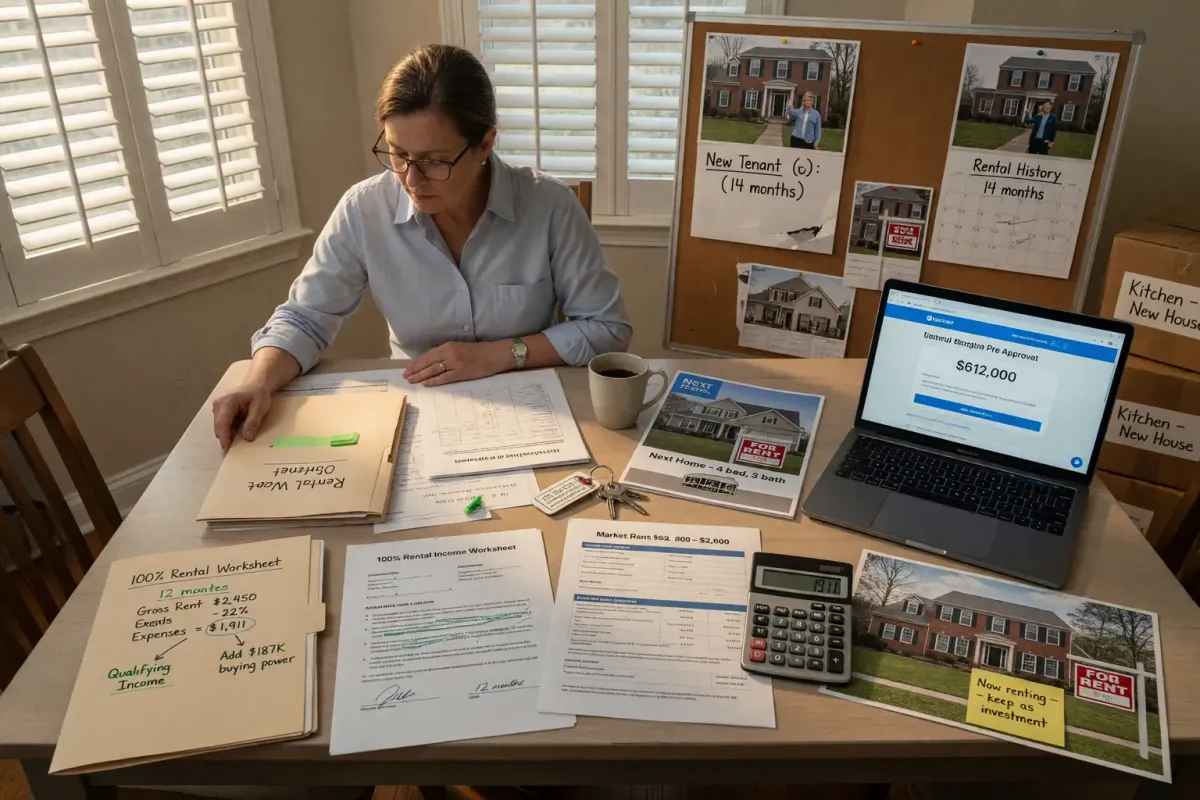
Keep Your Home, Rent It Out, and Still Buy Bigger
Here’s a situation I see all the time. You own a home. You want to buy a new one. But instead of selling, you think, “Why not just rent out my current place?”
Great idea. But here’s the problem: most banks will crush your buying power when you do this.
The good news? There’s a special program that fixes this. And most people have never heard of it.
Why Banks Make This So Hard
Let’s say your current mortgage payment is $3,000 a month. You can rent out that home for $3,000 a month too. Sounds like it evens out, right?
Not according to most banks.
Traditional lenders only count 50% of your rental income. So instead of using that full $3,000, they only count $1,500. That leaves a $1,500 “shortfall” on paper.
Now the bank treats your rental property like a $1,500 monthly debt. This tanks your debt ratios and borrowing limits. And suddenly, you qualify for way less on your new home.
If your bank is only counting 50% of your rental income and killing your approval amount, book a free strategy call with LendCity to see how the rental worksheet program could change your numbers.
Your debt ratios, income type, and property plans all affect what you qualify for — book a free strategy call with LendCity so we can map out a strategy that works for your goals.
The Rental Worksheet Program Changes Everything
A handful of lenders (maybe five or six) offer something different. It’s called a rental worksheet program.
Here’s how it works:
- You’re buying a new primary residence
- You’re keeping your current home as a rental
- The lender uses a rental worksheet instead of the standard 50% rule
With a rental worksheet, you can use up to 100% of the rental income. The lender plugs in your rent, subtracts the mortgage, property taxes, and a few other expenses.
The result? Instead of a $1,500 monthly loss, you might only show a $500 shortfall. That extra $1,000 per month translates into serious buying power.
A Real Example That Shows the Difference
I had a client come to me after getting approved at a bank. Their approval? $250,000.
In their market, that wasn’t enough. They couldn’t find anything they wanted. They were about to give up and just rent somewhere instead of buying.
For a deeper look at the financing angle behind this topic, see our guide to Residential Mortgage Financing.
Their realtor suggested they get a second opinion. Smart move.
We ran their numbers using the rental worksheet program. Their new approval? $450,000.
That’s an extra $200,000 in buying power. Same client. Same income. Same rental property mortgage financing situation. Just a different program.
The difference between a $250,000 and $450,000 approval could come down to the right program — book a free strategy call with us and we’ll run your numbers through the rental worksheet.
How much you qualify for depends on more than your income — debt ratios, property type, and lender choice all play a role. schedule a free strategy session with us and we’ll show you exactly where you stand.
Why Banks Don’t Offer This
Here’s the thing: banks don’t have this program. Period.
I used to work at a bank. When I’d hear about brokers getting clients approved for way more, I’d think, “They must be doing something shady.”
Turns out, they were just using programs the banks didn’t have access to.
This rental worksheet program is only available through certain Canadian mortgage brokers who work with specific lenders. The big banks simply don’t offer it.
Who Should Use This Program?
This program works great if you:
- Own your current home and want to keep it
- Plan to rent out your current home
- Are buying a new primary residence (not an investment property)
- Want to maximize your approval amount
If you already own multiple rentals, rental worksheets can also unlock buying power for scaling investors. We’re seeing more people use this strategy lately. The market has cooled. Homes take longer to sell. So more people are saying, “Forget selling. Let’s just rent it out and buy something new.”
And since you’re buying a primary residence, you only need 5% down to build a multimillion-dollar portfolio.
The Bottom Line
If you’re planning to rent out your current home and buy a new one, don’t just walk into a bank. You’ll likely leave money on the table.
The rental worksheet program can give you tens of thousands (sometimes hundreds of thousands) more in buying power.
Same income. Same rental property. Just a smarter program.
Talk to a mortgage broker who knows about this program before you start house hunting. It could be the difference between settling for something and getting the home you actually want.
Key Takeaways:
- Keep Your Home, Rent It Out, and Still Buy Bigger
- Why Banks Make This So Hard
- The Rental Worksheet Program Changes Everything
- A Real Example That Shows the Difference
- Why Banks Don’t Offer This
Frequently Asked Questions
What is the rental worksheet program?
Why do banks only use 50% of rental income?
Can I use this program for investment properties?
How much more can I qualify for with this program?
Do all mortgage brokers have access to this program?
How much down payment do I need?
What expenses get subtracted in the rental worksheet?
Should I get a second opinion if I've already been approved by a bank?
Free tool
Build a property proforma
Fill in income and expenses, then export a Year-1 operating statement (NOI, cap rate, cash flow, DSCR).
Disclaimer: LendCity Mortgages is a licensed mortgage brokerage. Content on this page is for educational purposes only and does not constitute legal, tax, investment, securities, or financial-planning advice. Rates, premiums, program terms, and regulations referenced are as of the page's last updated date and are subject to change. Any investment returns, rental yields, tax savings, or case-study figures shown are illustrative only — they are not guaranteed, not typical, and individual results will vary. Consult a licensed lawyer, Chartered Professional Accountant, or registered dealer before acting on any information above. Editorial standards.

Written by
Scott Dillingham
Published
January 5, 2026
· Updated June 29, 2026Reading time
5 min read
Down Payment
The upfront cash payment when purchasing a property. For 1-4 unit investment properties, minimum 20% down is required. 5+ unit multifamily can use CMHC MLI Select with lower down payments, and house hackers can put as little as 5% down on owner-occupied 2-4 plexes. Your down payment directly affects your [LTV](/glossary/ltv/) and the amount of [leverage](/glossary/leverage/) you use.
Cash Flow
The money left over after collecting rent and paying all expenses including mortgage, taxes, insurance, maintenance, and property management. Positive cash flow is the primary goal of buy-and-hold investors. See also [NOI](/glossary/noi/), [Cash-on-Cash Return](/glossary/cash-on-cash-return/), and [Vacancy Rate](/glossary/vacancy-rate/).
Mortgage Broker
A licensed professional who shops multiple lenders to find the best mortgage rates and terms for borrowers. Unlike banks, brokers have access to dozens of lending options.
Rental Offset
Using a percentage of rental income (typically 50-80%) to help qualify for a mortgage by offsetting property carrying costs.
GDS
Gross Debt Service ratio - the percentage of gross income needed to cover housing costs (mortgage, taxes, heating). Maximum typically 39%. For investors, rental income from the property can offset these costs through rental offset calculations. See also [TDS](/glossary/tds/) and [Mortgage Stress Test](/glossary/mortgage-stress-test/).
TDS
Total Debt Service ratio - the percentage of gross income needed to cover all debt payments. Maximum typically 44%. Investors can use rental income (50-80% offset) to help qualify, making it possible to scale a portfolio despite existing debts. See also [GDS](/glossary/gds/) and [DSCR](/glossary/dscr/).
Rental Income
Revenue generated from tenants paying rent on an investment property. Gross rental income is the total collected before expenses, while net rental income subtracts operating costs to show actual profitability.
Operating Expenses
The ongoing costs of running a rental property, including property taxes, insurance, maintenance, property management fees, utilities, and repairs. Subtracting operating expenses from gross rental income yields the net operating income.
Real Estate Agent
A licensed professional who represents buyers or sellers in real estate transactions, providing market expertise, negotiation skills, and access to the MLS. Working with an investor-friendly agent who understands rental property analysis and financing strategies can significantly impact deal quality.
Hover over terms to see definitions. View the full glossary for all terms.