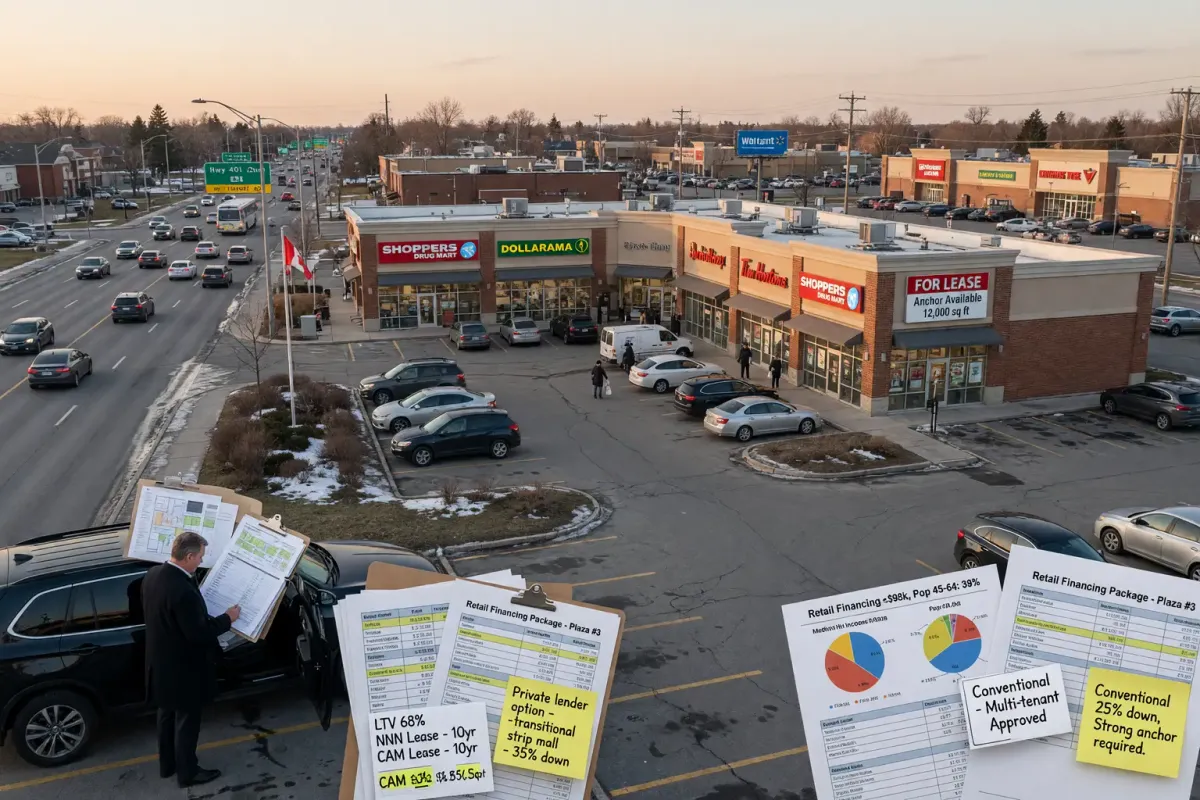
Retail property sits at a crossroads. Online shopping has reshaped the landscape. Some investors are running away from retail. Others are running toward it, picking up well-located strip malls and neighbourhood retail centres at prices that make the cash flow numbers sing.
If you are in the second group, you already know that retail tenants on long leases with strong foot traffic create reliable income. The question is how to actually finance these deals.
This guide breaks down everything you need to know about financing retail property investments in Canada. From how lenders evaluate anchor tenants to the exact terms you can expect, you will have a clear picture of what it takes to get approved and close. For complete details on retail-specific lending programs, visit our retail property mortgage financing page.
Types of Retail Properties and How Lenders View Them
Not all retail is created equal. Lenders categorize retail properties differently, and each type carries its own risk profile. Understanding this is the first step to knowing what financing you can access.
Strip Malls and Neighbourhood Retail Centres
These are the bread and butter of Canadian retail investing. A row of 5-15 units anchored by a grocery store, pharmacy, or bank branch. They serve the surrounding neighbourhood and depend on local foot traffic.
Lenders like strip malls because:
- They serve essential needs (groceries, healthcare, banking)
- Tenants are less vulnerable to e-commerce disruption
- Multiple tenants diversify income risk
- Locations are typically well-established
Financing terms for well-occupied strip malls are among the strongest in retail lending. Before committing to retail specifically, many investors explore our buying commercial real estate guide to understand the fundamentals across all commercial property types.
Standalone Retail Buildings
A single building leased to one tenant. Think a standalone Tim Hortons, a dental clinic, or a car dealership. These are simple to manage but carry concentration risk.
If the tenant is a national credit tenant on a long-term NNN lease, financing is straightforward. If it is a local business, lenders are more cautious. Your down payment will reflect that risk.
Shopping Centres and Power Centres
Larger retail complexes with big-box anchors and multiple inline tenants. These are institutional-grade properties that require significant capital. Financing is available but typically involves larger loan amounts, more complex underwriting, and relationships with commercial mortgage-backed securities (CMBS) lenders.
Most individual Canadian investors focus on strip malls and standalone properties. The financing is more accessible and the entry point is lower.
Mixed-Use Retail
Retail on the ground floor with residential or office space above. This is where financing gets interesting because the residential component can unlock CMHC-insured financing with dramatically better terms. If at least 50% of the gross floor area is residential, you may qualify for multi-family mortgage financing programs that offer higher leverage and longer amortization.
For detailed lending programs specific to retail assets, visit our retail property mortgage financing page.
How Lenders Evaluate Retail Properties
When you apply for financing on a retail property, the lender dissects the income, the tenants, and the market. Here is exactly what they focus on.
Anchor Tenant Strength
The anchor tenant is the primary draw that brings foot traffic to the property. In a strip mall, this might be a Shoppers Drug Mart, a Sobeys, or a Royal Bank branch. The anchor matters enormously because:
- It drives traffic that benefits all other tenants
- It typically occupies the largest space and pays the most rent
- Its creditworthiness signals overall property stability
- Its lease term sets the tone for the property’s financing potential
Lenders will review the anchor tenant’s financial health, corporate backing, and remaining lease term. A national grocery chain with 12 years left on a lease is worth far more in financing terms than a regional retailer with 2 years remaining.
Tenant Mix and Diversification
Beyond the anchor, lenders want to see a healthy mix of tenants serving different needs. A strong tenant mix might include:
- Grocery or pharmacy (essential, e-commerce resistant)
- Restaurant or quick-service food (experiential)
- Personal services (hair salon, dental, optometrist)
- Financial services (bank branch, insurance office)
- Specialty retail (liquor store, pet supply)
A property where every tenant sells clothing is far riskier than one with a diverse mix. Lenders want to see that if one tenant category struggles, the others can sustain the property.
Lease Terms and Structure
Retail leases are complex. Lenders look at several specific elements:
Base rent and escalations. Predictable rent growth built into leases shows lenders that income will increase over time. Annual escalations of 2-3% or CPI-linked increases are standard.
Percentage rent clauses. Some retail leases include a percentage rent component where the tenant pays additional rent based on gross sales above a threshold. Lenders may or may not include this in their underwriting, depending on the tenant’s sales history.
Lease term remaining. As with office property mortgage financing, lenders heavily weight remaining lease terms. Tenants with fewer than 2 years remaining may be treated as vacant in underwriting.
Options to renew. Tenants with multiple renewal options signal long-term commitment. This strengthens your financing application.
Location and Traffic Analysis
Retail properties live and die by location. Lenders evaluate:
- Traffic counts. How many vehicles pass the property daily? Higher traffic means higher visibility and more potential customers.
- Demographics. What does the surrounding population look like? Income levels, age distribution, and population density all matter.
- Accessibility. Easy access from major roads, adequate parking, and good signage visibility.
- Competition. What other retail exists nearby? Too much competition reduces tenant stability.
- Municipal plans. Is the area growing? New residential developments nearby mean more customers for your tenants.
Choosing the wrong lender or term can quietly erode your returns — book a free strategy call with LendCity and we’ll walk you through the numbers.
When you’re ready to structure the mortgage side of this strategy, our DSCR loans guide covers the programs that typically fit.
Understanding CAM Charges and Their Impact on NOI
Common Area Maintenance (CAM) charges are a critical component of retail property economics. They directly impact your net operating income and, by extension, your financing capacity.
What CAM Covers
CAM charges are fees tenants pay to cover the costs of maintaining shared spaces. In a strip mall, this includes:
- Parking lot maintenance, snow removal, and lighting
- Landscaping and exterior upkeep
- Common area cleaning
- Security
- Property management fees
- Insurance and property taxes (in NNN structures)
How CAM Affects Your Bottom Line
Here is a practical example for a 15,000-square-foot strip mall:
- Base rent collected: $300,000 per year
- CAM recoveries from tenants: $60,000 per year
- Actual CAM expenses: $55,000 per year
- CAM surplus: $5,000
Your effective gross income is $360,000, your operating expenses (beyond CAM) might be $20,000, and your NOI comes out to $285,000.
Lenders love seeing high CAM recovery ratios. A property where tenants cover 100% or more of operating costs through CAM charges presents minimal expense risk to the landlord.
CAM Caps and Controllable Expenses
Some leases include CAM caps that limit how much CAM charges can increase annually. This can create a gap between your actual costs and what you can recover from tenants. Lenders factor this into their underwriting. When negotiating leases, try to structure CAM clauses without caps, or with caps that are high enough to cover reasonable cost increases.
Financing Options for Canadian Retail Properties
Conventional Commercial Mortgages
This is the most common path for retail property financing. Here is what to expect:
Borrowers comparing options often continue with Office Building Financing Canada: Loans, Rates & NNN Leases before booking a strategy call.
- Loan-to-value: 55-70% (meaning 30-45% down payment)
- Amortization: 15-25 years
- Term: 5-10 years
- DSCR requirement: 1.2-1.3 (lenders tend to be slightly more conservative with retail)
- Interest rates: Retail commercial mortgages run roughly 5.00-6.75% in 2026, with grocery-anchored and necessity-based plazas at the tighter end of that range
The lower LTV range compared to office or multi-family reflects lender caution around retail. Strong anchor tenants and long leases push you toward 70% LTV. Weak tenants or short leases push you toward 55%.
CMHC Financing for Mixed-Use Retail
If your retail property includes residential units making up 50% or more of gross floor area, CMHC-insured financing dramatically improves your terms:
- Up to 85% loan-to-value
- Amortization up to 40-50 years
- Lower interest rates
- DSCR as low as 1.1
This is a powerful strategy for investors who can find or develop mixed-use properties. The residential mortgage financing component changes the entire lending equation in your favour.
Credit Unions and Regional Lenders
Credit unions are often the best option for smaller retail properties in their service area. They offer:
- Local market knowledge that big banks lack
- Flexibility on property types and tenant profiles
- Relationship-based lending
- Competitive rates for well-located properties
If your retail property is in a smaller market, a local credit union may be your strongest lending partner. They understand the tenants and the community in ways that national lenders cannot.
For a broader view of all Mortgage Financing for Canadians in Canada, working with a commercial broker who has access to multiple lender channels is essential.
Your debt ratios, income type, and property plans all affect what you qualify for — schedule a free strategy session with us so we can map out a strategy that works for your goals.
The E-Commerce Question: How Lenders View Retail Risk
You cannot talk about retail financing without addressing the elephant in the room. E-commerce has permanently changed how lenders evaluate retail properties.
Here is the reality: lenders are cautious about retail, but they are not avoiding it. They are selective. Properties that serve essential, experiential, or service-based needs are still financeable at attractive terms. Properties that compete directly with Amazon are not.
E-commerce resistant categories:
- Grocery stores and pharmacies
- Restaurants and food service
- Medical and dental clinics
- Hair salons and personal services
- Fitness centres and gyms
- Dollar stores and discount retailers
E-commerce vulnerable categories:
- Electronics retailers
- Bookstores
- Clothing stores (without a strong brand or experience component)
- Home goods without a service component
When you are selecting retail properties to finance, lean toward tenants in e-commerce resistant categories. Lenders will notice, and your financing terms will reflect the lower risk profile.
Pop-Up Retail as a Vacancy Bridge
When a bay sits empty waiting for a multi-year tenant, short-term pop-up arrangements can generate income that still helps protect NOI for lenders and cash flow for you.
Pop-up retail typically runs days to months rather than years—seasonal sales, product launches, brand activations, or online brands testing a physical presence. Per-period rent can be higher than a pro-rated long-term lease, but management intensity rises with turnover, move-ins, and space prep between occupants.
Before you pursue pop-ups:
- Confirm mortgage covenants allow short-term or alternative uses (many loans require lender consent)
- Check existing tenant exclusivity clauses so you do not breach co-tenancy or category restrictions
- Use proper documentation—often a license rather than a full commercial lease—and require insurance
- Keep HVAC, electrical, lighting, and security in working order; short-term tenants will not wait on deferred repairs
Treat pop-ups as a bridge while you continue leasing to creditworthy long-term tenants. Do not assume a string of temporary licenses will underwrite like an anchor lease on your next refinance.
The Application Process
The retail property financing process mirrors commercial lending generally, with a few retail-specific elements.
Step 1: Property analysis and pre-qualification. Before making an offer, get the property analyzed by a commercial mortgage broker. Bring the rent roll, lease summaries, and CAM reconciliation from the past two years. A broker can assess financing potential within 24-48 hours. Start with our investor resources and tools page for guidance on what lenders need.
Step 2: Offer and due diligence. With pre-qualification in hand, make your offer with confidence. During due diligence, request estoppel certificates from all tenants confirming their lease terms, rental rates, and any outstanding issues.
Step 3: Lender submission. Your broker packages the deal and submits to multiple lenders. For retail properties, this typically includes the rent roll, leases, two years of operating statements, CAM reconciliation, property condition report, and environmental assessment.
Step 4: Appraisal and underwriting. The lender orders a commercial appraisal that values the property based on income approach (NOI divided by market cap rate), comparable sales, and replacement cost. Underwriting takes 3-6 weeks for retail properties.
Step 5: Commitment and closing. The lender issues a commitment letter with final terms. Legal review, condition satisfaction, and closing follow. Budget 60-90 days from application to funding.
If you are also exploring opportunities outside of Canada, DSCR loans for Mortgage Financing for Canadians in the U.S.A. qualify the property based on rental income rather than personal income, require 20-25% down, and do not need US credit history. For opportunities further south, our team also supports property financing in Mexico for Canadian investors.
Building a Retail Investment Strategy
The most successful retail investors do not buy random properties. They build a portfolio strategy.
Start with necessity-based retail. Properties anchored by grocery, pharmacy, and medical tenants are your safest entry point. They generate reliable income and finance well.
Add value through lease-up. Buying a retail property with some vacancy and leasing it up creates forced appreciation. You increase the NOI, which increases the property value. Then you refinance at the higher value to pull out capital for your next deal.
Scale through development. Once you understand retail property dynamics, consider development mortgage financing for building new retail or mixed-use properties. Development financing is more complex but offers the highest returns.
Diversify across property types. Combine retail with office building investments and multi-family properties to create a balanced commercial portfolio.
Key Takeaways:
- Types of Retail Properties and How Lenders View Them
- How Lenders Evaluate Retail Properties
- Understanding CAM Charges and Their Impact on NOI
- Financing Options for Canadian Retail Properties
- The E-Commerce Question: How Lenders View Retail Risk
Frequently Asked Questions
What is the minimum down payment for retail property in Canada?
Do lenders still finance retail properties given e-commerce growth?
What DSCR do lenders require for retail property financing?
How important is the anchor tenant for financing?
What are CAM charges and do they affect my financing?
How long does it take to close on a retail property mortgage?
Free download
MLI Select document checklist
Appraisals, rent rolls, environmental reports, and the CMHC package lenders expect before they underwrite.
By submitting, you agree to receive occasional emails from LendCity. You can unsubscribe at any time.
4.8/5 (116 Google reviews)
Disclaimer: LendCity Mortgages is a licensed mortgage brokerage. Content on this page is for educational purposes only and does not constitute legal, tax, investment, securities, or financial-planning advice. Rates, premiums, program terms, and regulations referenced are as of the page's last updated date and are subject to change. Any investment returns, rental yields, tax savings, or case-study figures shown are illustrative only — they are not guaranteed, not typical, and individual results will vary. Consult a licensed lawyer, Chartered Professional Accountant, or registered dealer before acting on any information above. Editorial standards.

Written by
Scott Dillingham
Published
February 15, 2026
· Updated August 2, 2026Reading time
11 min read
Amortization
The period over which a mortgage is scheduled to be fully paid off through regular payments of principal and [interest](/glossary/interest-rate/). In Canada, common amortization periods are 25 or 30 years, though the mortgage term (when you renegotiate) is typically 1-5 years. A longer amortization lowers monthly payments, improving [cash flow](/glossary/cash-flow/) but increasing total interest paid.
Down Payment
The upfront cash payment when purchasing a property. For 1-4 unit investment properties, minimum 20% down is required. 5+ unit multifamily can use CMHC MLI Select with lower down payments, and house hackers can put as little as 5% down on owner-occupied 2-4 plexes. Your down payment directly affects your [LTV](/glossary/ltv/) and the amount of [leverage](/glossary/leverage/) you use.
LTV
Loan-to-Value ratio - the mortgage amount expressed as a percentage of the property's appraised value or purchase price (whichever is lower). An 80% LTV means you're borrowing 80% and putting 20% [down](/glossary/down-payment/). Lower LTV generally means better [interest rates](/glossary/interest-rate/) and terms. See also [Equity](/glossary/equity/) and [Leverage](/glossary/leverage/).
DSCR
Debt Service Coverage Ratio — a metric that compares a property's [net operating income](/glossary/noi/) to its mortgage payments. A DSCR of 1.25 means the property generates 25% more income than needed to cover the debt. Lenders typically require a minimum DSCR of 1.0 to 1.25 for investment property loans (including [DSCR loans](/glossary/dscr-loan/)). See also [Cap Rate](/glossary/cap-rate/) and [Cash Flow](/glossary/cash-flow/).
Cap Rate
Capitalization Rate - the ratio of a property's [net operating income (NOI)](/glossary/noi/) to its current market value or purchase price. A 6% cap rate means the property generates $60,000 NOI annually on a $1,000,000 value. Used to compare investment properties regardless of financing. See also [DSCR](/glossary/dscr/) and [Cash-on-Cash Return](/glossary/cash-on-cash-return/).
NOI
Net Operating Income - the total income a property generates minus all operating expenses, but before mortgage payments and income taxes. Calculated as gross rental income minus [vacancies](/glossary/vacancy-rate/), property taxes, insurance, maintenance, and property management fees. NOI is used to calculate both [Cap Rate](/glossary/cap-rate/) and [DSCR](/glossary/dscr/).
CMHC Insurance
Mortgage default insurance from Canada Mortgage and Housing Corporation. For 1-4 unit investment properties, investors must put 20%+ down (no insurance available). However, CMHC offers MLI Select for 5+ unit multifamily properties, and house hackers can access insured mortgages with 5-10% down.
Commercial Mortgage
Financing for commercial properties like retail, office, or multifamily buildings with 5+ units, with different qualification criteria than residential mortgages.
Commercial Lending
Financing for commercial real estate or business purposes, typically qualified based on property income (NOI) rather than personal income. Includes mortgages for multifamily buildings (5+ units), retail, office, and industrial properties.
Cash Flow
The money left over after collecting rent and paying all expenses including mortgage, taxes, insurance, maintenance, and property management. Positive cash flow is the primary goal of buy-and-hold investors. See also [NOI](/glossary/noi/), [Cash-on-Cash Return](/glossary/cash-on-cash-return/), and [Vacancy Rate](/glossary/vacancy-rate/).
Appreciation
The increase in a property's value over time, which builds [equity](/glossary/equity/) and wealth for the owner through market growth or [forced improvements](/glossary/forced-appreciation/).
Leverage
Using borrowed money (mortgage) to control a larger asset, amplifying both potential returns and risks on your investment. A higher [LTV](/glossary/ltv/) means more leverage. See also [Down Payment](/glossary/down-payment/) and [Equity](/glossary/equity/).
Multifamily
Properties with multiple dwelling units, from duplexes to large apartment buildings. Often offer better cash flow and economies of scale.
Refinance
Replacing an existing mortgage with a new one, typically to access equity, get a better rate, or change terms. Investors commonly refinance to pull out capital for purchasing additional properties (cash-out refinance) while retaining ownership of the original property.
Interest Rate
The cost of borrowing money, expressed as a percentage. It determines how much you pay on top of the principal borrowed. Interest rates directly affect monthly payments, [cash flow](/glossary/cash-flow/), and [DSCR](/glossary/dscr/). See also [Amortization](/glossary/amortization/).
Appraisal
A professional assessment of a property's market value, required by lenders to ensure the property is worth the loan amount.
Vacancy Rate
The percentage of rental units that are unoccupied over a given period. A critical factor in [cash flow](/glossary/cash-flow/) analysis, typically estimated at 4-8% for conservative projections. Vacancy directly reduces [NOI](/glossary/noi/).
Property Management
The operation, control, and oversight of real estate by a third party. Property managers handle tenant screening, rent collection, maintenance, and day-to-day operations.
Due Diligence
The comprehensive investigation and analysis of a property before purchase, including financial review, physical inspection, title search, and market analysis.
Rent Roll
A document listing every tenant in a commercial property along with their unit number, lease start and end dates, monthly rent, security deposits, and key lease terms. Required by all commercial mortgage lenders during underwriting, the rent roll is the primary tool used to verify and analyze a property's actual and potential rental income.
Underwriting
The process lenders use to evaluate the risk of a mortgage application, including reviewing credit, income, assets, and property value to determine loan approval.
Mortgage Broker
A licensed professional who shops multiple lenders to find the best mortgage rates and terms for borrowers. Unlike banks, brokers have access to dozens of lending options.
Turnover
The process and cost of preparing a rental unit for a new tenant after the previous tenant moves out, including cleaning, repairs, marketing, and vacancy time. High turnover rates significantly reduce profitability through lost rent and preparation expenses.
Rental Income
Revenue generated from tenants paying rent on an investment property. Gross rental income is the total collected before expenses, while net rental income subtracts operating costs to show actual profitability.
Operating Expenses
The ongoing costs of running a rental property, including property taxes, insurance, maintenance, property management fees, utilities, and repairs. Subtracting operating expenses from gross rental income yields the net operating income.
Comparable Properties
Similar properties in the same market area used to establish fair market value or rental rates through comparison of features, location, condition, and recent sale or rental prices. Analyzing comps is essential when determining offer prices and setting competitive rents.
Credit Union
A member-owned financial cooperative that provides banking services including mortgage lending. Credit unions often have more flexible lending policies for real estate investors than major banks, particularly for borrowers who have exceeded conventional lending limits.
Mixed-Use Property
A building that combines residential and commercial uses, such as retail on the ground floor with apartments above. Mixed-use properties can diversify income streams and may qualify for commercial financing terms.
Environmental Assessment
A professional evaluation of a property's environmental condition, typically required by commercial lenders. Phase I reviews historical records for contamination risk. Phase II involves soil and water testing. Essential for commercial and industrial property purchases.
Forced Appreciation
An increase in property value driven by the owner's actions rather than general market conditions. Strategies include renovations, increasing rents, reducing [vacancies](/glossary/vacancy-rate/), or cutting operating expenses. In commercial real estate, raising [NOI](/glossary/noi/) directly increases the property's income-based appraised value. Key to the [BRRRR strategy](/glossary/brrrr/) and improving [ARV](/glossary/after-repair-value-arv/).
Net Lease
A commercial lease where the tenant pays some or all operating expenses (taxes, insurance, maintenance) in addition to base rent. Variations include single net (N), double net (NN), and triple net (NNN) leases, shifting cost risk from landlord to tenant.
Lease-Up Period
The time between when a new or renovated property is ready for tenants and when it reaches stabilized occupancy. During lease-up, the property generates below-target income while carrying full expenses, requiring adequate cash reserves.
Common Area Maintenance
Expenses for maintaining shared spaces in commercial properties, including lobbies, parking lots, landscaping, and hallways. CAM charges are typically passed through to tenants as part of net lease structures.
Anchor Tenant
A major tenant in a commercial property, typically a well-known retailer or business, that draws customers and other tenants to the location. Anchor tenants provide stability and are a key factor in commercial property valuation.
Hover over terms to see definitions. View the full glossary for all terms.