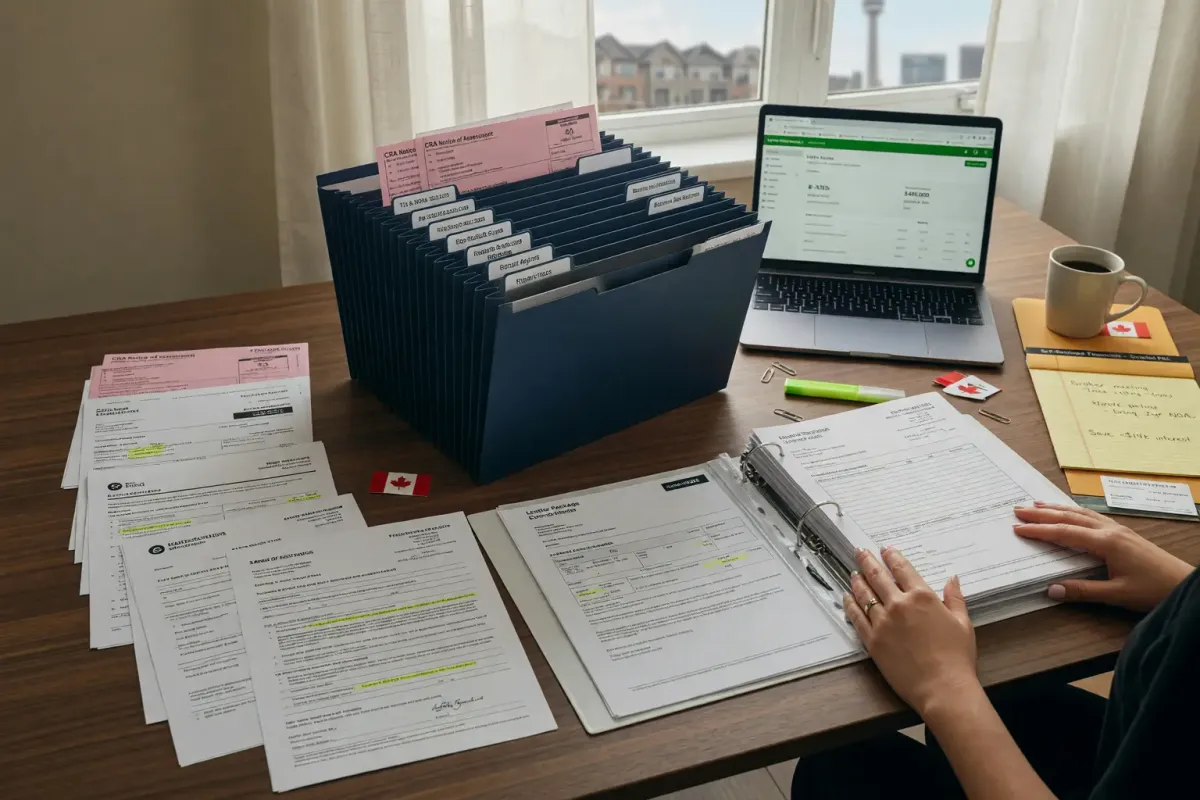
Getting approved for the best mortgage rates starts long before you find your dream property. Whether you’re purchasing your first home, refinancing an existing property, or scaling a real estate investment portfolio, having your financial documents organized can mean the difference between smooth approvals and costly delays.
In a recent episode of the Wisdom Lifestyle Money Show, mortgage expert Scott Dillingham joined forces with real estate investing coach Theresa Beneteau to discuss why document preparation and tax filing are non-negotiable for investors who want access to premium financing options.
The Hidden Cost of Disorganized Finances
Many investors underestimate how expensive poor document organization can be. Scott shared a compelling example from his practice involving a commercial property owner with a trucking facility in the GTA. Despite having solid financials, the client lost his relationship with a major bank simply because his paperwork wasn’t in order during an annual review.
The result? An entire year paying private lending rates on a multi-million dollar loan while scrambling to get documents organized. The fees, broker costs, and elevated interest rates created a significant financial burden that could have been avoided with proper preparation.
This scenario isn’t unique to commercial borrowers. Even homeowners looking to tap into their home equity through a refinance can face rejection if their financial house isn’t in order.
Why Lenders Demand Current Tax Filings
One of the most critical documents lenders require is your Notice of Assessment from the Canada Revenue Agency. But why do lenders care so much about your tax status?
The answer comes down to risk management. The CRA has priority over virtually all other creditors, including mortgage lenders. If you owe back taxes, the CRA can file a judgment against your property that supersedes any existing mortgage. In extreme cases, they can force a sale to collect what’s owed.
This priority status means lenders need assurance that you’re current with your tax obligations. Even relatively small tax debts can derail a mortgage application. Scott recounted helping a client who owed the CRA a substantial amount and wanted to refinance his home to pay off the debt. Despite having excellent credit and clear ability to make payments, major lenders wouldn’t approve the refinance until the tax situation was resolved.
One investor lost a full year paying private lending rates on a multi-million dollar loan because his documents weren’t ready — book a free strategy call with LendCity and we’ll make sure your paperwork is lender-ready before that happens to you.
Your debt ratios, income type, and property plans all affect what you qualify for — book a free strategy call with LendCity so we can map out a strategy that works for your goals.
When you’re ready to structure the mortgage side of this strategy, our real estate investing guide covers the programs that typically fit.
The Pre-Approval Process: Why Preparation Matters
Jumping into property hunting without a proper mortgage pre-approval is a recipe for disappointment. When you make an offer without knowing what lenders will actually approve, you risk:
Discovering the purchase price exceeds your borrowing capacity Losing your deposit if financing falls through Missing out on properties while scrambling to gather documents Accepting unfavorable terms due to time pressure
A proper pre-approval involves collecting and organizing key documents including proof of income, employment verification, bank statements showing down payment funds, and those crucial tax documents. The process gives you clarity on your buying power and shows sellers you’re a serious, qualified buyer.
Building Your Financial Documentation Binder
The concept of a financing binder has been promoted in real estate investment circles for decades. The idea is simple: maintain an organized collection of all documents a lender might request so you can move quickly when opportunities arise.
Your documentation package should include (see our detailed Document Checklist for Your Investment Property Mortgage):
Income Verification
Recent pay stubs covering the last 30 days T4 slips from previous tax years T1 General tax returns for self-employed individuals Employment letter confirming position and salary
Asset Documentation
Bank statements from the past 90 days Investment account statements RRSP and TFSA balances Proof of down paymentsource
Tax Compliance
Notice of Assessment for at least two years Any payment arrangements with CRA Business tax returns for incorporated individuals
Property Information
Current mortgage statements Property tax receipts Insurance documentation Lease agreements for rental properties
Working with a Canadian mortgage professional can help ensure your documents are formatted and organized the way lenders prefer to see them. This packaging can significantly speed up approval times and reduce back-and-forth requests.
Whether you need your Notice of Assessment sorted or want to know exactly what documents lenders want to see, book a free strategy call with us and we’ll walk you through a personalized checklist.
Refinancing at the wrong time or with the wrong lender can leave equity trapped — schedule a free strategy session with us to make sure your refinance actually moves you forward.
The Credit Score Connection
Your credit score plays a crucial role in determining not just approval, but the rates and terms you’ll qualify for. In Canada, most traditional lenders look for a minimum score of 680 to access the best rates and products.
Scott explained that a client recently wanted the best available fixed rate, but her Credit Score of 613 disqualified her from the best available products. While she still obtained financing, the lower score meant paying a higher rate and choosing a different lender with less favorable terms.
Beyond the score itself, lenders examine the depth of your credit profile. Having a high score with no active credit accounts is nearly as problematic as having a low score. Learn how to build and improve your credit score fast. Lenders want to see multiple active trade lines demonstrating your ability to manage credit responsibly.
Two key credit bureaus operate in Canada: Equifax and TransUnion. While most lenders primarily use Equifax, some items may be reported to one bureau but not the other. Checking both reports helps you identify and address any issues before they derail your application.
Commercial Mortgage Considerations
For investors purchasing multi-family properties with six or more units, the lending landscape differs significantly from residential mortgages. Commercial lenders focus more heavily on the property’s income potential and your ability to provide comprehensive financial documentation.
Unlike residential mortgages where you simply renew without requalification, commercial loans typically involve annual reviews. Lenders verify that the property continues to perform as expected and that your overall financial situation remains stable.
This ongoing scrutiny means commercial investors must maintain organized financial records year-round, not just at purchase time. Keeping current rent rolls, operating statements, and financial statements readily available ensures smooth annual reviews and positions you well for renewals.
JV Partners and Documentation Standards
For investors raising capital through joint venture partnerships, financial organization takes on additional importance. Potential partners often request credit reports and financial documentation as part of their due diligence process.
Theresa shared her approach to vetting potential JV partners: requesting credit bureaus and even police clearances before entering partnerships. When she offered to share her own documentation in return, one potential partner’s refusal to reciprocate told her everything she needed to know about their suitability as a business partner.
The principle extends to how partners will show up throughout the investment. If someone can’t organize basic financial documents before a deal, they’re unlikely to handle their responsibilities professionally when it comes time for refinancing or property management decisions.
Taking Action Before the New Year
For investors looking to position themselves for opportunities in the coming months, now is the ideal time to get financial documents in order. Here’s a practical timeline:
Immediate Actions
File any outstanding tax returns Request copies of your Notice of Assessment from CRA Check both Equifax and TransUnion credit reports Dispute any errors found on credit reports
Within 30 Days
Gather and organize all income documentation Compile asset statements from the past 90 days Calculate your current net worth Review debt obligations and payment histories
Ongoing Maintenance
Set calendar reminders for tax filing deadlines Create a system for organizing financial documents Monitor credit reports quarterly Keep digital copies of all important documents
The Underwriting Perspective
Beyond documentation, successful investors understand how lenders evaluate commercial properties. Familiarizing yourself with concepts like Net Operating Income and Debt Service Coverage Ratio helps you identify deals that will actually get funded.
Understanding these metrics before making offers prevents the frustration of finding properties that look great on paper but don’t meet lender requirements. Many investors benefit from using the same underwriting tools lenders use to pre-screen potential acquisitions.
Guest Information
Theresa Beneteau is a real estate investing coach and author of “Insta Wholesaler.” She runs the Trailblazing Tribe community and offers coaching programs covering wholesaling, fix and flips, and buy-and-hold strategies.
To connect with Theresa and learn more about her investor education programs, visit her website or reach out through her community platforms.
Key Takeaways:
- The Hidden Cost of Disorganized Finances
- Why Lenders Demand Current Tax Filings
- The Pre-Approval Process: Why Preparation Matters
- Building Your Financial Documentation Binder
- The Credit Score Connection
Frequently Asked Questions
What credit score do I need to qualify for the best mortgage rates in Canada?
How long does a mortgage pre-approval take in Canada?
What happens if I owe money to the CRA and want to refinance?
Why do commercial lenders require annual reviews?
Can I get a mortgage without filing taxes?
How does having a JV partner affect mortgage qualification?
What documents do I need for a rental property mortgage application?
How far back do lenders look at credit history?
Weekly Investor Insight
Sunday financing notes for investors
Market updates, rate moves, and deal structures — once a week. Unsubscribe anytime.
By submitting, you agree to receive occasional emails from LendCity. You can unsubscribe at any time.
Disclaimer: LendCity Mortgages is a licensed mortgage brokerage. Content on this page is for educational purposes only and does not constitute legal, tax, investment, securities, or financial-planning advice. Rates, premiums, program terms, and regulations referenced are as of the page's last updated date and are subject to change. Any investment returns, rental yields, tax savings, or case-study figures shown are illustrative only — they are not guaranteed, not typical, and individual results will vary. Consult a licensed lawyer, Chartered Professional Accountant, or registered dealer before acting on any information above. Editorial standards.

Written by
Scott Dillingham
Published
January 5, 2026
· Updated June 29, 2026Reading time
8 min read
Commercial Mortgage
Financing for commercial properties like retail, office, or multifamily buildings with 5+ units, with different qualification criteria than residential mortgages.
Credit Score
A numerical rating (300-900 in Canada) that represents your creditworthiness, affecting mortgage rates and approval. 680+ is typically needed for best rates.
DSCR
Debt Service Coverage Ratio — a metric that compares a property's [net operating income](/glossary/noi/) to its mortgage payments. A DSCR of 1.25 means the property generates 25% more income than needed to cover the debt. Lenders typically require a minimum DSCR of 1.0 to 1.25 for investment property loans (including [DSCR loans](/glossary/dscr-loan/)). See also [Cap Rate](/glossary/cap-rate/) and [Cash Flow](/glossary/cash-flow/).
Down Payment
The upfront cash payment when purchasing a property. For 1-4 unit investment properties, minimum 20% down is required. 5+ unit multifamily can use CMHC MLI Select with lower down payments, and house hackers can put as little as 5% down on owner-occupied 2-4 plexes. Your down payment directly affects your [LTV](/glossary/ltv/) and the amount of [leverage](/glossary/leverage/) you use.
Equity
The difference between a property's current market value and the remaining mortgage balance. If your home is worth $500,000 and you owe $300,000, you have $200,000 in equity. Equity builds through mortgage payments, [appreciation](/glossary/appreciation/), and [forced appreciation](/glossary/forced-appreciation/). See also [LTV](/glossary/ltv/) and [Refinancing](/glossary/refinancing/).
Joint Venture
A partnership between two or more parties to invest in real estate, combining capital, expertise, or credit to complete a deal.
NOI
Net Operating Income - the total income a property generates minus all operating expenses, but before mortgage payments and income taxes. Calculated as gross rental income minus [vacancies](/glossary/vacancy-rate/), property taxes, insurance, maintenance, and property management fees. NOI is used to calculate both [Cap Rate](/glossary/cap-rate/) and [DSCR](/glossary/dscr/).
Pre-Approval
A conditional commitment from a lender stating your borrowing capacity, valid for 90-120 days. For investors, getting pre-approved helps you move quickly on deals and shows sellers you're a serious buyer with financing in place.
Rent Roll
A document listing every tenant in a commercial property along with their unit number, lease start and end dates, monthly rent, security deposits, and key lease terms. Required by all commercial mortgage lenders during underwriting, the rent roll is the primary tool used to verify and analyze a property's actual and potential rental income.
Underwriting
The process lenders use to evaluate the risk of a mortgage application, including reviewing credit, income, assets, and property value to determine loan approval.
Fixed Rate Mortgage
A mortgage where the interest rate stays the same for the entire term, providing predictable monthly payments regardless of market changes.
Coverage Ratio
A measure of a property's ability to cover its debt payments, typically referring to DSCR. Commercial lenders often require a minimum of 1.2, meaning the property's net operating income exceeds debt payments by at least 20%.
Private Mortgage
A mortgage from a private lender rather than a traditional bank, typically with higher rates but more flexible qualification requirements.
Commercial Lending
Financing for commercial real estate or business purposes, typically qualified based on property income (NOI) rather than personal income. Includes mortgages for multifamily buildings (5+ units), retail, office, and industrial properties.
Multifamily
Properties with multiple dwelling units, from duplexes to large apartment buildings. Often offer better cash flow and economies of scale.
Refinance
Replacing an existing mortgage with a new one, typically to access equity, get a better rate, or change terms. Investors commonly refinance to pull out capital for purchasing additional properties (cash-out refinance) while retaining ownership of the original property.
Interest Rate
The cost of borrowing money, expressed as a percentage. It determines how much you pay on top of the principal borrowed. Interest rates directly affect monthly payments, [cash flow](/glossary/cash-flow/), and [DSCR](/glossary/dscr/). See also [Amortization](/glossary/amortization/).
Property Management
The operation, control, and oversight of real estate by a third party. Property managers handle tenant screening, rent collection, maintenance, and day-to-day operations.
Due Diligence
The comprehensive investigation and analysis of a property before purchase, including financial review, physical inspection, title search, and market analysis.
Property Tax
Annual tax levied by municipalities on real estate based on the assessed value of the property. Property taxes fund local services and are a significant operating expense that investors must account for in cash flow projections.
Wholesaling
A real estate investment strategy where an investor contracts to buy a property and then assigns that contract to another buyer for a fee, without ever taking ownership. Wholesaling requires minimal capital but significant marketing and negotiation skills.
Incorporation
The legal process of forming a corporation to own and operate investment properties. Incorporation creates a separate legal entity providing liability protection and tax planning options, but adds complexity and can affect mortgage qualification.
A Lender
A major bank or institutional lender offering the most competitive mortgage rates and terms but with the strictest qualification criteria, including full income verification and stress test compliance. Most investors use A lenders for their first four to six properties.
Second Mortgage
A subordinate loan taken against a property that already has a first mortgage. Second mortgages have higher interest rates due to increased lender risk and can be used to access equity without refinancing the first mortgage.
Notice of Assessment
A document issued by the CRA after processing a tax return, confirming income reported and taxes owed or refunded. Mortgage lenders require Notices of Assessment as proof of declared income, especially for self-employed borrowers.
Hover over terms to see definitions. View the full glossary for all terms.