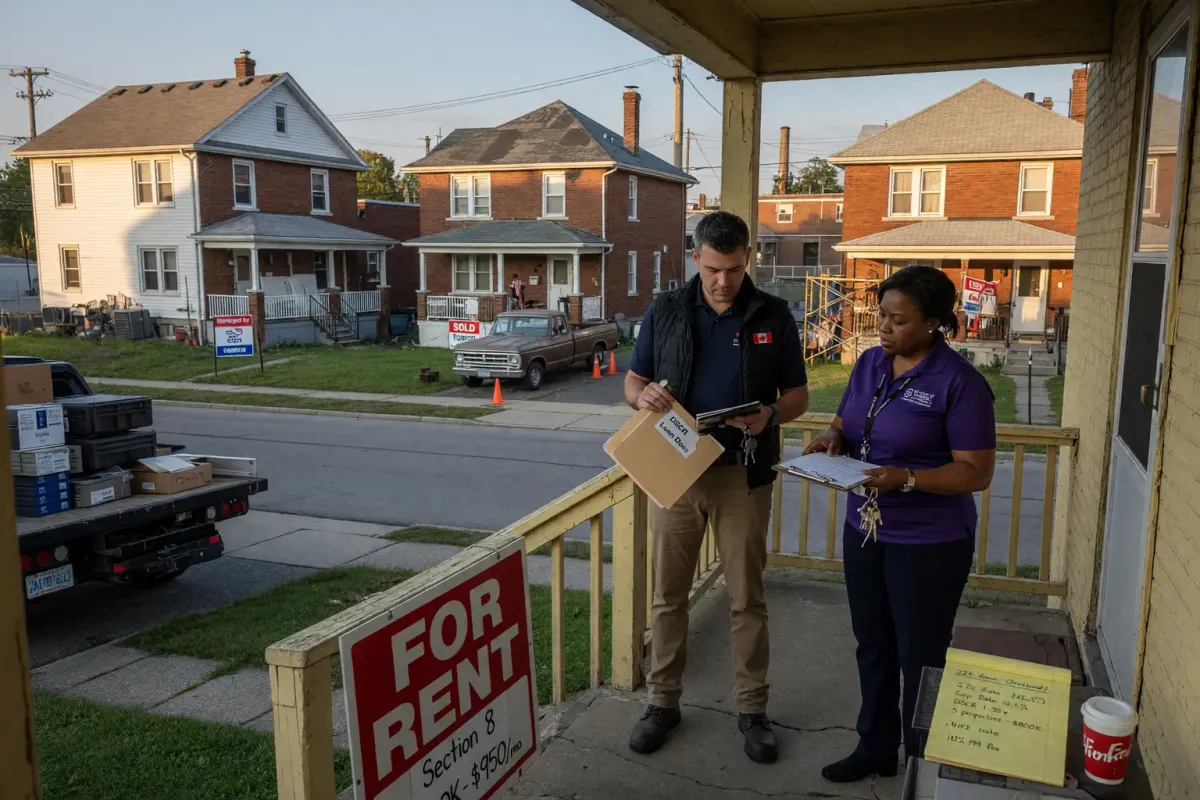
She Bought a House for $22,000. Then Things Got Interesting.
Here’s a story I love.
Araceli was a mechanical engineer in Canada. Great job. Seventeen years in aerospace. Good salary. But then she got divorced, lost half the household income overnight, and the bills didn’t shrink one bit.
Sound familiar? Maybe not the divorce part — but that feeling of “I make decent money and it’s still not enough”? Yeah. A lot of people know that feeling.
So she did what smart people do. She took action. She bought a property in Hamilton, Ontario, split it into three units, lived in one, rented the other two, and walked away with $400 a month in cash flow while living completely rent-free.
That’s the moment everything clicked. And what she built after that? It’s a playbook you can follow.
From Hamilton to Cleveland: Why She Left Canada
After her first deal in 2014, Araceli was hungry for more. But Canada had other plans.
By 2016, Hamilton properties were getting offers $50,000 to $100,000 over asking. The same type of fixer-upper she bought for $180,000 was now going for $300,000-plus. At those numbers, the cash flow disappeared. She’d be feeding the property out of her own pocket every month.
So she started looking elsewhere. St. Catharines. Niagara Falls. Nothing worked. Then someone asked her a simple question:
“Have you ever looked at buying in the US?”
She hadn’t. But she’d worked in Cleveland for six months as an engineer, so she knew the area — even if her memory of it wasn’t exactly glowing. The city had been rough back then.
But she took a look anyway. And she found two houses. One for $17,000. The other for $22,000.
Read those numbers again. $17,000 for a house. Coming from Canada, that’s the price of a used car.
You’ve got the right market and the right property — but most investors fumble the financing piece because they don’t know about DSCR loans and how they work for cross-border deals. book a free strategy call with LendCity and let’s make sure your capital is structured so you actually qualify.
Whether you’re buying your first rental or your tenth, having the right mortgage structure matters — book a free strategy call with LendCity to build a plan that scales with you.
The $22K House That Became a Cash Machine
Now, cheap doesn’t always mean good. Araceli learned that fast.
Her first property manager was terrible. The tenant trashed the place. She had to fire the manager, sell one property, and regroup.
Here’s the lesson she wants you to hear: A good property with a bad team becomes a bad property. Every time.
But the second house? That’s where things got good.
She bought it for $22,000, put about $20,000 into repairs, and placed her tenant on a lease-to-own agreement. The tenant paid $810 a month and took over all maintenance responsibilities.
Let’s do that math:
- Total investment: ~$42,000
- Monthly income: $810
- Annual gross: $9,720
- Maintenance costs: Minimal (tenant handled it)
The tenant stayed three years. Araceli paid back her entire investment — and then some — from a single house in Cleveland.
That’s the power of buying right in the US market.
A Quick Cleveland Market Snapshot (April 2026)
Cleveland is having a moment. Average home value sits around $232,400 in early 2026, with growth picking up to roughly 2.8% by September 2026 in the latest forecasts. The bigger story is rental yields: Cleveland is showing the highest gross rental yields among major US metros — around 11.3% — with a rent-to-value ratio near 0.63%. That cash-flow profile is exactly what’s drawing Canadian investors away from sub-5% Toronto numbers.
What You Actually Need to Know Before Buying in Cleveland (or Anywhere in the US)
Araceli has now done 20 deals. She’s got her E-2 visa, runs a renovation company in Cleveland full-time, and has seen every mistake in the book. Here’s her straight-up advice:
Don’t chase the cheapest house
Yes, you can still find houses for $30,000 to $50,000 in parts of Ohio. But here’s what nobody tells you: construction materials have nearly doubled since the pandemic. You’ll buy a $50,000 house, dump $80,000 into renovations, and end up past the after repair value (ARV). You’re upside down before you even start.
Borrowers comparing options often continue with Canadians Investing in US Real Estate: Pros & Cons before booking a strategy call.
Araceli’s recommendation — and I back this 100% — is to target properties at $100,000 and above. That’s the sweet spot where you get decent areas, reasonable renovation costs, real appreciation potential, and actual cash flow.
Below $100K, you’re often in D-grade neighborhoods where appreciation is slow, turnover is high, and repair costs eat you alive.
Get your ARV right
This is the single most important skill in real estate investing. The after repair value tells you what the property will be worth once it’s fixed up. Everything works backward from that number.
Wholesalers and even some realtors will tell you a deal is “cheap.” But cheap compared to what? A $50,000 house in a neighborhood where nothing sells for more than $60,000 isn’t a deal. It’s a trap.
Learn to run comps. Study the neighborhoods. Know what renovated properties actually sell or rent for in that specific area.
Find a contractor who shows up
Araceli started her own renovation company for one simple reason: most contractors don’t show up. That’s her entire competitive advantage — she’s reliable.
If you’re investing from Canada, your contractor and property manager ARE your investment. A bad one will destroy a great deal. A good one will make an okay deal profitable.
The difference between Araceli’s $22K deal that paid her back in three years and a money pit is nailing your ARV before you make an offer — schedule a free strategy session with us and we’ll walk you through exactly what a solid US investment looks like in your target market.
Many investors leave money on the table by not exploring all their financing options — schedule a free strategy session with us and we’ll show you what’s available.
The Financing Side: What Canadian Investors Need to Know
Back when Araceli started, everything had to be cash. No US credit, no Social Security number, no lending options.
That’s changed dramatically.
Today, Canadian investors can access DSCR loans for investors (Debt Service Coverage Ratio loans) without needing a US tax ID. These foreign national DSCR programs qualify based on the property’s rental income, not your personal income. You don’t even need to set foot in the country to close.
Here’s what you should know about the numbers:
- Minimum loan amount: Typically $75,000 for foreign nationals
- Minimum purchase price target: $100,000 (so you qualify for decent loan terms)
- Entity structure: A US LLC is strongly recommended for closing
- Fix and flip loans: Available, but if your renovation costs exceed the purchase price (an “upside down loan”), your options shrink fast and rates spike
The takeaway? Buy at $100K or above, keep renovations reasonable, and the lending world opens up with competitive terms.
Your Action Plan if You’re a Canadian Looking at US Real Estate
- Pick a market and study it. Cleveland, parts of Ohio, and the Midwest are still strong for cash flow. Learn the neighborhoods like a local.
- Master the ARV. Before you spend a dollar, know what fixed-up properties sell and rent for in your target area.
- Build your team first. Find a reliable property manager, contractor, and real estate agent who work with out-of-country investors. This is non-negotiable.
- Target $100K+ properties. You’ll get better neighborhoods, better tenants, better appreciation, and better financing terms.
- Get your financing lined up. Talk to a mortgage professional who specializes in Canadian mortgage financing options before you make offers.
- Start with one deal. Araceli’s first deal taught her more than any course ever could. Yours will too.
Key Takeaways:
- She Bought a House for $22,Then Things Got Interesting.
- From Hamilton to Cleveland: Why She Left Canada
- The $22K House That Became a Cash Machine
- What You Actually Need to Know Before Buying in Cleveland (or Anywhere in the US)
- The Financing Side: What Canadian Investors Need to Know
Frequently Asked Questions
Can Canadians buy rental properties in the US without US citizenship?
What is the after repair value (ARV) and why does it matter?
What's the minimum property price I should target in Cleveland or Ohio?
What is a DSCR loan and how does it work for foreign investors?
What is an "upside down" fix and flip loan?
How important is having a good property manager when investing out of country?
What is a lease-to-own agreement and when should I use it?
Do I need to visit the US to buy an investment property there?
Free download
DSCR property qualification checklist
What lenders score on a cash-flow loan — borrower, property, and deal structure — before you write an offer.
By submitting, you agree to receive occasional emails from LendCity. You can unsubscribe at any time.
4.8/5 (116 Google reviews)
Disclaimer: LendCity Mortgages is a licensed mortgage brokerage. Content on this page is for educational purposes only and does not constitute legal, tax, investment, securities, or financial-planning advice. Rates, premiums, program terms, and regulations referenced are as of the page's last updated date and are subject to change. Any investment returns, rental yields, tax savings, or case-study figures shown are illustrative only — they are not guaranteed, not typical, and individual results will vary. Consult a licensed lawyer, Chartered Professional Accountant, or registered dealer before acting on any information above. Editorial standards.

Written by
Scott Dillingham
Published
February 17, 2026
· Updated August 18, 2026Reading time
8 min read
After Repair Value (ARV)
After Repair Value (ARV) is the estimated market value of a property after all planned renovations and improvements have been completed, typically determined through comparable sales analysis. Canadian real estate investors use ARV to evaluate the profit potential of fix-and-flip or value-add projects and to determine how much financing a private or hard money lender may be willing to extend on the deal. ARV is central to the [BRRRR strategy](/glossary/brrrr/) and [forced appreciation](/glossary/forced-appreciation/).
DSCR Loan
A loan qualified based on the property's [Debt Service Coverage Ratio](/glossary/dscr/) rather than the borrower's personal income, popular for US investment properties. The property's [NOI](/glossary/noi/) and [cash flow](/glossary/cash-flow/) determine qualification.
Cash Flow
The money left over after collecting rent and paying all expenses including mortgage, taxes, insurance, maintenance, and property management. Positive cash flow is the primary goal of buy-and-hold investors. See also [NOI](/glossary/noi/), [Cash-on-Cash Return](/glossary/cash-on-cash-return/), and [Vacancy Rate](/glossary/vacancy-rate/).
Lease to Own
A lease to own arrangement allows a tenant to rent a property with an agreement that gives them the option or obligation to purchase it at a predetermined price within a specified period, with a portion of rent payments typically credited toward the purchase price. For Canadian real estate investors, this strategy can generate rental income while securing a future sale price, attract tenants who are more motivated to maintain the property, and provide a solution for buyers who need time to qualify for a mortgage or build a down payment.
Fix and Flip
Fix and flip is a real estate investment strategy where an investor purchases a property, typically below market value or in need of repair, renovates or improves it, and then resells it quickly for a profit. In Canada, investors pursuing this strategy should be aware that profits are generally taxed as business income rather than capital gains by the CRA, and financing is often arranged through private lenders or alternative mortgage sources since traditional lenders may not fund short-term investment purchases.
Property Manager
A property manager is a professional or company hired by a real estate investor to handle the day-to-day operations of a rental property, including tenant screening, rent collection, maintenance, and ensuring compliance with provincial landlord-tenant legislation. For Canadian investors, using a property manager is especially common when owning multiple properties or investing in markets outside their home province, with management fees typically ranging from 5% to 10% of collected rent.
Cross-Border Investing
Cross-border investing refers to Canadian real estate investors purchasing, financing, or managing properties in the United States or other foreign countries, which involves navigating different tax systems, financing requirements, currency exchange risks, and legal frameworks. This strategy allows Canadians to diversify their portfolios geographically and potentially access markets with lower property prices, higher rental yields, or stronger appreciation potential than their domestic market.
E-2 Visa
An E-2 visa is a U.S. non-immigrant visa that allows citizens of treaty countries, including Canada, to enter and work in the United States based on a substantial investment in a U.S. business. For Canadian real estate investors, this visa can facilitate living in the U.S. while managing significant real estate investments or property-related businesses, though passive real estate investment alone typically does not qualify.
Hover over terms to see definitions. View the full glossary for all terms.