- “Mortgage Broker”
- “Property Tax”
- “A Lender”
- “Foundation”
Your Credit Score Is Not Just a Number — It Is a Negotiating Tool
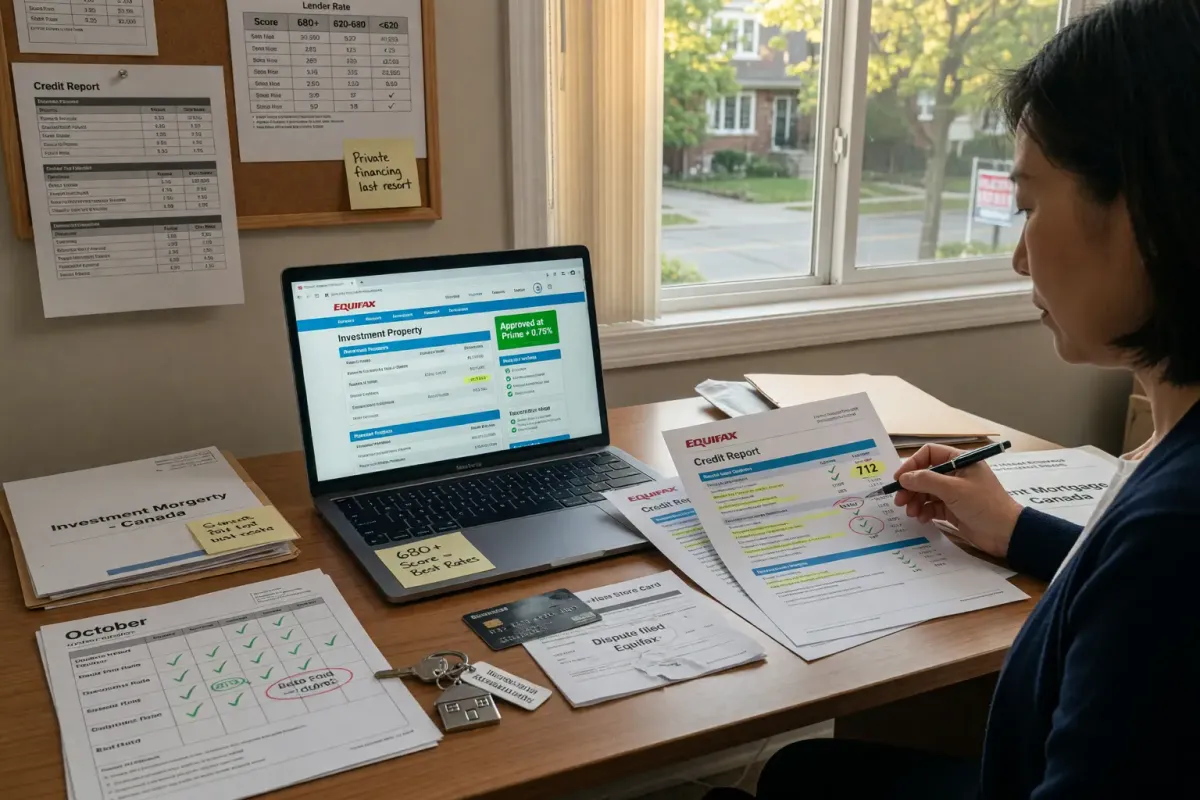
Most people think of their credit score as a pass/fail test. Either you have good credit or you do not. But for real estate investors, your credit score is something far more strategic. It determines which lenders will work with you, what interest rate you pay, and ultimately how many properties you can acquire.
A 50-point difference in your credit score can mean the difference between a 4.5% rate and a 5.5% rate. On a $400,000 mortgage over 25 years, that one percent costs you over $55,000 in extra interest. Multiply that across a portfolio of five or ten properties and you are looking at hundreds of thousands of dollars.
If you are planning to buy investment property in Canada, optimizing your credit score is not optional. It is one of the highest-return activities you can do before you ever make an offer.
How Credit Scores Impact Investment Mortgage Approval
In Canada, credit scores range from 300 to 900. Here is how lenders typically categorize them for investment property mortgages:
680 and above: A-lender territory
This is where you want to be. A-lenders (major banks and credit unions) offer the lowest rates and best terms. Most A-lenders require a minimum score of 680 for investment properties, and some prefer 700+.
At this level, you have access to the full range of residential mortgage financing products. You qualify for the best rates, and lenders compete for your business.
600 to 679: B-lender territory
B-lenders (alternative lenders) will work with scores in this range, but you will pay a premium — typically 0.5% to 2% higher than A-lender rates. The qualification criteria are more flexible, but the cost of borrowing is noticeably higher.
For investors in this range, improving your score by even 20-30 points before applying can save you thousands over the life of the mortgage.
Below 600: Private lending territory
With a score below 600, your options narrow to private lenders. Rates are significantly higher (often 8-14%+), terms are shorter (usually 1-2 years), and the focus shifts from your creditworthiness to the property’s equity and your exit strategy.
Private lending can still work as a short-term solution, but you should have a clear plan to improve your credit and refinance into a better product within 12-24 months.
The investors who succeed are the ones who take that first step — book a free strategy call with LendCity and let’s map out your path forward.
The Five Factors That Drive Your Credit Score
Understanding what makes up your credit score is the first step to optimizing it. In Canada, the score is calculated based on five factors:
1. Payment history (35%)
This is the single biggest factor. Paying every bill on time, every month, is the foundation of a strong credit score. Even one missed payment can drop your score by 50-100 points and stay on your report for six years. If you’re new to Canada and building credit from scratch, this means establishing a perfect payment history from day one.
For investors, this means treating every obligation with the same urgency — not just your mortgage, but your credit cards, phone bill, car loan, and property tax payments.
2. Credit utilization (30%)
This is the ratio of your outstanding balances to your total available credit. If you have $50,000 in total credit limits and $25,000 in balances, your utilization is 50%.
Lenders view high utilization as a sign of financial stress, even if you pay your bills on time. This factor is the one that most investors can improve quickly and dramatically.
3. Credit history length (15%)
The longer your credit accounts have been open, the better. Lenders want to see a track record. The average age of your accounts matters, and closing old accounts shortens that average.
4. Credit mix (10%)
Having different types of credit — credit cards, a line of credit, a mortgage, an auto loan — shows lenders you can manage various obligations. A thin credit file with only one or two accounts scores lower than a diversified one.
5. New credit inquiries (10%)
Every time you apply for credit, a hard inquiry appears on your report. Too many inquiries in a short period suggest you are desperate for credit, which lowers your score temporarily.
Credit Utilization: The Fastest Way to Boost Your Score
If you need to improve your score before applying for an investment property mortgage, credit utilization is your best lever. You can see results within 30-60 days.
The 30% rule (and why you should aim for 15%)
The standard advice is to keep utilization below 30%. But for investment mortgage approval, aim for below 15%. Scores increase significantly once utilization drops below this threshold.
Here is how to get there:
Pay down balances aggressively. If you have $15,000 across your credit cards, pay down as much as possible before applying. Even if you need to redirect savings temporarily, the improvement to your mortgage rate will more than compensate.
Request credit limit increases. If you have a $10,000 limit and a $4,000 balance, that is 40% utilization. Getting the limit increased to $20,000 drops your utilization to 20% without paying down a dollar. Call your credit card companies and ask.
Spread balances across cards. Individual card utilization matters too. It is better to have three cards each at 10% utilization than one card at 30% and two at 0%.
Time your payments. Credit card companies report your balance to the bureaus once per month, usually on your statement date. Pay down your balances before the statement date — not just before the due date — so the lower balance is what gets reported.
A real example
Sarah has three credit cards with a combined limit of $30,000 and combined balances of $12,000. Her utilization is 40%. Her credit score is 655 — just below A-lender territory.
She pays down $6,000 (using savings she had set aside), dropping her balances to $6,000 and her utilization to 20%. She also requests a limit increase on one card, bringing her total limits to $40,000. Her new utilization is 15%.
Within 60 days, her score jumps to 695. She now qualifies for A-lender rates on her investment property mortgage, saving her roughly $35,000 in interest over the life of the loan compared to the B-lender rate she would have received at 655.
That $6,000 payment was the best investment she ever made.
Financial clarity is the first step to financial freedom — schedule a free strategy session with us to understand your mortgage options and start planning.
Timing Strategies: What to Do (and Avoid) Before Applying
The six months before you apply for an investment property mortgage are critical. What you do — and do not do — with your credit during this window can make or break your approval.
Do NOT open new credit accounts
Every new account creates a hard inquiry (temporary score drop) and lowers your average account age (longer-term score impact). Do not sign up for new credit cards, store cards, or financing plans. Even a “no interest for 12 months” furniture deal creates a new account on your report.
Do NOT close old accounts
Closing a credit card removes that limit from your utilization calculation and reduces your average account age. Even if you are not using an old card, keep it open. Put a small recurring charge on it (like a streaming subscription) and set up auto-pay.
Do NOT make large purchases on credit
That new truck or kitchen renovation can wait. Large purchases spike your utilization and add new debt to your TDS ratio. Both hurt your mortgage approval.
DO pay everything on time
This is non-negotiable. Set up auto-pay minimums on every account as a safety net. Then pay more than the minimum manually. One missed payment can drop your score significantly and take months to recover.
DO check your credit report for errors
Pull your report from both Equifax and TransUnion (you can get free reports annually). Look for:
- Accounts that are not yours
- Incorrect balances or credit limits
- Old debts that should have dropped off (most negative items fall off after 6-7 years in Canada)
- Duplicate entries
Dispute any errors directly with the bureau. Correcting mistakes can sometimes add 20-50 points to your score.
DO become strategic about statement dates
As mentioned, pay balances down before your statement date so that low balances are reported. If you are planning to apply for a mortgage in March, make sure your January and February statement balances are as low as possible.
The Authorized User Strategy
This is a lesser-known tactic that can be surprisingly effective. If you have a spouse, parent, or family member with excellent credit and old accounts, ask to be added as an authorized user on one of their credit cards.
When you are added as an authorized user, that account’s history (including its age and payment history) appears on your credit report. If the account is 10 years old with perfect payment history and low utilization, your score benefits immediately.
Important caveats:
- The primary cardholder remains responsible for payments
- You do not need to actually use the card
- Choose an account with the longest history and lowest utilization
- This works best when you have a thin credit file (fewer than three accounts)
This is not a gimmick. It is a legitimate credit-building strategy used by financial planners and mortgage professionals.
Rapid Rescoring: When You Need Results Fast
If you are in a time crunch — maybe you have found a property and need to improve your score within days, not months — rapid rescoring may be an option.
Rapid rescoring is a process where your mortgage broker submits updated account information directly to the credit bureau, bypassing the normal monthly reporting cycle. If you pay off a credit card today, rapid rescoring can have that reflected on your credit report within 3-5 business days instead of 30+ days.
Not all brokers have access to this service, and it only works for information that is already positive (like a paid-off balance). It cannot remove legitimate negative items.
Ask your broker whether rapid rescoring is available. When timing is tight, it can be the difference between closing on a deal and watching it slip away. This is one reason to work with a broker experienced in Mortgage Financing for Canadians in Canada — they know these tools exist.
How Investment Properties Impact Your Credit Going Forward
Once you buy an investment property, your credit profile changes in several ways. Understanding this helps you plan for future acquisitions.
Your mortgage adds to your debt load
A new mortgage appears on your credit report as a large installment loan. Initially, this increases your total debt and may lower your score slightly. Over time, consistent payments improve your score.
Your utilization may change
If you used savings to make the down payment, you might rely more on credit cards for short-term expenses. Watch your utilization carefully in the months after closing. Do not let it creep up.
Multiple mortgages look different to lenders
Once you hold two, three, or four mortgages, lenders view your profile differently. They are not just assessing you as a homeowner — they are assessing you as a business operator. Strong payment history across multiple mortgages actually strengthens your profile for future approvals.
Stress test implications
Each mortgage you hold must be stress-tested at 5.25% or your contract rate plus 2%, whichever is higher. Your GDS must stay at or below 39% and TDS at or below 44%. As your portfolio grows, your credit score becomes even more important because it determines which lenders (and which ratio flexibility) you can access.
If you are planning to scale beyond a few properties, explore multi-family mortgage financing as an alternative path that shifts qualification from personal credit to property cash flow.
Common Mistakes That Tank Your Score Before Mortgage Application
These are the mistakes I see investors make most often. Avoid all of them.
Co-signing for someone else’s loan
When you co-sign, that entire debt appears on your credit report. If the primary borrower misses a payment, your score takes the hit. Never co-sign for anyone during the 6-12 months before applying for an investment mortgage.
Paying off collections just before applying
This one is counterintuitive. Paying off an old collection account can actually lower your score temporarily because it updates the “last activity” date on a negative item. If you have old collections, talk to your broker about whether to pay them off before or after your mortgage application.
Maxing out one card while others sit empty
Utilization is calculated per card and in aggregate. One maxed-out card hurts your score even if your overall utilization is low. Balance your spending across cards.
Ignoring your credit for months before applying
Check your score at least 3-6 months before you plan to apply. This gives you time to fix problems. Waiting until you need the mortgage to check your credit is like studying for an exam the night before.
Making only minimum payments
Minimum payments keep you in good standing but do nothing to reduce your utilization. Pay significantly more than the minimum, especially in the months leading up to your application.
Building an Investor Credit Profile
The best investors treat their credit like a business asset. Here is what a strong investor credit profile looks like:
- Credit score above 720. This gives you access to the best rates and the most flexible lenders.
- Utilization below 15%. Across all revolving accounts.
- Three to five active credit accounts. A mix of credit cards, a line of credit, and installment loans.
- Average account age above five years. Longevity demonstrates stability.
- Zero missed payments. Ever.
- Clean report. No errors, no collections, no judgments.
If your profile does not look like this today, start building toward it. Every improvement you make translates directly into better mortgage terms and more properties in your portfolio.
Explore the investor resources and education available at LendCity to support your investment planning, and if you are considering U.S. properties, review the mortgage financing for Canadians in the U.S.A. as credit requirements differ south of the border.
Your Credit Score Is the Foundation
You can find the perfect property, have the down payment ready, and understand every detail of real estate investing. But if your credit score is not where it needs to be, none of that matters. Lenders look at your credit first. It is the gateway to everything else.
The strategies in this article are not complicated. They take discipline, not genius. Start optimizing your credit today — even if you are not planning to buy for six months. The investors who prepare early close the best deals.
Need help figuring out where you stand and what you need to do? Use the CMHC MLI Max Loan Calculator to model your next deal, or check out Fix & Flip Mortgage Financing if your strategy involves renovation projects.
Key Takeaways:
- Your Credit Score Is Not Just a Number — It Is a Negotiating Tool
- How Credit Scores Impact Investment Mortgage Approval
- The Five Factors That Drive Your Credit Score
- Credit Utilization: The Fastest Way to Boost Your Score
- Timing Strategies: What to Do (and Avoid) Before Applying
Frequently Asked Questions
What credit score do I need for an investment property mortgage in Canada?
How quickly can I improve my credit score?
Does checking my own credit score lower it?
Should I close credit cards I do not use?
Will having multiple mortgages hurt my credit score?
What is rapid rescoring and how does it work?
Free download
MLI Select document checklist
Appraisals, rent rolls, environmental reports, and the CMHC package lenders expect before they underwrite.
By submitting, you agree to receive occasional emails from LendCity. You can unsubscribe at any time.
4.8/5 (116 Google reviews)
Disclaimer: LendCity Mortgages is a licensed mortgage brokerage. Content on this page is for educational purposes only and does not constitute legal, tax, investment, securities, or financial-planning advice. Rates, premiums, program terms, and regulations referenced are as of the page's last updated date and are subject to change. Any investment returns, rental yields, tax savings, or case-study figures shown are illustrative only — they are not guaranteed, not typical, and individual results will vary. Consult a licensed lawyer, Chartered Professional Accountant, or registered dealer before acting on any information above. Editorial standards.

Written by
Scott Dillingham
Published
February 15, 2026
· Updated June 29, 2026Reading time
12 min read
Mortgage Stress Test
A federal requirement to qualify at the higher of your contract rate +2% or the benchmark rate (around 5.25%). For investors, rental income can be used to offset this calculation, though lenders typically only count 50-80% of expected rent.
Down Payment
The upfront cash payment when purchasing a property. For 1-4 unit investment properties, minimum 20% down is required. 5+ unit multifamily can use CMHC MLI Select with lower down payments, and house hackers can put as little as 5% down on owner-occupied 2-4 plexes. Your down payment directly affects your [LTV](/glossary/ltv/) and the amount of [leverage](/glossary/leverage/) you use.
GDS
Gross Debt Service ratio - the percentage of gross income needed to cover housing costs (mortgage, taxes, heating). Maximum typically 39%. For investors, rental income from the property can offset these costs through rental offset calculations. See also [TDS](/glossary/tds/) and [Mortgage Stress Test](/glossary/mortgage-stress-test/).
TDS
Total Debt Service ratio - the percentage of gross income needed to cover all debt payments. Maximum typically 44%. Investors can use rental income (50-80% offset) to help qualify, making it possible to scale a portfolio despite existing debts. See also [GDS](/glossary/gds/) and [DSCR](/glossary/dscr/).
CMHC Insurance
Mortgage default insurance from Canada Mortgage and Housing Corporation. For 1-4 unit investment properties, investors must put 20%+ down (no insurance available). However, CMHC offers MLI Select for 5+ unit multifamily properties, and house hackers can access insured mortgages with 5-10% down.
CMHC MLI Select
A CMHC program offering reduced mortgage insurance premiums and extended amortization (up to 50 years) for multifamily properties with 5+ units that meet energy efficiency or accessibility standards. Popular among investors scaling into larger apartment buildings.
Private Mortgage
A mortgage from a private lender rather than a traditional bank, typically with higher rates but more flexible qualification requirements.
B Lender
Alternative lenders that serve borrowers who don't qualify with major banks, offering slightly higher rates with more flexible criteria.
Cash Flow
The money left over after collecting rent and paying all expenses including mortgage, taxes, insurance, maintenance, and property management. Positive cash flow is the primary goal of buy-and-hold investors. See also [NOI](/glossary/noi/), [Cash-on-Cash Return](/glossary/cash-on-cash-return/), and [Vacancy Rate](/glossary/vacancy-rate/).
Equity
The difference between a property's current market value and the remaining mortgage balance. If your home is worth $500,000 and you owe $300,000, you have $200,000 in equity. Equity builds through mortgage payments, [appreciation](/glossary/appreciation/), and [forced appreciation](/glossary/forced-appreciation/). See also [LTV](/glossary/ltv/) and [Refinancing](/glossary/refinancing/).
Multifamily
Properties with multiple dwelling units, from duplexes to large apartment buildings. Often offer better cash flow and economies of scale.
Refinance
Replacing an existing mortgage with a new one, typically to access equity, get a better rate, or change terms. Investors commonly refinance to pull out capital for purchasing additional properties (cash-out refinance) while retaining ownership of the original property.
Credit Score
A numerical rating (300-900 in Canada) that represents your creditworthiness, affecting mortgage rates and approval. 680+ is typically needed for best rates.
Credit Utilization
The percentage of your available credit that you're using. Keeping this under 30% helps maintain a healthy credit score.
Interest Rate
The cost of borrowing money, expressed as a percentage. It determines how much you pay on top of the principal borrowed. Interest rates directly affect monthly payments, [cash flow](/glossary/cash-flow/), and [DSCR](/glossary/dscr/). See also [Amortization](/glossary/amortization/).
Hover over terms to see definitions. View the full glossary for all terms.