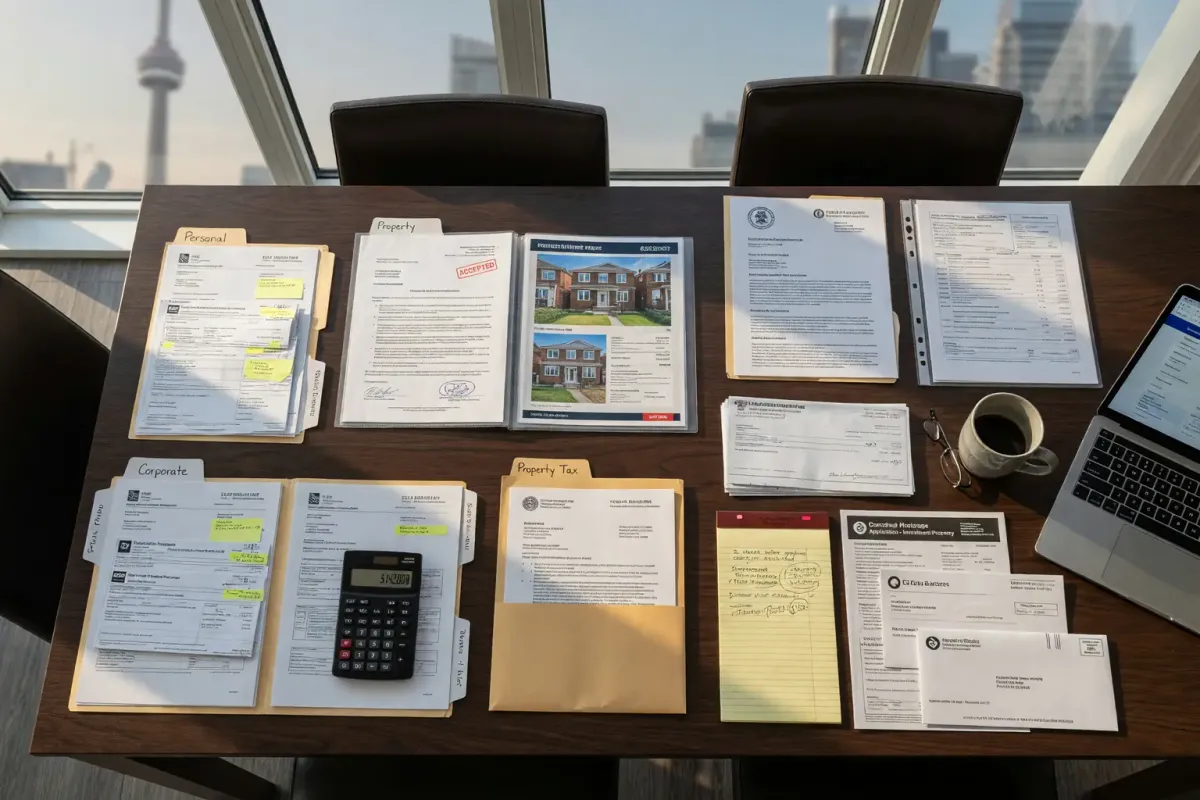
You found the property. You ran the numbers. You are ready to apply for financing. And then your lender sends you a document request list that looks like a tax audit.
This is where deals stall. Not because the investor does not qualify, but because they cannot get the paperwork together fast enough. Properties get snatched up while you are digging through filing cabinets looking for last year’s Notice of Assessment.
Here is the fix: prepare everything before you need it. This checklist covers every document a lender will ask for when you apply for an investment property mortgage in Canada. Get these organized now, and your application moves fast when it counts.
Category 1: Identity and Personal Information
Every application starts here. These documents verify who you are.
- Two pieces of government-issued photo ID. Driver’s license plus passport is the standard combination. Some lenders accept a provincial health card with a photo as a secondary ID.
- Social Insurance Number (SIN). Your lender needs this to pull your credit report and verify income with the CRA.
- Current address and contact information. If you have moved in the last two years, have your previous addresses ready as well.
- Marital status documentation. If applicable, your marriage certificate or separation agreement. This matters for property ownership structures and liability.
Keep digital scans of these documents in a secure folder. You will use them for every application going forward.
Category 2: Income and Employment Documents
This is the section where lenders spend the most time. They want to verify that you earn what you say you earn and that the income is stable.
For Salaried Employees
- Recent pay stubs. Most lenders want your two most recent pay stubs showing year-to-date earnings. Some want 30 days of consecutive stubs.
- Employment letter. This must be on company letterhead and include your position, salary, start date, and employment status (full-time, part-time, contract). It should be dated within 30 days of your application.
- T4 slips for the past two years. These show your total employment income as reported to the CRA.
- Notice of Assessment (NOA) for the past two years. This is your proof that the CRA accepted your tax return and confirms your declared income. You can download these from your CRA My Account.
- T1 General tax returns for the past two years. Some lenders request the full return, not just the NOA.
For Self-Employed Borrowers
Self-employed applicants face a higher documentation bar. Lenders want to see the full picture of your business income.
- T1 General tax returns for the past two years. This is the baseline. Lenders average your declared income over two years.
- Notice of Assessment for the past two years. Confirms CRA accepted your returns.
- T4A slips (if applicable). For contract income or commissions.
- Financial statements for your business. Income statements and balance sheets for the last two fiscal years. Prepared or reviewed statements carry more weight than self-prepared ones.
- Business licence or articles of incorporation. Proves your business exists and is registered.
- GST/HST returns. Some lenders use these to verify business revenue.
- Six to twelve months of business bank statements. Particularly important if you are applying through a B-lender that uses bank statement income verification instead of tax returns.
If you are self-employed and your declared income is lower than your actual cash flow, talk to your broker about stated income mortgage programs and B-lender options that look at bank deposits rather than tax returns.
For Commission-Based Income
- T4 and T4A slips for the past two years.
- Employment letter confirming commission structure, base salary (if any), and two-year earnings history.
- NOAs for the past two years.
Additional Income Sources
If you earn income from other sources, have documentation ready for each:
- Rental income from existing properties. Current signed leases and T776 (Statement of Real Estate Rentals) from your last two tax returns. Some lenders also want to see the rental worksheet calculation to offset your existing property carrying costs.
- Investment income. Brokerage statements or T5 slips.
- Pension or government benefits. Pension statements, OAS, CPP, or disability benefit letters.
- Child support or alimony received. Court order or separation agreement plus proof of consistent receipt.
Before you spend hours hunting down documents, book a quick call at book a free strategy call with LendCity — we’ll tell you exactly which docs your lender will actually ask for based on your situation, so you’re not scrambling last-minute.
Mortgage rules change frequently, so what worked last year might not apply today — book a free strategy call with LendCity to get current, personalized guidance.
If this approach is on your radar, our multi-family mortgage financing guide walks through how LendCity structures these deals.
Category 3: Asset and Down Payment Verification
Review our guide on buying a house with no down payment saved and confirm you have enough.
- 90 days of bank statements for every account holding down payment funds. The lender wants to see the money sitting there, not a sudden large deposit that appeared last week.
- Investment account statements. If your down payment is coming from investments, provide the most recent quarterly statements.
- RRSP statements (if using the Home Buyers’ Plan for an owner-occupied property). Note: the Home Buyers’ Plan does not apply to investment properties, but if you are purchasing a property you will live in while renting out units, it may qualify.
- Gift letter. If any portion of your down payment is a gift from a family member, the lender needs a signed gift letter confirming the funds are not a loan. Many lenders also require proof that the gift funds have been deposited into your account.
- Sale proceeds documentation. If you are using proceeds from selling another property, provide the sale agreement and closing statement.
Review commercial mortgage down payment requirements with federally regulated lenders. For larger multi-family property purchases, the down payment structure may differ, so confirm the specific requirements for your deal type.
Category 4: Property Documents
Once you have a specific property under contract, your lender needs details about it.
- Signed Agreement of Purchase and Sale. The fully executed offer with all schedules and amendments.
- MLS listing or property listing details. Photos, features, square footage, and listing history.
- Property appraisal. The lender will order this after you submit your application. Budget $300 to $500 for a residential appraisal. Multi-unit and commercial properties cost more.
- Property tax bill. The most recent annual property tax assessment.
- Home inspection report. While not always required by the lender, having a recent inspection demonstrates due diligence and can flag issues that affect the property’s value.
- Condo documents (if applicable). Status certificate, condo corporation financial statements, reserve fund study, insurance certificate, and bylaws. Some lenders will not finance condos with low reserve funds or pending special assessments.
- Rental agreements. If the property has existing tenants, provide all current signed leases showing rental amounts, terms, and tenant information.
- Insurance quote or binder. Proof that you can obtain property insurance. Lenders require insurance as a condition of funding.
If you’re self-employed or pulling from multiple income sources, the rules get messier — schedule a free strategy session with us and we’ll map out which documents carry the most weight with lenders and where you might need to dig deeper.
Choosing the wrong lender or term can quietly erode your returns — schedule a free strategy session with us and we’ll walk you through the numbers.
Category 5: Existing Property Documents
If you already own real estate, the lender needs information about those properties too.
- Current mortgage statements for all properties you own. These show outstanding balances, payment amounts, and terms.
- Property tax statements for all owned properties.
- Lease agreements for any rental properties you own.
- Most recent property appraisals or assessed values.
This information feeds directly into your debt service ratio calculations. The more properties you own — and learning how to buy unlimited rental properties in Canada is part of the strategy — the more documentation you need to provide. Having this organized in advance saves significant time.
Category 6: Corporate Documents (If Purchasing in a Corporation)
If you are purchasing through a corporation, the paperwork requirements expand significantly.
- Articles of Incorporation.
- Corporate profile report (from provincial registry).
- Shareholder register and director list.
- Corporate financial statements for the past two years. Accountant-prepared is strongly preferred.
- Corporate tax returns (T2) for the past two years.
- Corporate bank statements (90 days).
- Board resolution authorizing the purchase and mortgage.
- Personal guarantees. Most lenders require the shareholders to personally guarantee a corporate investment mortgage.
Buying in a corporation adds complexity to the application. Talk to your broker about whether corporate ownership makes sense for your situation. Some investors prefer corporate structures for liability protection, while others find the added cost and complexity are not worth it for their first few residential mortgage financing deals.
Common Mistakes That Delay Your Approval
Investors make the same documentation mistakes repeatedly. Avoid these and your application moves faster.
Mistake 1: Outdated Documents
Your employment letter from six months ago will not work. Your bank statements from last quarter are too old. Learn why organized financial documents are key to better mortgage rates. Check dates on everything before you submit.
Mistake 2: Inconsistent Information
If your employment letter says you earn $95,000 but your T4 shows $88,000 and your pay stubs project $92,000, the lender will question all three numbers. Make sure your income figures are consistent across documents, or have a clear explanation for any differences (overtime, bonus, raise).
Mistake 3: Unexplained Large Deposits
That $15,000 deposit in your bank statement from your buddy repaying a personal loan? Without documentation, your lender may assume it is a loan you need to repay, which adds to your debt ratios. Document the source of any large deposit that is not regular employment income.
Mistake 4: Missing Pages
Sending page 1 and page 3 of a four-page tax return will get your file kicked back. Always send complete documents. When scanning, check that every page is included and legible.
Mistake 5: Submitting Unofficial Documents
Screenshots of your bank balance do not replace official bank statements. A text from your boss does not replace an employment letter on company letterhead. Lenders need official documents from official sources.
Mistake 6: Not Declaring All Properties
If you own three rental properties and only disclose two, the lender will find the third when they pull your credit report. Non-disclosure raises red flags and can sink your application. Be upfront about everything you own and owe. Review how to qualify for multiple rental properties to understand how lenders treat your full portfolio.
How to Organize Your Document Package
Here is the system that works.
Create a dedicated digital folder with subfolders for each category listed above. Label every file clearly: “2025-T4-JohnSmith.pdf” is better than “scan003.pdf.”
Keep a master checklist that you update as you collect each document. Check off items as you add them to your folder.
Maintain two copies: one on your computer and one in cloud storage (Google Drive, Dropbox, or similar). When your broker requests a document at 9 PM on a Tuesday, you want to be able to send it immediately from your phone.
Update documents quarterly. Swap in new bank statements, pay stubs, and any other time-sensitive documents every three months. When a deal appears, you are ready to move.
Get your NOAs electronically. Log into your CRA My Account and download your Notices of Assessment directly. This is faster and more reliable than waiting for paper copies.
For investors who are serious about building a portfolio, this document system becomes a permanent tool. The first application is always the hardest. After that, you are just updating a few documents each time. Explore investor resources and tools to support your portfolio growth alongside your documentation system.
If you are considering cross-border opportunities, know that financing for Canadians purchasing U.S. properties has its own documentation requirements, so start building that package separately if you plan to invest south of the border.
Your Pre-Application Action Plan
Here is exactly what to do in the next seven days:
- Download your NOAs from CRA My Account for the past two years.
- Request an employment letter from your HR department or write one for yourself if self-employed.
- Gather your last two years of T4s (or T1 Generals if self-employed).
- Download 90 days of bank statements from every account holding down payment funds.
- Pull your credit report from Equifax or TransUnion and review it for errors.
- Create your digital folder system and organize everything by category.
- Book a call with a mortgage professional to review your package and identify any gaps before you start shopping for properties.
The investors who close deals fastest are the ones who have their documents ready before they find the property. Do not be the investor who loses a deal because you could not produce a Notice of Assessment over the weekend.
Get your package together. Our first rental property mortgage application guide walks you through the full process.
Key Takeaways:
- Category 1: Identity and Personal Information
- Category 2: Income and Employment Documents
- Category 3: Asset and Down Payment Verification
- Category 4: Property Documents
- Category 5: Existing Property Documents
Frequently Asked Questions
How far back do lenders look at income documents?
Can I use a gift for the down payment on an investment property?
What documents do I need if I am self-employed?
How recent do my bank statements need to be?
Do I need an appraisal before I apply?
What happens if I am missing a document?
Weekly Investor Insight
Sunday financing notes for investors
Market updates, rate moves, and deal structures — once a week. Unsubscribe anytime.
By submitting, you agree to receive occasional emails from LendCity. You can unsubscribe at any time.
Disclaimer: LendCity Mortgages is a licensed mortgage brokerage. Content on this page is for educational purposes only and does not constitute legal, tax, investment, securities, or financial-planning advice. Rates, premiums, program terms, and regulations referenced are as of the page's last updated date and are subject to change. Any investment returns, rental yields, tax savings, or case-study figures shown are illustrative only — they are not guaranteed, not typical, and individual results will vary. Consult a licensed lawyer, Chartered Professional Accountant, or registered dealer before acting on any information above. Editorial standards.

Written by
Scott Dillingham
Published
February 14, 2026
· Updated June 29, 2026Reading time
11 min read
A Lender
A major bank or institutional lender offering the most competitive mortgage rates and terms but with the strictest qualification criteria, including full income verification and stress test compliance. Most investors use A lenders for their first four to six properties.
Appraisal
A professional assessment of a property's market value, required by lenders to ensure the property is worth the loan amount.
B Lender
Alternative lenders that serve borrowers who don't qualify with major banks, offering slightly higher rates with more flexible criteria.
Carrying Costs
The ongoing expenses of holding a property, including mortgage payments, property taxes, insurance, utilities, and maintenance. Understanding carrying costs is essential during renovation periods when the property generates no rental income.
Cash Flow
The money left over after collecting rent and paying all expenses including mortgage, taxes, insurance, maintenance, and property management. Positive cash flow is the primary goal of buy-and-hold investors. See also [NOI](/glossary/noi/), [Cash-on-Cash Return](/glossary/cash-on-cash-return/), and [Vacancy Rate](/glossary/vacancy-rate/).
Debt Ratios
Debt ratios are financial calculations lenders use to determine how much of your income goes toward debt payments, with the two main types being Gross Debt Service (GDS) and Total Debt Service (TDS) ratios. For Canadian real estate investors, these ratios are critical qualifying factors that determine borrowing capacity, with most lenders requiring GDS below 39% and TDS below 44%, though rental income from investment properties can help offset these calculations.
Debt Service Ratio
A broad term for ratios measuring a borrower's ability to service debt. In Canadian residential lending, the key ratios are GDS and TDS. In commercial lending, the DSCR serves a similar function but focuses on property income rather than personal income.
Down Payment
The upfront cash payment when purchasing a property. For 1-4 unit investment properties, minimum 20% down is required. 5+ unit multifamily can use CMHC MLI Select with lower down payments, and house hackers can put as little as 5% down on owner-occupied 2-4 plexes. Your down payment directly affects your [LTV](/glossary/ltv/) and the amount of [leverage](/glossary/leverage/) you use.
Due Diligence
The comprehensive investigation and analysis of a property before purchase, including financial review, physical inspection, title search, and market analysis.
Incorporation
The legal process of forming a corporation to own and operate investment properties. Incorporation creates a separate legal entity providing liability protection and tax planning options, but adds complexity and can affect mortgage qualification.
Hover over terms to see definitions. View the full glossary for all terms.