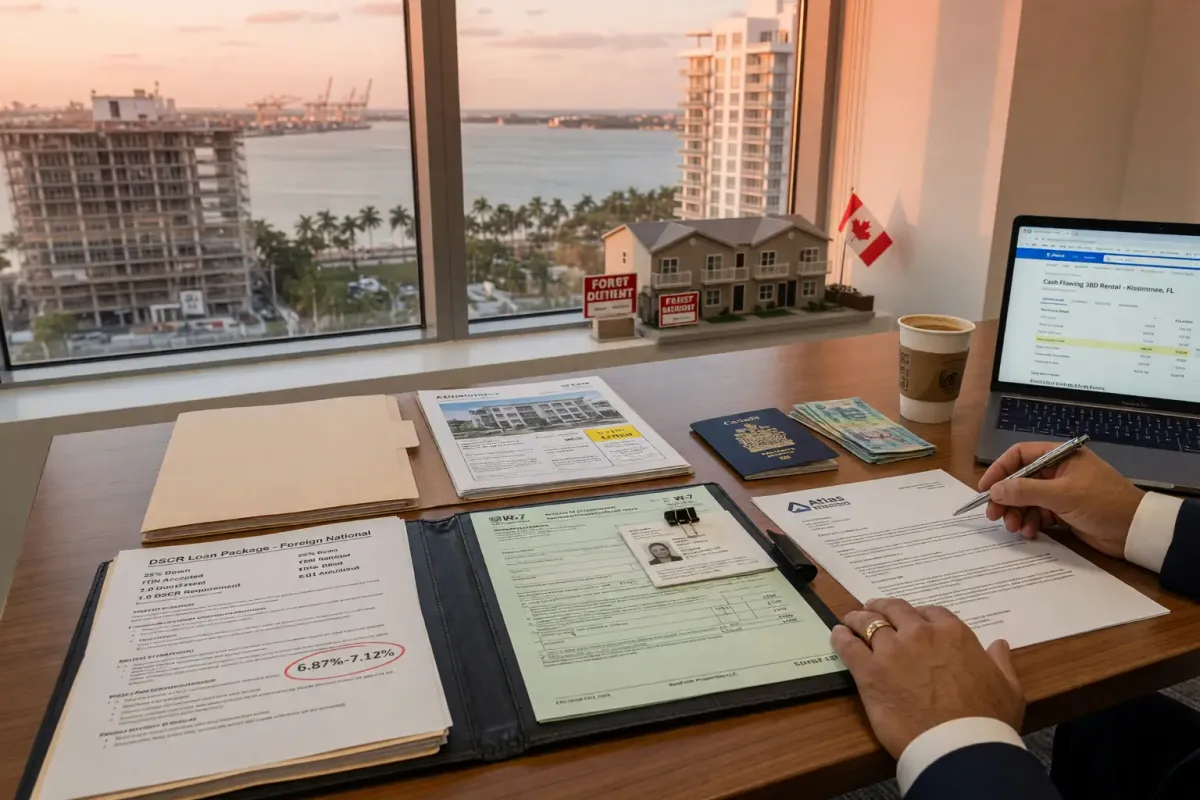
Want to buy rental properties in the US but you’re not an American citizen? You’re in luck. DSCR loans make it possible for Canadians, UK residents, and investors from almost any country to finance US investment properties without the usual headaches of proving income or dealing with credit score requirements. If you’re a Canadian exploring this path, start with our guide on building a US real estate empire from Canada.
Here’s what you need to know about how this actually works.
What Makes DSCR Loans Different
A DSCR loan (Debt Service Coverage Ratio loan) works completely differently than a regular mortgage. Instead of digging through your tax returns and employment history, lenders focus on one thing: can the property’s rental income cover the mortgage payment?
This is huge for foreign nationals because it means:
- Your personal income doesn’t matter
- Your credit score from your home country rarely comes into play
- You don’t need to prove employment
- The property itself does the heavy lifting
DSCR loans work for properties with eight units or less. Once you get into larger commercial properties, different products become available, but for most investors starting out, DSCR is your go-to option.
Who Can Actually Get These Loans
Good news: DSCR loans are available to investors from virtually any country, with one exception. You can’t be from a country under US sanctions. That’s it. The dedicated foreign national DSCR loan program is built specifically for non-US borrowers like Canadians.
If you’re from a non-Hague Convention country, you might need to visit a US embassy for notarization, but the financing itself is still available. The doors are wide open for international investors looking at US real estate. Learn more about financing US properties as a Canadian.
Since your home country credit score rarely matters and no income verification is required, the real question is whether the property’s rent covers the mortgage — book a free strategy call with LendCity and we’ll price your specific deal.
Cross-border investing adds layers of complexity to your financing — book a free strategy call with LendCity and we’ll walk you through the Canadian-friendly options.
The right financing product can change the math on this entirely — explore our DSCR loans guide for the options most investors use.
The Numbers You Need to Know
For Purchases
Expect to put down 25% (75% loan-to-value) on properties worth $150,000 or more. This is the sweet spot where you’ll get the best terms and widest range of lender options.
Below $150,000, things get trickier. You’ll need 30% down, face higher interest rates, pay more in origination fees, and deal with stricter cash reserve requirements. If you can, stick with properties above that threshold.
For Refinances
Here’s where it gets interesting. Maximum loan-to-value on refinances drops to 70%, and most lenders only go up to 65%. This surprises a lot of investors who assume they can pull out more equity.
Even more important: some lenders base your refinance on the appraised value, while others use your cost basis (what you paid for it). If you bought a property for $200,000 and it appraises at $250,000, some lenders will only let you refinance based on that $200,000 purchase price. This can seriously limit how much cash you can pull out.
Interest Rates and Pricing Reality Check
Let’s be straight about rates. DSCR loan rates for Canadian foreign nationals typically run in the 6.87%-7.12% range as of April 2026, depending on market conditions and property type. Domestic US borrowers with excellent profiles (720+ FICO, 1.25+ DSCR, 25%+ down) see DSCR rates of 6.5%-7.25% on the same programs.
But here’s the thing about DSCR loan pricing: it’s property-specific, not borrower-specific. Unlike getting pre-approved for a conventional mortgage where your rate applies to any property you buy, each DSCR property generates its own unique rate.
Real example: Two condos in the same Florida complex, just across the street from each other. Different ZIP codes. One was a quarter-point higher in interest because it sat in a slightly higher flood risk zone.
This means you should have your broker price each specific property before making an offer. Don’t assume the rate will be the same as your last deal.
Run your numbers through our DSCR loan calculator tool to estimate whether a property’s rental income covers the mortgage before requesting a rate quote.
With rates in the 6.87%-7.12% range for Canadian foreign nationals (April 2026) and pricing that varies by ZIP code, having your broker price each property before making an offer is essential — book a free strategy call with us and we’ll run the numbers on your target market.
DSCR loans and foreign national programs have specific requirements that most brokers miss — schedule a free strategy session with us to work with a team that specializes in cross-border deals.
The Credit Score Myth
Here’s something that surprises almost everyone: your Canadian or UK credit score probably won’t impact your US loan terms. In 99 out of 100 cases, foreign credit scores aren’t even considered.
This is actually great news if you’re self-employed, take lots of tax deductions, or have limited credit history in your home country. DSCR loans bypass all these traditional barriers because they focus solely on the property’s income potential.
Where You Sign Matters
This is a detail that affects your interest rate. You have two options:
Sign on US soil: Generally results in lower rates
Remote Online Notary (RON): Sign from anywhere in the world, but expect to pay about 0.125% more in interest
Real example: A client in Ottawa (an hour from the US border) could get 7% by signing in the US or 7.125% signing remotely. For him, driving across the border made sense. For someone in London or Sydney, paying the small rate premium for remote signing is probably worth it.
The 60-Day Money Rule
Lenders want to see where your down payment came from, going back 60 days. But here’s the catch: some lenders require these funds to be “seasoned” in a US bank account, while others accept funds coming directly from your home country.
Why does this matter? If you find a great deal requiring a 30-day closing, but your funds are in Canada and the lender requires 60 days of US seasoning, you either can’t buy that property or need to negotiate an extension with the seller.
This is why working with a broker who knows each lender’s specific requirements saves you from deal-killing surprises.
Prepayment Penalties Vary by State
Loan terms change based on where you’re buying. A property in Cleveland might have a higher rate but no prepayment penalty, while a comparable property in Kansas City offers a lower rate with a five-year step-down prepayment penalty.
The right choice depends on your plans. If you think you might refinance in two years when rates drop, paying slightly more for flexibility makes sense. If you plan to hold long-term, locking in the lower rate works better.
Borrowers comparing options often continue with How Canadians Can Finance US Investment Properties before booking a strategy call.
Why US Fixed Rates Are Amazing
If you’re from Canada or the UK, the concept of a 30-year fixed-rate mortgage might seem almost too good to be true. In Canada, mortgage rates nearly tripled in recent years, causing massive payment shock at renewal time. In the UK, most mortgages are variable rate products.
It’s one of the reasons why Canadian investors are moving to the US. With a US 30-year fixed DSCR rate around 7% (April 2026), you’re locked in. If rates climb to 12%, you keep paying 7%. If you start with $200-300 monthly cash flow, this expands over time as rents increase while your mortgage payment stays exactly the same.
You can even get 40-year Amortization options if you need to fix negative cash flow on rentals to make a deal work.
The Smart Refinance Strategy
If you’re planning to renovate and refinance (the BRRRR strategy), there’s a smarter way to do it than starting with a standard DSCR loan.
Use a fix-and-flip loan for your initial purchase:
- Down payment as low as 10-30% of purchase price
- 100% financing of renovation costs
- Interest rates around 8-10% for experienced investors (varies with market conditions)
After renovations, do a “transfer” to a DSCR loan instead of a traditional refinance. Transfer loans can go up to 75% loan-to-value (higher than standard refinances), and you can capitalize lender fees and closing costs into the loan amount.
This strategy lets you put less money in upfront and extract more capital on the backend. With demonstrated experience (think 60+ completed deals), you can qualify for even better terms: 87.5-90% financing on purchases and better interest rates.
What Lenders Actually Need From You
DSCR lenders don’t want your tax returns, employment verification, or personal financial statements. For a deeper breakdown of DSCR loan requirements on the US side, the standard checklist looks like this:
- Property title documentation
- Rental agreements or rent roll
- Property management agreement
- Insurance quote
- Property Appraisal (they order this)
- 60 days proof of down payment funds
- Entity documentation (LLC or LP paperwork)
- EIN (tax ID number) for your entity
Timeline-wise, expect 30 days from application to closing. The fastest DSCR loan on record closed in 11 days, but that’s cutting it close. Allow 3-4 weeks so you have time to shop among multiple lenders for the best terms.
Entity Structure: A Legal Decision, Not a One-Size-Fits-All
Many investors buy through a US entity primarily for liability-protection reasons. If a tenant’s unauthorized dog bites someone and they sue, owning through an entity may limit exposure to the assets held by that entity rather than reaching personal assets directly. Whether to use an entity — and which entity — is a legal decision that depends on your circumstances and should be made with counsel.
For Canadians specifically, simple LLC ownership has historically raised foreign-tax-credit and classification concerns that can create double-tax exposure. CRA’s treatment of hybrid entities has evolved, so confirm the current position with a cross-border accountant.
Cross-border advisors sometimes discuss structures such as:
- A US-domiciled Limited Partnership (LP) with an LLC as its general partner or manager
- Other configurations depending on your goals
Each option has different tax and reporting consequences on both sides of the border. The right structure for you requires advice from a cross-border tax lawyer and CPA — don’t adopt a structure from a general article without a professional review of your facts.
The EIN and ITIN Problem and Solution
You need an EIN (Employer Identification Number) to close on a US property. Standard IRS processing takes up to 8 weeks for foreign nationals. If you also need to file US taxes individually, the ITIN borrower pathway walks through how the two numbers fit together. Both your lender and the title company need this number, and you can’t close without it.
ITINs are typically issued through a Certified Acceptance Agent (CAA), with fees of roughly $300-$500. Standard processing through a CAA generally takes 2-3 weeks, though some specialized services advertise expedited turnarounds (sometimes within hours when you appear in person). If you try to do this yourself through standard IRS channels by mail, build in 8-12 weeks. Pair your ITIN application with a same-day EIN to avoid surprises before closing.
The solution: Work with a service that can get your US ITIN quickly and your EIN immediately (same day) with a proper letter in your name. Start the process well in advance, and remember you’ll also need to submit a W-8BEN to your lender to manage US tax withholding on rental income.
Don’t Use Your Bank for Wire Transfers
Many investors default to using their bank for wire transfers and foreign exchange. This is a costly mistake.
Specialized foreign exchange companies offer better exchange rates and lower fees. These services can save thousands of dollars on down payments. It’s free money you’re leaving on the table by not shopping around.
Work With Someone Who Knows This Stuff
US-based brokers who typically work with American clients often don’t understand the nuances of foreign national lending. They miss critical details about down payment seasoning requirements, entity structure implications, and property-specific pricing variations.
You need someone who specializes in mortgage financing for Canadians in the U.S.A.. Someone who knows which lenders accept remote signing, which require US seasoning of funds, and how to structure deals for maximum leverage.
The difference between working with a specialist and a generalist can mean the difference between closing your deal or watching it fall apart over a detail no one thought to check.
Key Takeaways:
- What Makes DSCR Loans Different
- Who Can Actually Get These Loans
- The Numbers You Need to Know
- Interest Rates and Pricing Reality Check
- The Credit Score Myth
Frequently Asked Questions
Can I get a DSCR loan if I'm not a US citizen?
How much down payment do I need as a foreign national?
Will my credit score from my home country affect my US loan?
Do I need to prove my income for a DSCR loan?
Should I buy US property in my personal name or through an entity?
Can I sign loan documents from my home country?
What interest rates should I expect as a foreign national?
How long does it take to close on a DSCR loan?
Free download
DSCR property qualification checklist
What lenders score on a cash-flow loan — borrower, property, and deal structure — before you write an offer.
By submitting, you agree to receive occasional emails from LendCity. You can unsubscribe at any time.
4.8/5 (116 Google reviews)
Disclaimer: LendCity Mortgages is a licensed mortgage brokerage. Content on this page is for educational purposes only and does not constitute legal, tax, investment, securities, or financial-planning advice. Rates, premiums, program terms, and regulations referenced are as of the page's last updated date and are subject to change. Any investment returns, rental yields, tax savings, or case-study figures shown are illustrative only — they are not guaranteed, not typical, and individual results will vary. Consult a licensed lawyer, Chartered Professional Accountant, or registered dealer before acting on any information above. Editorial standards.

Written by
Scott Dillingham
Published
December 22, 2025
· Updated August 18, 2026Reading time
11 min read
Amortization
The period over which a mortgage is scheduled to be fully paid off through regular payments of principal and [interest](/glossary/interest-rate/). In Canada, common amortization periods are 25 or 30 years, though the mortgage term (when you renegotiate) is typically 1-5 years. A longer amortization lowers monthly payments, improving [cash flow](/glossary/cash-flow/) but increasing total interest paid.
Appraisal
A professional assessment of a property's market value, required by lenders to ensure the property is worth the loan amount.
BRRRR
Buy, Rehab, Rent, Refinance, Repeat - a real estate investment strategy where you purchase a property below market value, renovate it to increase its [ARV](/glossary/after-repair-value-arv/), rent it out, [refinance](/glossary/refinancing/) to pull out your initial investment, and repeat the process with the recovered capital. Success depends on [forced appreciation](/glossary/forced-appreciation/) and strong [cash flow](/glossary/cash-flow/).
Cash Flow
The money left over after collecting rent and paying all expenses including mortgage, taxes, insurance, maintenance, and property management. Positive cash flow is the primary goal of buy-and-hold investors. See also [NOI](/glossary/noi/), [Cash-on-Cash Return](/glossary/cash-on-cash-return/), and [Vacancy Rate](/glossary/vacancy-rate/).
Closing Costs
Fees paid when completing a real estate transaction, including legal fees, land transfer tax, title insurance, appraisals, and adjustments. Closing costs affect your total cash invested and therefore your [cash-on-cash return](/glossary/cash-on-cash-return/).
Conventional Mortgage
A mortgage with 20% or more down payment, not requiring default insurance. This is the standard financing type for investment properties in Canada, as high-ratio (insured) mortgages aren't available for pure rentals.
Credit Score
A numerical rating (300-900 in Canada) that represents your creditworthiness, affecting mortgage rates and approval. 680+ is typically needed for best rates.
DSCR
Debt Service Coverage Ratio — a metric that compares a property's [net operating income](/glossary/noi/) to its mortgage payments. A DSCR of 1.25 means the property generates 25% more income than needed to cover the debt. Lenders typically require a minimum DSCR of 1.0 to 1.25 for investment property loans (including [DSCR loans](/glossary/dscr-loan/)). See also [Cap Rate](/glossary/cap-rate/) and [Cash Flow](/glossary/cash-flow/).
Underwriting
The process lenders use to evaluate the risk of a mortgage application, including reviewing credit, income, assets, and property value to determine loan approval.
Vacancy Rate
The percentage of rental units that are unoccupied over a given period. A critical factor in [cash flow](/glossary/cash-flow/) analysis, typically estimated at 4-8% for conservative projections. Vacancy directly reduces [NOI](/glossary/noi/).
Fixed Rate Mortgage
A mortgage where the interest rate stays the same for the entire term, providing predictable monthly payments regardless of market changes.
Variable Rate Mortgage
A mortgage where the interest rate fluctuates with the prime rate, meaning your payments or amortization can change over time.
Pre-Approval
A conditional commitment from a lender stating your borrowing capacity, valid for 90-120 days. For investors, getting pre-approved helps you move quickly on deals and shows sellers you're a serious buyer with financing in place.
Down Payment
The upfront cash payment when purchasing a property. For 1-4 unit investment properties, minimum 20% down is required. 5+ unit multifamily can use CMHC MLI Select with lower down payments, and house hackers can put as little as 5% down on owner-occupied 2-4 plexes. Your down payment directly affects your [LTV](/glossary/ltv/) and the amount of [leverage](/glossary/leverage/) you use.
LTV
Loan-to-Value ratio - the mortgage amount expressed as a percentage of the property's appraised value or purchase price (whichever is lower). An 80% LTV means you're borrowing 80% and putting 20% [down](/glossary/down-payment/). Lower LTV generally means better [interest rates](/glossary/interest-rate/) and terms. See also [Equity](/glossary/equity/) and [Leverage](/glossary/leverage/).
Coverage Ratio
A measure of a property's ability to cover its debt payments, typically referring to DSCR. Commercial lenders often require a minimum of 1.2, meaning the property's net operating income exceeds debt payments by at least 20%.
Equity
The difference between a property's current market value and the remaining mortgage balance. If your home is worth $500,000 and you owe $300,000, you have $200,000 in equity. Equity builds through mortgage payments, [appreciation](/glossary/appreciation/), and [forced appreciation](/glossary/forced-appreciation/). See also [LTV](/glossary/ltv/) and [Refinancing](/glossary/refinancing/).
Leverage
Using borrowed money (mortgage) to control a larger asset, amplifying both potential returns and risks on your investment. A higher [LTV](/glossary/ltv/) means more leverage. See also [Down Payment](/glossary/down-payment/) and [Equity](/glossary/equity/).
Refinance
Replacing an existing mortgage with a new one, typically to access equity, get a better rate, or change terms. Investors commonly refinance to pull out capital for purchasing additional properties (cash-out refinance) while retaining ownership of the original property.
DSCR Loan
A loan qualified based on the property's [Debt Service Coverage Ratio](/glossary/dscr/) rather than the borrower's personal income, popular for US investment properties. The property's [NOI](/glossary/noi/) and [cash flow](/glossary/cash-flow/) determine qualification.
ITIN
Individual Taxpayer Identification Number - a US tax ID for foreign nationals, required for Canadians to invest in US real estate and file US taxes.
LLC
Limited Liability Company — a US business structure commonly used to hold US investment properties. Important caveat for Canadian residents: the CRA generally treats a US LLC as a corporation for Canadian tax purposes, which can create mismatched treatment with the IRS and double taxation; many cross-border advisors recommend a US LP (with an LLC as general partner) or direct ownership instead. Entity choice is a legal and tax decision — consult a cross-border attorney and a CPA experienced in Canada–US tax before forming one.
Mortgage Penalty
A fee charged for breaking your mortgage early, calculated as either 3 months' interest or the Interest Rate Differential (IRD), whichever is greater.
Interest Rate
The cost of borrowing money, expressed as a percentage. It determines how much you pay on top of the principal borrowed. Interest rates directly affect monthly payments, [cash flow](/glossary/cash-flow/), and [DSCR](/glossary/dscr/). See also [Amortization](/glossary/amortization/).
Property Management
The operation, control, and oversight of real estate by a third party. Property managers handle tenant screening, rent collection, maintenance, and day-to-day operations.
Rent Roll
A document listing every tenant in a commercial property along with their unit number, lease start and end dates, monthly rent, security deposits, and key lease terms. Required by all commercial mortgage lenders during underwriting, the rent roll is the primary tool used to verify and analyze a property's actual and potential rental income.
Rental Income
Revenue generated from tenants paying rent on an investment property. Gross rental income is the total collected before expenses, while net rental income subtracts operating costs to show actual profitability.
Succession Planning
The process of preparing for the eventual transfer of a real estate portfolio to heirs, partners, or professional managers. Includes documentation, insurance planning, legal structuring through wills and trusts, and gradual transition of operational responsibility.
Cash Reserve
Liquid funds set aside by a property investor to cover unexpected expenses such as repairs, vacancy periods, or mortgage payments during tenant turnover. Lenders may require proof of cash reserves as part of mortgage qualification.
100% Financing
A mortgage structure where no down payment is required from the borrower's personal funds. In Canada, this is available for owner-occupied commercial properties through CMHC programs and for residential purchases using gifted down payments, borrowed down payments (where permitted), or vendor take-back mortgages combined with a first mortgage.
Hover over terms to see definitions. View the full glossary for all terms.