Most people get into apartment building investing for the cash flow. And sure, cash flow is nice. But here’s the thing – you pay taxes on that cash flow.
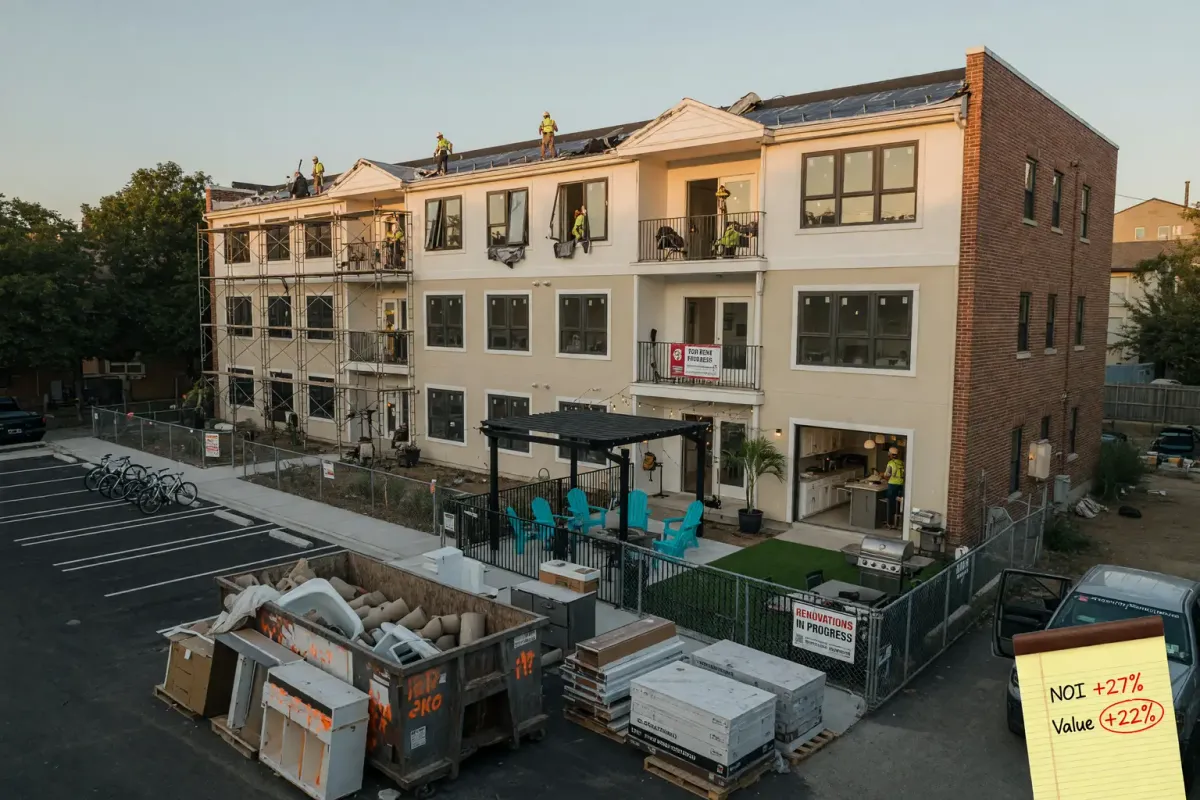
There’s a better strategy that lets you build serious wealth: forcing Appreciation. This is the core of the BRRRR method applied to multifamily — you create equity you control, pull out your original investment, and own a building with basically none of your own money left in it.
Let’s break down how this works.
Why Multifamily Is Different
When you own a single family rental versus a multifamily property, your property value depends on what similar houses around you sell for. You can’t really control that.
But apartment buildings? Totally different game.
The value of a multifamily property is based on how much income it generates. That means you can directly control what your building is worth by raising income and lowering expenses.
This is powerful because you can actually predict what your property will be worth after you make improvements. No guessing. No hoping the neighborhood gets better. You’re in control.
The Basic Strategy
Here’s how forcing appreciation works in practice:
You buy an apartment building for $1,500,000. Maybe the rents are below market because the previous owner didn’t care or didn’t know better.
You put $200,000 into renovations – updating units, improving common areas, making the place somewhere people actually want to live.
Then you raise the rents to market rates as leases come up for renewal or when new tenants move in.
Because the building now generates more income, it’s worth more. In this example, your property is now valued at $2,100,000.
If you’re eyeing a building where rents sit below market and you want to map out how $200K in renovations could create over $500K in equity, book a free strategy call with LendCity and we’ll run the numbers with you.
The biggest mistake scaling investors make is not planning their financing two or three deals ahead — book a free strategy call with LendCity so we can build that roadmap together.
If this approach is on your radar, our multi-family mortgage financing guide walks through how LendCity structures these deals.
Pulling Your Money Back Out
Now comes the really cool part.
You refinance the property at 75% loan to value. Your new loan amount is $1,570,000.
Think about that for a second. You started with $1,500,000 (your purchase price) plus $200,000 (renovations) – that’s $1,700,000 total. Your new loan gives you $1,570,000.
You’ve pulled almost all your money back out. And you now own a building worth $2,100,000 with only $130,000 of your own capital still in the deal. That’s instant equity of over $500,000.
Your returns on invested capital can be extremely high, because you have almost no money left in the property.
The Two-Loan Approach
This strategy typically requires two different mortgages at two different times.
First is your purchase loan. You can use a credit union at 75% loan to value, but a better option is usually a bridge loan for apartment building acquisitions.
Bridge loans come with interest-only payments. This keeps your costs down while you’re doing renovations and getting rents stabilized. You’re not paying down principal when you need that cash for improvements.
Once the building is stabilized with rents at market rates, you get your second mortgage – the takeout financing. This is your long-term loan, usually a five-year term. This can be conventional financing or CMHC insured programs that go above 75% loan to value. Reviewing multifamily mortgage rates helps you compare options at refinance time.
Use our free CMHC MLI max loan calculator to estimate how much you can pull out when you refinance with CMHC insurance.
Important note: remember you’ll have closing costs and fees twice. Factor that into your numbers from the start.
Where This Strategy Works Best
Not all markets are created equal for this approach.
You want landlord-friendly markets where you can actually raise rents without tons of restrictions. Alberta and Saskatchewan are prime examples — there is no rent cap, so you can move sitting tenants to market on turnover and adjust in-place rents. Our multi-family mortgage financing solutions cover the CMHC and conventional programs available for value-add refinances.
Markets with heavy rent control make this harder. Ontario’s 2026 rent increase guideline is 2.1% on units first occupied before November 15, 2018; BC’s 2026 cap is 3.0%. You can still hit market on tenant turnover, but in-place rent gains are limited, so the math has to work primarily through turnover, suite improvements, and operating expense reductions.
To put the upside in perspective: a $100/month rent increase across a 10-unit building at a 5% cap rate translates to a $240,000 lift in property value. That’s the leverage forced appreciation gives you on multifamily — small income gains compound into large equity gains because the asset is valued on NOI.
This strategy also works really well in the US, where many markets are very landlord-friendly.
Whether you need a bridge loan for the renovation phase or a takeout mortgage once rents stabilize, book a free strategy call with us and we’ll walk you through both stages of the two-loan approach.
At a certain point, your mortgage strategy matters more than the deal itself — schedule a free strategy session with us to make sure your financing keeps up with your ambitions.
Why This Beats Just Collecting Cash Flow
Remember what we said at the start – cash flow gets taxed.
When you force appreciation and refinance, you’re pulling out cash that generally isn’t treated as taxable income (consult your accountant). You’re not selling the property (which would trigger capital gains). You’re taking out a loan against the equity you created. To maximize your tax efficiency as you scale, consider implementing tax structuring strategies for multifamily investors using holding companies and operating companies.
Plus, you can now take that money and do it again with another property. And again. And again.
This is how you scale a real estate portfolio quickly without constantly needing to save up for down payments.
This content is for informational purposes only and does not constitute financial, investment, or legal advice. Past performance does not guarantee future results. Always consult qualified professionals before making investment decisions.
Is This Strategy Right For You?
Forcing appreciation in multifamily properties isn’t for everyone. You need to:
- Have enough capital for the down payment and renovations
- Be comfortable managing a larger property or hiring property management
- Be willing to put in the work to stabilize rents and improve the property
- Choose the right market where rent increases are possible
- Understand the financing process and timeline
But if you can check those boxes, this strategy is genuinely game-changing. It lets you build wealth faster than almost any other real estate approach.
The key is being strategic about which properties you buy, making smart renovations that justify rent increases, securing bridge loan financing for your BRRRR projects, and understanding your multi-family mortgage financing options so you can structure both the bridge loan and the takeout mortgage correctly.
Key Takeaways:
- Why Multifamily Is Different
- The Basic Strategy
- Pulling Your Money Back Out
- Where This Strategy Works Best
- Why This Beats Just Collecting Cash Flow
Frequently Asked Questions
What does forcing appreciation mean in multifamily investing?
How is multifamily property valuation different from single-family homes?
What is a bridge loan in multifamily investing?
Can I get all my money back out after forcing appreciation?
Which markets are best for the value-add multifamily strategy?
Why is forcing appreciation better than just collecting cash flow?
How much should I budget for renovations on a value-add property?
Do I need two separate mortgages for this strategy?
Free download
MLI Select document checklist
Appraisals, rent rolls, environmental reports, and the CMHC package lenders expect before they underwrite.
By submitting, you agree to receive occasional emails from LendCity. You can unsubscribe at any time.
4.8/5 (116 Google reviews)
Disclaimer: LendCity Mortgages is a licensed mortgage brokerage. Content on this page is for educational purposes only and does not constitute legal, tax, investment, securities, or financial-planning advice. Rates, premiums, program terms, and regulations referenced are as of the page's last updated date and are subject to change. Any investment returns, rental yields, tax savings, or case-study figures shown are illustrative only — they are not guaranteed, not typical, and individual results will vary. Consult a licensed lawyer, Chartered Professional Accountant, or registered dealer before acting on any information above. Editorial standards.

Written by
Scott Dillingham
Published
December 22, 2025
· Updated June 29, 2026Reading time
7 min read
Appreciation
The increase in a property's value over time, which builds [equity](/glossary/equity/) and wealth for the owner through market growth or [forced improvements](/glossary/forced-appreciation/).
CMHC Insurance
Mortgage default insurance from Canada Mortgage and Housing Corporation. For 1-4 unit investment properties, investors must put 20%+ down (no insurance available). However, CMHC offers MLI Select for 5+ unit multifamily properties, and house hackers can access insured mortgages with 5-10% down.
Cash Flow
The money left over after collecting rent and paying all expenses including mortgage, taxes, insurance, maintenance, and property management. Positive cash flow is the primary goal of buy-and-hold investors. See also [NOI](/glossary/noi/), [Cash-on-Cash Return](/glossary/cash-on-cash-return/), and [Vacancy Rate](/glossary/vacancy-rate/).
Closing Costs
Fees paid when completing a real estate transaction, including legal fees, land transfer tax, title insurance, appraisals, and adjustments. Closing costs affect your total cash invested and therefore your [cash-on-cash return](/glossary/cash-on-cash-return/).
Down Payment
The upfront cash payment when purchasing a property. For 1-4 unit investment properties, minimum 20% down is required. 5+ unit multifamily can use CMHC MLI Select with lower down payments, and house hackers can put as little as 5% down on owner-occupied 2-4 plexes. Your down payment directly affects your [LTV](/glossary/ltv/) and the amount of [leverage](/glossary/leverage/) you use.
Equity
The difference between a property's current market value and the remaining mortgage balance. If your home is worth $500,000 and you owe $300,000, you have $200,000 in equity. Equity builds through mortgage payments, [appreciation](/glossary/appreciation/), and [forced appreciation](/glossary/forced-appreciation/). See also [LTV](/glossary/ltv/) and [Refinancing](/glossary/refinancing/).
LTV
Loan-to-Value ratio - the mortgage amount expressed as a percentage of the property's appraised value or purchase price (whichever is lower). An 80% LTV means you're borrowing 80% and putting 20% [down](/glossary/down-payment/). Lower LTV generally means better [interest rates](/glossary/interest-rate/) and terms. See also [Equity](/glossary/equity/) and [Leverage](/glossary/leverage/).
Multifamily
Properties with multiple dwelling units, from duplexes to large apartment buildings. Often offer better cash flow and economies of scale.
Market Value
The estimated price a property would sell for on the open market under normal conditions. Determined by comparable sales, location, condition, and market demand.
NOI
Net Operating Income - the total income a property generates minus all operating expenses, but before mortgage payments and income taxes. Calculated as gross rental income minus [vacancies](/glossary/vacancy-rate/), property taxes, insurance, maintenance, and property management fees. NOI is used to calculate both [Cap Rate](/glossary/cap-rate/) and [DSCR](/glossary/dscr/).
BRRRR
Buy, Rehab, Rent, Refinance, Repeat - a real estate investment strategy where you purchase a property below market value, renovate it to increase its [ARV](/glossary/after-repair-value-arv/), rent it out, [refinance](/glossary/refinancing/) to pull out your initial investment, and repeat the process with the recovered capital. Success depends on [forced appreciation](/glossary/forced-appreciation/) and strong [cash flow](/glossary/cash-flow/).
Single Family
A detached home designed for one household, the most common property type for beginner real estate investors.
Value-Add Property
A property with potential to increase value through renovations, better management, rent increases, or adding units.
Refinance
Replacing an existing mortgage with a new one, typically to access equity, get a better rate, or change terms. Investors commonly refinance to pull out capital for purchasing additional properties (cash-out refinance) while retaining ownership of the original property.
Principal
The original amount of money borrowed on a mortgage, not including interest. Each mortgage payment includes both principal (paying down what you owe) and interest (the cost of borrowing). Over time, more of each payment goes toward principal as the loan balance decreases.
Property Management
The operation, control, and oversight of real estate by a third party. Property managers handle tenant screening, rent collection, maintenance, and day-to-day operations.
Capital Gains Tax
Tax owed on the profit from selling an investment property, calculated as the difference between the sale price and the adjusted cost base. In Canada, 50% of capital gains are currently included in taxable income. A 2024 federal budget proposal to raise the inclusion rate to 66.67% on gains above $250,000 was deferred and has not been enacted; the 50% rate remains in effect. Tax outcomes depend on your specific situation — consult a Chartered Professional Accountant.
Credit Union
A member-owned financial cooperative that provides banking services including mortgage lending. Credit unions often have more flexible lending policies for real estate investors than major banks, particularly for borrowers who have exceeded conventional lending limits.
Takeout Financing
Permanent long-term mortgage financing that replaces a short-term construction loan after a development project is completed and stabilized. Securing a takeout commitment before construction begins reduces project risk.
Second Mortgage
A subordinate loan taken against a property that already has a first mortgage. Second mortgages have higher interest rates due to increased lender risk and can be used to access equity without refinancing the first mortgage.
Rent Control
Provincial regulations that limit how much a landlord can increase rent annually for existing tenants. Rules vary by province - Ontario caps increases at a government-set guideline, while Alberta has no rent control. Rent control directly impacts investment cash flow projections.
Forced Appreciation
An increase in property value driven by the owner's actions rather than general market conditions. Strategies include renovations, increasing rents, reducing [vacancies](/glossary/vacancy-rate/), or cutting operating expenses. In commercial real estate, raising [NOI](/glossary/noi/) directly increases the property's income-based appraised value. Key to the [BRRRR strategy](/glossary/brrrr/) and improving [ARV](/glossary/after-repair-value-arv/).
Hover over terms to see definitions. View the full glossary for all terms.