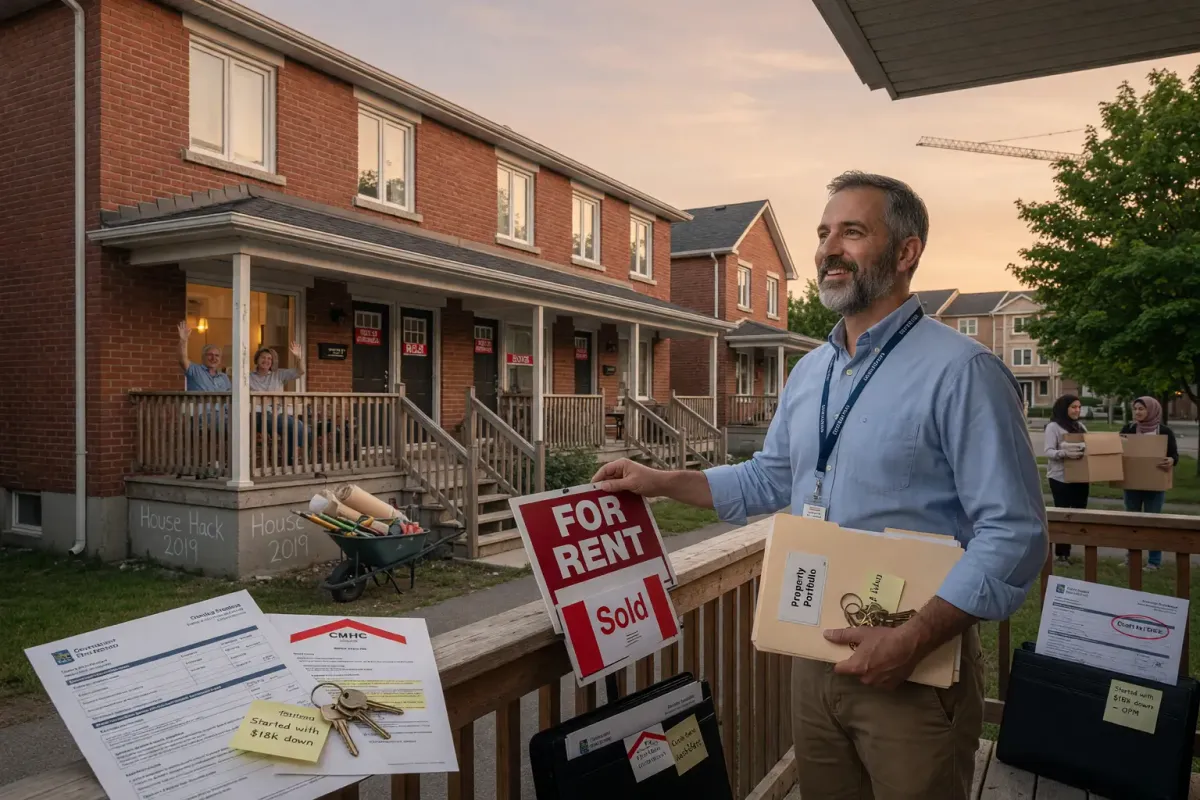
Picture this: You’ve spent 10 years in the same government job. Good salary. Pension. Benefits. On paper, you’ve got it made. But inside, you feel trapped.
That was Scott Innocente’s reality. After a decade in government work, he felt stuck in what he calls the “golden handcuffs” – a comfortable job that kept him from building real wealth.
Today, he owns multiple investment properties and works as a full-time development mortgage financing specialist helping other investors escape their own golden handcuffs. Here’s how he did it.
The Two-Year Wake-Up Call
Scott’s journey didn’t start with a lightning bolt moment. A colleague kept talking to him about real estate investing. For two full years, Scott brushed it off.
Then something clicked. He realized real estate wasn’t just another side hustle – it was a genuine path to financial freedom. Once that light bulb went on, everything changed.
He became obsessed. He got his real estate license while buying his first properties. The funny part? He never wanted to be an agent. He just wanted access to property listings without waiting for someone else’s schedule.
Why Fear Keeps You Broke
Scott identifies fear as the number one thing stopping people from investing. But here’s the tricky part – fear doesn’t usually show up looking like fear.
Instead, it disguises itself as reasonable concerns:
-
“The market’s going to crash”
-
“I won’t find good tenants”
-
“Interest rates are too high right now”
-
“I need to wait for the perfect time”
The problem? Fear packages itself in a way that makes you feel smart about doing nothing. You tell yourself you’re being careful and strategic when really, you’re just scared.
Here’s what Scott learned: The only way past fear is action. He was terrified buying his first couple of properties. But by property two or three, the fear completely disappeared. Why? Because he discovered that good tenants do exist, properties don’t spontaneously combust, and the numbers actually work.
Scott’s fear disappeared after property two or three once he saw that the numbers actually work — if you’re stuck in that same hesitation, book a free strategy call with LendCity and we’ll help you see what’s realistic for your first deal.
Building wealth starts with knowing your options — book a free strategy call with LendCity and find out what’s possible for your situation.
For a deeper look at the financing angle behind this topic, see our private mortgage investing guide.
Analysis Paralysis Will Steal Years of Your Life
Scott wasted nearly two years consuming content. YouTube videos. Podcasts. Books. Forums. He learned every strategy under the sun.
And he bought exactly zero properties during that time.
His wake-up call came from a simple truth: Michael Jordan didn’t become great by reading basketball books. He became great by playing basketball.
You only need baseline knowledge to start. The real education comes from doing. Stop researching and start buying.
Why Your Real Estate Agent Is Costing You Money
Scott shared a story about a client who bought a duplex with an illegal basement apartment near a strip club in a rough area. The previous agent wasn’t incompetent – they just didn’t specialize in investment properties.
The result? Constant headaches. Social assistance tenants. Missed rent payments. So much stress that the client sold the property just to escape the problems.
Sure, he made a small profit (it’s hard to lose money in real estate), but he missed the entire point. Real wealth in real estate comes from holding properties long-term. When you buy wrong, you can’t stomach holding, and you lose all those long-term gains.
The lesson: Work with agents who focus exclusively on investment properties. They’ve seen enough deals to know what to avoid.
The order you apply to lenders can make or break how many properties you ultimately finance — book a free strategy call with us and we’ll map out the right lender sequence so you don’t accidentally limit your growth.
The investors who succeed are the ones who take that first step — schedule a free strategy session with us and let’s map out your path forward.
For a deeper look at the financing angle behind this topic, see our guide to Real Estate Investor Resources & Education.
The Mortgage Strategy Nobody Tells You About
Here’s something most investors don’t know: the order you apply to lenders matters. A lot.
One major bank will finance five properties total, regardless of where those properties are mortgaged. Another bank will finance five properties on top of whatever you already own.
A general mortgage broker won’t know this. They’ll accidentally limit your growth before you even get started. Learn more about How to Buy Unlimited Rental Properties in Canada.
The 50% Rule Is Killing Your Portfolio Growth
Most big banks only count 50% of your rental income when qualifying you for your next mortgage. So if your property rents for $2,000 per month, they’ll only use $1,000 to help you qualify.
But certain lenders count 80-100% of that rental income. That difference is massive when you’re trying to scale from one property to five, or five to ten.
This strategy works especially well in affordable markets where rent is high relative to purchase price. It keeps your ratios balanced and lets you keep growing.
Skip the Expensive B-Lenders
When investors max out their capacity with traditional banks, many brokers immediately push them to B-lenders or private lenders. These come with brutal interest rates and expensive fees.
There’s a better way: commercial lending and how it differs from residential. Explore investment property mortgage options and commercial options side by side. The rates are similar to residential mortgages, but you avoid the expensive costs of B-lending. You can keep expanding your portfolio without your costs exploding.
How to Renovate Properties Without Cash
Here’s a powerful strategy for investors with limited capital: build renovation costs directly into your mortgage.
Instead of needing $30,000 upfront to improve a property, you can use purchase plus improvements programs. You complete the bathroom, the lender releases those funds. You finish the kitchen, they release more funds. Stage by stage.
This lets you buy properties that need work and improve them using the bank’s money, not yours. You turn negative Cash Flow properties into profitable ones without draining your savings.
Location Still Matters More Than Numbers
Scott won’t let his clients buy in bad locations, no matter how good the numbers look on paper. He’s direct about it: “If you want to buy those types of properties, go work with somebody else.”
Why? Because when you buy in a bad location, you create so many headaches that you won’t want to hold the property. And if you don’t hold it, you miss out on all the long-term wealth that makes real estate worthwhile.
There’s a difference between identifying up-and-coming neighborhoods with growth potential and buying in areas that will consistently cause problems. Know the difference.
Stop Planning Your Tenth Property
One of the biggest mistakes Scott sees is investors trying to plan their entire portfolio before buying their first property.
They worry: “If I buy this duplex, I’ll use all my money and won’t be able to buy my second property.”
His response? Don’t worry about that. Buy your first.
Many beginning investors think they can only get five properties total. That’s a myth. Working with the right professionals, you can get 10, 15, even 20 properties.
But none of that matters if you never buy number one.
The Power of Burning Your Ships
Scott quit his government job after only six months in real estate. His original plan was to stay for five more years.
Why did he leave so early? Because having no backup plan forces you to make it work. When your back is against the wall, you figure things out. You work harder. You get creative. You solve problems.
Desperation drives results in a way that comfortable planning never will.
Your Next Steps
If you’re stuck in a job dreaming about real estate investing, here’s what to do:
First, stop consuming content and start taking action. You have enough knowledge already.
Second, work with professionals who specialize in investment properties – both agents and mortgage brokers. They’ll help you avoid expensive mistakes and scale faster.
Third, stop trying to plan your entire portfolio. Just buy your first property. Then buy your second. The path becomes clear as you walk it.
Scott spent 10 years feeling trapped. Two years learning and planning. And six months of real action to completely transform his life. His story echoes the journey of an engineer who built wealth with scale through similar determination and strategy.
The question is: how many years will you spend planning before you start doing?
Key Takeaways:
- The Two-Year Wake-Up Call
- Why Fear Keeps You Broke
- Analysis Paralysis Will Steal Years of Your Life
- Why Your Real Estate Agent Is Costing You Money
- The Mortgage Strategy Nobody Tells You About
Frequently Asked Questions
How many properties can I buy with traditional bank financing?
Do I need a lot of money saved up to start investing in real estate?
How do I overcome fear of buying my first investment property?
Should I work with a regular real estate agent or one who specializes in investment properties?
What's more important – cash flow numbers or location?
How much should I research before buying my first property?
What's the difference between B-lenders and commercial lending?
How do I plan for buying multiple properties?
Weekly Investor Insight
Sunday financing notes for investors
Market updates, rate moves, and deal structures — once a week. Unsubscribe anytime.
By submitting, you agree to receive occasional emails from LendCity. You can unsubscribe at any time.
Disclaimer: LendCity Mortgages is a licensed mortgage brokerage. Content on this page is for educational purposes only and does not constitute legal, tax, investment, securities, or financial-planning advice. Rates, premiums, program terms, and regulations referenced are as of the page's last updated date and are subject to change. Any investment returns, rental yields, tax savings, or case-study figures shown are illustrative only — they are not guaranteed, not typical, and individual results will vary. Consult a licensed lawyer, Chartered Professional Accountant, or registered dealer before acting on any information above. Editorial standards.

Written by
Scott Dillingham
Published
December 22, 2025
· Updated June 29, 2026Reading time
9 min read
Cash Flow
The money left over after collecting rent and paying all expenses including mortgage, taxes, insurance, maintenance, and property management. Positive cash flow is the primary goal of buy-and-hold investors. See also [NOI](/glossary/noi/), [Cash-on-Cash Return](/glossary/cash-on-cash-return/), and [Vacancy Rate](/glossary/vacancy-rate/).
Passive Income
Earnings from rental properties or investments that require minimal day-to-day involvement. The goal of most real estate investors seeking financial freedom.
Property Management
The operation, control, and oversight of real estate by a third party. Property managers handle tenant screening, rent collection, maintenance, and day-to-day operations.
Due Diligence
The comprehensive investigation and analysis of a property before purchase, including financial review, physical inspection, title search, and market analysis.
Mortgage Broker
A licensed professional who shops multiple lenders to find the best mortgage rates and terms for borrowers. Unlike banks, brokers have access to dozens of lending options.
Commercial Lending
Financing for commercial real estate or business purposes, typically qualified based on property income (NOI) rather than personal income. Includes mortgages for multifamily buildings (5+ units), retail, office, and industrial properties.
Interest Rate
The cost of borrowing money, expressed as a percentage. It determines how much you pay on top of the principal borrowed. Interest rates directly affect monthly payments, [cash flow](/glossary/cash-flow/), and [DSCR](/glossary/dscr/). See also [Amortization](/glossary/amortization/).
Purchase Plus Improvements
A Canadian mortgage program that combines the purchase price with renovation costs into a single mortgage, based on the property's after-improvement value.
Rental Income
Revenue generated from tenants paying rent on an investment property. Gross rental income is the total collected before expenses, while net rental income subtracts operating costs to show actual profitability.
Duplex
A residential property containing two separate dwelling units, either side-by-side or stacked. Duplexes are popular among beginner investors because they can house-hack by living in one unit while renting the other to offset mortgage costs.
Hover over terms to see definitions. View the full glossary for all terms.