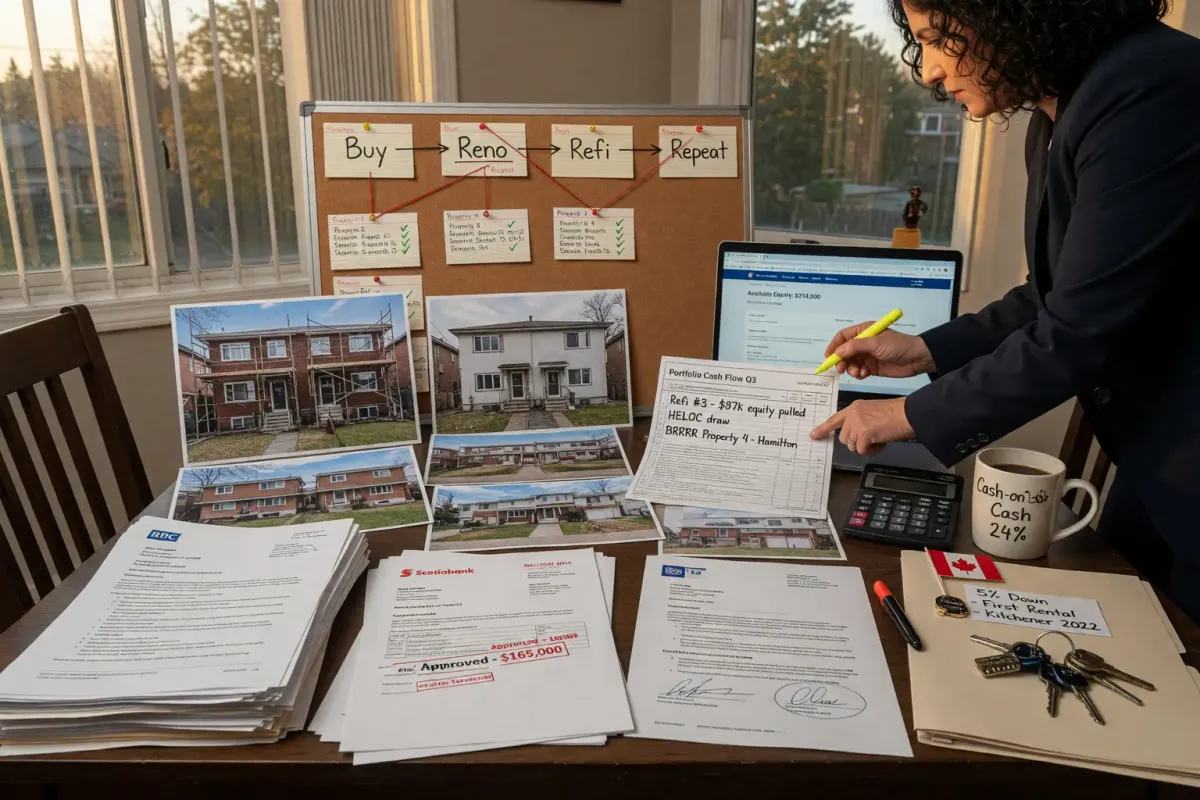
The biggest thing stopping people from investing in real estate? Money. Specifically, investment property financing.
If you want to buy multiple rental properties but don’t have piles of cash sitting around, you’re not alone. The good news is there’s a proven path forward, and it starts with way less money than you think. Master these top leverage strategies for real estate and stock investing to maximize your returns across asset classes.
Starting Small: The 5% Down Strategy
Here’s something most people don’t know: you can buy a property with just 5% down. There’s a catch though – you have to actually live in it.
The smartest move? Buy a duplex or any property with two units. Learn more about single-family vs multifamily investing. Live in one side and rent out the other. Your tenant helps pay your mortgage while you build equity.
This isn’t just theory. Scott Dillingham from LendCity did exactly this. He started in Sarnia with his first property at 5% down, then moved to Windsor and bought a duplex the same way. Each time he moved, the previous property became a rental.
The Reality Check
You actually have to move into the property. Saying you’ll live there just to get 5% down, then not doing it? That’s fraud. Don’t do it.
Also, this owner-occupied strategy has limits. CMHC and the private insurers (Sagen and Canada Guaranty) generally only insure one owner-occupied home per borrower at a time, and high-ratio insured mortgages now cap at $1.5M (raised from $1M in December 2024). So you can roll the strategy by moving and converting your old home to a rental — but you cannot stack multiple owner-occupied insured mortgages at once.
Why You Should Renovate Before Renting
Here’s what successful investors do differently: they renovate every rental property before putting tenants in.
This does three things:
- You can charge higher rent for a nice, updated unit
- You deal with way fewer maintenance calls and complaints
- The property is immediately worth more than you paid for it
Think about it. Would you rather constantly fix broken appliances and outdated fixtures, or handle the occasional minor issue? Renovating upfront means you’re fixing problems before they become your problem.
If you’ve renovated a property and want to pull equity out for your next purchase, timing and lender choice matter — book a free strategy call with LendCity so we can help you maximize what you qualify for.
The biggest mistake scaling investors make is not planning their financing two or three deals ahead — book a free strategy call with LendCity so we can build that roadmap together.
If this approach is on your radar, our multi-family mortgage financing guide walks through how LendCity structures these deals.
Turning Equity Into More Properties
After you buy a property with 5% down, something cool starts happening. The property goes up in value. Between market appreciation and your renovations, that 5% equity you started with could be 20%, 30%, or even 40% within a year or two. Explore refinancing your rental portfolio to make the most of this growth.
Now you can refinance. Banks will lend you up to 80% of your property’s value. If your home is worth more now, you can pull that extra equity out as cash. For homeowners 55 and older, reverse mortgages can unlock equity without requiring monthly payments, providing another path to fund your next acquisition.
What About Down Markets?
Sometimes the market goes down. That’s normal. Look at any long-term real estate chart – from 1900 to today, it trends up despite temporary dips.
Don’t let a down year scare you. Sometimes the best time to buy is when prices drop. Just make sure you’re holding properties long enough to benefit from the upward trend.
The Mortgage Plus Improvements Trick
Once you’re buying full investment properties (20% down, not living there), here’s a strategy most investors don’t know about: mortgage plus improvements.
Here’s how it works:
- Get quotes from contractors for your planned renovations
- The lender approves your mortgage plus the renovation amount
- They hold onto the renovation money
- You do the work using your own funds
- Once it’s done, they reimburse you
This lets you buy and renovate without having all the cash tied up long-term. You just need enough to float the renovations until you get reimbursed.
For Bigger Projects
If your renovations are really big, you might need a progress draw mortgage instead. These release money in stages as you complete the work – maybe 20% after you’re 20% done, another 20% at 40% completion, and so on.
These come as open mortgages (higher interest rate) because they’re temporary. Once renovations are done, you convert to a regular mortgage.
Whether you’re using the mortgage plus improvements trick or a progress draw mortgage, the financing structure can get tricky fast — book a free strategy call with us and we’ll walk you through the best approach for your renovation budget.
At a certain point, your mortgage strategy matters more than the deal itself — schedule a free strategy session with us to make sure your financing keeps up with your ambitions.
Timing Your Refinance
After you finish renovations, don’t rush to refinance right away. Wait 3-6 months.
Why? Appraisers who see fresh before-and-after photos often only value the property at what you paid plus renovation costs. They don’t give you credit for the actual appreciation.
Borrowers comparing options often continue with Leverage Strategies: Build a Real Portfolio in Canada before booking a strategy call.
Wait a bit, and they’re more likely to value it higher. That means more money in your pocket to buy the next property.
The Critical Mistake Most Investors Make
Here’s where people mess up: they work with lenders who don’t specialize in investment properties.
Picture this: You refinance your home to pull out money for a rental property. The lender gets you the refinance, you get your cash, everyone’s happy. Except… that lender never checked if you have enough income to actually qualify for the rental purchase.
Now you owe more on your home, pay more interest, and can’t buy the rental. You’re worse off than when you started.
Moving Up to Commercial Properties
After you’ve got several houses or duplexes, the next move isn’t buying more of the same. It’s moving to bigger buildings – 6 units, 12 units, 20+ units.
Commercial financing actually works better for bigger properties:
- With CMHC MLI Select, qualifying properties can require as little as 5% down; conventional commercial typically requires 20-25%
- You can get 40-50 year amortization via CMHC (vs 25-30 years for residential)
- Longer amortization means lower payments and better cash flow
Many investors eventually sell their smaller properties and use all that money as down payments for larger apartment buildings. It’s not exiting real estate – it’s scaling up.
Economies of Scale
Bigger properties cost less per unit to maintain. Need to replace 6 furnaces? Buying all at once gets you volume discounts on equipment and labor. Same with flooring, roofing, everything.
This is why successful investors eventually move to commercial. The numbers just work better.
How Commercial Properties Are Valued
Here’s something important: commercial properties are valued based on the income they produce, not just comparable sales.
This means every dollar you increase monthly rent can increase property value by $10-$100, depending on location and property type.
So when you renovate and raise rents on a commercial property, you’re not just improving cash flow. You’re dramatically increasing the building’s value. Then you refinance, pull that equity out, and buy something even bigger.
Protecting Your Cash Flow
Throughout all of this, never forget: properties need to cash flow. Don’t pull out so much equity that your properties barely break even or go negative.
Aim for at least a couple hundred dollars positive cash flow per property after refinancing. This cushion protects you during vacancies, repairs, or market changes. Having smart insurance strategies in place adds another layer of protection for your portfolio.
The Bottom Line
You can build a serious rental property portfolio starting with just 5% down. The secret is understanding the cycle:
- Buy with low down payment (5% if you’ll live there, 20% for pure investment)
- Renovate to increase value and rent
- Wait for appreciation
- refinance to pull equity out
- Use that equity to buy the next property
- Scale up to commercial when ready
The money doesn’t have to come from your job or savings. It comes from the properties themselves, as long as you work with lenders who understand investment properties and plan multiple steps ahead.
Want to talk about your specific situation? Call LendCity at (226) 783-1640 or visit podcast.lendcity.ca for more resources.
Key Takeaways:
- Starting Small: The 5% Down Strategy
- Why You Should Renovate Before Renting
- Turning Equity Into More Properties
- The Mortgage Plus Improvements Trick
- Timing Your Refinance
Frequently Asked Questions
How much money do I need to buy my first rental property?
Can I say I'll live in a property just to get 5% down, then rent it out?
Should I renovate a rental property before getting tenants?
How do I get money for my second and third rental properties?
When should I refinance after completing renovations?
What is mortgage plus improvements and how does it work?
When should I switch from houses to apartment buildings?
How much cash flow should each rental property generate?
Free download
MLI Select document checklist
Appraisals, rent rolls, environmental reports, and the CMHC package lenders expect before they underwrite.
By submitting, you agree to receive occasional emails from LendCity. You can unsubscribe at any time.
4.8/5 (116 Google reviews)
Disclaimer: LendCity Mortgages is a licensed mortgage brokerage. Content on this page is for educational purposes only and does not constitute legal, tax, investment, securities, or financial-planning advice. Rates, premiums, program terms, and regulations referenced are as of the page's last updated date and are subject to change. Any investment returns, rental yields, tax savings, or case-study figures shown are illustrative only — they are not guaranteed, not typical, and individual results will vary. Consult a licensed lawyer, Chartered Professional Accountant, or registered dealer before acting on any information above. Editorial standards.

Written by
Scott Dillingham
Published
December 22, 2025
· Updated August 16, 2026Reading time
9 min read
Amortization
The period over which a mortgage is scheduled to be fully paid off through regular payments of principal and [interest](/glossary/interest-rate/). In Canada, common amortization periods are 25 or 30 years, though the mortgage term (when you renegotiate) is typically 1-5 years. A longer amortization lowers monthly payments, improving [cash flow](/glossary/cash-flow/) but increasing total interest paid.
Appraisal
A professional assessment of a property's market value, required by lenders to ensure the property is worth the loan amount.
Appreciation
The increase in a property's value over time, which builds [equity](/glossary/equity/) and wealth for the owner through market growth or [forced improvements](/glossary/forced-appreciation/).
CMHC Insurance
Mortgage default insurance from Canada Mortgage and Housing Corporation. For 1-4 unit investment properties, investors must put 20%+ down (no insurance available). However, CMHC offers MLI Select for 5+ unit multifamily properties, and house hackers can access insured mortgages with 5-10% down.
Cash Flow
The money left over after collecting rent and paying all expenses including mortgage, taxes, insurance, maintenance, and property management. Positive cash flow is the primary goal of buy-and-hold investors. See also [NOI](/glossary/noi/), [Cash-on-Cash Return](/glossary/cash-on-cash-return/), and [Vacancy Rate](/glossary/vacancy-rate/).
Down Payment
The upfront cash payment when purchasing a property. For 1-4 unit investment properties, minimum 20% down is required. 5+ unit multifamily can use CMHC MLI Select with lower down payments, and house hackers can put as little as 5% down on owner-occupied 2-4 plexes. Your down payment directly affects your [LTV](/glossary/ltv/) and the amount of [leverage](/glossary/leverage/) you use.
Equity
The difference between a property's current market value and the remaining mortgage balance. If your home is worth $500,000 and you owe $300,000, you have $200,000 in equity. Equity builds through mortgage payments, [appreciation](/glossary/appreciation/), and [forced appreciation](/glossary/forced-appreciation/). See also [LTV](/glossary/ltv/) and [Refinancing](/glossary/refinancing/).
Interest Rate
The cost of borrowing money, expressed as a percentage. It determines how much you pay on top of the principal borrowed. Interest rates directly affect monthly payments, [cash flow](/glossary/cash-flow/), and [DSCR](/glossary/dscr/). See also [Amortization](/glossary/amortization/).
Leverage
Using borrowed money (mortgage) to control a larger asset, amplifying both potential returns and risks on your investment. A higher [LTV](/glossary/ltv/) means more leverage. See also [Down Payment](/glossary/down-payment/) and [Equity](/glossary/equity/).
Market Value
The estimated price a property would sell for on the open market under normal conditions. Determined by comparable sales, location, condition, and market demand.
Commercial Lending
Financing for commercial real estate or business purposes, typically qualified based on property income (NOI) rather than personal income. Includes mortgages for multifamily buildings (5+ units), retail, office, and industrial properties.
Multifamily
Properties with multiple dwelling units, from duplexes to large apartment buildings. Often offer better cash flow and economies of scale.
Single Family
A detached home designed for one household, the most common property type for beginner real estate investors.
Refinance
Replacing an existing mortgage with a new one, typically to access equity, get a better rate, or change terms. Investors commonly refinance to pull out capital for purchasing additional properties (cash-out refinance) while retaining ownership of the original property.
Duplex
A residential property containing two separate dwelling units, either side-by-side or stacked. Duplexes are popular among beginner investors because they can house-hack by living in one unit while renting the other to offset mortgage costs.
Comparable Properties
Similar properties in the same market area used to establish fair market value or rental rates through comparison of features, location, condition, and recent sale or rental prices. Analyzing comps is essential when determining offer prices and setting competitive rents.
Draw Schedule
A plan specifying when and how much of a construction loan's funds will be released as building milestones are reached. An inspector verifies work completion before each draw is disbursed.
Roof Replacement
A major capital expenditure involving the complete removal and installation of a new roofing system. Roof age and condition are critical factors in property inspections, insurance eligibility, and financing approvals, with typical costs ranging from $5,000 to $30,000+ depending on property size.
Collateral Mortgage
A mortgage registered for more than the actual loan amount — often up to 125% of the property value. This allows borrowers to access additional funds later without paying for a new registration. Most major Canadian banks use collateral mortgages by default. The trade-off is that switching lenders at renewal typically requires a full discharge and new registration, which adds cost.
Insured Mortgage
A mortgage backed by mortgage default insurance from CMHC, Sagen, or Canada Guaranty, required when the down payment is less than 20% on owner-occupied properties. The insurance premium — which currently ranges from roughly 0.60% to 4.50% of the mortgage amount depending on loan-to-value band, and is higher for non-traditional down payments or extended amortization — is typically added to the loan balance. Insured mortgages often qualify for lower interest rates because the lender's risk is covered by the insurer. Confirm the current premium schedule with CMHC/Sagen/Canada Guaranty; rates and tiers are subject to change.
Hover over terms to see definitions. View the full glossary for all terms.