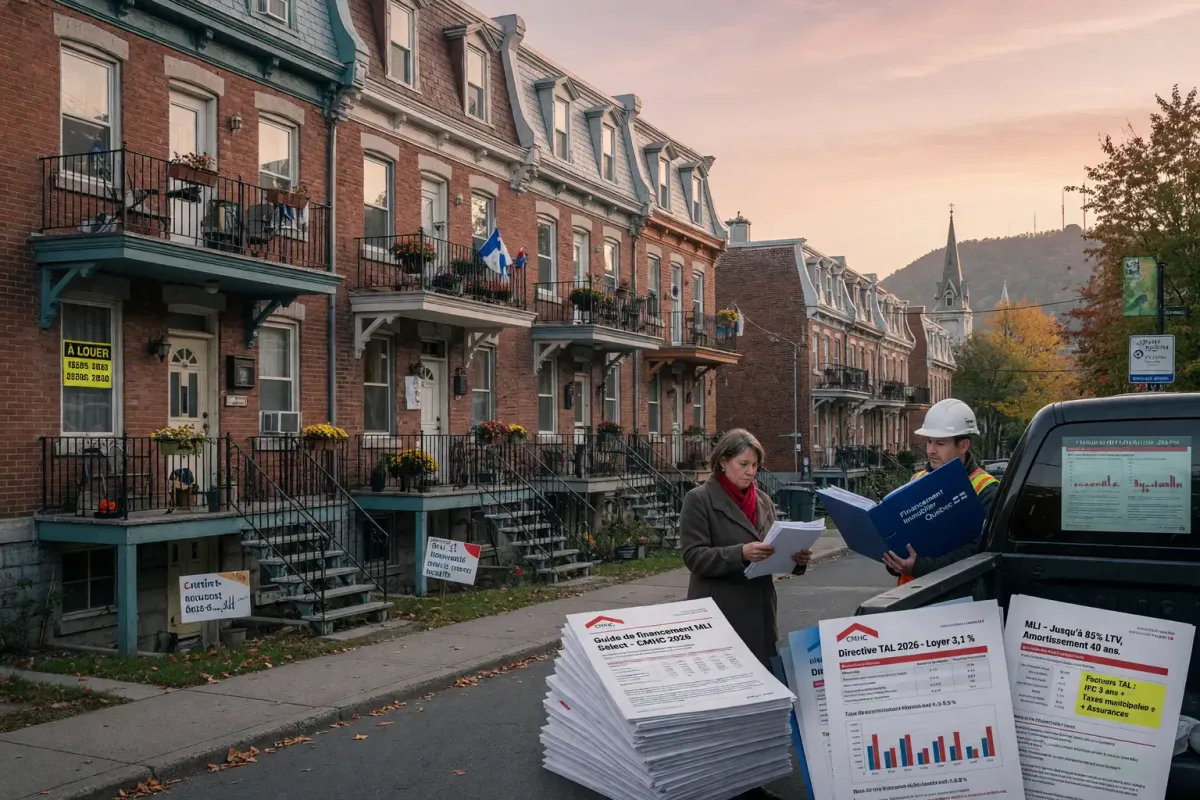
Investing in Quebec multifamily properties offers compelling opportunities—but the province’s unique regulatory environment demands a different approach than the rest of Canada.
Rent control through the Régie du logement, civil law frameworks, Quebec-specific tax considerations, and CMHC program nuances create both obstacles and advantages for informed investors. The Montreal rental market alone shows strong fundamentals: strong immigration-driven demand, walkable neighbourhood infrastructure, and significant younger demographic influx driving rental demand.
But here’s the challenge: many Canadian investors stop at the Quebec border because they don’t understand the regulations or financing mechanics specific to the province. That creates opportunity for investors willing to learn the landscape.
Let me walk you through Quebec multifamily investing from regulatory and financing perspectives.
Understanding Quebec’s Rental Market Dynamics
Quebec’s multifamily market operates differently from other Canadian provinces. Understanding these fundamentals is essential before analyzing deals.
The Montreal rental landscape continues to shift. While Canada’s total population declined for the first time on record in 2025 (down 103,504 to 41.47 million as of January 2026 — driven by federal targets reducing temporary residents from a peak of 3.15M to 2.68M), Montreal still benefits from steady permanent resident inflows under the 2026 immigration plan (380,000 PR/year, 385,000 temp residents). International students, skilled workers, and families seeking affordable housing relative to Toronto and Vancouver continue to support rental demand. Montreal average home prices reached approximately $656,807 in March 2026 (+5.1% YoY), still well below Toronto and Vancouver.
Rent control through the TAL is the defining characteristic of Quebec rental markets. Unlike Ontario or British Columbia, Quebec implements strict rent control provisions. Landlords cannot freely raise rents; increases are subject to provincial guidelines. For 2026, the Tribunal administratif du logement (TAL, formerly Régie du logement) guideline is 3.1% for leases renewing between April 2, 2026 and April 1, 2027. This reflects the TAL’s new simplified four-factor calculation methodology effective January 1, 2026 (3-year average Quebec CPI, municipal taxes, school taxes, and insurance costs). Increases above this rate require applying to the tribunal and demonstrating justified costs.
This fundamental difference impacts your investment math. You cannot assume significant annual rent escalation. Instead, focus on operational efficiency, expense control, and forced appreciation through value-add renovations that justify higher rent brackets through the Régie du logement approval process.
Property class divisions exist in Montreal and Quebec markets. Class A properties (newer, well-maintained buildings in prime neighbourhoods) command higher rents but face more competition. Class B and C properties (older buildings requiring renovation or located in secondary markets) offer better value-add opportunities and cap rate potential.
Quebec Regulations Every Multifamily Investor Must Know
Navigating Quebec’s civil law system and tenant protection framework differs fundamentally from common law provinces.
The Régie du logement governs landlord-tenant relationships. Unlike provincial tribunals elsewhere, the Régie operates as a quasi-judicial body with real enforcement power. Eviction, rent disputes, and lease modifications all require Régie approval. Wrongful eviction can expose landlords to penalties—understand your obligations before acquiring property.
Lease requirements are codified. Standard residential leases must include specific language and comply with civil law provisions. Pre-printed lease forms available through the Régie du logement are widely used and protect both parties. Using proper lease documentation is non-negotiable.
Tenant protections include fixed lease terms (typically 12 months), restrictions on rent increases, and mandatory notice periods for non-renewal. A landlord cannot simply choose not to renew a lease for arbitrary reasons. The Régie du logement protects tenants from displacement.
Bill 31 (2023) introduced important changes to Quebec’s rental market. The legislation aimed to increase housing supply and streamline rental processes. Key provisions include:
- Reduced renewal periods for new leases
- Streamlined non-renewal procedures under specific conditions
- Exemptions for newly constructed housing (certain protections don’t apply for 5 years)
- Increased Régie du logement authority to manage disputes
Understanding Bill 31’s provisions directly impacts your investment thesis. New construction benefits from temporary exemptions from certain rent control provisions, creating a window for value creation.
Civil law framework differs from common law. Contracts are interpreted differently, legal precedent works differently, and dispute resolution follows different paths. Consider engaging Quebec-based real estate lawyers for document review and strategy.
Choosing the wrong lender or term can quietly erode your returns — book a free strategy call with LendCity and we’ll walk you through the numbers.
CMHC Financing Programs in Quebec Context
CMHC programs are available in Quebec, but program-specific considerations exist.
CMHC MLI Standard (mortgage loan insurance) covers 5+ unit residential rental properties. The program requires:
- 5-20% down payment (80-95% LTV financing available)
- DSCR requirement: 1.30x minimum for MLI Standard (1.10x for MLI Select with 50+ points)
- 25-35 year amortizations
- Fixed or variable rate options
Quebec multifamily properties qualify for MLI Standard financing with the same terms as other provinces. The difference: Quebec’s rent control environment means your NOI calculations must reflect realistic rent escalation (approximately 3.1% annually under the 2026 TAL guideline, not market-driven increases).
CMHC MLI Select programs specifically target affordable housing and new construction with accelerated approvals. These programs offer:
- Higher LTV financing (up to 95%)
- 50-year amortizations on qualifying new construction
- Reduced insurance premiums
- Expedited approval timelines
Quebec’s housing shortage makes MLI Select attractive for development projects. The provincial housing shortage narrative aligns with federal affordable housing targets, creating program eligibility opportunities.
Program requirements demand accurate financial documentation. Lenders and CMHC appraisers will adjust rent assumptions to reflect Quebec’s rent control reality. Submit actual lease documentation, not inflated market rent projections.
Cap Rates and Valuation Across Quebec Markets
Where you invest within Quebec significantly impacts deal metrics.
Montreal cap rates vary dramatically by neighbourhood:
- Downtown/Plateau (prime residential): 3.5-4.5% cap rates, lower cash flow but strong appreciation and tenant demand
- Longueuil (Montérégie region): 5.0-6.0% cap rates, stronger cash flow, more stable C-class tenant profile
- Outremont/NDG: 4.0-5.0% cap rates, mixed demographics, moderate upside
- Secondary corridors (Côte-des-Neiges, Villeray): 5.5-6.5% cap rates, better cash flow, renovation upside
Cap rate variation reflects neighbourhood demand, proximity to transit, and property condition. Higher cap rates in secondary markets often indicate realistic value-add opportunities—acquire properties at 6%, implement operational improvements and cosmetic renovations, refinance at 5%, and repeat.
Quebec City and regional markets offer different metrics. Quebec City shows:
- Lower absolute prices than Montreal (entry point $2-4M for acceptable multifamily)
- Slightly lower cap rates overall (government employment base provides stability)
- Strong student housing demand (Université Laval, UQAM proximity)
- Growing retirement community interests
Gatineau and Hull (Outaouais region) offer:
- Proximity to Ottawa (cross-border commuting dynamics)
- Affordable entry pricing relative to Ontario markets
- Smaller supply and less professional investor competition
- Gateway market for investors expanding across borders
Your debt ratios, income type, and property plans all affect what you qualify for — schedule a free strategy session with us so we can map out a strategy that works for your goals.
Tax Considerations for Quebec Multifamily Investors
Quebec’s tax environment requires specific attention.
QST (Quebec Sales Tax) is higher than federal GST (9.975% QST + 5% GST). This impacts your renovation and improvement costs significantly. Building materials, contractor services, and equipment face combined 14.975% sales tax. Budget accordingly when modeling value-add investments.
Corporate structures for holding multifamily properties in Quebec benefit from similar HoldCo/OpCo optimization as other provinces, but Quebec’s civil law creates some structural nuances. Consult with Quebec-based tax accountants on provincial payroll tax integration and provincial investment tax credits.
Deduction timing follows Canadian federal rules but Quebec provincial return filing requires attention to provincial-specific claims. Rental losses, capital cost allowance (CCA), and property expense deductions follow federal rules but need provincial reporting accuracy.
Property transfer tax (transfer duties) varies by municipality but averages 0.5-1.0% of purchase price depending on location. Some municipalities have higher rates. Factor transfer taxes into your acquisition cost calculations.
Bill 31 Impacts on Multifamily Investment Strategy
Bill 31 fundamentally changed Quebec’s rental landscape. Understanding its provisions shapes your investment approach.
New construction exemptions provide the most significant opportunity. Residential buildings completed after the Bill 31 implementation date benefit from temporary exemptions:
- Certain rent increase restrictions don’t apply for the first 5 years post-completion
- Non-renewal procedures are streamlined
- The exemption window creates a value creation opportunity
This means ground-up apartment construction projects can raise rents more aggressively during the exemption period. If you’re evaluating development projects or new construction multifamily, Bill 31 exemptions significantly improve deal economics. Our multifamily mortgage financing service page provides detailed insights on provincial programs and nationwide financing options.
Streamlined non-renewal procedures allow landlords to not renew leases without just cause under specific conditions, though conditions are restrictive. The process still requires Régie du logement compliance.
Lease term flexibility was reduced. New leases can now be for periods shorter than traditional 12-month terms, though 12-month leases remain standard. This provides marginal flexibility.
Implications for your deal analysis:
- Prioritize new construction projects to capitalize on exemption windows
- Acquire properties with below-market rents and implement Bill 31-compliant rent increase strategies
- Understand Régie du logement ruling patterns on rent increase requests (approval is not automatic)
French Language Requirements in Applications
Conducting business in Quebec involves French-language requirements.
Lease documentation must be available in French. Bilingual leases are standard, but French is required. Many standard lease forms from the Régie du logement are bilingual.
CMHC applications can be submitted in English, but supporting documents (lease summaries, property descriptions, locational analysis) are often submitted in French. CMHC has bilingual staff, but clearer communication typically results from French documentation.
Communication with Régie du logement occurs in French. If you’re representing yourself in disputes or submitting rent increase applications, French language capability matters. Most professional property managers and lawyers navigate this for landlords, but be aware of the language dynamic.
Marketing and tenant communications work in French. Professional property management typically handles tenant notices, lease renewals, and repair requests in French. This doesn’t prevent English-speaking investors from owning property, but professional management becomes important.
For English-speaking investors, partnerships with Quebec-based property managers, lawyers, and accountants are essential. The language barrier is manageable but shouldn’t be ignored.
Montreal Neighbourhood Analysis and Cap Rates
Understanding Montreal’s geography and neighbourhood-specific dynamics directly impacts deal selection.
Plateau-Mont-Royal remains Montreal’s most expensive multifamily market. Modern buildings with strong tenant profiles command premium prices. Cap rates reflect this: 3.5-4.5% for well-maintained properties. Appreciation is strong, but cash flow is modest. Target demographic: young professionals, students, established families.
Mile End and adjacent areas show similar metrics to Plateau with slightly lower rents. Rising transit development (future REM connections) may improve long-term appreciation.
Saint-Michel and Villeray-Saint-Michel-Parc-Extension offer better cap rates (5.0-6.0%) with significant value-add potential. Older properties, lower current rents, but strong neighbourhood investment trends. Transit connections to downtown and growing retail corridors create tenant demand.
Longueuil (south shore) provides the strongest cash flow for Montreal-area multifamily. Properties range from $2-4M for acceptable 6-8 unit buildings. Cap rates run 5.5-6.5%. Commuting accessibility to Montreal is strong.
Outremont and Westmount (wealthy anglophone enclaves) show different dynamics: higher rents, higher entry prices, lower cap rates (4.0-5.0%). Tenant stability is excellent. Professional class and retirees comprise tenant base.
NDG (Notre-Dame-de-Grâce) shows mixed metrics. Some pockets offer good value; others are fully valued. Proximity to McGill and Concordia universities creates stable student rental demand.
Financing Your Quebec Multifamily Deal
The actual financing process requires steps specific to Quebec context.
Pre-qualification starts with clear deal analysis. Your lender needs:
- Complete lease schedules (in French and English)
- Actual rent roll for past 24 months
- Operating expense documentation
- Régie du logement rent increase history (if applicable)
- Building inspection report (inspection by Quebec-based commercial inspectors)
Appraiser selection matters. CMHC requires appraisals by qualified commercial appraisers. Choose appraisers familiar with Quebec rent control dynamics—they’ll properly adjust NOI for realistic rent growth assumptions.
NOI calculations must reflect Quebec-specific factors:
- 3.1% annual rent escalation (based on the 2026 TAL guideline under the updated simplified methodology)
- Operating expense ratios typically 35-50% (similar to other Canadian markets)
- Vacancy assumption of 5-7% (Montreal has relatively tight vacancy, but seasonal fluctuation exists)
Commercial mortgage brokers specializing in Quebec multifamily are invaluable. They understand CMHC program nuances, lender preferences for Quebec properties, and typical documentation requirements. Brokers with Quebec relationships expedite approvals.
Loan structure for Quebec multifamily typically follows:
- 20-30% down payment for conventional financing
- 5-20% down for CMHC-insured programs
- 5-10 year amortizations (commercial standard)
- Variable or fixed rate options
Case Study: Montreal Duplex Value-Add
Let’s walk through a realistic Quebec multifamily acquisition.
Property profile: 8-unit residential building in Villeray-Saint-Michel. Built in 1985, solid structure, but cosmetic condition is dated. Current rents average $750/month, below market.
Acquisition: Purchased for $2.4M (reasonable market value for the neighbourhood and condition). Down payment: 25% ($600K).
Financing: CMHC MLI Standard mortgage for $1.8M at 4.75% fixed rate (within the April 2026 MLI Standard 4.50–5.25% band), 40-year amortization. Monthly payment approximately $9,200 (including property tax, insurance, reserves).
As-is NOI analysis:
- Gross potential income: $72,000 (8 units × $750 × 12)
- Vacancy/collection loss (5%): $3,600
- Effective gross income: $68,400
- Operating expenses (40%): $27,360
- NOI: $41,040 (4.58% cap rate)
Value-add strategy:
- Cosmetic renovations to units as tenants turn: painting, flooring, updated fixtures
- Building exterior improvements: new entrance, landscaping
- Common area upgrades: lobby, laundry room modernization
- Target rent increase: $850-900/month within 18 months
Post-renovation NOI (pro forma):
- Gross potential income: $86,400 (8 units × $900 × 12)
- Vacancy/collection loss (5%): $4,320
- Effective gross income: $82,080
- Operating expenses (38% after efficiency gains): $31,190
- NOI: $50,890 (pro forma 5.7% cap rate)
Refinancing scenario: After 18-month renovation period, property appraises at $2.8M (based on improved NOI). Refinance at 75% LTV: $2.1M loan. Pay off original $1.8M, extract $300K equity (less refinancing costs).
Outcome: Original $600K investment generates $300K equity extraction, plus cash flow improvement from increased rents. Investor repeats process on next property. These figures are based on projected assumptions for this specific scenario. Actual returns depend on renovation costs, Régie du logement rent increase approvals, market conditions, and financing terms. Individual outcomes will vary.
Due Diligence Specific to Quebec Properties
Before acquiring, complete thorough due diligence unique to Quebec context.
Lease review is essential. Examine:
- Actual rent per unit (lease documentation, not landlord claims)
- Lease expiration dates (when do renewal negotiations occur?)
- Any special lease terms (rent control exemptions for specific units?)
- Tenant payment history (bank deposits from rent collection)
Régie du logement history research. The quasi-judicial body maintains records of disputes, rent increase decisions, and evictions. Ask the seller for access to previous rent increase applications and results. This shows what Régie du logement actually approved.
Building condition assessment requires Quebec-specific inspections. Hire commercial property inspectors familiar with Quebec buildings. Montreal buildings frequently feature:
- Basement moisture issues (common in older buildings)
- Aging roofing systems (20-30 year lifespan)
- Outdated mechanical/electrical systems
- Potential asbestos in older buildings
Insurance and liability assessment matters in Quebec. Liability frameworks differ under civil law. Ensure property insurance aligns with Quebec’s legal requirements.
Title and deed research requires attention to Quebec civil law structure. French language legal descriptions and civil law provisions apply. Real estate lawyers familiar with Quebec property law are essential.
Professional Team Building in Quebec
Success in Quebec multifamily investing requires the right professionals.
Quebec real estate lawyer specializing in multifamily and commercial property is non-negotiable. They review documents in French, understand civil law implications, and protect your interests.
Commercial mortgage broker with Quebec market experience accelerates financing. They know which lenders compete for Quebec multifamily deals, typical approval timelines, and documentation shortcuts.
Bilingual property manager or property management company handles tenant relations, Régie du logement communications, and operational management. English-speaking investors typically delegate this role.
Quebec-based accountant optimizes tax strategy, tracks provincial deductions, and manages QST implications on renovations.
Commercial appraiser with Quebec experience ensures realistic valuations aligned with rent control dynamics.
Multifamily-focused real estate agent connects you with off-market opportunities and understands neighbourhood-specific metrics.
Frequently Asked Questions
How does Quebec's rent control affect my multifamily investment returns?
What is CMHC MLI Select and how does it apply to Quebec projects?
What cap rates should I target in Montreal neighbourhoods?
What is Bill 31 and how does it create investment opportunities?
Do I need to speak French to invest in Quebec multifamily?
What are the key differences between acquiring in Montreal versus other Quebec cities?
Key Takeaways:
- Understanding Quebec’s Rental Market Dynamics
- Quebec Regulations Every Multifamily Investor Must Know
- CMHC Financing Programs in Quebec Context
- Cap Rates and Valuation Across Quebec Markets
- Tax Considerations for Quebec Multifamily Investors
The Bottom Line
Quebec multifamily investing rewards investors willing to understand the provincial landscape. Rent control, Régie du logement regulations, civil law frameworks, and French-language dynamics create complexity—but they also deter casual competitors.
Montreal’s strong fundamentals—immigration-driven demand, walkable neighbourhoods, transit connectivity, and younger demographic concentration—support healthy rental markets. Secondary cities like Quebec City and Gatineau offer different metrics but viable opportunities.
The key to success: hire Quebec-based professionals, understand rent control dynamics, focus on value-add opportunities rather than rent escalation assumptions, and target neighbourhoods where your investment thesis aligns with market fundamentals.
Quebec’s multifamily market is accessible to Canadian investors. Start with professional guidance, complete thorough due diligence, and execute disciplined acquisitions. The returns reward this effort.
Disclaimer: This case study is presented for educational purposes only. Some details may have been adjusted for clarity and readability. Individual investment outcomes vary — past results do not guarantee future performance. LendCity Mortgages provides mortgage financing services for real estate investors and does not offer investment, legal, or tax advice.
Free download
MLI Select document checklist
Appraisals, rent rolls, environmental reports, and the CMHC package lenders expect before they underwrite.
By submitting, you agree to receive occasional emails from LendCity. You can unsubscribe at any time.
4.8/5 (116 Google reviews)
Disclaimer: LendCity Mortgages is a licensed mortgage brokerage. Content on this page is for educational purposes only and does not constitute legal, tax, investment, securities, or financial-planning advice. Rates, premiums, program terms, and regulations referenced are as of the page's last updated date and are subject to change. Any investment returns, rental yields, tax savings, or case-study figures shown are illustrative only — they are not guaranteed, not typical, and individual results will vary. Consult a licensed lawyer, Chartered Professional Accountant, or registered dealer before acting on any information above. Editorial standards.

Written by
Scott Dillingham
Published
February 26, 2026
· Updated June 29, 2026Reading time
13 min read
CMHC Insurance
Mortgage default insurance from Canada Mortgage and Housing Corporation. For 1-4 unit investment properties, investors must put 20%+ down (no insurance available). However, CMHC offers MLI Select for 5+ unit multifamily properties, and house hackers can access insured mortgages with 5-10% down.
Multifamily
Properties with multiple dwelling units, from duplexes to large apartment buildings. Often offer better cash flow and economies of scale.
Cap Rate
Capitalization Rate - the ratio of a property's [net operating income (NOI)](/glossary/noi/) to its current market value or purchase price. A 6% cap rate means the property generates $60,000 NOI annually on a $1,000,000 value. Used to compare investment properties regardless of financing. See also [DSCR](/glossary/dscr/) and [Cash-on-Cash Return](/glossary/cash-on-cash-return/).
NOI
Net Operating Income - the total income a property generates minus all operating expenses, but before mortgage payments and income taxes. Calculated as gross rental income minus [vacancies](/glossary/vacancy-rate/), property taxes, insurance, maintenance, and property management fees. NOI is used to calculate both [Cap Rate](/glossary/cap-rate/) and [DSCR](/glossary/dscr/).
DSCR
Debt Service Coverage Ratio — a metric that compares a property's [net operating income](/glossary/noi/) to its mortgage payments. A DSCR of 1.25 means the property generates 25% more income than needed to cover the debt. Lenders typically require a minimum DSCR of 1.0 to 1.25 for investment property loans (including [DSCR loans](/glossary/dscr-loan/)). See also [Cap Rate](/glossary/cap-rate/) and [Cash Flow](/glossary/cash-flow/).
Commercial Mortgage
Financing for commercial properties like retail, office, or multifamily buildings with 5+ units, with different qualification criteria than residential mortgages.
Rent Control
Provincial regulations that limit how much a landlord can increase rent annually for existing tenants. Rules vary by province - Ontario caps increases at a government-set guideline, while Alberta has no rent control. Rent control directly impacts investment cash flow projections.
Down Payment
The upfront cash payment when purchasing a property. For 1-4 unit investment properties, minimum 20% down is required. 5+ unit multifamily can use CMHC MLI Select with lower down payments, and house hackers can put as little as 5% down on owner-occupied 2-4 plexes. Your down payment directly affects your [LTV](/glossary/ltv/) and the amount of [leverage](/glossary/leverage/) you use.
Hover over terms to see definitions. View the full glossary for all terms.