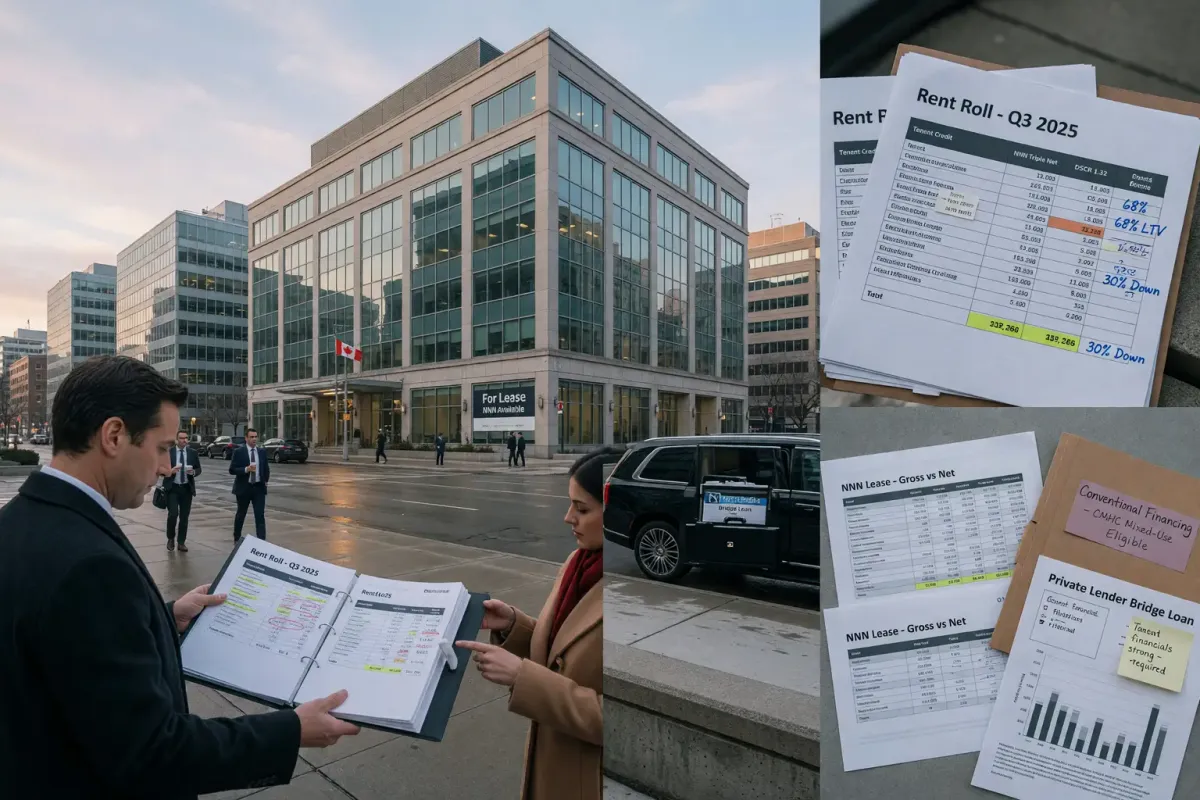
You have been looking at office buildings. Maybe it is a single-tenant professional building in a suburban business park. Maybe it is a multi-tenant downtown tower with a mix of law firms, tech companies, and medical clinics. Either way, you are wondering how to actually finance the thing.
Office buildings are one of the most misunderstood asset classes in Canadian commercial real estate. Most residential investors never consider them. But those who do often discover something powerful: long-term tenants, triple-net lease structures that push operating costs to the tenant, and stable cash flow that lenders love.
Here is everything you need to know about financing an office building investment in Canada, from how lenders evaluate these properties to the exact steps you need to take to get approved.
Why Office Buildings Deserve Your Attention
Most Canadian investors start with residential properties. Single-family homes, duplexes, maybe a small multi-family building. That is smart for building experience. But if you want to scale into serious cash flow territory, office buildings offer advantages that residential properties simply cannot match.
Long-term lease commitments. Residential tenants sign 12-month leases. Office tenants sign 5, 7, even 10-year leases. That is a decade of predictable income locked in with a single signature. Lenders see that stability and reward it with better terms.
Triple-net lease structures. In a standard residential rental, you pay the property taxes, insurance, and maintenance. In a triple-net (NNN) office lease, the tenant pays all of those costs. Your net operating income stays clean because operating expenses are the tenant’s responsibility, not yours.
Professional tenant base. Law firms, accounting practices, medical offices, and tech companies tend to be stable, creditworthy tenants. They invest heavily in their spaces and do not move frequently. A law firm that has spent $200,000 building out their office is not leaving when the lease comes up for renewal.
Management efficiency. A 20-unit apartment building means dealing with 20 different tenants, 20 sets of maintenance requests, and 20 lease renewals. A 20,000-square-foot office building might have 3 or 4 tenants. Less management, fewer headaches.
Before diving into office buildings, many investors build experience with simpler commercial assets. Our guide on buying commercial real estate for the first time covers the fundamentals that apply across all property types.
If you are serious about office property investing, explore our dedicated office property mortgage financing page for specific lending programs and current terms.
How Lenders Evaluate Office Buildings
When you apply for financing on an office building, the lender is not just looking at you. They are looking hard at the property itself. Here is what matters most.
Tenant Quality and Creditworthiness
This is the single biggest factor in your approval. Lenders want to know: who is paying the rent, and can they keep paying it?
A building leased to a Fortune 500 company is treated completely differently than one leased to a two-year-old startup. Lenders will pull credit reports on your major tenants, review their financial statements, and assess their ability to honour their lease obligations.
Here is the hierarchy most lenders follow:
- Government tenants (federal, provincial, municipal) — lowest risk, best financing terms
- National credit tenants (banks, insurance companies, large corporations) — very strong
- Regional businesses with long track records — solid
- Small businesses and startups — higher risk, may require larger down payment
If your building has a single government tenant on a 10-year lease, you are looking at the best financing terms available. If it is full of small businesses on short-term leases, expect to put more money down.
Lease Terms and Structure
Lenders dig into your lease agreements. They want to see:
- Remaining lease term. A tenant with 8 years left is worth more to a lender than one with 8 months left. If your major tenant’s lease expires within 2 years of your purchase, lenders may treat that space as vacant in their underwriting.
- Rent escalation clauses. Built-in annual increases of 2-3% show the lender that your income will grow over time.
- Renewal options. Tenants with renewal options signal stability. Lenders love seeing this.
- Personal guarantees. For smaller tenants, personal guarantees from business owners add security.
Building Classification: A, B, and C
Office buildings are classified into three tiers, and lenders treat each differently.
Class A buildings are premium properties in prime locations with modern systems, high-end finishes, and professional management. These command the highest rents and attract the strongest tenants. Lenders offer the most favourable terms.
Class B buildings are solid but not top-tier. They may be older, in secondary locations, or need some updating. Most Canadian office investors land here. Financing is readily available, though terms are slightly less favourable than Class A.
Class C buildings are older properties that may need significant capital improvements. These can offer the best cash-on-cash returns if you can add value through renovations, but financing is harder to secure and lenders require more equity.
Location and Market Fundamentals
The city matters. The neighbourhood matters even more. Lenders look at:
- Local office vacancy rates
- Employment trends in the market
- Public transit access
- Proximity to amenities (restaurants, shops, parking)
- Competitive supply (new office developments planned nearby)
Markets with low vacancy and strong employment growth get the best financing terms. If you are looking at a secondary market with rising vacancy, expect lenders to be more conservative. As of April 2026, downtown office vacancy ranges from roughly 15-22% across major Canadian markets — Toronto downtown class A sits near 16-18%, Calgary downtown closer to 25%. Lenders price that risk into both LTV and rate.
DSCR loans let you qualify based on the property’s income, not yours — book a free strategy call with LendCity and we’ll help you figure out if a DSCR loan makes sense for your next deal.
For a deeper look at the financing angle behind this topic, see our DSCR loans guide.
Financing Options for Canadian Office Buildings
You have several paths to finance an office building in Canada. The right one depends on the property type, size, and your personal financial situation.
CMHC Insured Financing (Mixed-Use Only)
If the office building has a residential component where at least 50% of the gross floor area is residential, you may qualify for CMHC-insured financing. This is the gold standard for terms:
- Up to 85% loan-to-value
- Amortization up to 40-50 years
- Lower interest rates than conventional commercial
- DSCR requirement as low as 1.1
The catch is the residential component requirement. A pure office building does not qualify. But if you are looking at a mixed-use property with apartments above office space, this opens the door to exceptional financing. You can learn more about Multi-Family Mortgage Financing that apply to these mixed-use structures.
Conventional Commercial Mortgages
For standard office buildings, conventional commercial financing through banks, credit unions, and commercial mortgage companies is your primary option.
Typical terms look like this:
- Loan-to-value: 60-75% (meaning 25-40% down payment)
- Amortization: 15-25 years
- Term: 5-10 years (then you renew or refinance)
- DSCR requirement: 1.2 minimum, some lenders want 1.25
- Interest rates: Office mortgages typically run 5.50-7.50% in 2026, reflecting elevated downtown vacancy that pushes office rates above other commercial classes
The better your tenant quality and lease terms, the closer you get to that 75% LTV ceiling. Weak tenant profiles push you toward 60% LTV or lower.
Credit Union and Alternative Lenders
Credit unions can be surprisingly competitive for office building financing, especially in markets where they have a strong presence. They often offer:
- More flexible underwriting
- Relationship-based lending (your overall banking relationship matters)
- Competitive rates for smaller office properties
- Willingness to finance Class B and C buildings that big banks pass on
Alternative lenders fill gaps when traditional financing does not work. Higher rates, but they can move fast and handle situations that banks cannot. If you are navigating Mortgage Financing for Canadians in Canada broadly, a broker who knows commercial lending will find the right fit.
Understanding NNN Leases and Their Impact on NOI
Triple-net leases are the reason office buildings can generate such clean cash flow. Here is how they work and why lenders pay close attention to them.
In a standard NNN lease, the tenant pays:
- Base rent — the fixed monthly amount
- Property taxes — their proportionate share
- Insurance — their proportionate share
- Common area maintenance (CAM) — their proportionate share of building upkeep
As the building owner, your responsibilities shrink to structural maintenance and major capital items. Everything else flows to the tenants.
Related reading: Retail Property Financing Canada: Loans & Lender Criteria covers the practical angles we see on similar files.
How NNN Leases Boost Your NOI
Let’s say you own a 10,000-square-foot office building:
- Gross rent collected: $200,000 per year
- Property taxes: $25,000 (paid by tenants under NNN)
- Insurance: $8,000 (paid by tenants under NNN)
- CAM costs: $15,000 (paid by tenants under NNN)
- Your actual expenses: $12,000 (structural maintenance reserve)
Your NOI is $188,000. Without NNN leases, your NOI would drop to $140,000 because you would be absorbing those $48,000 in operating costs.
Lenders calculate your debt service coverage ratio using NOI. Higher NOI means you qualify for a larger loan. NNN leases directly translate to better financing.
Modified Gross vs. Full NNN
Not all office leases are true NNN. Some are modified gross leases where the landlord covers certain expenses up to a base year amount, and tenants pay increases above that. Lenders adjust their underwriting based on the actual lease structure, so make sure your broker understands the specifics.
If you want to scale without hitting income qualification walls, DSCR financing is worth exploring — schedule a free strategy session with us to see what rates and terms are available.
Managing Vacancy Risk in Office Buildings
The biggest risk lenders see in office buildings is vacancy. A single tenant leaving a small building can drop your occupancy from 100% to 50% overnight. Here is how to manage this risk and how lenders account for it.
Diversify your tenant base. A building with 5 tenants is less risky than one with a single tenant, even if that single tenant is strong. If your only tenant leaves, you have zero income. If one of five leaves, you still have 80% occupancy.
Stagger lease expirations. Make sure all your leases do not expire in the same year. Staggered expirations mean you are never facing a fully vacant building.
Build a capital reserve. Lenders want to see that you have reserves to cover mortgage payments during vacant periods. Most require 6-12 months of mortgage payments in reserve at closing.
Maintain the property. Class B buildings that are well-maintained compete with Class A for tenants. Deferred maintenance drives tenants away and makes refinancing harder.
Lenders typically underwrite office buildings assuming 5-15% vacancy, depending on the market and property class. Even if your building is 100% occupied, they will stress-test the income.
The Application Process: Step by Step
Here is exactly what the process looks like when you are ready to finance an office building.
Step 1: Pre-qualification. Before you make an offer, talk to a commercial mortgage broker. Bring the property financials, rent roll, and lease summaries. A good broker can tell you within 24-48 hours what financing is achievable. LendCity’s team handles this through our investor resources and tools to help you make informed decisions.
Step 2: Letter of intent. Once you are ready to proceed, the lender issues a letter of intent (LOI) outlining the proposed terms. This is not a commitment, but it shows you what to expect.
Step 3: Due diligence. The lender orders an appraisal, environmental assessment (Phase 1, sometimes Phase 2), and reviews all lease documents, tenant financials, and property condition reports.
Step 4: Underwriting. The lender’s team analyzes everything. They calculate NOI, DSCR, and assess overall risk. This takes 2-6 weeks depending on the complexity.
Step 5: Commitment letter. If everything checks out, the lender issues a formal commitment letter with final terms, conditions, and closing requirements.
Step 6: Legal and closing. Lawyers prepare mortgage documents, you satisfy any conditions, and funds are advanced. Commercial closings typically take 60-90 days from application to funding.
Documents You Will Need
Prepare these before you start the process:
- Rent roll (current tenants, lease terms, rental rates)
- Copies of all lease agreements
- Two years of operating statements
- Property tax assessment
- Building condition report or recent inspection
- Environmental reports if available
- Your personal net worth statement
- Business plan or investment summary
- If you are exploring development mortgage financing, you will also need construction budgets and timelines
Office Building Financing Compared to Other Commercial Assets
Office buildings occupy a specific position in the commercial lending landscape. Compared to retail property mortgage financing, office buildings tend to have longer lease terms but face different vacancy dynamics. Retail tenants may generate percentage rent on top of base rent, while office tenants provide more predictable fixed income.
Multi-family buildings through multi-family mortgage financing programs generally receive the most favourable terms because residential demand is consistent. Office buildings sit in the middle — better than retail in many lender’s eyes, but not as favourable as purpose-built residential.
If you are a Canadian investor also looking at US commercial properties, cross-border financing programs offer DSCR-based qualification where the property’s income is what matters, not your personal income. DSCR loans qualify the property rather than the person, require 20-25% down, and do not need US credit history.
Common Mistakes to Avoid
Not verifying tenant financials. Just because a tenant signed a lease does not mean they can pay it. Always request financial statements from major tenants before purchasing.
Ignoring upcoming lease expirations. A building with 95% occupancy looks great until you realize three of four tenants have leases expiring within 18 months. Lenders catch this. You should too.
Underestimating capital expenditures. Older office buildings need HVAC replacements, elevator upgrades, roof repairs, and technology infrastructure. Budget for these or your NOI projections will be wildly optimistic.
Assuming residential financing rules. Commercial financing is a different world. Terms, processes, and timelines differ significantly from residential mortgage financing. Work with a broker who specializes in commercial deals.
Going to your bank first. Your personal bank may not offer the best commercial terms. A commercial mortgage broker accesses dozens of lenders and gets competitive bids. The difference can save you tens of thousands over the life of the loan. Understanding the differences between A lenders and B lenders is crucial when evaluating your financing options.
Key Takeaways:
- Why Office Buildings Deserve Your Attention
- How Lenders Evaluate Office Buildings
- Financing Options for Canadian Office Buildings
- Understanding NNN Leases and Their Impact on NOI
- Managing Vacancy Risk in Office Buildings
Frequently Asked Questions
What is the minimum down payment for an office building in Canada?
What DSCR do lenders require for office building financing?
Can I finance a vacant office building?
How long does it take to close on an office building mortgage?
Are NNN leases required to get office building financing?
Should I buy a single-tenant or multi-tenant office building?
Free download
MLI Select document checklist
Appraisals, rent rolls, environmental reports, and the CMHC package lenders expect before they underwrite.
By submitting, you agree to receive occasional emails from LendCity. You can unsubscribe at any time.
4.8/5 (116 Google reviews)
Disclaimer: LendCity Mortgages is a licensed mortgage brokerage. Content on this page is for educational purposes only and does not constitute legal, tax, investment, securities, or financial-planning advice. Rates, premiums, program terms, and regulations referenced are as of the page's last updated date and are subject to change. Any investment returns, rental yields, tax savings, or case-study figures shown are illustrative only — they are not guaranteed, not typical, and individual results will vary. Consult a licensed lawyer, Chartered Professional Accountant, or registered dealer before acting on any information above. Editorial standards.

Written by
Scott Dillingham
Published
February 15, 2026
· Updated June 29, 2026Reading time
12 min read
Amortization
The period over which a mortgage is scheduled to be fully paid off through regular payments of principal and [interest](/glossary/interest-rate/). In Canada, common amortization periods are 25 or 30 years, though the mortgage term (when you renegotiate) is typically 1-5 years. A longer amortization lowers monthly payments, improving [cash flow](/glossary/cash-flow/) but increasing total interest paid.
Down Payment
The upfront cash payment when purchasing a property. For 1-4 unit investment properties, minimum 20% down is required. 5+ unit multifamily can use CMHC MLI Select with lower down payments, and house hackers can put as little as 5% down on owner-occupied 2-4 plexes. Your down payment directly affects your [LTV](/glossary/ltv/) and the amount of [leverage](/glossary/leverage/) you use.
LTV
Loan-to-Value ratio - the mortgage amount expressed as a percentage of the property's appraised value or purchase price (whichever is lower). An 80% LTV means you're borrowing 80% and putting 20% [down](/glossary/down-payment/). Lower LTV generally means better [interest rates](/glossary/interest-rate/) and terms. See also [Equity](/glossary/equity/) and [Leverage](/glossary/leverage/).
DSCR
Debt Service Coverage Ratio — a metric that compares a property's [net operating income](/glossary/noi/) to its mortgage payments. A DSCR of 1.25 means the property generates 25% more income than needed to cover the debt. Lenders typically require a minimum DSCR of 1.0 to 1.25 for investment property loans (including [DSCR loans](/glossary/dscr-loan/)). See also [Cap Rate](/glossary/cap-rate/) and [Cash Flow](/glossary/cash-flow/).
Coverage Ratio
A measure of a property's ability to cover its debt payments, typically referring to DSCR. Commercial lenders often require a minimum of 1.2, meaning the property's net operating income exceeds debt payments by at least 20%.
NOI
Net Operating Income - the total income a property generates minus all operating expenses, but before mortgage payments and income taxes. Calculated as gross rental income minus [vacancies](/glossary/vacancy-rate/), property taxes, insurance, maintenance, and property management fees. NOI is used to calculate both [Cap Rate](/glossary/cap-rate/) and [DSCR](/glossary/dscr/).
CMHC Insurance
Mortgage default insurance from Canada Mortgage and Housing Corporation. For 1-4 unit investment properties, investors must put 20%+ down (no insurance available). However, CMHC offers MLI Select for 5+ unit multifamily properties, and house hackers can access insured mortgages with 5-10% down.
Private Mortgage
A mortgage from a private lender rather than a traditional bank, typically with higher rates but more flexible qualification requirements.
Commercial Mortgage
Financing for commercial properties like retail, office, or multifamily buildings with 5+ units, with different qualification criteria than residential mortgages.
Commercial Lending
Financing for commercial real estate or business purposes, typically qualified based on property income (NOI) rather than personal income. Includes mortgages for multifamily buildings (5+ units), retail, office, and industrial properties.
Cash Flow
The money left over after collecting rent and paying all expenses including mortgage, taxes, insurance, maintenance, and property management. Positive cash flow is the primary goal of buy-and-hold investors. See also [NOI](/glossary/noi/), [Cash-on-Cash Return](/glossary/cash-on-cash-return/), and [Vacancy Rate](/glossary/vacancy-rate/).
Equity
The difference between a property's current market value and the remaining mortgage balance. If your home is worth $500,000 and you owe $300,000, you have $200,000 in equity. Equity builds through mortgage payments, [appreciation](/glossary/appreciation/), and [forced appreciation](/glossary/forced-appreciation/). See also [LTV](/glossary/ltv/) and [Refinancing](/glossary/refinancing/).
Multifamily
Properties with multiple dwelling units, from duplexes to large apartment buildings. Often offer better cash flow and economies of scale.
Single Family
A detached home designed for one household, the most common property type for beginner real estate investors.
Refinance
Replacing an existing mortgage with a new one, typically to access equity, get a better rate, or change terms. Investors commonly refinance to pull out capital for purchasing additional properties (cash-out refinance) while retaining ownership of the original property.
Interest Rate
The cost of borrowing money, expressed as a percentage. It determines how much you pay on top of the principal borrowed. Interest rates directly affect monthly payments, [cash flow](/glossary/cash-flow/), and [DSCR](/glossary/dscr/). See also [Amortization](/glossary/amortization/).
Appraisal
A professional assessment of a property's market value, required by lenders to ensure the property is worth the loan amount.
Vacancy Rate
The percentage of rental units that are unoccupied over a given period. A critical factor in [cash flow](/glossary/cash-flow/) analysis, typically estimated at 4-8% for conservative projections. Vacancy directly reduces [NOI](/glossary/noi/).
Due Diligence
The comprehensive investigation and analysis of a property before purchase, including financial review, physical inspection, title search, and market analysis.
Rent Roll
A document listing every tenant in a commercial property along with their unit number, lease start and end dates, monthly rent, security deposits, and key lease terms. Required by all commercial mortgage lenders during underwriting, the rent roll is the primary tool used to verify and analyze a property's actual and potential rental income.
Underwriting
The process lenders use to evaluate the risk of a mortgage application, including reviewing credit, income, assets, and property value to determine loan approval.
Mortgage Broker
A licensed professional who shops multiple lenders to find the best mortgage rates and terms for borrowers. Unlike banks, brokers have access to dozens of lending options.
Rental Income
Revenue generated from tenants paying rent on an investment property. Gross rental income is the total collected before expenses, while net rental income subtracts operating costs to show actual profitability.
HVAC
Heating, Ventilation, and Air Conditioning systems that control temperature and air quality in buildings. HVAC is often one of the largest energy expenses in rental properties, and upgrading to high-efficiency systems can significantly reduce operating costs and increase NOI.
Deferred Maintenance
Necessary repairs and maintenance that have been postponed or neglected, creating a backlog of work that will eventually require attention. Properties with significant deferred maintenance can be value-add opportunities for investors willing to address accumulated issues.
Capital Expenditures
Major one-time expenses for property improvements that extend the useful life of the asset, such as roof replacement, foundation repairs, or new HVAC systems. CapEx differs from regular maintenance and is typically budgeted separately in investment property analysis.
Operating Expenses
The ongoing costs of running a rental property, including property taxes, insurance, maintenance, property management fees, utilities, and repairs. Subtracting operating expenses from gross rental income yields the net operating income.
Reserve Fund
Money set aside by a condo corporation or property owner for future major repairs and capital expenditures like roof replacement, building envelope repairs, or mechanical system upgrades. A well-funded reserve indicates responsible financial management and reduces the risk of special assessments.
Property Tax
Annual tax levied by municipalities on real estate based on the assessed value of the property. Property taxes fund local services and are a significant operating expense that investors must account for in cash flow projections.
Property Tax Assessment
The process by which a municipality determines the value of a property for taxation purposes. Investors can appeal assessments they believe are too high, potentially reducing annual property tax expenses and improving cash flow.
A Lender
A major bank or institutional lender offering the most competitive mortgage rates and terms but with the strictest qualification criteria, including full income verification and stress test compliance. Most investors use A lenders for their first four to six properties.
Credit Union
A member-owned financial cooperative that provides banking services including mortgage lending. Credit unions often have more flexible lending policies for real estate investors than major banks, particularly for borrowers who have exceeded conventional lending limits.
Net Worth Statement
A financial document listing all assets and liabilities to calculate total net worth. Commercial and portfolio lenders often require this as part of mortgage applications, using total equity across all properties as a qualification factor.
Mixed-Use Property
A building that combines residential and commercial uses, such as retail on the ground floor with apartments above. Mixed-use properties can diversify income streams and may qualify for commercial financing terms.
Environmental Assessment
A professional evaluation of a property's environmental condition, typically required by commercial lenders. Phase I reviews historical records for contamination risk. Phase II involves soil and water testing. Essential for commercial and industrial property purchases.
Net Lease
A commercial lease where the tenant pays some or all operating expenses (taxes, insurance, maintenance) in addition to base rent. Variations include single net (N), double net (NN), and triple net (NNN) leases, shifting cost risk from landlord to tenant.
Common Area Maintenance
Expenses for maintaining shared spaces in commercial properties, including lobbies, parking lots, landscaping, and hallways. CAM charges are typically passed through to tenants as part of net lease structures.
Hover over terms to see definitions. View the full glossary for all terms.