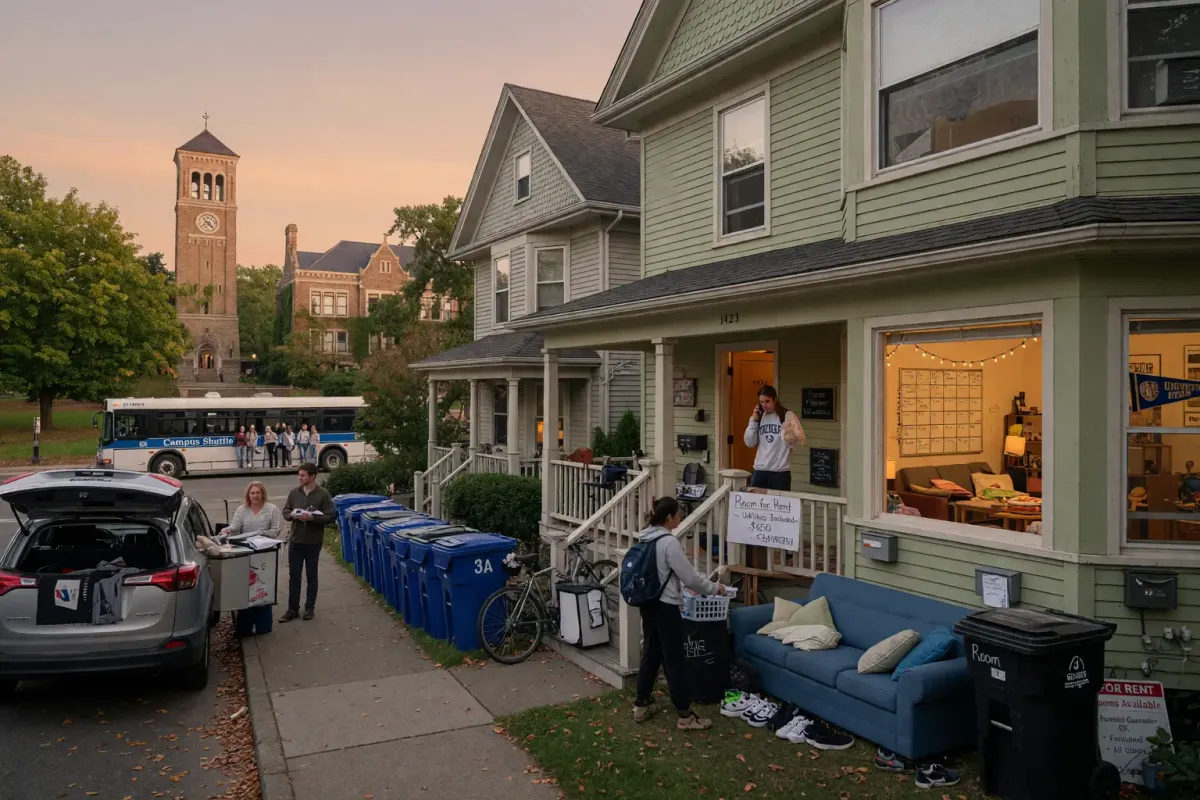
Student rental properties might sound scary. You’re probably thinking about wild parties, damaged walls, and couches left on the front lawn. But here’s the truth: student rentals can be one of the most profitable and lowest-risk investment strategies available—if you know what you’re doing.
Why Student Rentals Work Better Than You Think
The demand for student housing remains strong, though the market has evolved. During COVID, many landlords sold their student rental properties, creating a supply shortage that drove rental rates up about 40%. As of 2026, the federal cap on international study permits — reduced to roughly 437,000 in 2025 and held at similar levels for 2026 — has modestly eased demand pressure in some markets compared to the post-COVID peak. However, off-campus housing still only accommodates about 16% of total student enrollment, and rental vacancy rates remain under 1% in many Canadian university towns. CMHC’s MLI Select program now offers a dedicated student-housing scoring category (added in 2023) for purpose-built developments, opening up high-leverage financing for investors at the larger end of the spectrum.
What does this mean for you? The extreme supply shortage has modestly improved, but demand still comfortably exceeds supply near most major Canadian universities. Student rentals continue to outperform conventional rentals on a per-bedroom basis in nearly every university market.
If you’re struggling to make the numbers work on regular single-family rentals in Ontario, student rentals near a university or college might be your answer. The Cash Flow potential is significantly stronger than traditional rental strategies.
The Secret That Eliminates Most Risk
Here’s what changes everything: parental guarantors.
When you rent to students, you require their parents to co-sign the lease. This creates multiple layers of protection that you don’t get with any other rental strategy:
-
Parents are legally responsible for paying rent and any damages
-
Students don’t want their landlord calling mom and dad, so they behave
-
You have two parties responsible for the rent—the student and their parents
-
Any damage that does occur gets paid quickly with one phone call to the parents
Think about it from the student’s perspective. They’ve worked incredibly hard to get into university. No student is going to risk getting kicked out of their housing after all that effort. They’re not going to jeopardize their living situation.
One experienced investor who specializes in student rentals says she’s never had a party or significant damage on any of her properties. The parental guarantor system really works.
With rental rates up 40% and parental guarantors reducing your risk, student rentals deserve a serious look — book a free strategy call with LendCity and we’ll help you run the numbers.
Whether you’re buying your first rental or your tenth, having the right mortgage structure matters — book a free strategy call with LendCity to build a plan that scales with you.
When you’re ready to structure the mortgage side of this strategy, our multi-family mortgage financing guide covers the programs that typically fit.
The Only Real Downside
Is everything perfect? Not quite. Student rentals do have one legitimate downside: a bit more general wear and tear because there are more people living in the house.
But that’s it. That’s the main negative. And any actual damage gets covered by the students themselves or their parents.
Financing Student Rentals: What You Need to Know
The financing side has gotten trickier since COVID, but options definitely exist.
Before the pandemic, getting financing for student rentals was pretty straightforward. Then COVID hit, and lenders got scared. They didn’t just tighten up on student rentals—they eliminated most of their specialty programs across the board because they feared a major economic collapse.
Your Best Options Today
Here’s what works now:
For buying: It’s easier to purchase a regular property near a university and then convert it to a student rental than to buy an existing student rental. Many more lenders will work with you on this approach.
For refinancing: Only a few lenders will refinance existing student rentals, but they do exist. You need to work with a specialist who knows which ones and maintains those relationships. Our guides on PadSplit financing for room rental investors and PadSplit Investment: Room Rental for Cash Flow explain similar room-by-room rental models.
The parent-child strategy: If parents buy a property with their child, many major banks will treat it as owner-occupied financing (even though other students will rent the other rooms). This gets you better rates and terms. Plus, the child learns about property management and landlording.
If you’re buying near a university and planning to convert to a student rental, the right lender matters more than you think — book a free strategy call with us and we’ll match you with one who specializes in this.
Many investors leave money on the table by not exploring all their financing options — schedule a free strategy session with us and we’ll show you what’s available.
Making Your First Purchase Less Scary
First Investment Property: Why It’s the Hardest to Buy. Here’s why: if you have a vacancy in a single-family home versus a multifamily property, you must pay all the expenses yourself. That’s nerve-wracking.
But once you own multiple properties, they carry each other. Even if one sits vacant, you barely notice because the others cover it. The fear you feel before your first purchase? It goes away with experience.
Every skill feels overwhelming when you’re learning it. Real estate investing is no different. Nothing will surprise you after you’ve been doing it for a while.
Setting Yourself Up for Growth
Most mortgage brokers just approve your current transaction. They don’t think about how it affects your ability to buy property number two, three, or four.
This is a huge mistake.
The right approach involves strategic planning. Which lender you use for property one affects how many more properties you can buy. Some lenders allow more rental properties than others. Some have better debt ratio calculations for investors.
The Commercial Lending Path
Most investors have no idea that you can buy unlimited rental properties in Canada. This is the path that lets you scale indefinitely once you’ve maxed out traditional residential lending.
If another broker told you that you’ve hit a wall and can’t buy more properties, they probably just don’t know about commercial lending options. The right mortgage professional can show you how to keep growing your portfolio.
Beyond Student Rentals: Four-Season Cottage Strategy
Here’s an interesting twist on rental properties: four-season cottages.
The key is buying properties that offer activities year-round. In summer, guests want lake access, swimming, and boating. In winter, they want downhill skiing, snowmobiling, and ice fishing nearby.
Why now, during economic uncertainty? Because this is exactly why affordable rentals outperform in a recession. When people tighten their belts, they cut expensive international travel. But they still want vacations. A cottage rental becomes an affordable option, especially when two families split the cost.
Americans also love these properties because their strong dollar makes Canadian vacations cheap compared to domestic options.
The financing is easier too. Many more lenders work with four-season cottages compared to three-season properties.
Getting Started
If you’re interested in student rental investing or want to grow your existing portfolio, here’s what matters:
-
Work with a residential investment mortgages specialist who actually invests in real estate themselves
-
Make sure they understand how to structure deals for portfolio growth, not just single transactions
-
Analyze every rental property properly before buying — student rentals need the same due diligence as any other investment
-
Ask about commercial lending options if you’ve been told you’ve hit a financing wall
-
Don’t let fear of the first property stop you—it gets easier after that
The student rental market remains a compelling strategy in 2026. The federal international student cap has modestly eased the extreme tightness of 2022-2024, but supply still trails demand in almost every university town. Rents near universities remain substantially above comparable conventional rentals on a per-bedroom basis. If you’ve been looking for a cash-flowing strategy that works in today’s market, this remains one of the strongest options available.
Just remember: parental guarantors are what make the whole thing work. Don’t skip that step, and you’ll avoid most of the horror stories you’ve heard about student tenants.
Key Takeaways:
- Why Student Rentals Work Better Than You Think
- The Secret That Eliminates Most Risk
- The Only Real Downside
- Financing Student Rentals: What You Need to Know
- Making Your First Purchase Less Scary
Frequently Asked Questions
Are student rental properties actually profitable?
How do I protect myself from property damage with student tenants?
Can I get financing for a student rental property?
What's the biggest mistake new real estate investors make?
Do student tenants really have wild parties and trash properties?
What happens when I hit my financing limit for rental properties?
Is investing in cottage rentals a good idea during a recession?
Should I be scared to buy my first investment property?
Free download
MLI Select document checklist
Appraisals, rent rolls, environmental reports, and the CMHC package lenders expect before they underwrite.
By submitting, you agree to receive occasional emails from LendCity. You can unsubscribe at any time.
4.8/5 (116 Google reviews)
Disclaimer: LendCity Mortgages is a licensed mortgage brokerage. Content on this page is for educational purposes only and does not constitute legal, tax, investment, securities, or financial-planning advice. Rates, premiums, program terms, and regulations referenced are as of the page's last updated date and are subject to change. Any investment returns, rental yields, tax savings, or case-study figures shown are illustrative only — they are not guaranteed, not typical, and individual results will vary. Consult a licensed lawyer, Chartered Professional Accountant, or registered dealer before acting on any information above. Editorial standards.

Written by
Scott Dillingham
Published
December 22, 2025
· Updated June 29, 2026Reading time
9 min read
Cash Flow
The money left over after collecting rent and paying all expenses including mortgage, taxes, insurance, maintenance, and property management. Positive cash flow is the primary goal of buy-and-hold investors. See also [NOI](/glossary/noi/), [Cash-on-Cash Return](/glossary/cash-on-cash-return/), and [Vacancy Rate](/glossary/vacancy-rate/).
Refinance
Replacing an existing mortgage with a new one, typically to access equity, get a better rate, or change terms. Investors commonly refinance to pull out capital for purchasing additional properties (cash-out refinance) while retaining ownership of the original property.
Single Family
A detached home designed for one household, the most common property type for beginner real estate investors.
Property Management
The operation, control, and oversight of real estate by a third party. Property managers handle tenant screening, rent collection, maintenance, and day-to-day operations.
Vacancy Rate
The percentage of rental units that are unoccupied over a given period. A critical factor in [cash flow](/glossary/cash-flow/) analysis, typically estimated at 4-8% for conservative projections. Vacancy directly reduces [NOI](/glossary/noi/).
Mortgage Broker
A licensed professional who shops multiple lenders to find the best mortgage rates and terms for borrowers. Unlike banks, brokers have access to dozens of lending options.
Commercial Lending
Financing for commercial real estate or business purposes, typically qualified based on property income (NOI) rather than personal income. Includes mortgages for multifamily buildings (5+ units), retail, office, and industrial properties.
Multifamily
Properties with multiple dwelling units, from duplexes to large apartment buildings. Often offer better cash flow and economies of scale.
Due Diligence
The comprehensive investigation and analysis of a property before purchase, including financial review, physical inspection, title search, and market analysis.
Student Rental
A rental property near a college or university leased to students, typically on a per-room basis. Student rentals generate higher cash flow than traditional single-family rentals because rent is collected per bedroom rather than per unit, with risk mitigated through parental guarantors.
Cottage Rental
A vacation property investment in recreational or resort areas. Four-season cottages with year-round activities tend to outperform three-season properties and may be more resilient during economic downturns.
Room Rental
A strategy where individual rooms within a property are leased separately to different tenants rather than renting the entire unit. Room rentals generate higher per-property revenue but require more management and may have specific zoning and financing considerations.
Parental Guarantor
A parent who co-signs a lease on behalf of their child, becoming legally responsible for rent payments and property damage. Requiring parental guarantors is a key risk mitigation strategy in student rental investing.
Hover over terms to see definitions. View the full glossary for all terms.