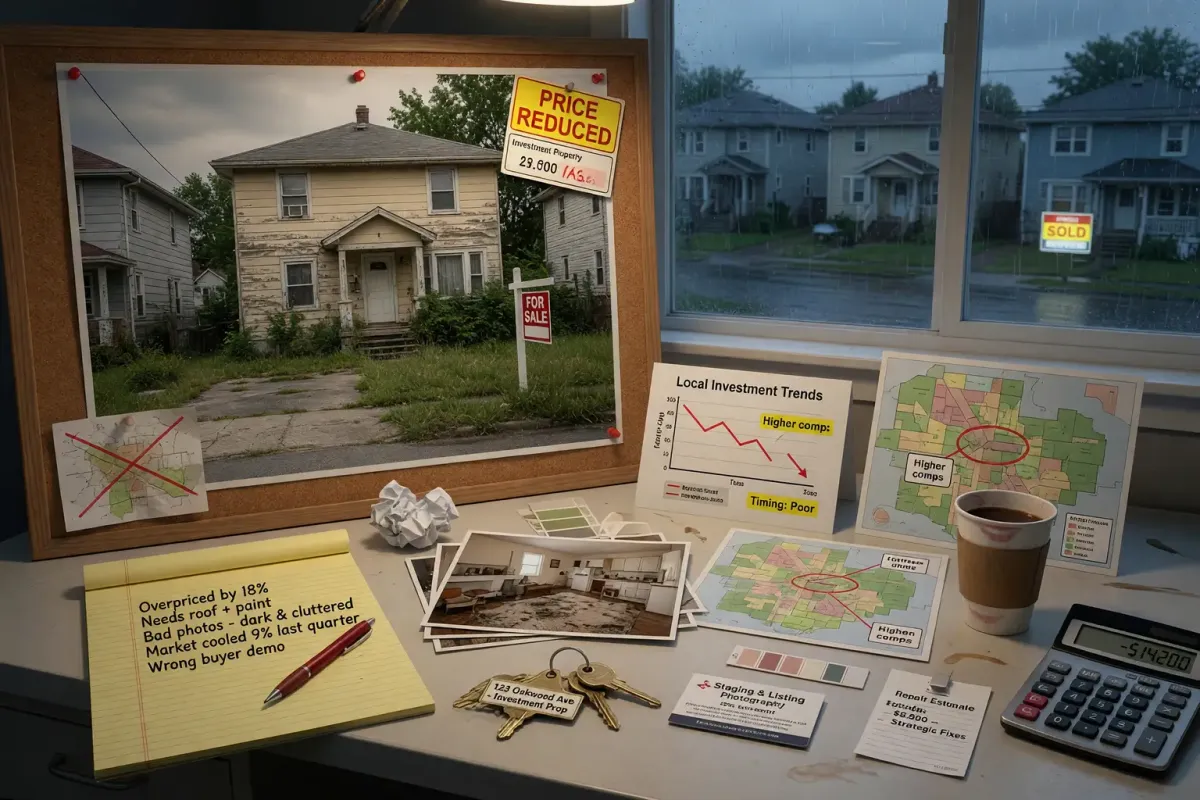
Imagine getting ready to sell one of your investment properties to cash in on appreciation, expecting offers to roll in—but receiving nothing. What happened? Why is selling proving so difficult?
Investors enter real estate because it’s always in demand. Regardless of market conditions, people always need places to live. Yet with such universal demand, sometimes properties sit on the market without offers. Here are five reasons that happens — and exactly what to do about each one.
This guide identifies five common reasons you may be having trouble selling and provides solutions for each.
Understanding Market Reality
Why properties sometimes don’t sell.
The Selling Challenge
Common difficulties:
Market Mismatch - Property characteristics don’t align with current buyer preferences.
Pricing Disconnection - Asking price exceeds what buyers will pay.
Presentation Issues - Property doesn’t show well or isn’t marketed effectively.
Timing Problems - Market conditions aren’t favorable for selling.
| Selling Problem | Impact |
|---|---|
| Overpricing | No showings or offers |
| Poor condition | Buyer rejection |
| Bad marketing | Low visibility |
| Slow market | Extended timeline |
Setting Expectations
Here’s the truth most sellers don’t want to hear: your property is worth exactly what a buyer will pay for it — not a dollar more. Some properties sell in days; others take months. Every listing competes against every other available option in your price range. The investors who sell fastest are the ones willing to adjust their approach when something isn’t working.
Problem 1: Listing Price Too High
Overpricing kills buyer interest.
The Overpricing Problem
Here’s what overpricing actually does to your listing. Buyers search by price range — if you’re priced too high, you don’t even show up in the right searches. The buyers who do find you are comparing your property against better-priced competition, and yours loses every time. Buyer agents often skip obviously overpriced listings entirely. And the longer your property sits, the more future buyers assume something is wrong with it. It becomes a self-reinforcing problem.
Price Reality Check
Evaluating your listing price:
Comparable Sales - What have similar properties actually sold for recently?
Active Competition - What are competing properties listed for?
Agent Feedback - What do showing agents report about price perception?
Interest Level - Are you getting showings? Offers? If not, price may be the problem.
Price Adjustment Strategy
How to correct overpricing:
Meaningful Reduction - Small reductions don’t change perception. Make significant adjustments.
Market Alignment - Price at or slightly below comparable sales to attract interest.
Fresh Start - Consider relisting after substantial price adjustment to reset market perception.
For a deeper look at the financing angle behind this topic, see our real estate investing guide.
Problem 2: Property Needs Work
Condition issues deter buyers.
Condition Impact
How property condition affects selling:
First Impression - Visible problems create negative first impressions.
Buyer Concerns - Obvious issues make buyers wonder what’s hidden.
Financing Barriers - Poor condition may prevent buyer financing approval.
Price Negotiation - Buyers discount offers for needed repairs.
Common Condition Issues
I’ve seen investors lose deals over things that cost a few hundred dollars to fix. Deferred maintenance — the dripping tap, the cracked drywall, the overgrown yard — tells buyers the whole property has been neglected. Dated finishes make buyers mentally add up renovation costs before they even make an offer. Cosmetic problems like scuffed paint and worn flooring are cheap to fix but expensive to ignore. And any hint of HVAC, plumbing, or electrical issues will send buyers running, or kill their financing approval entirely.
Condition Solutions
Addressing property problems:
Strategic Repairs - Fix issues providing best return for investment.
Pre-Listing Inspection - Identify and address problems before listing.
Cosmetic Refreshing - Paint, cleaning, and minor updates improve presentation.
Price Reflection - If repairs aren’t feasible, price must reflect condition.
Problem 3: Poor Listing Presentation
Marketing quality matters.
Listing Quality Impact
How presentation affects interest:
Online First Impression - Most buyers find properties online. Poor listings get skipped.
When tired finishes weaken listing photos and online appeal, well-run renovations often reverse that first impression. Investors who understand how to find, vet, and manage local contractors can complete those upgrades with quality results on time and on budget.
While strong online listings are essential for residential investment properties, agricultural assets involve distinct buyer considerations. Investors can learn farmland investing for portfolio diversification and inflation protection including agricultural markets and due diligence.
For a deeper look at the financing angle behind this topic, see our guide to Rental Property Vacancy Solutions: Addressing Properties Not Renting Fast Enough.
Photo Quality - Bad photos kill interest regardless of actual property quality.
Description Content - Weak descriptions fail to highlight property strengths.
Marketing Reach - Limited marketing means fewer potential buyers see the listing.
Common Presentation Problems
What weakens listings:
Amateur Photography - Dark, distorted, or unflattering photos.
Incomplete Information - Missing details buyers want to know.
Poor Descriptions - Generic or uninspiring property descriptions.
Limited Exposure - Insufficient marketing reach.
Presentation Improvement
Enhancing your listing:
Professional Photos - Invest in professional real estate photography.
Complete Information - Provide all relevant property details.
Compelling Description - Highlight unique features and investment potential.
Broad Marketing - Ensure listing appears on all major platforms.
Problem 4: Market Slowdown
External conditions affect timing.
Market Condition Reality
How markets affect selling:
Buyer’s Market - More inventory than buyers creates selling challenges.
Economic Factors - Interest rates, employment, and economic conditions affect buyer activity.
Seasonal Patterns - Some periods see less buying activity.
Local Factors - Area-specific conditions may affect your market.
Recognizing Market Conditions
Identifying market environment:
Days on Market - Are properties selling quickly or sitting?
Price Trends - Are prices rising, stable, or falling?
Inventory Levels - How many competing properties are available?
Buyer Activity - Are buyers actively purchasing?
Market Response Strategies
Adapting to conditions:
Patience - In slow markets, selling may simply take longer.
Price Adjustment - Slow markets may require more aggressive pricing.
Competitive Positioning - Stand out from competition through presentation or terms.
Timing Consideration - If possible, consider waiting for better market conditions.
Problem 5: Investment Property Considerations
Ready to explore your financing options? Book a free strategy call with LendCity and let our team help you find the right path forward.
Unique challenges selling investment properties.
Investment Property Differences
What distinguishes investment sales:
Buyer Pool - Investment properties sell primarily to investors, not owner-occupants.
Income Focus - Buyers evaluate based on income potential, not emotional appeal.
Due Diligence - Investment buyers conduct thorough financial analysis.
Mortgage Complications - Existing mortgages may have penalties or restrictions.
Investment-Specific Solutions
Addressing investment property challenges:
Income Documentation - Provide clear rental income and expense documentation.
Investment Marketing - Market to investment buyers specifically.
Financial Presentation - Present property as investment opportunity with returns analysis.
Mortgage Planning - Understand and plan for any mortgage-related complications.
Frequently Asked Questions
How long should I wait before reducing price?
um list-none"> How long should I wait before reducing price?Should I make repairs or sell as-is?
How do I know if my agent is the problem?
Can I sell a property with tenants in place?
What if I owe more than the property is worth?
How important is professional photography when selling an investment property?
Should I consider switching real estate agents if my property is not selling?
Free tool
Build a property proforma
Fill in income and expenses, then export a Year-1 operating statement (NOI, cap rate, cash flow, DSCR).
Disclaimer: LendCity Mortgages is a licensed mortgage brokerage. Content on this page is for educational purposes only and does not constitute legal, tax, investment, securities, or financial-planning advice. Rates, premiums, program terms, and regulations referenced are as of the page's last updated date and are subject to change. Any investment returns, rental yields, tax savings, or case-study figures shown are illustrative only — they are not guaranteed, not typical, and individual results will vary. Consult a licensed lawyer, Chartered Professional Accountant, or registered dealer before acting on any information above. Editorial standards.

Written by
Scott Dillingham
Published
June 21, 2026
· Updated June 29, 2026Reading time
6 min read
Appreciation
The increase in a property's value over time, which builds [equity](/glossary/equity/) and wealth for the owner through market growth or [forced improvements](/glossary/forced-appreciation/).
Buyer's Market
A buyer's market occurs when the supply of available properties exceeds buyer demand, giving purchasers more negotiating power. In a buyer's market, homes tend to sit on the market longer, prices may soften, and sellers are more likely to accept offers below asking price or agree to conditions such as financing and inspection clauses.
Days on Market
The number of days a property has been listed for sale or rent without being leased or sold, used as an indicator of market demand and pricing appropriateness. Properties with high days on market typically signal pricing issues or property deficiencies.
Deferred Maintenance
Necessary repairs and maintenance that have been postponed or neglected, creating a backlog of work that will eventually require attention. Properties with significant deferred maintenance can be value-add opportunities for investors willing to address accumulated issues.
Due Diligence
The comprehensive investigation and analysis of a property before purchase, including financial review, physical inspection, title search, and market analysis.
HVAC
Heating, Ventilation, and Air Conditioning systems that control temperature and air quality in buildings. HVAC is often one of the largest energy expenses in rental properties, and upgrading to high-efficiency systems can significantly reduce operating costs and increase NOI.
Interest Rate
The cost of borrowing money, expressed as a percentage. It determines how much you pay on top of the principal borrowed. Interest rates directly affect monthly payments, [cash flow](/glossary/cash-flow/), and [DSCR](/glossary/dscr/). See also [Amortization](/glossary/amortization/).
ITIN
Individual Taxpayer Identification Number - a US tax ID for foreign nationals, required for Canadians to invest in US real estate and file US taxes.
Plumbing
The system of pipes, drains, fixtures, and fittings in a building that distributes water and removes waste. Plumbing issues are among the most costly repairs in rental properties, and older galvanized or polybutylene pipes often need replacement during renovations.
Real Estate Agent
A licensed professional who represents buyers or sellers in real estate transactions, providing market expertise, negotiation skills, and access to the MLS. Working with an investor-friendly agent who understands rental property analysis and financing strategies can significantly impact deal quality.
Hover over terms to see definitions. View the full glossary for all terms.