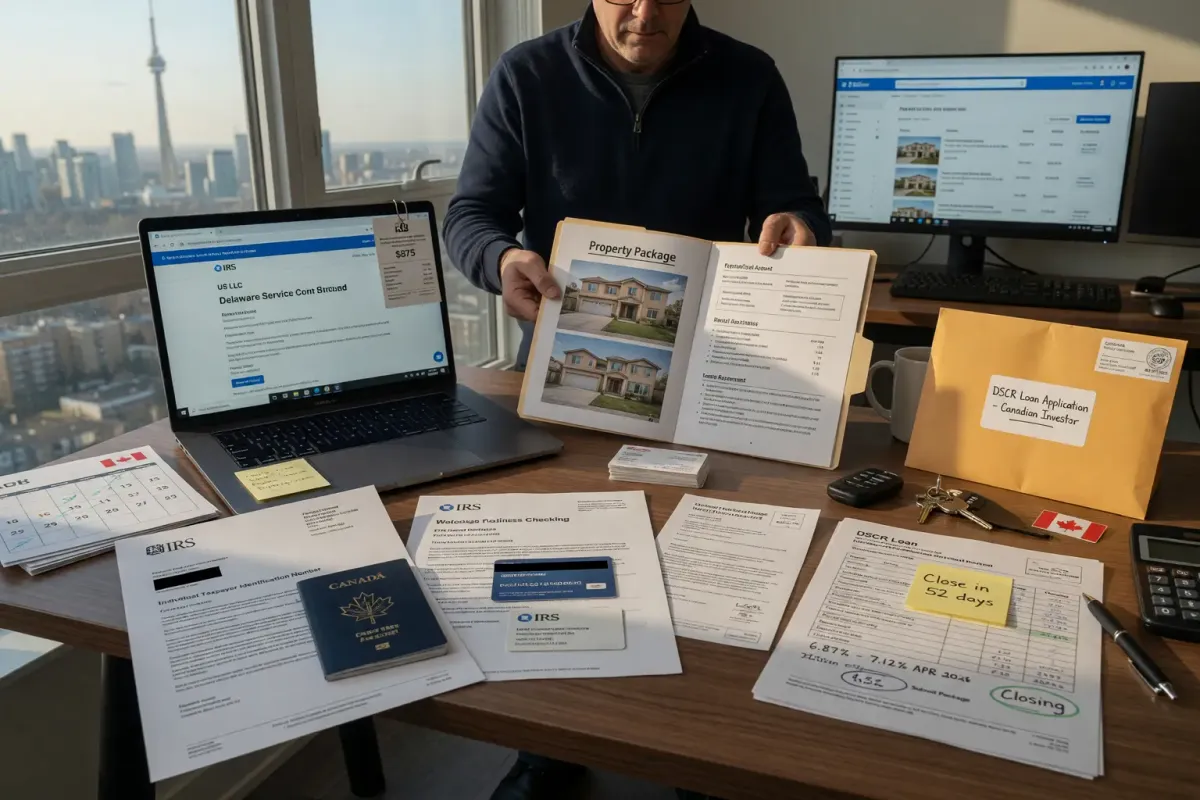
You have done the research, picked a US market, and found a property that pencils out. Now you need to actually get the financing in place. For most Canadians buying rental properties in the United States, a DSCR loan is the clearest path forward. No US credit history required. No US income verification. The property qualifies itself.
But the application process is not the same as walking into your local Canadian bank and signing papers. There are entity structures to set up, specific documents to prepare, and timelines to manage. Miss a step and you could delay your closing by weeks or lose the deal entirely.
This guide walks you through every stage of the DSCR loan application from start to finish so you know exactly what to expect.
What a DSCR Loan Is and Why It Works for Canadians
A DSCR loan (Debt Service Coverage Ratio loan) qualifies the property, not the borrower. Instead of analyzing your personal income, tax returns, or employment history, the lender looks at one thing: does the property’s rental income cover the mortgage payment?
The DSCR ratio is calculated by dividing the property’s gross rental income by the total mortgage payment (principal, interest, taxes, insurance, and any HOA fees). A ratio of 1.0 means the rent exactly covers the payment. Most lenders want to see a DSCR of 1.0 or higher, though some will approve deals down to 0.75-0.80 with compensating factors like a larger down payment.
This structure is ideal for Canadians because:
- No US credit score needed. You do not have one, and DSCR lenders do not require one for foreign nationals.
- No US income verification. Your Canadian employment or business income is irrelevant to the approval.
- No US tax returns required. The property’s income is what matters.
- Entity-based lending. You borrow through a US LLC, which also provides liability protection.
If you are new to investing across the border, our overview of mortgage financing for Canadians in the USA covers the broader landscape of available programs. For a look at how DSCR loans fit into a full cross-border strategy, read our guide on building a US real estate empire from Canada.
Step 1: Set Up Your US LLC and EIN
Before you do anything else, you need a US entity. Nearly every DSCR lender requires foreign nationals to hold property through a US Limited Liability Company (LLC).
Why You Need an LLC
The LLC serves two purposes. First, it provides a legal structure that DSCR lenders can underwrite. Second, it creates a layer of liability protection between the property and your personal assets. If a tenant sues, the LLC is the defendant, not you personally.
How to Form the LLC
You can form an LLC in any US state, but most Canadian investors choose the state where they are buying property or a business-friendly state like Wyoming or Florida. The process involves:
- Choose a registered agent. Since you do not live in the US, you need a registered agent with a physical address in the state. This costs roughly $100-$300 per year.
- File articles of organization. This is the formation document filed with the state. Filing fees vary from $50 to $500 depending on the state.
- Draft an operating agreement. This internal document outlines ownership and management. Even if you are the sole member, lenders want to see it.
- Apply for an EIN and ITIN. An Employer Identification Number is the LLC’s tax ID. You apply through the IRS. As a foreign national without an SSN, you will need to apply by mail or fax using Form SS-4, which typically takes 4-8 weeks. You’ll also typically need an ITIN (Individual Taxpayer Identification Number) — through a Certified Acceptance Agent the standard timeline is 2-3 weeks at $300-$500, while expedited services advertise turnaround in hours. Don’t forget to file a W-8BEN with your lender to manage US tax withholding on rental income.
Start the EIN/ITIN process early. That 4-8 week EIN timeline is the single biggest bottleneck for Canadian investors and has derailed more closing dates than any other factor.
Open a US Bank Account
With your LLC and EIN in hand, open a US business bank account. You will need this for rental income deposits, mortgage payments, and property expenses. Some banks require an in-person visit, but several now offer remote account opening for foreign nationals.
Cross-border investing adds layers of complexity to your financing — book a free strategy call with LendCity and we’ll walk you through the Canadian-friendly options.
Step 2: Select Your Target Property
DSCR lenders are not just qualifying you. They are qualifying the property. This means your property selection directly impacts whether you get approved and on what terms.
What Lenders Want to See
- Property type: Single-family homes, duplexes, triplexes, fourplexes, condos, and townhomes. Some lenders go up to 8 units.
- Property condition: The property must be habitable and in rentable condition. Major deferred maintenance can kill a deal.
- Minimum property value: Most DSCR lenders set a floor around $100,000-$150,000. Below that threshold, expect worse terms or outright rejection.
- Market rents that support the debt: The property needs to generate enough rental income for a DSCR of 1.0 or better. Run these numbers before you make an offer.
Run your numbers through our DSCR Loan Calculator to see if your property qualifies.
This is where working with a team that understands investment property lending locations becomes critical. The right advisor can help you identify markets where the numbers work.
For a deeper look at how rental income math affects your approval, check out our article on DSCR loans for foreign nationals.
Step 3: Choose Your DSCR Lender
Not all DSCR lenders work with Canadian borrowers. Some only serve US citizens. Others technically serve foreign national borrowers but have minimal experience with cross-border transactions. You want a lender who has closed multiple deals for Canadians and understands the nuances.
Key Factors to Compare
- Down payment requirements: Typically 25-30% for foreign nationals. Some lenders require 25% on the first deal and relax to 20-25% for subsequent purchases.
- Interest rates: Foreign-national DSCR rates run 6.87%-7.12% as of April 2026, with pricing typically 0.75%-2.0% above conventional US investment property mortgages.
- Minimum DSCR: Most lenders require 1.0, but some accept 0.75-0.80 with a larger down payment (no-ratio programs typically run 0.5%-1.0% higher in rate).
- Prepayment penalties: Common in DSCR loans. Typical structures are 3-2-1 (3% if you prepay in year one, 2% in year two, 1% in year three) or 5-4-3-2-1. Factor this into your hold strategy.
- Seasoning requirements for refinances: If you plan to use a BRRRR strategy, ask how long you must hold the property before refinancing. Six months is standard, but some lenders require twelve.
LendCity works with multiple DSCR lenders who actively serve Canadian investors. We can match you with the right program based on your specific deal. Learn more about DSCR loan financing for your US investment property.
DSCR loans and foreign national programs have specific requirements that most brokers miss — schedule a free strategy session with us to work with a team that specializes in cross-border deals.
Step 4: Prepare and Submit Your Application
Once you have your LLC set up and a property under contract, it is time to submit the actual loan application. Cross-reference your prep with the US-side document checklist so nothing slows underwriting down. Here is what you will need:
Required Documents
- Passport (valid Canadian passport)
- LLC documents (articles of organization, operating agreement, EIN confirmation letter)
- Purchase agreement (fully executed contract for the property)
- Bank statements (2-3 months showing sufficient funds for down payment, closing costs, and reserves)
- Proof of reserves (most lenders require 6-12 months of mortgage payments in liquid reserves post-closing)
- Rental income documentation (existing lease if the property is tenant-occupied, or a rent comparable analysis for vacant properties)
- Property insurance quote (from a US insurer, naming the LLC as the insured)
- US bank account information (for wire transfers and ongoing payment)
For a general overview of the application steps that apply to all DSCR borrowers, see our guide on how to apply for a DSCR loan.
Common Mistakes at This Stage
- Insufficient reserves. This catches many first-time cross-border investors. If the mortgage payment is $1,500 per month and the lender requires 6 months of reserves, you need $9,000 sitting in your account after closing.
- Documents not in English. If any bank statements or financial documents are in French, get them translated by a certified translator before submitting.
- LLC ownership mismatch. The LLC that holds the property must be the same entity on the loan application. If your spouse is on the LLC but not the loan, or vice versa, the lender will flag it.
Step 5: Appraisal and Rent Verification
After the lender accepts your application, they order a third-party appraisal. This serves two purposes: confirming the property value and verifying that market rents support the DSCR.
What the Appraiser Does
The appraiser visits the property, evaluates its condition, compares it to recent sales (the “comps”), and provides a market rent estimate based on comparable rentals in the area.
If the appraised value comes in lower than your purchase price, you have three options: renegotiate the price with the seller, bring additional cash to cover the gap, or walk away.
If the market rent estimate results in a DSCR below the lender’s minimum, the deal may not work. This is why running your own rent analysis before making an offer is so important.
Timeline
Appraisals in most US markets take 1-3 weeks from the time they are ordered. In busy markets or rural areas, it can take longer. Build this into your closing timeline.
Step 6: Underwriting Review
With the appraisal complete, the full file goes to underwriting. The underwriter reviews everything: your documents, the appraisal, the DSCR calculation, the LLC structure, and the title work.
What Underwriters Look For
- Clean title. No liens, encumbrances, or unresolved ownership issues.
- DSCR compliance. The final ratio based on the appraised rent and actual loan terms.
- Entity verification. The LLC is properly formed, the EIN is valid, and ownership matches.
- Insurance adequacy. The property insurance meets lender requirements for coverage amounts and named insured.
- Reserve verification. Your bank statements confirm sufficient post-closing liquidity.
Underwriting typically takes 1-2 weeks. The underwriter may issue conditions, which are additional documents or clarifications needed before approval. Respond to conditions quickly. Every day of delay pushes your closing date.
Understanding the full DSCR loan requirements before you apply helps you avoid surprises during underwriting.
Step 7: Closing
Once underwriting issues a “clear to close,” the closing process begins. As a Canadian investor, you will likely close remotely.
Remote Closing Process
- Title company sends closing documents. You will receive the loan documents, title documents, and closing disclosure electronically for review.
- Wire transfer. You send your down payment and closing costs to the title company’s escrow account. Double and triple check the wire instructions by phone. Wire fraud is a real and growing risk in US real estate transactions.
- Notarization. You sign the documents in front of a notary. As a Canadian, you can typically use a notary in Canada, but the documents may need to be notarized at the US Embassy or Consulate depending on the lender and state requirements. Confirm this early.
- Recording. The title company records the deed and mortgage with the county. The property is officially yours.
Closing Costs
Expect to pay 2-5% of the loan amount in closing costs, which include origination fees, appraisal fees, title insurance, attorney fees, recording fees, and prepaid expenses like insurance and property taxes. Budget for the higher end to avoid surprises.
Common Pitfalls to Avoid
Having helped hundreds of Canadian investors navigate cross-border deals, here are the mistakes we see most often:
- Starting the LLC and EIN process too late. Begin this the moment you decide to invest in the US. The EIN alone takes 4-8 weeks by mail.
- Underestimating reserves. Budget for down payment, closing costs, and 6-12 months of reserves. Many investors plan for the first two and forget the third.
- Choosing the wrong state for your LLC. Forming in Wyoming when you are buying in Ohio can create extra compliance requirements. Consult a cross-border accountant and review the US-side entity structure LLC guide before filing your articles.
- Ignoring the DSCR before making an offer. Run the numbers first. If the property does not hit a 1.0 DSCR at current rates, the deal will not get approved.
- Forgetting about US tax obligations. Owning US rental property triggers US tax filing requirements. Work with a cross-border tax professional from day one. Our investor resources hub includes tools and guides to help you plan ahead.
- Skipping property management. You are managing from another country. Professional property management is not optional. Budget 8-10% of gross rents.
- Converting currency at the bank for large wires. Retail FX spreads of roughly 2–3% on a six-figure purchase can cost thousands versus a foreign-exchange specialist. Hold USD in a USD account when you will redeploy into the next US deal.
- Underestimating dual-country tax filings. Plan for US Form 1040-NR (and state returns where applicable), Canadian reporting of worldwide income with foreign tax credits, T1135 when foreign property cost exceeds $100,000 CAD, and FIRPTA withholding on a future sale. Budget for a cross-border accountant early — not after your first filing season.
Key Takeaways:
- What a DSCR Loan Is and Why It Works for Canadians
- Step 1: Set Up Your US LLC and EIN
- Step 2: Select Your Target Property
- Step 3: Choose Your DSCR Lender
- Step 4: Prepare and Submit Your Application
Frequently Asked Questions
Do I need a US credit score to get a DSCR loan?
No. DSCR lenders who serve foreign nationals do not require a US credit score. The property’s rental income is what qualifies the loan, not your personal credit history. Some lenders may pull a Canadian credit report, but this is not standard across all programs.
How much do I need for a down payment?
Most DSCR lenders require 25-30% down for Canadian foreign national borrowers. The exact amount depends on the lender, property type, and your overall profile. Properties valued under $150,000 typically require 30% down, while loans above $200,000 may qualify for 25%.
How long does the entire process take from start to finish?
If your LLC and EIN are already set up, expect 30-45 days from application to closing. If you are starting from scratch with entity formation, add 4-8 weeks for the EIN process. Total timeline: 8-12 weeks for first-time cross-border investors.
Can I use a DSCR loan for a property that needs renovation?
Standard DSCR loans require the property to be in rentable condition at closing. If you want to buy a fixer-upper, you would need a bridge loan or hard money loan for the acquisition and renovation, then refinance into a DSCR loan once the property is stabilized and rented. This is the BRRRR strategy applied to US real estate investing.
What happens if rents drop and my DSCR falls below 1.0 after closing?
The DSCR is evaluated at the time of application and closing. Once the loan is in place, the lender does not re-check the ratio. As long as you make your mortgage payments, a temporary dip in rental income does not trigger a default. That said, maintaining adequate reserves protects you during vacancies.
Can I buy multiple properties with DSCR loans?
Yes. There is no limit on the number of DSCR loans you can have. Many Canadian investors build entire portfolios this way, adding one property at a time. Each property is underwritten independently. For scaling your residential portfolio with investment mortgages, DSCR loans offer repeatable, predictable financing.
Do I need to visit the US to close on the property?
Not necessarily. Most DSCR loan closings can be handled remotely with documents notarized in Canada. However, some lenders and states have specific requirements about where notarization takes place. Confirm with your lender and title company early in the process.
What are current DSCR loan interest rates?
As of April 2026, DSCR rates for Canadian foreign nationals run 6.87%-7.12%. Domestic US borrowers with strong profiles see DSCR rates of 6.5%-7.75% depending on credit, down payment, and DSCR ratio. DSCR pricing typically runs 0.75%-2.0% above conventional US investment property mortgages. Rates change regularly — confirm current pricing with your broker before running your numbers.
Your Next Step
You now have the complete roadmap for getting a DSCR loan as a Canadian investor. The process is straightforward when you know what to expect and prepare properly. The biggest time savings come from starting your LLC and EIN setup early and having your documents organized before you find a property.
If you want to skip the guesswork and work with a team that has guided hundreds of Canadians through this exact process, we are here for you. Our team understands cross-border mortgage financing inside and out and can connect you with the right DSCR lender for your situation.
Sources
Rates and program rules are subject to change. Verify current figures with primary sources:
- Bank of Canada — policy interest rate
- CMHC — multifamily and mortgage insurance programs
- OSFI — mortgage underwriting guidelines
Free download
MLI Select document checklist
Appraisals, rent rolls, environmental reports, and the CMHC package lenders expect before they underwrite.
By submitting, you agree to receive occasional emails from LendCity. You can unsubscribe at any time.
4.8/5 (116 Google reviews)
Disclaimer: LendCity Mortgages is a licensed mortgage brokerage. Content on this page is for educational purposes only and does not constitute legal, tax, investment, securities, or financial-planning advice. Rates, premiums, program terms, and regulations referenced are as of the page's last updated date and are subject to change. Any investment returns, rental yields, tax savings, or case-study figures shown are illustrative only — they are not guaranteed, not typical, and individual results will vary. Consult a licensed lawyer, Chartered Professional Accountant, or registered dealer before acting on any information above. Editorial standards.

Written by
Scott Dillingham
Published
February 15, 2026
· Updated August 18, 2026Reading time
12 min read
Down Payment
The upfront cash payment when purchasing a property. For 1-4 unit investment properties, minimum 20% down is required. 5+ unit multifamily can use CMHC MLI Select with lower down payments, and house hackers can put as little as 5% down on owner-occupied 2-4 plexes. Your down payment directly affects your [LTV](/glossary/ltv/) and the amount of [leverage](/glossary/leverage/) you use.
DSCR
Debt Service Coverage Ratio — a metric that compares a property's [net operating income](/glossary/noi/) to its mortgage payments. A DSCR of 1.25 means the property generates 25% more income than needed to cover the debt. Lenders typically require a minimum DSCR of 1.0 to 1.25 for investment property loans (including [DSCR loans](/glossary/dscr-loan/)). See also [Cap Rate](/glossary/cap-rate/) and [Cash Flow](/glossary/cash-flow/).
Coverage Ratio
A measure of a property's ability to cover its debt payments, typically referring to DSCR. Commercial lenders often require a minimum of 1.2, meaning the property's net operating income exceeds debt payments by at least 20%.
BRRRR
Buy, Rehab, Rent, Refinance, Repeat - a real estate investment strategy where you purchase a property below market value, renovate it to increase its [ARV](/glossary/after-repair-value-arv/), rent it out, [refinance](/glossary/refinancing/) to pull out your initial investment, and repeat the process with the recovered capital. Success depends on [forced appreciation](/glossary/forced-appreciation/) and strong [cash flow](/glossary/cash-flow/).
Single Family
A detached home designed for one household, the most common property type for beginner real estate investors.
Refinance
Replacing an existing mortgage with a new one, typically to access equity, get a better rate, or change terms. Investors commonly refinance to pull out capital for purchasing additional properties (cash-out refinance) while retaining ownership of the original property.
DSCR Loan
A loan qualified based on the property's [Debt Service Coverage Ratio](/glossary/dscr/) rather than the borrower's personal income, popular for US investment properties. The property's [NOI](/glossary/noi/) and [cash flow](/glossary/cash-flow/) determine qualification.
LLC
Limited Liability Company — a US business structure commonly used to hold US investment properties. Important caveat for Canadian residents: the CRA generally treats a US LLC as a corporation for Canadian tax purposes, which can create mismatched treatment with the IRS and double taxation; many cross-border advisors recommend a US LP (with an LLC as general partner) or direct ownership instead. Entity choice is a legal and tax decision — consult a cross-border attorney and a CPA experienced in Canada–US tax before forming one.
Closing Costs
Fees paid when completing a real estate transaction, including legal fees, land transfer tax, title insurance, appraisals, and adjustments. Closing costs affect your total cash invested and therefore your [cash-on-cash return](/glossary/cash-on-cash-return/).
Credit Score
A numerical rating (300-900 in Canada) that represents your creditworthiness, affecting mortgage rates and approval. 680+ is typically needed for best rates.
Interest Rate
The cost of borrowing money, expressed as a percentage. It determines how much you pay on top of the principal borrowed. Interest rates directly affect monthly payments, [cash flow](/glossary/cash-flow/), and [DSCR](/glossary/dscr/). See also [Amortization](/glossary/amortization/).
Principal
The original amount of money borrowed on a mortgage, not including interest. Each mortgage payment includes both principal (paying down what you owe) and interest (the cost of borrowing). Over time, more of each payment goes toward principal as the loan balance decreases.
Appraisal
A professional assessment of a property's market value, required by lenders to ensure the property is worth the loan amount.
Title Insurance
Insurance that protects against losses from defects in title to a property, such as liens, encumbrances, or ownership disputes.
Property Management
The operation, control, and oversight of real estate by a third party. Property managers handle tenant screening, rent collection, maintenance, and day-to-day operations.
Fixer-Upper
A property that needs repairs or renovations, typically priced below market value. Often targeted by investors using BRRRR or fix-and-flip strategies.
Underwriting
The process lenders use to evaluate the risk of a mortgage application, including reviewing credit, income, assets, and property value to determine loan approval.
Market Rent
The rental rate that a property could reasonably command in the current market based on comparable properties, location, and condition. Understanding market rent is essential to maximize income while maintaining competitive positioning and minimizing vacancy.
Rental Income
Revenue generated from tenants paying rent on an investment property. Gross rental income is the total collected before expenses, while net rental income subtracts operating costs to show actual profitability.
Deferred Maintenance
Necessary repairs and maintenance that have been postponed or neglected, creating a backlog of work that will eventually require attention. Properties with significant deferred maintenance can be value-add opportunities for investors willing to address accumulated issues.
Condo Fees
Monthly fees paid by condo owners to cover building maintenance, insurance, common area utilities, reserve fund contributions, and amenities. Also known as strata fees or maintenance fees, these directly reduce cash flow and are a critical consideration when analyzing condo investment opportunities.
Comparable Properties
Similar properties in the same market area used to establish fair market value or rental rates through comparison of features, location, condition, and recent sale or rental prices. Analyzing comps is essential when determining offer prices and setting competitive rents.
A Lender
A major bank or institutional lender offering the most competitive mortgage rates and terms but with the strictest qualification criteria, including full income verification and stress test compliance. Most investors use A lenders for their first four to six properties.
Hard Money Loan
A short-term loan from private lenders secured by the property itself rather than the borrower's creditworthiness. Hard money loans offer fast approvals and flexible terms but at higher interest rates, commonly used for fix-and-flip projects and bridge financing.
Cash Reserve
Liquid funds set aside by a property investor to cover unexpected expenses such as repairs, vacancy periods, or mortgage payments during tenant turnover. Lenders may require proof of cash reserves as part of mortgage qualification.
Hover over terms to see definitions. View the full glossary for all terms.