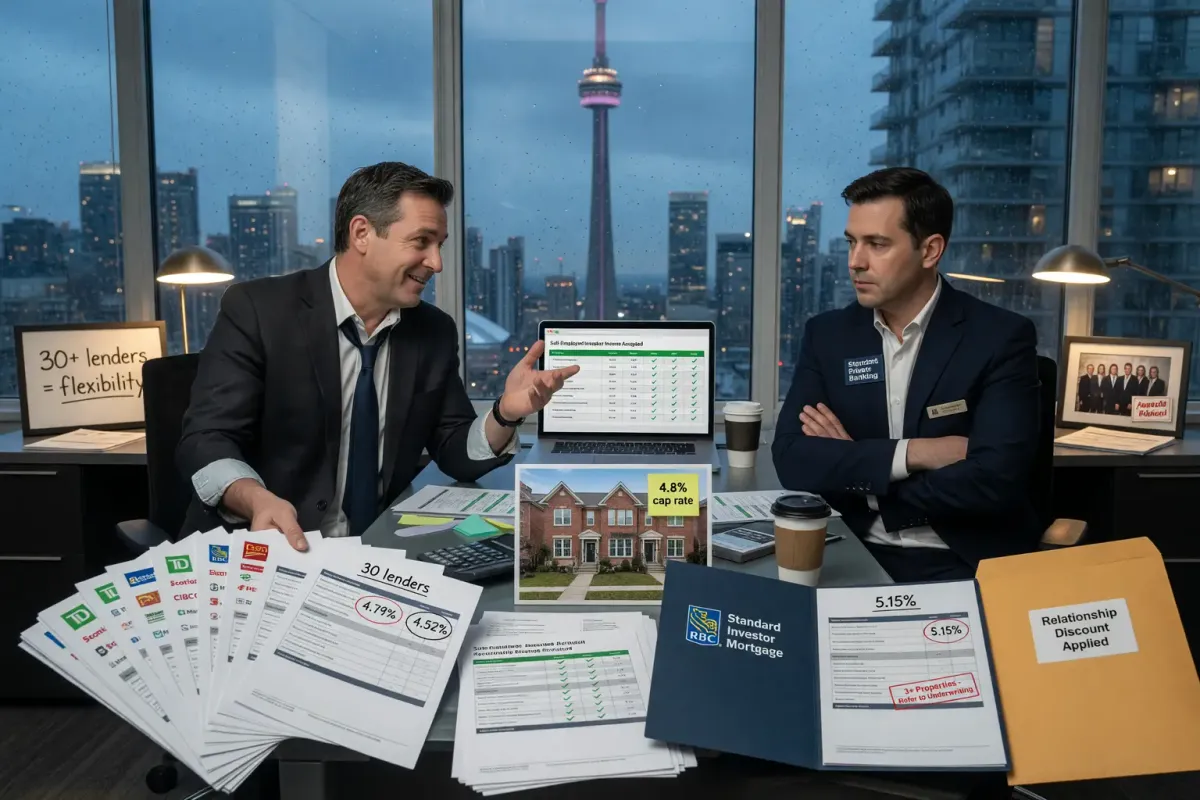
Quick Answer: For investment property financing, mortgage brokers typically deliver better outcomes than banks. Brokers access 30+ lenders (including monoline lenders and credit unions), often secure rates 0.1–0.3% lower, and handle complex qualification scenarios that banks decline. Banks offer convenience and relationship pricing but struggle with investors holding multiple properties.
When you’re buying an investment property in Canada, one of the first decisions you’ll face is whether to work with a mortgage broker or go directly to a bank. This choice can mean the difference between a competitive rate that makes your rental cash flow — and a rate that kills the deal.
Most first-time investors default to their personal bank. After all, they already have a chequing account, maybe a line of credit, and a relationship with their banker. But investment property financing is fundamentally different from getting a mortgage on your primary residence, and that relationship advantage disappears quickly when the bank’s underwriting guidelines don’t support your investment strategy.
This guide breaks down the real differences between brokers and banks for investment property financing — not just rates, but qualification flexibility, speed, portfolio scalability, and long-term strategy.
How Mortgage Brokers Work for Investment Properties
A mortgage broker is a licensed professional who acts as an intermediary between you and multiple lenders. In Canada, brokers are regulated provincially — in Ontario, for example, through the Financial Services Regulatory Authority of Ontario (FSRA) under the Mortgage Brokerages, Lenders and Administrators Act.
The broker advantage for investors
When you approach a broker with an investment property deal, here’s what happens:
- File assessment — The broker reviews your income, credit, existing properties, and the target property’s financials
- Lender matching — They shop your file across their network (typically 30–50 lenders) to find the best fit
- Rate negotiation — Brokers leverage volume relationships to negotiate rate buy-downs
- Submission and advocacy — They package your application and advocate with the underwriter
For investment properties specifically, brokers access lender categories that banks simply cannot match:
- Monoline lenders (MCAP, First National, RMG) — often have the lowest rates and more flexible rental income policies
- Credit unions — may count 100% of rental income vs. the 50-80% that major banks typically use
- B lenders (Equitable Bank, Home Trust) — serve investors who don’t meet A-lender stress test requirements
- Private lenders — bridge financing or short-term solutions while repositioning properties
What brokers cost
In most Canadian provinces, brokers are paid by the lender — not by you. The lender pays a finder’s fee (typically 0.5–1.1% of the mortgage amount) when your deal closes. For A-lender deals, there is usually no cost to the borrower.
For B-lender or private placements, you may pay a broker fee of 1–2% of the mortgage amount. This is standard and should be disclosed upfront in the broker’s commitment letter.
How Banks Handle Investment Property Mortgages
When you walk into a major Canadian bank (RBC, TD, BMO, Scotiabank, CIBC, or National Bank) for an investment property mortgage, you’re dealing with a single institution’s products. The mortgage specialist can only offer you what that bank has on its rate sheet.
The bank approach
Banks follow a more rigid process for investment properties:
- Product matching — The specialist checks if your situation fits their available products (usually 1–3 investment property options)
- Fixed underwriting guidelines — Banks apply standardized income qualification formulas with limited exceptions
- Internal approval — Your file goes through the bank’s underwriting team with set policies
- Relationship consideration — Existing banking relationships may provide modest rate discounts
Where banks fall short for investors
The biggest challenge with banks for investment property financing is scalability. Most major banks have internal policies that limit how many rental properties they’ll finance for a single borrower — typically 3–5 properties before the file gets escalated to a commercial lending team with different (usually worse) terms.
Banks also tend to be more conservative with rental income calculations. The Office of the Superintendent of Financial Institutions (OSFI) sets the stress test rules, but individual banks interpret rental income qualification differently. Many banks add a vacancy factor and only count 50% of gross rental income for qualification purposes.
Every borrower’s situation is different, and the wrong mortgage structure can cost you thousands — book a free strategy call with LendCity to make sure you’re set up properly.
For a deeper look at the financing angle behind this topic, see our U.S. mortgage financing guide for Canadians.
Rate Comparison: Broker vs Bank for Investment Properties
Rates are what most investors focus on first — and for good reason. On a $400,000 investment property mortgage, a 0.2% rate difference equals roughly $800/year or $4,000 over a five-year term.
Investment Property Rate Ranges (Canada)
| Channel | Typical Add-On vs Primary Residence | Notes |
|---|---|---|
| Broker (A-lender) | +0.10–0.20% | Lowest rates via monoline lenders |
| Major bank | +0.20–0.50% | Single-institution pricing |
| Broker (B-lender) | +1.00–2.00% | For non-standard qualification |
Investment property rates carry a premium over primary residence rates. Actual rates depend on credit score, down payment, property type, and current market conditions. Contact a broker for today’s numbers.
Why brokers typically beat bank rates
Three factors drive the broker rate advantage:
- Competition — When 30+ lenders compete for your file, rates compress. Banks compete only with themselves.
- Volume pricing — High-volume brokerages negotiate rate buy-downs that individual bank branches cannot access.
- Monoline access — Lenders like First National and MCAP often post the lowest rates because they have lower overhead than banks (no branches, no chequing accounts).
When banks win on rate
Banks occasionally match or beat broker rates in specific scenarios:
- Bundle discounts — If you hold significant assets with the bank (typically $500K+), you may receive portfolio pricing
- New-to-Canada programs — Some banks offer competitive investment property rates for newcomers as part of relationship-building
- HELOC combos — Banks can sometimes structure a mortgage + HELOC combination that brokers can’t replicate
Qualification Flexibility: The Real Differentiator
For many investors, the rate is secondary to whether they can actually qualify. This is where the broker-vs-bank gap becomes massive.
Income qualification differences
Banks typically follow rigid qualification formulas:
- Salary income: straightforward
- Self-employed income: require 2 years of tax returns showing sufficient declared income
- Rental income: count 50–80% of gross rents, minus a vacancy factor
- Multiple properties: may not count rental income from properties 3+ for qualification
Brokers access lenders with more flexible approaches:
- Stated income programs (B-lenders): declare reasonable income without full tax verification
- DSCR-based qualification: qualify based on the property’s rental income, not your personal income
- Rental income add-back: some monoline lenders count 80–100% of rental income
- Portfolio approach: specialized lenders who understand investors with 5, 10, or 20+ properties
The stress test factor
Since 2018, OSFI’s B-20 guidelines require all federally regulated lenders to stress test borrowers at the contract rate + 2% or 5.25%, whichever is higher. As of November 2024, OSFI removed the stress test for same-lender renewal switches — but it still applies to new mortgages and switches to a new lender.
Banks must follow this to the letter. However, brokers can place files with provincially regulated credit unions or alternative lenders that may apply the stress test differently or have different qualification thresholds.
Mortgage rules change frequently, so what worked last year might not apply today — schedule a free strategy session with us to get current, personalized guidance.
Portfolio Scalability: Building Beyond Your First Rental
If you’re planning to build a portfolio of investment properties — not just buy one rental — the broker-vs-bank decision becomes even more clear-cut.
For a closer look at the same decision, How to Choose the Right Mortgage for Your Investment breaks down how LendCity approaches it.
Related reading: Optimize Your Credit Score for Investment Mortgages covers the practical angles we see on similar files.
The bank ceiling
Most banks hit a wall at 3–5 financed investment properties. After that, you’ll encounter:
- Enhanced documentation requirements — tax returns, rental statements, property appraisals for every existing property
- Reduced rental income weighting — banks may count even less rental income as your portfolio grows
- Commercial lending redirect — the bank pushes you to their commercial team, where rates are 1–2% higher and terms are less favorable
- Total debt service ratio (TDSR) constraints — banks’ rigid TDSR calculations often cap investors earlier than necessary
The broker pathway
Brokers help investors scale through several strategies:
- Lender diversification — spreading properties across multiple lenders to avoid single-lender concentration limits
- Alternative qualification — using B-lenders or DSCR programs for properties 4+ while keeping A-lender rates on your first properties
- Refinancing optimization — timing refinances to pull equity and redeploy into new acquisitions
- Joint venture structures — connecting investors with JV-friendly lenders who understand partnership agreements
Speed and Service: Processing Investment Property Applications
Investment property purchases often move faster than primary residence deals. You might be competing with other investors, or the deal has a short conditional period. Processing speed matters.
Bank timelines
Major banks typically require:
- Pre-approval: 1–3 business days
- Full approval: 5–10 business days (can be longer for investment properties)
- Appraisal: bank orders through their approved vendor (3–7 days)
- Conditions fulfillment: varies, but banks are known for requesting additional documentation mid-process
Broker timelines
Brokers can often move faster because they:
- Pre-qualify instantly — experienced brokers know which lenders will approve your file before submitting
- Submit to the right lender first — instead of trying one bank and getting declined, then starting over
- Manage the appraisal process — brokers coordinate with lender-approved appraisers and follow up proactively
- Advocate for urgency — brokers have direct relationships with underwriters and can escalate time-sensitive files
When to Use a Bank for Your Investment Property
Despite the broker advantages, there are legitimate scenarios where going directly to a bank makes sense:
- You want a HELOC on an investment property — Some banks offer investment property HELOCs that monoline lenders don’t provide
- You need a construction mortgage — Banks with builder programs may offer better terms for renovation or construction projects
- You have significant deposits with the bank — If you hold $1M+ in deposits or investments, the bank may offer institutional pricing
- Simple first investment property — If you have strong income, excellent credit, and 20%+ down payment, the bank experience is straightforward
- You want everything in one place — Some investors prefer the simplicity of one institution managing their chequing, savings, and mortgages
When to Use a Mortgage Broker for Your Investment Property
Brokers are typically the better choice when:
- You’re buying your 2nd+ investment property — lender diversification becomes important
- You’re self-employed — stated income and alternative documentation programs are broker-exclusive
- You want the lowest rate — competition among 30+ lenders drives better pricing
- The property needs creative financing — mixed-use, multi-unit, or properties requiring renovation financing
- You’re scaling a portfolio — brokers understand the long-term strategy and can plan 3–5 acquisitions ahead
- You have credit challenges — brokers access B-lenders and private lenders that banks don’t offer
- You’re investing cross-border — DSCR loans and foreign national programs are broker-channel products
How to Choose the Right Mortgage Broker for Investment Properties
Not all brokers are equal when it comes to investment property expertise. Here’s what to look for:
Questions to ask a potential broker
- How many investment property mortgages did you close last year? (Look for 50+ per year)
- Which lenders do you work with for investors? (They should name specific monoline and B-lender options)
- How do you handle properties 5+? (They should have a scalability strategy)
- Can you do DSCR or stated income? (Essential for serious investors)
- What’s your typical turnaround time? (Competitive brokers close in 10–15 business days)
Red flags to watch for
- Broker only works with 3–5 lenders (too limited)
- No experience with investment properties specifically
- Cannot explain the stress test and how it applies to your situation
- Pushes a single lender for every deal
- No clear plan for helping you scale beyond one property
The Bottom Line: Broker vs Bank for Investment Property
Decision Framework
| Factor | Broker Wins | Bank Wins |
|---|---|---|
| Rates | Almost always | Bundle/relationship pricing |
| Qualification | Complex income, multiple properties | Simple employment, strong credit |
| Speed | For investment properties | For existing bank clients |
| Scalability | Clear advantage for 2+ properties | Limited to 3-5 properties |
| Product variety | 30+ lender options | 1-3 internal products |
| Cost | Usually free (A-lender) | Free |
| HELOC access | Limited | Better for investment HELOCs |
For the vast majority of Canadian real estate investors, a mortgage broker who specializes in investment properties is the better choice. The rate savings, qualification flexibility, and portfolio scalability advantages compound over time. An investor with five properties, each saving 0.2% through broker-sourced rates, saves $4,000–$8,000 annually — money that can be reinvested into the next acquisition.
The exception is if you’re buying your first rental property with a simple employment income, excellent credit, and a strong relationship with your bank. Even then, it’s worth getting a broker quote for comparison — there’s no cost, and the rate difference might surprise you.
At LendCity, our brokerage works with investors across Canada to structure investment property financing that supports long-term portfolio growth. Whether you’re buying your first rental or your fifteenth, having access to 30+ lenders means we find the right financing for each deal — not just the financing that one bank happens to offer.
Frequently Asked Questions
Is it better to use a mortgage broker or bank for an investment property?
For most Canadian investors, a mortgage broker offers significant advantages including access to 30+ lenders, typically lower rates (0.1–0.3% savings), and more flexible qualification for rental income. Banks are suitable for simple first-time investment purchases with strong employment income.
Do mortgage brokers charge fees for investment property mortgages?
For A-lender placements, mortgage brokers are paid by the lender — there is no cost to the borrower. For B-lender or private mortgage placements, brokers may charge a fee of 1–2% of the mortgage amount, which is disclosed upfront.
Can banks finance multiple investment properties?
Most major Canadian banks limit individual borrowers to 3–5 financed investment properties before redirecting to their commercial lending division, which typically offers higher rates and shorter terms. Mortgage brokers can diversify across multiple lenders to avoid these limits.
What credit score do I need for an investment property mortgage?
Through a broker with A-lender access, you typically need a 680+ credit score. B-lenders may approve with scores as low as 550–620. Banks generally require 680+ with stricter guidelines for investment properties.
How much down payment do I need for a Canadian investment property?
Investment properties in Canada require a minimum 20% down payment as mandated by CMHC guidelines — mortgage insurance is not available for investment properties. Some lenders require 25% for multi-unit investment properties.
Do brokers or banks offer better rates for rental properties?
Mortgage brokers typically secure rates 0.1–0.3% lower than major bank posted rates for investment properties, primarily because they access monoline lenders and negotiate volume-based pricing. This translates to approximately $800–$2,400 in annual savings per $400,000 mortgage.
How long does it take to get approved for an investment property mortgage?
Through a mortgage broker, expect 5–10 business days for full approval on an investment property. Banks may take 7–14 business days, especially if the application triggers additional review for investors with multiple properties.
Free download
MLI Select document checklist
Appraisals, rent rolls, environmental reports, and the CMHC package lenders expect before they underwrite.
By submitting, you agree to receive occasional emails from LendCity. You can unsubscribe at any time.
4.8/5 (116 Google reviews)
Disclaimer: LendCity Mortgages is a licensed mortgage brokerage. Content on this page is for educational purposes only and does not constitute legal, tax, investment, securities, or financial-planning advice. Rates, premiums, program terms, and regulations referenced are as of the page's last updated date and are subject to change. Any investment returns, rental yields, tax savings, or case-study figures shown are illustrative only — they are not guaranteed, not typical, and individual results will vary. Consult a licensed lawyer, Chartered Professional Accountant, or registered dealer before acting on any information above. Editorial standards.

Written by
Scott Dillingham
Published
March 9, 2026
· Updated June 29, 2026Reading time
11 min read
Mortgage Broker
A licensed professional who shops multiple lenders to find the best mortgage rates and terms for borrowers. Unlike banks, brokers have access to dozens of lending options.
B Lender
Alternative lenders that serve borrowers who don't qualify with major banks, offering slightly higher rates with more flexible criteria.
A Lender
A major bank or institutional lender offering the most competitive mortgage rates and terms but with the strictest qualification criteria, including full income verification and stress test compliance. Most investors use A lenders for their first four to six properties.
Monoline Lender
A financial institution that exclusively originates mortgage loans without offering other banking products. Monoline lenders often provide competitive rates and more flexible investor policies than big banks, accessed through mortgage brokers.
Pre-Approval
A conditional commitment from a lender stating your borrowing capacity, valid for 90-120 days. For investors, getting pre-approved helps you move quickly on deals and shows sellers you're a serious buyer with financing in place.
Private Mortgage
A mortgage from a private lender rather than a traditional bank, typically with higher rates but more flexible qualification requirements.
Hover over terms to see definitions. View the full glossary for all terms.