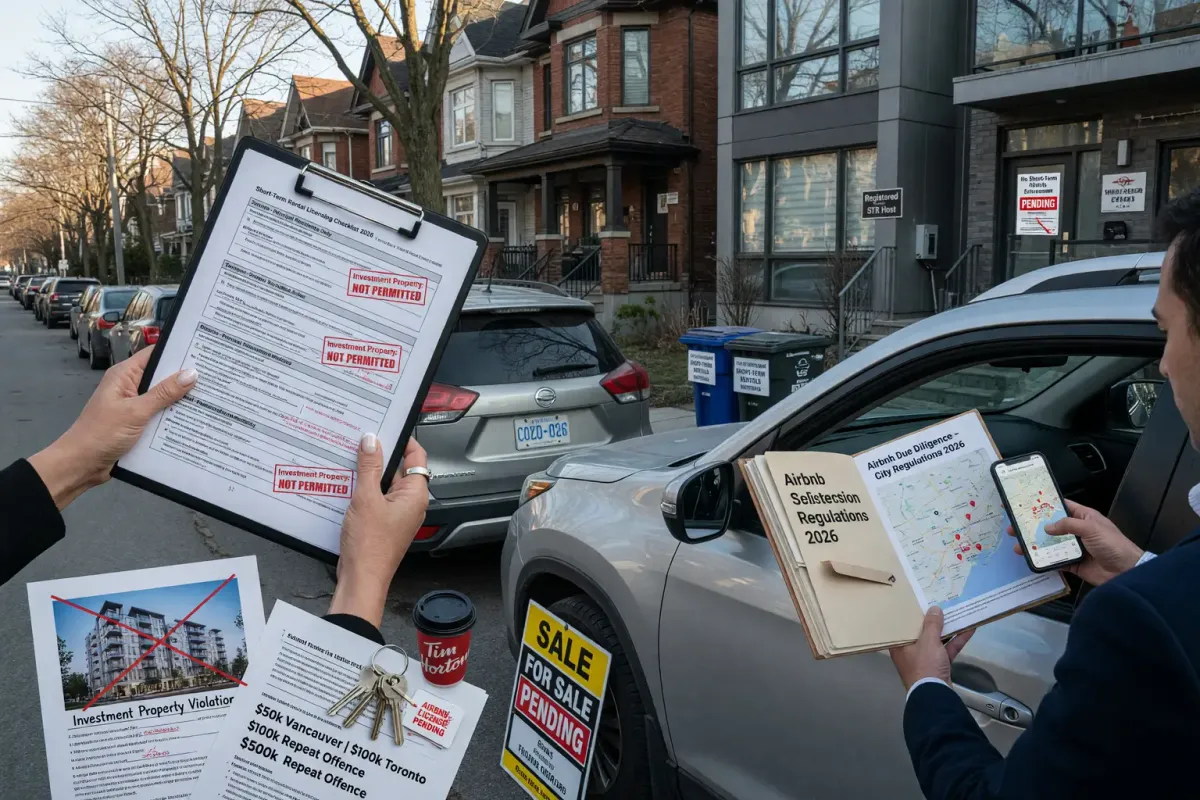
Here’s the thing nobody tells you before you buy that investment property and list it on Airbnb: the rules are completely different depending on which city you’re in. And I don’t mean slightly different. I mean “perfectly legal in one city, $10,000 fine in the next city over” different.
I’ve watched investors buy properties specifically for short-term rentals without checking the local bylaws first. That’s an expensive mistake. Some found out their city requires the STR to be their principal residence—meaning their investment property can’t be listed at all. Others discovered licensing requirements that take months to process.
So let’s walk through the major Canadian markets and what the rules actually look like. I’ll give you the practical stuff: what you can and can’t do, what it costs, and what happens if you break the rules.
Important note: Municipal regulations change frequently. This is current as of July 2026, but always verify with your local municipality before making investment decisions.
Jump to a city: Toronto · Vancouver · Ottawa · Montreal · Niagara Region
Planning to finance an STR property? Read what lenders want to see on short-term rental files before you apply.
Toronto
Toronto cracked down hard on short-term rentals starting in 2020, and enforcement has only gotten tighter.
The big rule: You can only operate a short-term rental in your principal residence. That means the home where you live, sleep, and get your mail. Investment properties cannot be listed for stays under 28 days. Period.
What counts: You can rent out your entire home while you’re away (up to 180 nights per year), or you can rent out individual rooms in your home year-round.
Registration: You must register with the City of Toronto and obtain an STR operator registration number. This number must appear on every listing. The registration fee is approximately $390 per year as of 2026 (subject to annual increases; was lower in prior years). The city also launched an API in late 2025 that platforms like Airbnb must use to verify registration numbers, further tightening enforcement against non-compliant listings.
Platform accountability: Airbnb, Vrbo, and other platforms are required to collect and remit the Municipal Accommodation Tax (MAT) on all Toronto bookings. The MAT rate was temporarily increased to 8.5% from June 1, 2025 through July 31, 2026 to help fund the 2026 World Cup (the standard rate is 6%). Platforms must also ensure listings include a valid registration number.
Fines: Operating without registration or operating from a non-principal residence can result in fines of up to $10,000 per offence for individuals and $50,000 for corporations. The city has a dedicated enforcement team that actively investigates complaints and monitors listings. Airbnb automatically blocks listings that aren’t registered with the city.
What this means for investors: Toronto is essentially off-limits for traditional STR investment properties. If you own an investment condo or house in Toronto, you cannot legally Airbnb it for stays under 28 days. Your options are long-term rental, mid-term rental (28+ days), or living in the property and renting rooms.
Vancouver
Vancouver was one of the first Canadian cities to regulate STRs, and their rules are similar to Toronto’s.
Principal residence requirement: Yes. You can only offer short-term rentals in your principal residence—the home where you live and sleep at least 180 days per year.
License required: You need a business licence from the City of Vancouver. The annual fee is approximately $100. Your licence number must appear on all listings.
Nightly limits: You can rent your entire principal residence for up to 180 nights per year when you’re away. You can rent rooms within your principal residence year-round.
Provincial requirement: British Columbia requires all STR operators, platforms, and strata hotel platforms to be registered on the provincial STR registry, which launched May 1, 2025. All listings must display a valid provincial registration number. Platforms stopped advertising unregistered listings starting June 2, 2025, and cancelled all future bookings for those listings as of June 23, 2025. Annual registration fees are $100/year for operators who live in the STR, or $450/year for non-owner-occupied STRs (such as secondary suites or cottages). This is separate from the municipal business licence, which remains required.
Strata restrictions: Even if the city allows it, your strata (condo) corporation may have bylaws prohibiting short-term rentals. Many Vancouver stratas have passed rental restriction bylaws. Check your strata rules before assuming you can list.
Fines: The province can impose fines up to $50,000 for non-compliance with the Short-Term Rentals Accommodation Act. Municipalities can issue tickets of up to $3,000 per infraction per day. The city cross-references Airbnb listings with property records and BC Assessment data to identify non-compliant operators.
What this means for investors: Same story as Toronto. Investment properties in Vancouver are not eligible for short-term rentals. If you want to do STR in the Vancouver market, you either need to live there or look at municipalities just outside Vancouver’s jurisdiction—but many of those (like Burnaby and Richmond) have adopted similar rules.
Ottawa
Ottawa’s approach is slightly more flexible than Toronto or Vancouver, but there are still meaningful restrictions.
Principal residence requirement: Yes, but with a twist. Ottawa requires that the STR be your principal residence, but the definition allows you to rent the entire home for up to 180 days per year. You can rent rooms within your principal residence without a day limit.
Licensing: You need a short-term rental permit. The cost is around $100-$200 per year depending on the type of permit.
Rural vs urban: Ottawa is a massive municipality that includes a lot of rural land. The rules apply throughout the city boundaries, but enforcement intensity is naturally focused on urban areas.
Condo rules: Ottawa condos may have their own restrictions through their declaration or rules. The Condominium Act allows condo boards to pass rules restricting STRs even if the city permits them.
Fines: Up to $100,000 for individuals and $500,000 for corporations for bylaw violations under the Ontario Municipal Act provisions.
What this means for investors: Like Toronto, investment properties in Ottawa cannot legally be used as short-term rentals. The principal residence requirement blocks non-owner-occupied STRs. However, Ottawa’s strong government and tech workforce makes it excellent for mid-term rentals (30+ days) which are not subject to STR regulations.
Montreal
Quebec does things differently. The province regulates STRs through the Quebec Tourism Act rather than leaving it entirely to municipalities.
Provincial classification: In Quebec, short-term accommodations (31 days or less) are considered tourist accommodation and require a classification certificate from the Corporation de l’industrie touristique du Quebec (CITQ). This applies province-wide.
Montreal-specific rules: Montreal also has its own municipal bylaw. As of recent amendments, operators must hold a valid CITQ classification number and register with the city. The property must be the operator’s principal residence for whole-unit rentals.
Zones: Montreal has designated certain zones where STRs are permitted and others where they are restricted. Check the borough-specific rules, as regulations vary between boroughs like Le Plateau, Ville-Marie, and Rosemont.
Quebec tax obligations: Operators must collect and remit the 3.5% lodging tax plus applicable QST (Quebec Sales Tax). Airbnb collects these automatically for bookings made through their platform.
Fines: Operating without a CITQ classification can result in fines of $2,500 to $25,000 for a first offence and $5,000 to $50,000 for repeat offences.
What this means for investors: The dual provincial and municipal requirements make Montreal one of the more complex markets for STR investors. You need both CITQ classification and municipal compliance. Investment properties face significant barriers, and the principal residence requirement in Montreal proper limits your options.
Niagara Region
This is where things get more interesting for investors. The Niagara Region includes several municipalities with different approaches to STRs, and some are much more investor-friendly.
Niagara Falls: Requires an STR licence. No principal residence requirement for many property types, making it one of the more accessible Ontario markets for STR investment. Licence fees are approximately $250-$500 per year. Properties must meet fire and safety standards.
Niagara-on-the-Lake: This is one of Ontario’s premier tourist destinations, and the town has licensing requirements for STRs. Due to high demand from wine country tourism and the Shaw Festival, nightly rates are strong. Licensing involves an application process, inspections, and annual renewal. Check current rules as the town periodically adjusts its regulations.
St. Catharines: The city has implemented STR licensing. Rules are somewhat more permissive than Toronto, but regulations have been tightening. Check current bylaws for the latest requirements.
Fort Erie: Has STR licensing requirements. As a border town with summer beach tourism, there’s seasonal demand.
What this means for investors: The Niagara Region is one of the best areas in Ontario for STR investing because several municipalities allow non-owner-occupied STRs with proper licensing. Strong tourism demand from Niagara Falls, wine country, and summer recreation supports solid nightly rates. Just make sure you get the right licence for your specific municipality.
Canmore, Alberta
Canmore is a unique market—a small mountain town next to Banff National Park with massive tourism demand and very specific STR rules.
Tourist home designation: Canmore uses a land-use designation system. Properties can only operate as short-term rentals if they’re in a zone that permits “tourist homes.” This typically includes properties in specific resort-zoned areas and some commercially zoned properties.
Not permitted in most residential zones: If you buy a regular residential property in Canmore, you likely cannot operate it as an STR. The town has been enforcing this increasingly strictly.
Business licence: Required for all STR operations. Annual fees vary based on property type.
Visitor accommodation bylaws: The town has detailed bylaws about parking, noise, garbage, and maximum occupancy for tourist homes.
Fines: Enforcement is active, and fines can be significant. The town monitors listing platforms.
What this means for investors: Canmore offers outstanding STR revenue potential—nightly rates of $300-$500+ for nice properties near town are common during peak season. But you must buy in the right zone. Properties in tourist-home-permitted zones command a significant premium because of this restriction. A $600,000 condo in a tourist-home zone might generate double the income of the same unit in a residential-only zone—which is why it also costs more to buy. Do your due diligence on zoning before purchasing.
Other Markets Worth Knowing
Halifax: Has implemented STR registration requirements. Principal residence rules apply to some categories. Check HRM’s current bylaws.
Kelowna: Has STR licensing. The city permits STRs in principal residences and in some commercially zoned properties. Investment property STRs are more restricted in residential zones.
Whistler: Requires a business licence for STRs. Whistler has specific zoning that permits nightly rentals in certain areas (typically resort-zoned properties) and restricts them in residential areas. Similar to Canmore—location within the municipality matters enormously.
Prince Edward County, Ontario: A popular wine and tourism destination with STR licensing requirements. Regulations have evolved as the area has grown in popularity.
Muskoka region: Various townships have different approaches. Some require licensing, others are less regulated. The cottage country dynamic creates unique STR opportunities but verify rules for the specific township.
When you’re ready to structure the mortgage side of this strategy, our PadSplit mortgage financing guide covers the programs that typically fit.
How to Check Before You Buy
Before you put an offer on any property you plan to use as an STR, do these five things:
-
Call the municipal planning department. Ask specifically whether your intended property can be used as a short-term rental. Ask about zoning, licensing, and principal residence requirements.
-
Check the provincial requirements. In Quebec, you need CITQ classification. In BC, you need provincial registration. Ontario municipalities handle it locally, but provincial legislation enables enforcement powers.
-
Read the condo documents. If it’s a condo, review the declaration, bylaws, and rules for any rental restrictions. Many condo boards have banned or restricted STRs even where the city allows them.
-
Search for recent bylaw changes. Google “[city name] short-term rental bylaw 2026” and look for recent council decisions. Many cities are actively updating their rules.
-
Talk to a local real estate agent who works with investors. They’ll know the practical enforcement reality, not just the legal text. Some cities have rules on the books that aren’t heavily enforced. Others enforce aggressively.
The Regulation Trend
I want to be straight with you about where this is heading. The trend across Canada is toward more regulation, not less. Cities that currently have loose rules are likely to tighten them over the next few years as housing affordability concerns drive political action.
That doesn’t mean STR investing is dead. It means:
- Buy in markets where STRs are explicitly permitted and licensed. If the city has a licensing framework, they’ve decided to allow STRs—they just want them regulated. That’s much safer than operating in a grey area.
- Properties in tourist-zoned areas are the safest bet. These are designated for visitor accommodation and are least likely to face future restrictions.
- Have a backup plan. Any property you buy for STR should also work as a mid-term or long-term rental. If regulations change, you need to pivot without losing money.
The investors who get burned are the ones who pay a premium for a property that only works as an Airbnb, and then the rules change. Don’t be that investor.
Frequently Asked Questions
Ready to explore your financing options? Book a free strategy call with LendCity and let our team help you find the right path forward.
Can I Airbnb my investment property in Toronto?
What is the principal residence requirement for short-term rentals?
What happens if I operate an illegal short-term rental in Canada?
Which Canadian cities allow short-term rental investment properties?
Do I need to collect taxes on short-term rental income in Canada?
Can my condo board prevent me from doing short-term rentals even if the city allows it?
How long does it take to get an STR licence in Canada?
Are mid-term rentals (30+ days) subject to the same STR regulations?
Free tool
Build a property proforma
Fill in income and expenses, then export a Year-1 operating statement (NOI, cap rate, cash flow, DSCR).
Disclaimer: LendCity Mortgages is a licensed mortgage brokerage. Content on this page is for educational purposes only and does not constitute legal, tax, investment, securities, or financial-planning advice. Rates, premiums, program terms, and regulations referenced are as of the page's last updated date and are subject to change. Any investment returns, rental yields, tax savings, or case-study figures shown are illustrative only — they are not guaranteed, not typical, and individual results will vary. Consult a licensed lawyer, Chartered Professional Accountant, or registered dealer before acting on any information above. Editorial standards.

Written by
Scott Dillingham
Published
March 20, 2026
· Updated August 18, 2026Reading time
12 min read
Airbnb
An online marketplace connecting property owners with short-term guests. In real estate investing, Airbnb is commonly used as shorthand for the short-term rental business model, which involves higher operational demands but potentially higher returns than long-term rentals.
Condominium
A type of property ownership where an individual owns a specific unit within a larger building or complex, sharing ownership of common areas with other unit owners. Condos offer lower entry prices but come with monthly fees and potential rental restrictions that affect investment returns.
Due Diligence
The comprehensive investigation and analysis of a property before purchase, including financial review, physical inspection, title search, and market analysis.
ITIN
Individual Taxpayer Identification Number - a US tax ID for foreign nationals, required for Canadians to invest in US real estate and file US taxes.
Mid-Term Rental
A furnished rental leased for 30 days to 6 months, targeting travel nurses, corporate relocations, and remote workers. Mid-term rentals generate higher revenue than long-term leases with fewer regulatory hurdles than short-term rentals.
NOI
Net Operating Income - the total income a property generates minus all operating expenses, but before mortgage payments and income taxes. Calculated as gross rental income minus [vacancies](/glossary/vacancy-rate/), property taxes, insurance, maintenance, and property management fees. NOI is used to calculate both [Cap Rate](/glossary/cap-rate/) and [DSCR](/glossary/dscr/).
Principal Residence Exemption
A Canadian tax provision that can eliminate capital gains tax on the sale of a property designated as the owner's principal residence for each year of ownership. The rules are strict: only one property per family unit can be designated as principal residence for any given year (since 2016), sales must be reported to the CRA, and designation involves a formula that may not fully shelter gains if the property was also rented. Changes in use (e.g., renting out a former principal residence) can trigger a deemed disposition. Consult a Chartered Professional Accountant before making designation decisions.
Principal
The original amount of money borrowed on a mortgage, not including interest. Each mortgage payment includes both principal (paying down what you owe) and interest (the cost of borrowing). Over time, more of each payment goes toward principal as the loan balance decreases.
Real Estate Agent
A licensed professional who represents buyers or sellers in real estate transactions, providing market expertise, negotiation skills, and access to the MLS. Working with an investor-friendly agent who understands rental property analysis and financing strategies can significantly impact deal quality.
Rental Income
Revenue generated from tenants paying rent on an investment property. Gross rental income is the total collected before expenses, while net rental income subtracts operating costs to show actual profitability.
Hover over terms to see definitions. View the full glossary for all terms.