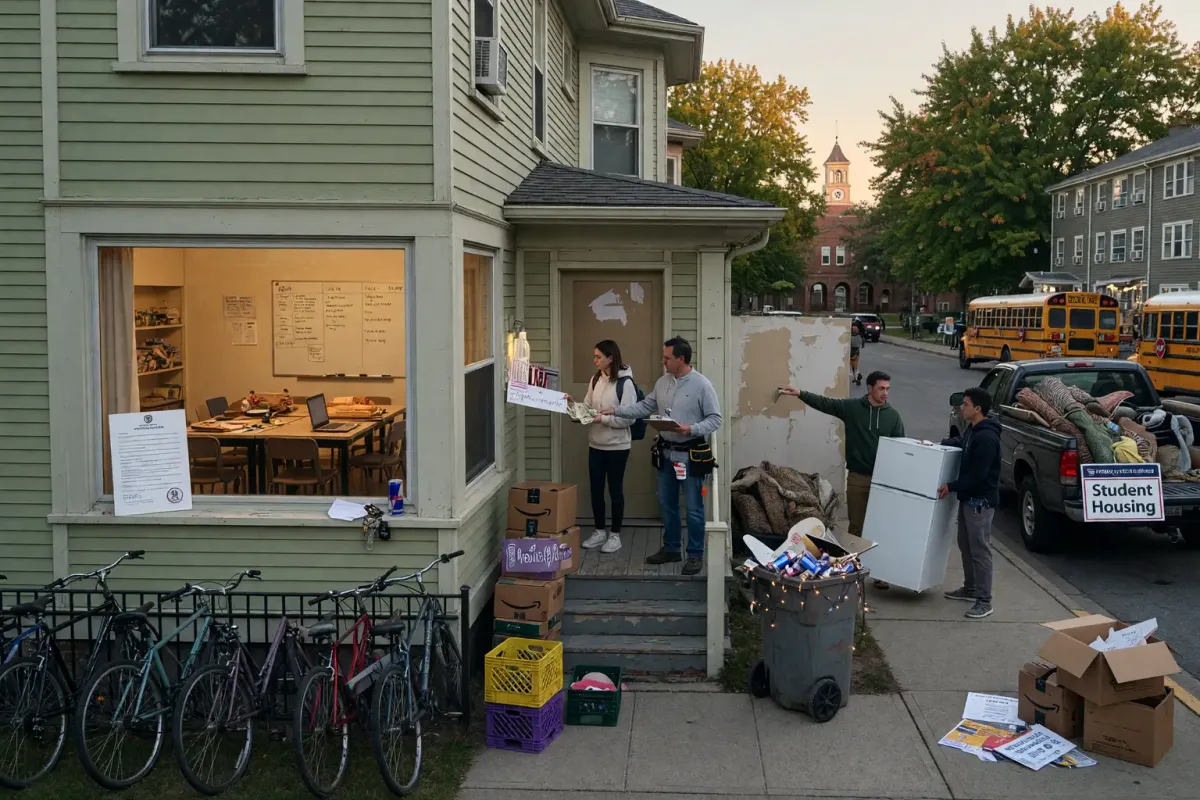
Student housing represents a specialized rental niche with characteristics that differ significantly from conventional residential rentals. Properties near universities and colleges attract student tenants with unique needs, expectations, and behaviors. Understanding both the opportunities and challenges of student rentals helps investors decide whether this niche fits their investment strategy and management capacity.
Understanding the Student Rental Market
Student housing operates on different rhythms and with different dynamics than traditional rental markets.
The Student Tenant Profile
Students differ from typical tenants in several important ways. They’re generally younger, with limited rental history and often no credit history. Their income may come from parents, student loans, part-time work, or combinations thereof.
Students also have predictable housing cycles tied to academic calendars. They typically need housing during school years but may not require it during summer months. This seasonality creates both challenges and opportunities.
Market Characteristics
Student rental markets exist wherever educational institutions draw students from beyond commuting distance. The strength of the market depends on student enrollment numbers, on-campus housing availability, and off-campus housing supply.
Strong student markets feature high demand, predictable tenant turnover cycles, and often higher per-bedroom rental rates than conventional housing would achieve. As of 2026, vacancy rates in most Canadian university towns remain under 1% — well below the national average of 3.1% — even after the federal cap on international study permits was held at roughly 437,000 for 2025-2026. CMHC’s MLI Select program added a dedicated student-housing scoring category in 2023 for purpose-built operators, which has unlocked higher-leverage financing on the larger end of this asset class.
| Student Housing Factor | Impact on Investors | Management Implication |
|---|---|---|
| Seasonal demand | Predictable vacancy windows | Align lease terms to academic calendar |
| Room rentals | Higher per-unit income | More lease management complexity |
| Younger tenants | Limited history to evaluate | Require guarantors |
| Group living | Shared responsibility issues | Clear individual accountability |
Advantages of Student Rentals
Student housing offers several compelling benefits for investors.
Higher Cash Flow Potential
Students typically rent by the room rather than by the unit, enabling higher total rental income from properties. A four-bedroom house might rent to a single family for $2,000 monthly, while the same house rented to four students at $650 per room generates $2,600.
This per-room premium often produces substantially better cash flow than conventional rentals, particularly in properties that can accommodate multiple tenants.
Vacancy Security Through Room Rentals
When renting individual rooms, vacancy in one room doesn’t eliminate all income. If one of four tenants leaves unexpectedly, three-quarters of rental income continues while you find a replacement.
Conventional rentals with single tenants face all-or-nothing vacancy exposure. Student rentals’ distributed risk provides meaningful protection.
Lower Finish Expectations
Students generally prioritize location, functionality, and price over premium finishes. They’re typically not seeking granite countertops, high-end appliances, or luxury fixtures.
This reduced finish expectation means lower renovation costs when preparing properties for student use. Investors can focus on durability and functionality rather than expensive aesthetic improvements.
Predictable Rental Cycles
Student housing operates on predictable annual cycles. Most students seek housing for the following academic year during specific windows—typically early in the spring semester. Lease terms align with academic calendars, usually running from May to April.
This predictability enables systematic marketing and tenant selection processes. Rather than unpredictable turnover throughout the year, you know exactly when leases renew and when marketing must occur.
Rent Security
Despite perceptions of student unreliability, non-payment is relatively uncommon in student housing. Students have strong incentives to maintain their housing—disruption affects their education. Many have parents or other guarantors backing their obligations.
Payment sources—whether parental support, student loans, or employment—are typically arranged before students commit to housing. These planned funding sources provide reliability.
Guarantor Availability
Student tenants’ parents commonly serve as lease guarantors. These guarantors typically have established credit, stable income, and strong motivation to ensure their children’s housing obligations are met.
Guarantor backing provides additional security that standard rentals to young tenants might not offer.
Disadvantages of Student Rentals
Student housing also presents significant challenges.
Higher Wear and Tear
Students living in group housing situations often generate more wear and tear than traditional tenants. Multiple occupants mean more use. Younger tenants may be less experienced with property care. Social activities can stress properties.
Budget for higher maintenance and turnover costs compared to conventional rentals.
More Intensive Management
Managing properties with multiple individual tenants requires more administrative effort than single-tenant properties. Multiple leases, multiple rent payments, and individual tenant issues all multiply management demands.
Each room represents its own tenancy with its own potential problems. Properties that might be straightforward as single-family rentals become more complex as multi-tenant student housing.
For a deeper look at the financing angle behind this topic, see our guide to Invest in Real Estate Canada.
Seasonal Vacancy Risk
While lease predictability has advantages, it also creates risks. Properties that don’t lease during the brief marketing window may sit vacant for the entire academic year.
Additionally, summer months may see reduced occupancy if students leave for the season. Managing summer vacancy—whether through twelve-month leases or reduced expectations—requires strategic planning.
Reputation and Neighbor Relations
Student housing can create neighborhood friction. Noise, parking, parties, and lifestyle differences between students and established residents sometimes generate complaints.
These issues can affect your reputation, relationships with neighbors, and potentially your ability to operate in certain areas. Some neighborhoods actively resist student housing expansion.
Limited Tenant History
Evaluating student tenants is challenging because they lack the rental and credit history that typical screening relies upon. You’re essentially betting on young people without track records.
Guarantor requirements and other safeguards partially address this challenge but don’t eliminate it.
Property Selection for Student Housing
Not every property suits student use.
Location Requirements
Proximity to campus matters enormously. Students seek housing within easy reach of classes, libraries, and campus activities. Properties beyond reasonable distance—whether walking, biking, or transit—struggle to attract quality tenants.
Research typical student housing patterns in target markets. Understand which neighborhoods students favor and why.
Bedroom Configuration
More bedrooms generally mean more rental potential. Properties that can accommodate four, five, or more students generate proportionally more income.
However, common areas must remain adequate for the occupancy level. Cramming bedrooms into every available space without appropriate living, kitchen, and bathroom capacity creates unlivable situations.
Durability Requirements
Student housing requires durable finishes and fixtures. Expect heavy use and select materials accordingly.
Flooring should withstand high traffic. Appliances should be reliable workhorses rather than temperamental high-end units. Finishes should be easy to repair or repaint between tenants.
Parking Considerations
Student parking needs vary by location and campus characteristics. Some student markets require substantial off-street parking; others feature minimal car ownership.
Understand local patterns and ensure properties provide appropriate parking for expected occupancy.
Management Strategies
Effective student housing management requires specialized approaches.
Individual Leases
Consider whether to use individual leases for each room or joint leases with all tenants collectively responsible. Individual leases provide flexibility but create more administration. Joint leases create collective accountability but complicate situations when some tenants leave.
Many student landlords use individual leases with shared responsibility for common areas and utilities.
Guarantor Requirements
Require guarantors for all student tenants without established credit or rental history. Guarantor backing provides security that student qualifications alone cannot.
Verify guarantor capacity just as you would verify tenant qualifications.
Communication Systems
Establish clear communication channels and expectations. Students accustomed to texting may expect instant responses. Set appropriate boundaries while remaining accessible for legitimate issues.
Maintenance Responsiveness
Student tenants may lack experience identifying or reporting maintenance needs. Some issues go unreported until they become serious. Regular inspections and proactive communication help identify problems early.
Lease Timing
Align lease terms with academic calendars. Most markets favor May-to-April twelve-month leases that match academic year timing.
Market properties during the window when students are actively seeking housing—typically January through March for the following academic year.
Frequently Asked Questions
Ready to explore your financing options? Book a free strategy call with LendCity and let our team help you find the right path forward.
Are student rentals more profitable than conventional rentals?
How do I handle tenants who don't get along?
Should I allow parties?
How do I market to students?
What about summer vacancy?
Why should I require guarantors for student tenants?
What durable materials work best for student rental properties?
Conclusion
Student rental properties offer higher income potential and predictable cycles but require more intensive management and tolerance for higher wear and tear. The niche suits investors who can handle the specialized demands and appreciate the unique benefits.
Success in student housing requires understanding student tenant characteristics, selecting appropriate properties, and setting up management systems suited to the niche. Generic approaches that work for conventional rentals may not translate effectively.
For investors willing to master the specialization, student housing can be highly profitable. For those preferring simpler management, conventional rentals may better match their preferences despite potentially lower returns.
Free download
MLI Select document checklist
Appraisals, rent rolls, environmental reports, and the CMHC package lenders expect before they underwrite.
By submitting, you agree to receive occasional emails from LendCity. You can unsubscribe at any time.
4.8/5 (116 Google reviews)
Disclaimer: LendCity Mortgages is a licensed mortgage brokerage. Content on this page is for educational purposes only and does not constitute legal, tax, investment, securities, or financial-planning advice. Rates, premiums, program terms, and regulations referenced are as of the page's last updated date and are subject to change. Any investment returns, rental yields, tax savings, or case-study figures shown are illustrative only — they are not guaranteed, not typical, and individual results will vary. Consult a licensed lawyer, Chartered Professional Accountant, or registered dealer before acting on any information above. Editorial standards.

Written by
Scott Dillingham
Published
March 20, 2026
· Updated June 29, 2026Reading time
7 min read
Cash Flow Optimization
Cash flow optimization is the strategic process of maximizing the net income generated from a rental property by increasing rental revenue and minimizing operating expenses, mortgage costs, and vacancies. For Canadian real estate investors, this often involves tactics such as selecting the right financing structure, leveraging rental income from multiple units, and managing expenses like property taxes and maintenance to ensure the property generates consistent positive monthly returns.
Cash Flow
The money left over after collecting rent and paying all expenses including mortgage, taxes, insurance, maintenance, and property management. Positive cash flow is the primary goal of buy-and-hold investors. See also [NOI](/glossary/noi/), [Cash-on-Cash Return](/glossary/cash-on-cash-return/), and [Vacancy Rate](/glossary/vacancy-rate/).
Common Area Maintenance
Expenses for maintaining shared spaces in commercial properties, including lobbies, parking lots, landscaping, and hallways. CAM charges are typically passed through to tenants as part of net lease structures.
NOI
Net Operating Income - the total income a property generates minus all operating expenses, but before mortgage payments and income taxes. Calculated as gross rental income minus [vacancies](/glossary/vacancy-rate/), property taxes, insurance, maintenance, and property management fees. NOI is used to calculate both [Cap Rate](/glossary/cap-rate/) and [DSCR](/glossary/dscr/).
Porting
Transferring your existing mortgage to a new property without penalty, keeping your current rate and terms. Useful when moving before your term ends.
Rental Income
Revenue generated from tenants paying rent on an investment property. Gross rental income is the total collected before expenses, while net rental income subtracts operating costs to show actual profitability.
Room Rental
A strategy where individual rooms within a property are leased separately to different tenants rather than renting the entire unit. Room rentals generate higher per-property revenue but require more management and may have specific zoning and financing considerations.
Single Family
A detached home designed for one household, the most common property type for beginner real estate investors.
STR
Short-Term Rental - a furnished property rented for periods of less than 30 days, typically through platforms like Airbnb or VRBO. STRs can generate 2-3x the income of long-term rentals but require more active management, higher operating costs, and compliance with local short-term rental regulations.
Student Rental
A rental property near a college or university leased to students, typically on a per-room basis. Student rentals generate higher cash flow than traditional single-family rentals because rent is collected per bedroom rather than per unit, with risk mitigated through parental guarantors.
Hover over terms to see definitions. View the full glossary for all terms.