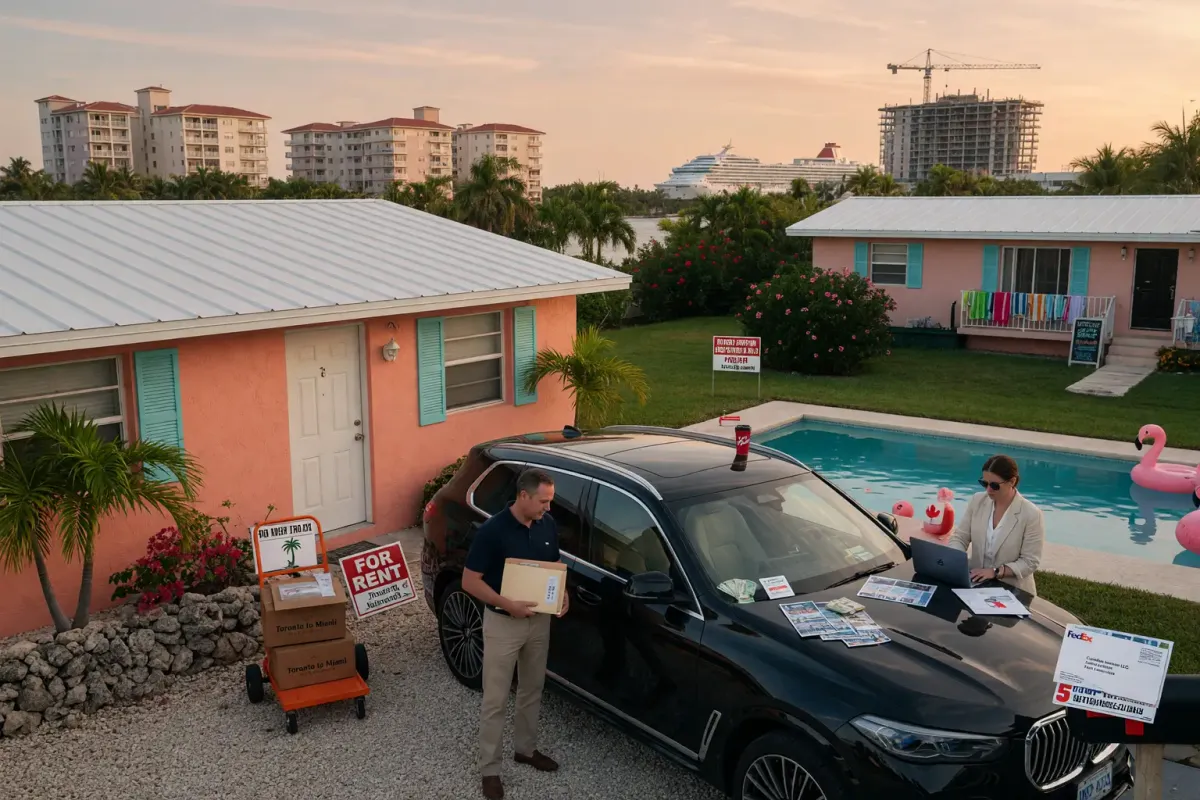
More and more Canadian investors are buying rental properties in South Florida. And it’s not hard to see why.
Ryan Poole, a realtor with over 25 years of experience in the West Palm Beach area, explains what makes Florida real estate so attractive compared to Canadian markets. If you’re exploring this path, our US cross-border investing hub covers everything from financing to entity setup.
The core appeal is simple: while Canadian markets have squeezed cash flow through rent control, high valuations, and landlord-unfriendly regulations, Florida offers the opposite. No rent control. Fast evictions. Strong population growth. And for Canadian investors, a currency arbitrage opportunity that makes every dollar work harder.
The Numbers That Matter
Florida rental properties are generating returns that Canadian investors can only dream about. Ryan shared three real examples:
A four-unit property in Lake Worth Beach purchased for $830,000 brings in $105,000 in annual rent. That’s an 11% cash-on-cash return.
A condo in downtown West Palm Beach bought for $450,000 generates an 8% cash-on-cash return through 30-day rentals. Add in the potential 5% annual Appreciation, and you’re looking at a 13% total return.
A single-family home in Northwood purchased for $395,000 produces an 11.67% cash-on-cash return as a short-term rental.
Search US mortgage records to research property financing details and ownership history in South Florida before making an offer.
These figures are based on properties available at the time of writing. Individual results vary.
A 2025-2026 reality check: South Florida saw notable price corrections in 2025 after the 2021-2024 boom, and the Florida insurance crisis has pushed homeowner premiums up significantly — eating into cash flow on coastal properties in particular. The average Miami metro home is around $590K (April 2026), and HOA dues on condos in older buildings have spiked because of post-Surfside structural reserve requirements. The big picture is still favorable (no state income tax, strong population growth, no rent control), but underwrite insurance and HOA costs carefully and don’t assume 2022-style appreciation continues.
This content is for informational purposes only and does not constitute financial, investment, or legal advice. Past performance does not guarantee future results. Always consult qualified professionals before making investment decisions.
No Rent Control Changes Everything
Here’s the biggest difference between Canadian and Florida rentals: rent control.
In Canada, you’re usually stuck with 3% annual rent increases. That’s it. Even when your property taxes jump or your insurance doubles, you can’t adjust.
Florida has no rent control. When a lease expires, you can raise rent to match current market rates. If market rent increases 10%, you can increase your rent 10%. This flexibility keeps your investment profitable even as expenses rise.
An 11% cash-on-cash return in Lake Worth Beach looks great, but only if your financing is structured to support it — book a free strategy call with LendCity and we’ll help you run the real numbers on Florida properties.
Currency exchange, LLC structures, and DSCR requirements all affect your deal — book a free strategy call with LendCity and we’ll help you navigate all of it.
For a deeper look at the financing angle behind this topic, see our PadSplit mortgage financing guide.
Evictions Take Weeks, Not Months
Canadian landlords know the pain of the eviction process. You’re looking at eight to nine months through the tribunal system.
In Florida, the maximum time from start to finish is two months. The system moves fast, and the laws protect property owners.
But here’s the interesting part: evictions rarely happen. The rental market is so tight that tenants work hard to keep their housing. Nobody wants to end up searching for a place when vacancy rates are near zero.
1,000 New Residents Every Day
Florida’s population is exploding. About 1,000 people move to the state every single day.
This creates constant demand for housing. Short-term rentals see occupancy rates around 85%. Long-term rentals fill up immediately.
Ryan notes that South Florida has some of the highest occupancy rates in the entire country. You’re not going to struggle to find tenants.
With 1,000 people moving to Florida every day and near-zero vacancy rates, the demand side is covered — book a free strategy call with us and let’s make sure your cross-border financing keeps pace.
Short-term rental properties can generate strong cash flow, but lenders look at them differently — schedule a free strategy session with us to understand your financing options for STR investments.
The Weather Isn’t Just Nice, It’s Profitable
From November through May, South Florida has what Ryan calls “magical” weather. Temperatures between 65 and 80 degrees with no humidity.
This isn’t just about lifestyle. It’s about rental income. Snowbirds from Canada and the northern United States flood the area during winter months, paying premium rates for short-term rentals.
No State Income Tax
Florida has zero state income tax. None. The broader Florida investor landscape consistently ranks among the most landlord-friendly markets in the US.
That means no state taxes on your rental income. No state taxes on your capital gains when you sell. The only taxes you pay are federal.
For Canadian investors, this also creates a currency play. You’re putting money into US dollars while building equity in an appreciating asset.
What About Flooding?
This is the first question most people ask about Florida real estate.
West Palm Beach sits on a ridge with coral bedrock. Parts of the area are 20, 30, even 40 feet above sea level. The natural drainage is excellent.
The area hasn’t had a major hurricane since the 1920s. There have been some Category 2 and low Category 3 storms, but nothing causing major flooding in West Palm Beach proper.
Ryan’s been selling real estate in the area for 20 years. He’s never once had a client unable to get flood and wind insurance. Insurance companies wouldn’t cover properties if the risk was too high.
The RealTrade Platform
Ryan built a platform called RealTrade that makes researching Florida properties much easier for Canadian investors.
The platform pulls directly from the MLS, so you’re seeing the most current listings. You can filter by size, type, price, and days on market.
But the real value is the integrated network. Through RealTrade, you connect with mortgage lenders, property managers, contractors, insurance agents, and inspectors. Everything you need to invest from Canada is in one place.
The platform is free for buyers and sellers. You can save properties, track listings, and chat directly with agents through the app.
Different Property Types, Different Strategies
South Florida offers several investment strategies:
Multifamily Properties (2-4 Units)
These are Ryan’s favorites. The four-unit example shows why. Strong Cash Flow, multiple income streams, and solid appreciation potential. The “1% rule” works here – monthly rent equals about 1% of the purchase price.
Condos with Short-Term Rental Rights
Most condos require year-long or six-month leases. But some allow 30-day minimum rentals. This sweet spot gives you higher rental income without the intensive management of nightly Airbnb rentals.
The HOA fees cover insurance and maintenance, which is perfect for out-of-country investors who can’t handle repairs themselves.
Single-Family Homes for Nightly Rentals
Properties near high-value areas like Palm Beach Island can work as weekly or nightly rentals. Management is more intensive (15% fees versus 10%), but the cash-on-cash returns hit 11-12%. Investors targeting heavier STR demand often look further south at the Miami short-term rental market for stronger nightly rates.
Management Made Simple
You don’t need to fly to Florida every time something breaks.
For annual leases, property management costs are low. Turnover is minimal, so managers just collect rent and coordinate occasional repairs.
For 30-day rentals, expect to pay around 10% for management. For weekly or nightly rentals, fees run 15-18%.
At 18%, you get completely hands-off service. The manager handles everything from listing creation to guest communication to cleaning coordination. You just watch the deposits hit your account.
Getting Started
Ryan recommends Canadian investors start by creating a free account on RealTrade.io. Browse properties, save the ones you like, and filter for new listings weekly.
Connect with mortgage lenders who work with Canadian buyers. LendCity offers Mortgage Financing for Canadians in the U.S.A.. Canadian investors typically qualify using DSCR loans for investors — you qualify based on the property’s rental income rather than your personal Canadian income, which makes cross-border DSCR financing for foreign nationals much more accessible. Read up on common DSCR loan mistakes to avoid before you apply.
Focus on West Palm Beach and surrounding areas like Lake Worth Beach and Northwood. These neighborhoods offer the best combination of Cash Flow and appreciation.
The direct flights from Toronto to Palm Beach International Airport make it easy to visit properties before buying.
The Bottom Line
South Florida real estate offers something Canadian markets can’t: strong cash flow combined with solid appreciation.
No rent control means your investment stays profitable. Fast eviction processes protect your rights. Zero state income tax maximizes your returns.
The population growth isn’t slowing down. The rental demand isn’t softening. And with recent restrictions on Chinese buyers, Canadian investors have less competition for prime properties.
Ryan’s seen the Florida market explode over his 25-year career, exactly as his mentor predicted. For Canadian investors looking to finance US investment properties, South Florida checks every box.
Key Takeaways:
- The Numbers That Matter
- No Rent Control Changes Everything
- Evictions Take Weeks, Not Months
- 1,000 New Residents Every Day
- The Weather Isn’t Just Nice, It’s Profitable
Frequently Asked Questions
Can Canadians get mortgages for Florida investment properties?
What returns can I expect from a Florida rental property?
Is flooding a major risk in West Palm Beach?
How much does property management cost in Florida?
Does Florida have rent control like Canada?
What's the eviction process like in Florida?
Should I buy a condo or single-family home in Florida?
What is the RealTrade platform?
Free tool
Build a property proforma
Fill in income and expenses, then export a Year-1 operating statement (NOI, cap rate, cash flow, DSCR).
Disclaimer: LendCity Mortgages is a licensed mortgage brokerage. Content on this page is for educational purposes only and does not constitute legal, tax, investment, securities, or financial-planning advice. Rates, premiums, program terms, and regulations referenced are as of the page's last updated date and are subject to change. Any investment returns, rental yields, tax savings, or case-study figures shown are illustrative only — they are not guaranteed, not typical, and individual results will vary. Consult a licensed lawyer, Chartered Professional Accountant, or registered dealer before acting on any information above. Editorial standards.

Written by
Scott Dillingham
Published
December 22, 2025
· Updated June 29, 2026Reading time
9 min read
Appreciation
The increase in a property's value over time, which builds [equity](/glossary/equity/) and wealth for the owner through market growth or [forced improvements](/glossary/forced-appreciation/).
Cash Flow
The money left over after collecting rent and paying all expenses including mortgage, taxes, insurance, maintenance, and property management. Positive cash flow is the primary goal of buy-and-hold investors. See also [NOI](/glossary/noi/), [Cash-on-Cash Return](/glossary/cash-on-cash-return/), and [Vacancy Rate](/glossary/vacancy-rate/).
Cash-on-Cash Return
A metric that measures the annual pre-tax [cash flow](/glossary/cash-flow/) relative to the total cash invested in a property. Calculated as annual cash flow divided by total cash invested (including [down payment](/glossary/down-payment/) and [closing costs](/glossary/closing-costs/)), expressed as a percentage. A 10% cash-on-cash return means you earn $10,000 annually on a $100,000 investment. See also [Cap Rate](/glossary/cap-rate/).
Down Payment
The upfront cash payment when purchasing a property. For 1-4 unit investment properties, minimum 20% down is required. 5+ unit multifamily can use CMHC MLI Select with lower down payments, and house hackers can put as little as 5% down on owner-occupied 2-4 plexes. Your down payment directly affects your [LTV](/glossary/ltv/) and the amount of [leverage](/glossary/leverage/) you use.
Equity
The difference between a property's current market value and the remaining mortgage balance. If your home is worth $500,000 and you owe $300,000, you have $200,000 in equity. Equity builds through mortgage payments, [appreciation](/glossary/appreciation/), and [forced appreciation](/glossary/forced-appreciation/). See also [LTV](/glossary/ltv/) and [Refinancing](/glossary/refinancing/).
Multifamily
Properties with multiple dwelling units, from duplexes to large apartment buildings. Often offer better cash flow and economies of scale.
Single Family
A detached home designed for one household, the most common property type for beginner real estate investors.
Property Management
The operation, control, and oversight of real estate by a third party. Property managers handle tenant screening, rent collection, maintenance, and day-to-day operations.
Passive Income
Earnings from rental properties or investments that require minimal day-to-day involvement. The goal of most real estate investors seeking financial freedom.
ROI
Return on Investment - a measure of profitability calculated by dividing net profit by total investment. Used to compare the efficiency of different investments.
Vacancy Rate
The percentage of rental units that are unoccupied over a given period. A critical factor in [cash flow](/glossary/cash-flow/) analysis, typically estimated at 4-8% for conservative projections. Vacancy directly reduces [NOI](/glossary/noi/).
Eviction
The legal process of removing a tenant from a rental property for reasons such as non-payment of rent, lease violations, or property damage. Eviction laws vary by province and typically require landlords to follow specific notice periods and tribunal processes.
Turnover
The process and cost of preparing a rental unit for a new tenant after the previous tenant moves out, including cleaning, repairs, marketing, and vacancy time. High turnover rates significantly reduce profitability through lost rent and preparation expenses.
Market Rent
The rental rate that a property could reasonably command in the current market based on comparable properties, location, and condition. Understanding market rent is essential to maximize income while maintaining competitive positioning and minimizing vacancy.
Rental Income
Revenue generated from tenants paying rent on an investment property. Gross rental income is the total collected before expenses, while net rental income subtracts operating costs to show actual profitability.
Condo Fees
Monthly fees paid by condo owners to cover building maintenance, insurance, common area utilities, reserve fund contributions, and amenities. Also known as strata fees or maintenance fees, these directly reduce cash flow and are a critical consideration when analyzing condo investment opportunities.
Capital Gains Tax
Tax owed on the profit from selling an investment property, calculated as the difference between the sale price and the adjusted cost base. In Canada, 50% of capital gains are currently included in taxable income. A 2024 federal budget proposal to raise the inclusion rate to 66.67% on gains above $250,000 was deferred and has not been enacted; the 50% rate remains in effect. Tax outcomes depend on your specific situation — consult a Chartered Professional Accountant.
Days on Market
The number of days a property has been listed for sale or rent without being leased or sold, used as an indicator of market demand and pricing appropriateness. Properties with high days on market typically signal pricing issues or property deficiencies.
Short-Term Rental
A furnished property rented for periods shorter than 30 days through platforms like Airbnb or VRBO. Short-term rentals generate higher gross revenue but carry higher operating costs and stricter municipal regulations.
Airbnb
An online marketplace connecting property owners with short-term guests. In real estate investing, Airbnb is commonly used as shorthand for the short-term rental business model, which involves higher operational demands but potentially higher returns than long-term rentals.
Condominium
A type of property ownership where an individual owns a specific unit within a larger building or complex, sharing ownership of common areas with other unit owners. Condos offer lower entry prices but come with monthly fees and potential rental restrictions that affect investment returns.
Rent Control
Provincial regulations that limit how much a landlord can increase rent annually for existing tenants. Rules vary by province - Ontario caps increases at a government-set guideline, while Alberta has no rent control. Rent control directly impacts investment cash flow projections.
MLS
Multiple Listing Service - a database used by licensed real estate agents to list properties for sale, providing standardized property information, photos, and pricing. Investors also use off-market strategies to find deals not listed on the MLS.
Real Estate Agent
A licensed professional who represents buyers or sellers in real estate transactions, providing market expertise, negotiation skills, and access to the MLS. Working with an investor-friendly agent who understands rental property analysis and financing strategies can significantly impact deal quality.
1% Rule
A quick screening formula where the monthly rent should equal at least 1% of the purchase price. A $200,000 property should rent for $2,000/month to pass the test. It's a rough filter for cash flow potential — not a substitute for full analysis, but useful for quickly eliminating poor deals.
STR
Short-Term Rental - a furnished property rented for periods of less than 30 days, typically through platforms like Airbnb or VRBO. STRs can generate 2-3x the income of long-term rentals but require more active management, higher operating costs, and compliance with local short-term rental regulations.
Hover over terms to see definitions. View the full glossary for all terms.