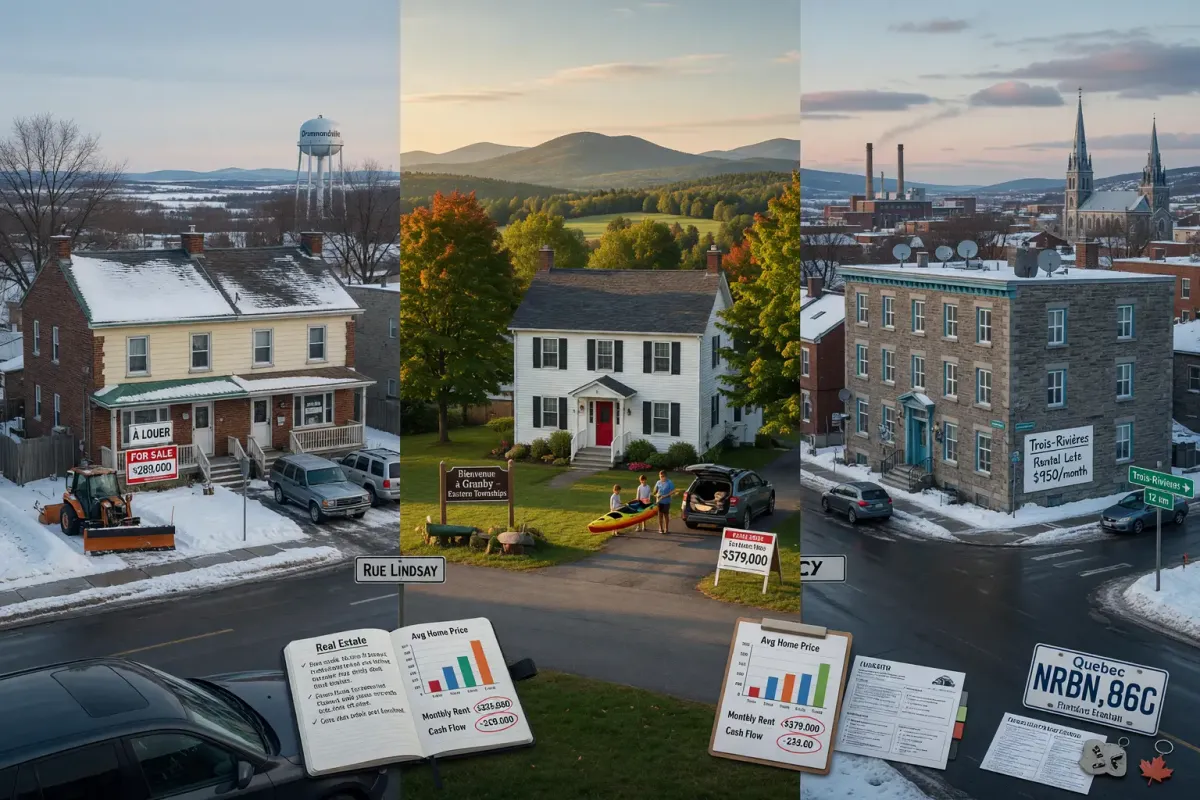
If you have been watching Montreal prices climb higher and wondering whether Quebec still has affordable entry points for real estate investors, the answer is yes — but you need to look beyond the island. Three secondary markets stand out: Drummondville, Granby, and Trois-Rivières. Each sits within reasonable driving distance of Montreal, each offers meaningfully lower price points, and each comes with its own economic story.
But here is the honest truth: none of these markets are slam-dunk cash flow plays. Quebec’s regulatory environment, property taxes, and rising prices mean you are likely looking at modest negative cash flow in the early years, banking on appreciation and mortgage paydown to build wealth over time.
Let me walk you through all three markets so you can figure out which one — if any — fits your investing strategy.
At a Glance: Three Markets Compared
Before we dive into the details, here is a side-by-side snapshot of these three cities as of early 2026.
| Factor | Drummondville | Granby | Trois-Rivières |
|---|---|---|---|
| Population (est. 2025) | ~86,000 | ~72,000 | ~151,000 |
| Metro area population | ~115,000 | ~85,000 | ~162,000 |
| Median home price | ~$330,000 | ~$490,000 | ~$290,000 |
| Avg. 2BR rent | ~$1,400/mo | ~$1,300/mo | ~$1,100/mo |
| Distance to Montreal | 110 km (1 hr 15 min) | 84 km (1 hr) | 130 km (1 hr 30 min) |
| Key economic driver | Manufacturing hub | Eastern Townships tourism + industry | University town (UQTR) + industrial |
| Population growth (2016-2021) | +5.4% | +4.4% | +3.5% |
| Primary language | French (95%+) | French (90%+) | French (94%+) |
A few things jump out immediately. Trois-Rivières is the largest city but has the lowest median home price, which makes it the most accessible entry point. Granby is the smallest but has the highest prices, driven by Eastern Townships demand and proximity to Montreal. Drummondville sits in the middle on almost every metric, which is fitting for a city that literally sits in the middle of the highway between Montreal and Quebec City.
Drummondville: The Manufacturing Crossroads
The Story
Drummondville’s pitch is straightforward: it sits at the halfway point on the Trans-Canada Highway between Montreal and Quebec City, and it has leveraged that positioning into a diversified manufacturing economy that has been growing steadily for decades.
The city has been on a genuine growth trajectory. Its population has jumped from about 76,000 in 2016 to nearly 86,000 today — a growth rate of roughly 2.5% year over year in recent periods. The broader MRC de Drummond region has crossed 114,000 residents and continues climbing.
Economy and Employers
Drummondville brands itself as the capital of the Centre-du-Québec region, and it backs that up with a surprisingly diverse employer base. The economy was historically built on manufacturing — the construction of the Hemmings Falls hydroelectric dam in 1920 kicked off an industrial wave that never really stopped. Today the city has employers across manufacturing, technology, retail, and services.
The employment rate for working-age adults (25-64) sits at a healthy 79.9%. That is a strong number for a secondary market and reflects genuine economic vitality rather than a town coasting on one or two large employers.
One thing to watch: the aging population is starting to show up in workforce data. Between 2008 and 2016, Quebec Pension Plan recipients in the area grew by over 50%. This is not an immediate crisis, but it is a demographic headwind that could affect long-term rental demand if immigration and in-migration do not keep pace.
Property Market
Median single-family home prices in Drummondville sit around $350,000 as of early 2026, which is significantly below Montreal’s average but has risen substantially over the past few years. The market here has been competitive — the Centre-du-Québec region has seen active listings decline and days on market shrink, classic signs of a seller’s market.
Rents have also risen sharply. Average asking rent for a two-bedroom apartment roughly doubled from $600 to $1,200 between 2019 and 2025. Current two-bedroom rents sit around $1,200 to $1,400 depending on the unit.
Who Should Look at Drummondville
Drummondville makes the most sense for investors who want a balanced market: not the cheapest entry point, not the most expensive, but solid fundamentals across the board. If you value economic diversity and population growth momentum over rock-bottom pricing, this is your market.
Granby: The Eastern Townships Premium
The Story
Granby sits 84 kilometers southeast of Montreal in Quebec’s Eastern Townships, a region known for tourism, outdoor recreation, and a quality of life that consistently attracts both retirees and young families looking for a different pace than city living.
The city has grown from about 66,000 in 2016 to approximately 72,000 today. It is the smallest of our three markets, but it punches above its weight economically and culturally.
Economy and Employers
Granby’s economy is more diversified than you might expect from a town famous for its zoo. Manufacturing still accounts for over 30% of the workforce, with textiles, clothing, metal products, and lumber being major sectors. The city and nearby Bromont have successfully attracted transportation and electronics plants, adding higher-value employment.
Tourism is genuinely significant here. The Granby Zoo is one of the largest in Canada and draws visitors year-round. The annual Festival de la chanson de Granby adds cultural cachet. CEGEP Granby provides post-secondary education and employs a substantial professional workforce.
The Eastern Townships location also means Granby benefits from the broader regional appeal — proximity to ski hills, lakes, and the US border (only 48 km away) creates a lifestyle draw that supports housing demand from demographics beyond the typical rental tenant.
Property Market
Here is where Granby gets interesting — and potentially challenging for investors. The median price for single-family homes reached $468,250 in Q4 2024, up 9% year over year. By mid-2025, median prices had climbed to around $490,000. That is significantly higher than either Drummondville or Trois-Rivières, and it starts to push against the price points where cash flow becomes very difficult.
The rental construction boom tells part of the story: in 2024, the city saw 706 new homes built, with 490 of those being rental units. More than 75% of new construction in 2025 has been in the rental segment. The city aims to add 5,500 housing units by 2034 through densification.
Yet the vacancy rate remains extraordinarily low at 0.5%, and rents continue climbing. This is a market where demand genuinely outstrips supply, even with aggressive construction activity.
Who Should Look at Granby
Granby is the appreciation play among these three markets. The higher entry price means cash flow will be tighter, but the Eastern Townships lifestyle premium, low vacancy rates, and strong demand fundamentals suggest continued price growth. If you are comfortable with negative cash flow in exchange for equity building and you believe in the Eastern Townships long-term story, Granby could work.
Trois-Rivières: The Affordable University Town
The Story
Trois-Rivières is the granddaddy of these three markets — literally. Founded in 1634, it is one of the oldest cities in North America and Canada’s oldest industrial city (its first foundry dates to 1738). With a population of roughly 151,000, it is also by far the largest of our three cities.
The city sits on the confluence of the Saint-Maurice and St. Lawrence rivers, about 130 km northeast of Montreal. It was once known as the pulp and paper capital of the world — from the late 1920s through the early 1960s, that industry dominated. Today the economy has diversified considerably, though the transition has not always been smooth.
Economy and Employers
The single biggest institutional presence in Trois-Rivières is the Université du Québec à Trois-Rivières (UQTR), which anchors the city’s identity as a university town and provides stable employment plus a steady flow of student renters.
On the industrial side, Marmen Incorporated manufactures wind turbine towers and employs about 1,000 people between its Trois-Rivières and Matane operations. The city has industrial strengths in metal transformation, electronics, thermoplastics, and cabinet making. An industrial park near the Trois-Rivières Airport serves as a regional hub for the aeronautical industry.
One concern worth flagging: the Mauricie region has been disproportionately affected by trade tensions with the United States, with unemployment rates rising more quickly than the provincial average. Given the city’s industrial profile, any escalation in trade disputes could create headwinds for the local economy and, by extension, rental demand.
Property Market
Trois-Rivières offers the most accessible entry point of these three markets. The average MLS listing price hovers around $430,000, but median sold prices for typical investment properties (smaller single-family homes and duplexes) are closer to $250,000 to $300,000. The aggregate home price is forecast to increase about 10% by Q4 2026 compared to Q4 2025, which would push it toward $430,000.
The market has been competitive: Q2 2025 saw 404 transactions, historically high for that period. Active listings declined 3%, and the time to sell existing inventory dropped to just 2.5 months — well below the historical average of nearly 7 months.
Average rents are the lowest of our three markets, with two-bedroom apartments around $1,100 per month. One-bedroom units sit around $900.
Who Should Look at Trois-Rivières
Trois-Rivières is the value play. Lowest entry price, student rental demand from UQTR, and strong forecast appreciation. The risks are the aging demographic (median age 47.2 years vs. the Canadian average of 41.6), exposure to trade-related economic disruption, and slightly more distance from Montreal. But if affordable entry and a diversified tenant base (students, workers, families) appeal to you, this market deserves serious consideration.
Quebec Regulations Every Investor Must Understand
Investing in Quebec is fundamentally different from investing in Ontario, Alberta, or British Columbia. The regulatory framework, legal system, and cultural context all require specific knowledge and preparation.
The Tribunal Administratif du Logement (Formerly Régie du Logement)
Quebec’s rental board — now officially called the Tribunal administratif du logement (TAL) — governs landlord-tenant relationships throughout the province. Here is what you need to know.
Rent increases are not capped, but tenants can contest them. Unlike Ontario or British Columbia, Quebec does not impose a hard percentage cap on annual rent increases. However, the TAL publishes recommended increase percentages each year based on landlord expense categories, and tenants who disagree with a proposed increase can file a dispute with the tribunal.
For 2025, the TAL recommended increases of up to 5.9% for units where heat is not included — the highest recommendation in over three decades. If a tenant refuses your proposed increase, the TAL will adjudicate based on its formula.
Major changes took effect January 1, 2026. Quebec overhauled its rent increase calculation method for the first time in nearly 40 years. The old system used 13 criteria; the new system uses just four variables:
- Changes in municipal property taxes
- Changes in insurance premiums
- 5% of capital expenditures (maintenance and repairs)
- The average Consumer Price Index (CPI) over the past three years
Landlords who finance renovation work must amortize those costs over 20 years when calculating allowable increases. Housing advocates worry this simplified formula could lead to higher increases; landlord associations have generally welcomed the reform.
Civil Law vs. Common Law
Quebec operates under a civil law system derived from French law, not the common law system used in the rest of Canada. This has practical implications for property ownership, contracts, and dispute resolution. Your lawyer, notary, and accountant must be versed in Quebec civil law — do not assume that professionals experienced in Ontario or other provinces can seamlessly handle Quebec transactions.
In Quebec, real estate transactions are finalized by a notary (notaire), not a lawyer. This is a legal requirement, not a suggestion. The notary examines title, handles the deed of sale, and registers the transaction.
Language Requirements
Quebec operates primarily in French under the provisions of the Charter of the French Language (Bill 101). Leases, official communications, and government interactions are conducted in French. You do not need to be personally fluent, but you absolutely need French-capable property management, legal support, and tenant communication.
In Drummondville, Granby, and Trois-Rivières specifically, the francophone population exceeds 90% in all three cities. English is far less prevalent here than in Montreal.
Transfer Tax (Droit de Mutation / Welcome Tax)
Quebec charges a property transfer tax — colloquially called the “welcome tax” — on every property purchase. The standard provincial rates for 2025 are:
| Property Value Bracket | Tax Rate |
|---|---|
| First $61,500 | 0.5% |
| $61,500 to $307,800 | 1.0% |
| Above $307,800 | 1.5% |
Some municipalities can impose rates up to 3% on amounts exceeding $500,000 by passing a local by-law. On a $300,000 property purchase, expect to pay roughly $3,200 to $3,500 in transfer tax.
Property Tax Rates
Municipal property tax rates in Quebec secondary markets tend to be higher than in Montreal, which can surprise investors. Research the specific mill rates for the municipality and borough where you plan to buy. Property taxes are a significant operating expense and directly affect your cash flow projections.
Cash Flow Projections: Let’s Be Honest
Here is where most market analysis articles fall apart — they either ignore cash flow entirely or paint unrealistically rosy pictures. Let me run you through realistic scenarios for each market using a standard duplex purchase with 20% down.
Drummondville Duplex Example
| Item | Amount |
|---|---|
| Purchase price | $350,000 |
| Down payment (20%) | $70,000 |
| Mortgage ($280,000 @ 4.5%, 25 yr) | $1,540/mo |
| Property taxes (est.) | $350/mo |
| Insurance | $150/mo |
| Maintenance reserve (5%) | $140/mo |
| Vacancy allowance (3%) | $84/mo |
| Total monthly expenses | $2,264/mo |
| Gross rental income (2 units x $1,400) | $2,800/mo |
| Net monthly cash flow | -$64/mo |
Not exciting. You are essentially breaking even before accounting for property management fees (typically 8-10% of rents), which would push you to roughly -$290/mo with professional management. The thesis here is mortgage paydown (about $700/month in principal) plus appreciation.
Granby Duplex Example
| Item | Amount |
|---|---|
| Purchase price | $475,000 |
| Down payment (20%) | $95,000 |
| Mortgage ($380,000 @ 4.5%, 25 yr) | $2,090/mo |
| Property taxes (est.) | $420/mo |
| Insurance | $175/mo |
| Maintenance reserve (5%) | $130/mo |
| Vacancy allowance (2%) | $52/mo |
| Total monthly expenses | $2,867/mo |
| Gross rental income (2 units x $1,300) | $2,600/mo |
| Net monthly cash flow | -$267/mo |
Granby is the tightest of the three markets. With professional management, you are looking at roughly -$475/mo in negative cash flow. The very low vacancy rate (0.5%) helps justify the lower vacancy allowance, but you are betting heavily on appreciation in this market.
Trois-Rivières Duplex Example
| Item | Amount |
|---|---|
| Purchase price | $290,000 |
| Down payment (20%) | $58,000 |
| Mortgage ($232,000 @ 4.5%, 25 yr) | $1,276/mo |
| Property taxes (est.) | $320/mo |
| Insurance | $140/mo |
| Maintenance reserve (5%) | $110/mo |
| Vacancy allowance (4%) | $88/mo |
| Total monthly expenses | $1,934/mo |
| Gross rental income (2 units x $1,100) | $2,200/mo |
| Net monthly cash flow | +$266/mo |
Trois-Rivières is the only market of the three that shows positive cash flow before management fees. With professional management (8%), you are looking at roughly +$90/mo — essentially break-even but at least not draining your bank account monthly.
What These Numbers Tell You
None of these markets are going to make you rich through monthly cash flow alone. The investment thesis for all three relies on a combination of:
- Mortgage paydown: Your tenants are paying down your mortgage, building equity over time
- Appreciation: Quebec secondary markets have been appreciating at 5-10% annually
- Rent growth: Rents in these markets have been rising 5-8% per year
- Tax benefits: Depreciation and expense deductions reduce your taxable income
If you need immediate positive cash flow, you may need to look at different markets or different property types (such as triplexes or fourplexes where the math improves with additional units).
Challenges and Risks You Cannot Ignore
Language Barrier
This is not a soft risk — it is a practical operational challenge. Leases, TAL proceedings, municipal communications, contractor negotiations, and tenant interactions all happen in French. If you are an anglophone investor, you need a fully French-capable team on the ground. Remote management without French language capacity is a recipe for expensive mistakes.
Regulatory Complexity
Quebec’s tenant protections are among the strongest in Canada. Evictions are difficult and time-consuming. The TAL process can take months. Understanding the lease renewal process, the rent increase contestation framework, and the rules around major renovations (renovictions are heavily scrutinized) is essential before you buy your first property.
Smaller Market Liquidity
These are not Toronto or Vancouver. When you want to sell, your buyer pool is smaller, your days on market may be longer, and you may not be able to time your exit perfectly. Liquidity risk is real in secondary markets and should factor into your investment timeline.
Trade Exposure
All three cities have significant manufacturing sectors. Trade disputes, tariffs, or supply chain disruptions can ripple through these economies faster than through diversified metropolitan areas. Trois-Rivières, with its Mauricie region industrial profile, is particularly exposed.
Aging Demographics
The median age in Trois-Rivières is 47.2 years — significantly above the Canadian average. Drummondville’s pension-aged population has grown rapidly. While all three cities are growing through in-migration, the underlying demographic trend requires watching. Aging populations can mean softer rental demand over the long term if not offset by newcomers.
Rising Prices Eroding Cash Flow
Ready to explore your financing options? Book a free strategy call with LendCity and let our team help you find the right path forward.
The irony of these markets is that their affordability is what attracted investor attention, and that attention has driven prices up. Average asking rents in Drummondville doubled between 2019 and 2025, but purchase prices have risen in step, keeping the rent-to-price ratio stubbornly low. There is no guarantee that rents will continue rising fast enough to keep pace with property values.
Which Market Is Right for You?
Use this decision framework to narrow your focus.
Choose Drummondville if:
- You want balanced fundamentals without extreme risk or reward
- Economic diversity and strong population growth matter to you
- You plan to buy-and-hold for 10+ years and let compounding work
- You want a market with solid transportation links in both directions along the Trans-Canada
Choose Granby if:
- You are comfortable with negative cash flow in exchange for appreciation potential
- The Eastern Townships lifestyle story resonates with you as a long-term demand driver
- You can handle a higher entry price point ($475,000+ for a duplex)
- You believe the 0.5% vacancy rate and aggressive rental construction signal sustained demand rather than a bubble
Choose Trois-Rivières if:
- Affordable entry is your top priority
- You want the closest thing to positive cash flow in Quebec’s secondary markets
- Student rental demand from UQTR appeals to you as a tenant base
- You are comfortable with the risks of an aging population and trade exposure
- Forecast appreciation of 10% in 2026 catches your attention
Consider none of these if:
- You need strong positive cash flow from day one
- You are not prepared to operate entirely in French or hire a French-capable team
- You do not have a 10+ year investment horizon
- You are uncomfortable with Quebec’s civil law system and tenant protections
Frequently Asked Questions
Can anglophone investors succeed in Quebec secondary markets?
How do Quebec rent increase rules differ from Ontario?
What is the welcome tax and how much will I pay?
Is it realistic to achieve positive cash flow in these markets?
How difficult is it to evict a tenant in Quebec?
Should I invest in one of these markets or just buy in Montreal?
What property types work best in these markets?
How do I find reliable property management in these cities?
The Bottom Line
Quebec’s secondary markets offer something increasingly rare in Canadian real estate: entry points below $350,000 for investment-grade properties (especially in Trois-Rivières and Drummondville). But affordability alone does not make a good investment. You need to go in with realistic expectations about cash flow, a solid understanding of Quebec’s regulatory environment, and a French-capable team on the ground.
Drummondville gives you balanced fundamentals and strong growth momentum. Granby gives you the Eastern Townships appreciation play at a premium price. Trois-Rivières gives you the most accessible entry point with student rental demand from UQTR.
All three markets share the same fundamental dynamic: rising prices and rents driven by genuine supply constraints, tempered by Quebec’s strong tenant protections and a regulatory system that does not always favor landlords.
Do your research. Build your team. Run the numbers on specific properties rather than relying on market averages. And if the numbers do not work, do not force it — these markets will still be here when conditions improve.
Free tool
Build a property proforma
Fill in income and expenses, then export a Year-1 operating statement (NOI, cap rate, cash flow, DSCR).
Disclaimer: LendCity Mortgages is a licensed mortgage brokerage. Content on this page is for educational purposes only and does not constitute legal, tax, investment, securities, or financial-planning advice. Rates, premiums, program terms, and regulations referenced are as of the page's last updated date and are subject to change. Any investment returns, rental yields, tax savings, or case-study figures shown are illustrative only — they are not guaranteed, not typical, and individual results will vary. Consult a licensed lawyer, Chartered Professional Accountant, or registered dealer before acting on any information above. Editorial standards.

Written by
Scott Dillingham
Published
August 2, 2026
Reading time
18 min read
1031 Exchange
A US tax provision allowing investors to defer capital gains taxes by reinvesting proceeds from a property sale into a like-kind replacement property within specific timeframes. Not available in Canada, but relevant for Canadians investing in US real estate.
ADU
Accessory Dwelling Unit - a secondary residential unit on a single-family property, such as a basement suite, laneway house, garden suite, or in-law suite. ADUs increase rental income and property value while leveraging existing land and infrastructure.
Appreciation
The increase in a property's value over time, which builds [equity](/glossary/equity/) and wealth for the owner through market growth or [forced improvements](/glossary/forced-appreciation/).
Capital Expenditures
Major one-time expenses for property improvements that extend the useful life of the asset, such as roof replacement, foundation repairs, or new HVAC systems. CapEx differs from regular maintenance and is typically budgeted separately in investment property analysis.
Cash Flow Optimization
Cash flow optimization is the strategic process of maximizing the net income generated from a rental property by increasing rental revenue and minimizing operating expenses, mortgage costs, and vacancies. For Canadian real estate investors, this often involves tactics such as selecting the right financing structure, leveraging rental income from multiple units, and managing expenses like property taxes and maintenance to ensure the property generates consistent positive monthly returns.
Cash Flow
The money left over after collecting rent and paying all expenses including mortgage, taxes, insurance, maintenance, and property management. Positive cash flow is the primary goal of buy-and-hold investors. See also [NOI](/glossary/noi/), [Cash-on-Cash Return](/glossary/cash-on-cash-return/), and [Vacancy Rate](/glossary/vacancy-rate/).
Commercial Mortgage
Financing for commercial properties like retail, office, or multifamily buildings with 5+ units, with different qualification criteria than residential mortgages.
Contractor
A licensed professional hired to perform construction, renovation, or repair work on investment properties. Using licensed and insured contractors is essential for permitted work, as unlicensed contractors can result in voided insurance, property liens, and liability for injuries.
Days on Market
The number of days a property has been listed for sale or rent without being leased or sold, used as an indicator of market demand and pricing appropriateness. Properties with high days on market typically signal pricing issues or property deficiencies.
Depreciation
An accounting method that allocates the cost of a building over its useful life as a tax deduction. In US real estate, depreciation reduces taxable rental income. The Canadian equivalent is Capital Cost Allowance (CCA).
Hover over terms to see definitions. View the full glossary for all terms.