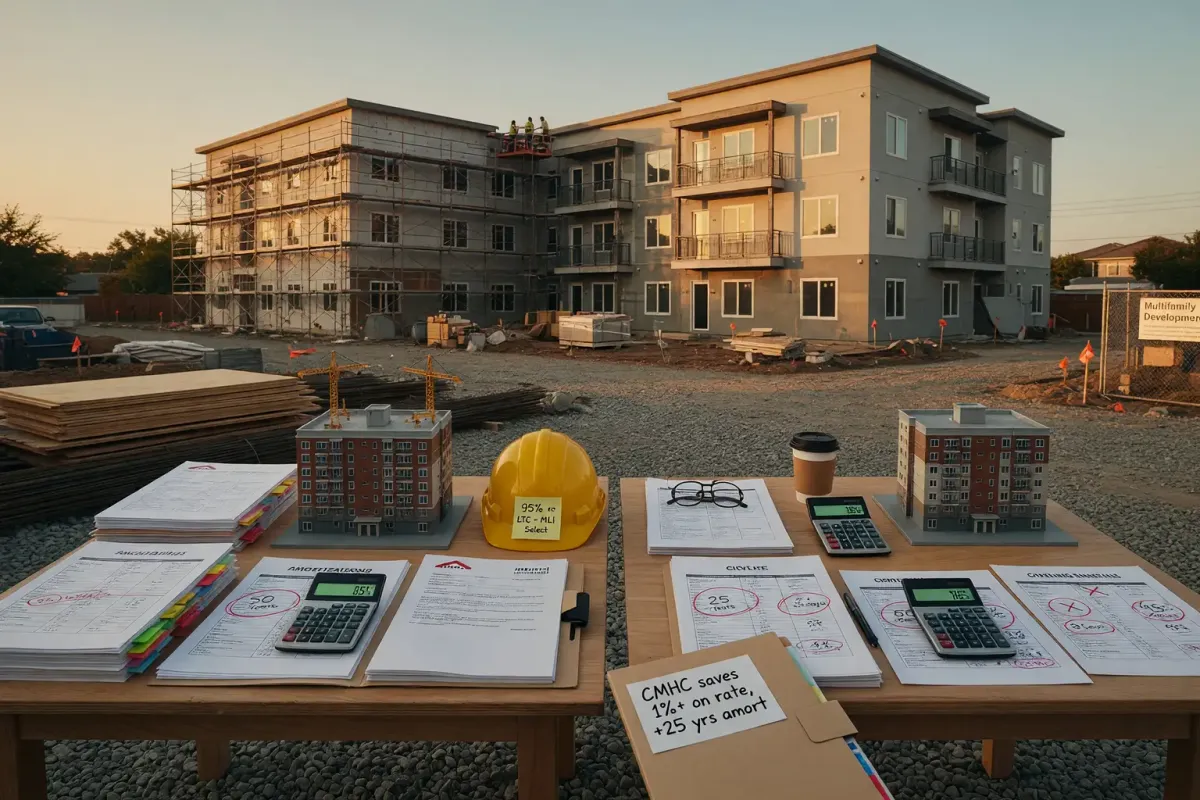
Every commercial real estate investor in Canada faces the same decision when financing a multi-family property: go the CMHC-insured route or use conventional financing. The answer is not always obvious. CMHC offers lower rates and higher leverage, but it comes with insurance premiums, longer timelines, and stricter property requirements. Conventional financing is faster and more flexible, but it costs more and requires significantly more equity.
This guide puts both options side by side with real numbers so you can make the right call for your specific deal. For a broader overview of all commercial mortgage options available in Canada, start with our multi-family mortgage financing page.
The Core Difference
CMHC-insured financing means Canada Mortgage and Housing Corporation provides mortgage insurance to the lender. If you default, CMHC covers the lender’s losses. Because the lender’s risk is eliminated, they can offer you lower rates, higher loan-to-value ratios, and longer amortization periods.
Conventional financing means the lender takes on the full risk of the loan. No government insurance. That risk gets priced into higher rates, lower LTVs, and shorter amortizations. The tradeoff: fewer restrictions on what properties qualify, faster processing, and no insurance premium.
Side-by-Side Comparison
Here is how the two paths stack up across every metric that matters.
| Factor | CMHC-Insured | Conventional |
|---|---|---|
| Interest rate | 4.25% - 5.25% | 5.00% - 6.50% |
| Maximum LTV | 85% (existing) / 95% LTC (CMHC MLI Select program new build) | 65% - 75% |
| Minimum down payment | 15% (existing) / 5% (MLI Select new build) | 25% - 35% |
| Amortization | Up to 40 years (standard) / 50 years (MLI Select) | 20 - 25 years |
| Insurance premium | 2.5% - 6.0%+ base under July 2025 risk-based pricing, plus 0.25% surcharge per 5-yr amortization beyond 25 yrs (MLI Select: 10/20/30% discount at 50/70/100 pts) | None |
| Minimum DSCR | 1.10x (MLI Select) / 1.20x (standard) | 1.20x - 1.30x |
| Property types | Multi-family rental (5+ units) | All commercial property types |
| Recourse | Limited recourse (MLI Select 100+ pts) | Full recourse |
| Timeline to close | 8 - 16 weeks | 4 - 10 weeks |
| Prepayment flexibility | More restrictive | Varies by lender |
| Property condition | Must meet CMHC standards | Lender-specific |
| Environmental assessment | Required (Phase I minimum) | Usually required |
| Application complexity | High (detailed documentation) | Moderate |
The numbers tell one story. But the right choice depends on which of these factors matters most to your deal.
Compare Your Financing Options
Before you commit to any mortgage product, it helps to get a second opinion — book a free strategy call with LendCity to see which options actually fit your financial picture.
If this approach is on your radar, our multi-family mortgage financing guide walks through how LendCity structures these deals.
When CMHC-Insured Financing Is the Better Choice
You Are Buying Stabilized Multi-Family
If you are purchasing a multi-family rental building with 5+ units, strong occupancy (85%+), and stable income, CMHC-insured financing will almost always be the better deal. The rate savings, higher leverage, and extended amortization create a financing package that conventional lenders simply cannot match.
This is the bread and butter of CMHC lending. The program was designed for exactly this type of property. If your building qualifies, there is rarely a good reason to go conventional.
You Want to Maximize Leverage
CMHC allows up to 85% LTV on existing properties and up to 95% loan-to-cost on new construction through MLI Select. On a $5 million deal, the difference between 15% down (CMHC) and 30% down (conventional) is $750,000 in capital. Our guide to commercial mortgage down payment requirements in Canada covers strategies to reduce that upfront cost.
The same leverage gap shows up on mid-size apartment buildings. On a $2 million property, the difference between 15% down and 25-35% conventional equity is $200,000 to $400,000 — capital that can fund another acquisition, renovations, or reserves.
That freed-up capital, if deployed into another property, could generate its own returns. For investors focused on portfolio growth, the leverage efficiency of CMHC financing is a significant strategic advantage.
You Need Cash Flow Optimization
The combination of lower rates and longer amortization directly improves monthly cash flow. A $4 million mortgage at 4.85% (typical April 2026 MLI Select) over 40 years costs approximately $18,800 per month. The same mortgage at 5.75% (typical conventional) over 25 years costs approximately $25,000 per month. That is over $6,000 per month in cash flow improvement — roughly $74,000 per year.
On a smaller multifamily scale, a $1.5 million mortgage at 4.75% costs approximately $8,550 monthly over 25 years versus about $7,150 monthly over 40 years. That $1,400 monthly difference ($16,800 annually) is often what makes a tight apartment deal cash-flow positive. Rate savings compound the effect: a 1% lower rate on that same $1.5 million mortgage saves roughly $15,000 per year in interest.
For properties where cash flow is tight, this difference can be the margin between a deal that works and one that does not.
You Are Building New Multi-Family
The CMHC MLI Select program is specifically designed for new construction and offers the best terms available in Canadian commercial lending: up to 95% loan-to-cost financing, 50-year amortization, limited recourse, and the ability to roll premiums and fees into the loan. Learn more about MLI Select’s points system and how it works to maximize your financing benefits.
If you are developing a purpose-built rental building, MLI Select should be your first stop. Use our CMHC MLI max loan calculator to run the numbers on your project.
When Conventional Financing Is the Better Choice
You Need Speed
CMHC deals take 8 to 16 weeks to close. Conventional deals can close in 4 to 10 weeks. If you are in a competitive bidding situation and the seller wants a fast close, conventional financing gives you an edge.
Some investors use conventional financing to close quickly, then refinance into CMHC once the property is stabilized. This “bridge to CMHC” strategy captures the deal while eventually locking in better long-term financing.
The Property Does Not Qualify for CMHC
CMHC has specific eligibility requirements. The property must be a multi-family rental with 5+ units, in acceptable physical condition, and meet environmental standards. Properties that need significant repairs, have deferred maintenance, or are in poor condition may not qualify.
Conventional lenders are more flexible about property condition. Value-add investors who buy distressed or underperforming buildings to force appreciation through renovations and better management often have no choice but to go conventional for the initial purchase.
You Are Buying Non-Residential Commercial
CMHC insurance only applies to multi-family residential rental properties. If you are buying an office building investment guide, retail space, industrial warehouse, or any non-residential commercial property, conventional financing is your only option.
You Have Significant Equity and Want Simplicity
If you have substantial capital and do not need maximum leverage, conventional financing avoids the CMHC application complexity. The documentation requirements are lighter, the process is more straightforward, and you avoid the insurance premium entirely. On a $2 million property at 85% LTV, a 5.5% CMHC premium is about $110,000 — real money that conventional financing skips when you already have adequate equity and the rate gap is narrow.
For investors with large portfolios and strong banking relationships, conventional financing through an existing lender relationship can offer competitive terms with minimal friction.
You Want Prepayment Flexibility
CMHC-insured mortgages typically have more restrictive prepayment provisions. If you plan to sell the property, pay down the mortgage aggressively, or refinance mid-term, conventional lenders may offer more flexibility on prepayment without penalties.
This matters particularly for value-add investors who plan to renovate, increase NOI, and refinance within two to three years.
Every borrower’s situation is different, and the wrong mortgage structure can cost you thousands — schedule a free strategy session with us to make sure you’re set up properly.
MLI Select Premium Reductions
One factor that tilts the comparison further toward CMHC for qualifying projects is the MLI Select premium reduction system. Properties that earn points through affordability, energy efficiency, and accessibility commitments receive reduced insurance premiums. Since the July 14, 2025 risk-based pricing update, MLI Select files require a minimum of 50 points to qualify. For details on how the scoring works, see our guide to CMHC MLI Select and how the points system determines financing terms.
| Points Earned | Premium Reduction | Effective Premium Rate |
|---|---|---|
| 0 - 49 points | Does not qualify (50 pt minimum) | n/a |
| 50 - 69 points | 10% discount | ~4.5% - 5.4% |
| 70 - 99 points | 20% discount | ~4.0% - 4.8% |
| 100+ points | 30% discount | ~3.5% - 4.2% |
At 100+ points, the insurance premium is reduced by 30%. On a $4 million mortgage with base rate 5.5%, the premium drops from $220,000 to $154,000 — a $66,000 savings. Combined with 95% financing and 50-year amortization, the leverage and rate advantages of MLI Select become even more compelling.
Earning 100+ points also unlocks 95% loan-to-cost financing and 50-year amortization — the most aggressive financing terms available in Canada.
Cost Comparison: $5 Million Property Both Ways
Let us model a real scenario. You are purchasing a stabilized 20-unit apartment building for $5 million.
CMHC-Insured Path
| Item | Amount |
|---|---|
| Purchase price | $5,000,000 |
| LTV | 85% |
| Mortgage amount | $4,250,000 |
| Down payment | $750,000 |
| CMHC premium (5.5%) | $233,750 |
| Total mortgage (with premium) | $4,483,750 |
| Interest rate | 4.85% |
| Amortization | 40 years |
| Monthly payment | $20,170 |
| Annual debt service | $242,040 |
| Total interest paid (5-year term) | $989,000 |
| Total cost (5-year term, interest + premium) | $1,222,750 |
Conventional Path
| Item | Amount |
|---|---|
| Purchase price | $5,000,000 |
| LTV | 75% |
| Mortgage amount | $3,750,000 |
| Down payment | $1,250,000 |
| CMHC premium | $0 |
| Total mortgage | $3,750,000 |
| Interest rate | 5.75% |
| Amortization | 25 years |
| Monthly payment | $23,580 |
| Annual debt service | $282,960 |
| Total interest paid (5-year term) | $1,030,000 |
| Total cost (5-year term, interest only) | $1,030,000 |
The Comparison
| Metric | CMHC-Insured | Conventional | Difference |
|---|---|---|---|
| Down payment required | $750,000 | $1,250,000 | $500,000 less with CMHC |
| Monthly payment | $20,170 | $23,580 | $3,410/month savings with CMHC |
| Annual debt service | $242,040 | $282,960 | $40,920/year savings with CMHC |
| 5-year total cost | $1,222,750 | $1,030,000 | CMHC costs more in 5-yr window due to premium |
| Capital freed up | — | — | $500,000 available for other investments |
On a 5-year basis, the CMHC path costs somewhat more due to the insurance premium, but the real advantage is the $500,000 in freed-up capital. If that $500,000 earns even a modest return elsewhere, the total advantage of CMHC financing grows significantly. Over longer holds (10+ years), the rate savings and cash flow improvements compound in CMHC’s favour.
On a cash-flow basis, the CMHC path generates roughly $41,000 more annually from lower debt service. Over five years, that is over $200,000 in additional cash flow.
See Which Option Saves You More
Decision Framework: Which Should You Choose?
Use this framework to quickly determine which path fits your situation.
Choose CMHC-insured financing if:
- You are buying or building a multi-family rental property with 5+ units
- The property is stabilized with 85%+ occupancy and meets CMHC physical standards
- You want to conserve capital for other investments or reserves
- Cash flow optimization is a priority
- You are comfortable with longer timelines (8-16 weeks)
- You do not plan to sell or refinance within the first term
Choose conventional financing if:
- You are buying office, retail, industrial, or other non-residential commercial property
- The property needs significant work before it would meet CMHC standards
- Speed is critical and you need to close in under 8 weeks
- You have substantial equity and prefer a simpler process
- You plan to sell, refinance, or make major prepayments mid-term
- You are buying a value-add property and plan to refinance into CMHC later
Consider a hybrid approach if:
- You want to close quickly on a value-add multi-family property, renovate, stabilize, and then refinance into CMHC for better long-term terms
- You are building new construction and need bridge financing during construction before converting to CMHC permanent financing
The Hybrid Strategy: Conventional Now, CMHC Later
One of the most effective strategies for value-add investors is using conventional financing as a bridge to CMHC. Here is how it works:
-
Purchase with conventional financing. Close quickly, accept the higher rate and lower leverage. The seller gets their fast close, and you get the property.
-
Execute your value-add plan. Renovate units, raise rents to market, fill vacancies, and stabilize the building. This typically takes 12 to 24 months.
-
Refinance into CMHC. Once the property is stabilized with strong occupancy and meets CMHC physical standards, apply for CMHC-insured refinancing. Our guide on how to refinance a commercial property in Canada covers the full process. You lock in lower rates, extend amortization, and potentially pull out equity to recycle into your next deal.
This strategy works particularly well for investors buying multi-family properties that need repositioning. The conventional financing gets you in the door, and the CMHC refinance optimizes your long-term returns.
Common Misconceptions
“CMHC is only for affordable housing.” Not true. While MLI Select rewards affordability commitments, standard CMHC multi-family insurance (MLI Standard) is available for market-rate rental properties that meet basic eligibility requirements. You do not need to rent below market to qualify.
“The CMHC premium makes it more expensive.” In most cases, the interest rate savings and extended amortization more than offset the premium cost within the first five-year term. Always run the full comparison before dismissing CMHC based on the premium alone.
“Conventional financing is always faster.” While generally true, some CMHC lenders have streamlined their processes significantly. And some conventional lenders can be just as slow if their internal processes are cumbersome. Timeline depends on the specific lender as much as the financing type.
“I need to choose one or the other permanently.” You can absolutely switch between financing types. Many investors start with conventional and refinance into CMHC, or use CMHC for acquisitions and conventional for properties that do not qualify. Your financing strategy should evolve with your portfolio.
“CMHC insurance protects me as the borrower.” It does not. CMHC insurance protects the lender. If you default, you still face all the consequences — credit damage, potential deficiency judgments, and loss of equity. The insurance enables better terms for you, but it does not reduce your personal risk.
Making the Decision
The right financing type is not about which is “better” in the abstract. It is about which is better for your specific deal, your capital situation, and your long-term strategy.
If your property qualifies for CMHC and you can handle the longer timeline, the numbers almost always favor CMHC-insured financing. The rate savings, leverage advantages, and cash flow improvements compound over time and across your portfolio. Our breakdown of commercial mortgage rates in Canada shows exactly what to expect on both paths.
If speed, flexibility, or property type pushes you toward conventional, that is a perfectly valid path — especially if you plan to optimize the financing later through refinancing.
The worst decision is choosing without running the numbers. Model both options with your actual deal and compare total cost of borrowing, monthly cash flow, and the opportunity cost of the additional equity required. Review current multifamily mortgage rates across both CMHC and conventional options to understand what terms are available in your market. Our DSCR calculator for Canadian commercial mortgages can help you determine which path your property’s income supports.
Work with a broker who can present both options honestly and help you structure the financing that best serves your goals. The right financing strategy is the one that optimizes your returns not just on this deal, but across your entire portfolio.
Get Your CMHC Eligibility Assessed
Key Takeaways:
- The Core Difference
- Side-by-Side Comparison
- When CMHC-Insured Financing Is the Better Choice
- When Conventional Financing Is the Better Choice
- MLI Select Premium Reductions
Frequently Asked Questions
Can I switch from conventional to CMHC-insured financing later?
How much does the CMHC insurance premium actually cost?
What types of properties qualify for CMHC commercial mortgage insurance?
Is the CMHC insurance premium worth the cost for a small apartment building?
Can I use CMHC financing to buy a mixed-use property with commercial tenants?
Is the CMHC insurance premium tax deductible?
How long does CMHC approval take compared to conventional?
Rates and program rules are subject to change. Verify current figures with primary sources:
- Bank of Canada — policy interest rate
- CMHC — multifamily and mortgage insurance programs
- OSFI — mortgage underwriting guidelines
Free download
MLI Select document checklist
Appraisals, rent rolls, environmental reports, and the CMHC package lenders expect before they underwrite.
By submitting, you agree to receive occasional emails from LendCity. You can unsubscribe at any time.
4.8/5 (116 Google reviews)
Disclaimer: LendCity Mortgages is a licensed mortgage brokerage. Content on this page is for educational purposes only and does not constitute legal, tax, investment, securities, or financial-planning advice. Rates, premiums, program terms, and regulations referenced are as of the page's last updated date and are subject to change. Any investment returns, rental yields, tax savings, or case-study figures shown are illustrative only — they are not guaranteed, not typical, and individual results will vary. Consult a licensed lawyer, Chartered Professional Accountant, or registered dealer before acting on any information above. Editorial standards.

Written by
Scott Dillingham
Published
February 8, 2026
· Updated August 18, 2026Reading time
14 min read
CMHC Insurance
Mortgage default insurance from Canada Mortgage and Housing Corporation. For 1-4 unit investment properties, investors must put 20%+ down (no insurance available). However, CMHC offers MLI Select for 5+ unit multifamily properties, and house hackers can access insured mortgages with 5-10% down.
CMHC MLI Select
A CMHC program offering reduced mortgage insurance premiums and extended amortization (up to 50 years) for multifamily properties with 5+ units that meet energy efficiency or accessibility standards. Popular among investors scaling into larger apartment buildings.
Commercial Mortgage
Financing for commercial properties like retail, office, or multifamily buildings with 5+ units, with different qualification criteria than residential mortgages.
Multifamily Financing
Multifamily financing refers to mortgage loans specifically designed for purchasing or refinancing residential properties with five or more units, such as apartment buildings or large rental complexes. For Canadian real estate investors, these commercial-style loans typically require larger down payments and are evaluated primarily on the property's rental income and net operating income rather than personal income alone.
LTV
Loan-to-Value ratio - the mortgage amount expressed as a percentage of the property's appraised value or purchase price (whichever is lower). An 80% LTV means you're borrowing 80% and putting 20% [down](/glossary/down-payment/). Lower LTV generally means better [interest rates](/glossary/interest-rate/) and terms. See also [Equity](/glossary/equity/) and [Leverage](/glossary/leverage/).
Amortization
The period over which a mortgage is scheduled to be fully paid off through regular payments of principal and [interest](/glossary/interest-rate/). In Canada, common amortization periods are 25 or 30 years, though the mortgage term (when you renegotiate) is typically 1-5 years. A longer amortization lowers monthly payments, improving [cash flow](/glossary/cash-flow/) but increasing total interest paid.
Down Payment
The upfront cash payment when purchasing a property. For 1-4 unit investment properties, minimum 20% down is required. 5+ unit multifamily can use CMHC MLI Select with lower down payments, and house hackers can put as little as 5% down on owner-occupied 2-4 plexes. Your down payment directly affects your [LTV](/glossary/ltv/) and the amount of [leverage](/glossary/leverage/) you use.
NOI
Net Operating Income - the total income a property generates minus all operating expenses, but before mortgage payments and income taxes. Calculated as gross rental income minus [vacancies](/glossary/vacancy-rate/), property taxes, insurance, maintenance, and property management fees. NOI is used to calculate both [Cap Rate](/glossary/cap-rate/) and [DSCR](/glossary/dscr/).
DSCR
Debt Service Coverage Ratio — a metric that compares a property's [net operating income](/glossary/noi/) to its mortgage payments. A DSCR of 1.25 means the property generates 25% more income than needed to cover the debt. Lenders typically require a minimum DSCR of 1.0 to 1.25 for investment property loans (including [DSCR loans](/glossary/dscr-loan/)). See also [Cap Rate](/glossary/cap-rate/) and [Cash Flow](/glossary/cash-flow/).
Mortgage Insurance Premium
The fee charged by CMHC or other insurers for mortgage default insurance on high-ratio mortgages. The premium is calculated as a percentage of the loan amount and can be added to the mortgage balance or paid upfront.
Insured Mortgage
A mortgage backed by mortgage default insurance from CMHC, Sagen, or Canada Guaranty, required when the down payment is less than 20% on owner-occupied properties. The insurance premium — which currently ranges from roughly 0.60% to 4.50% of the mortgage amount depending on loan-to-value band, and is higher for non-traditional down payments or extended amortization — is typically added to the loan balance. Insured mortgages often qualify for lower interest rates because the lender's risk is covered by the insurer. Confirm the current premium schedule with CMHC/Sagen/Canada Guaranty; rates and tiers are subject to change.
Uninsured Mortgage
A mortgage without government-backed default insurance, required when the down payment is 20% or more, or for investment properties and refinances. Uninsured mortgages typically carry slightly higher interest rates than insured ones because the lender bears the full default risk. Most investment property mortgages in Canada are uninsured.
Hover over terms to see definitions. View the full glossary for all terms.