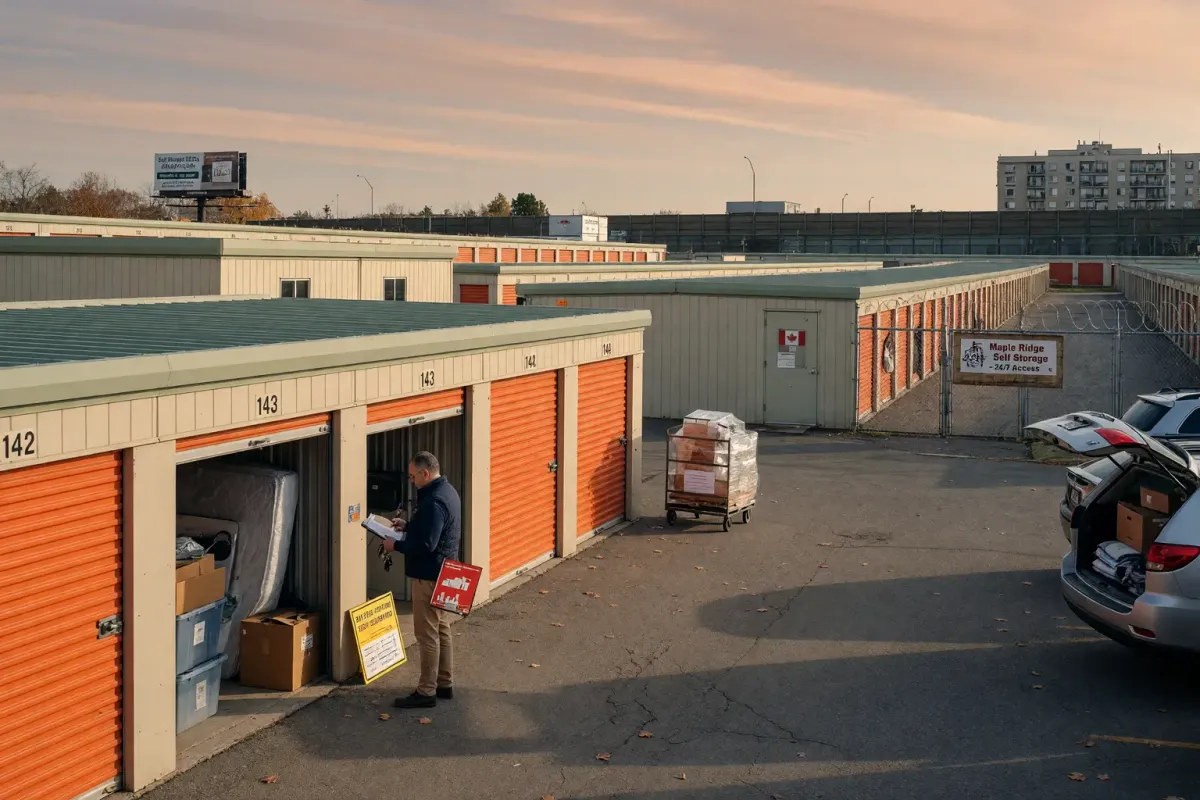
While residential properties dominate most real estate investment discussions, self-storage facilities offer an alternative asset class with compelling characteristics. Storage units provide steady income with lower management intensity than residential rentals, weather economic cycles differently than housing, and can produce attractive returns. Understanding the self-storage sector helps investors evaluate whether this alternative fits their investment strategy.
Understanding the Self-Storage Sector
Self-storage has grown into a significant real estate category with distinct characteristics.
Market Overview
Self-storage is among the fastest-growing real estate sectors in Canada. Demand has increased steadily as populations grow in urban centres, households accumulate possessions, and living spaces—especially condos in Toronto, Vancouver, and Montreal—remain constrained.
The Canadian sector includes independent operators and larger players such as StorageVault Canada. Consolidation continues as national operators acquire smaller facilities across the provinces.
Demand Drivers
Multiple factors drive storage demand. Population growth creates more households needing storage. Consumer spending means more possessions requiring space. Housing constraints—smaller living spaces, downsizing trends—push belongings into storage rather than homes.
Life transitions also drive demand. Moving, divorcing, inheriting estates, renovating homes, and other changes create temporary or permanent storage needs.
Economic Resilience
Self-storage shows unusual economic resilience compared to other real estate categories. During strong economies, people accumulate possessions needing storage. During weak economies, people downsize and store belongings rather than disposing of them.
This counter-cyclical characteristic provides stability through economic fluctuations. Storage facilities have historically shown lower foreclosure rates than other property types.
| Storage Advantage | Residential Comparison | Investor Implication |
|---|---|---|
| Economic resilience | Cyclical sensitivity | More stable income |
| Simple turnover | Intensive turnover | Lower turnover cost |
| Less maintenance | Significant maintenance | Lower operating expense |
| Diverse tenant base | Concentrated risk | Reduced vacancy impact |
Investment Advantages
Storage facilities offer several advantages over residential rentals.
Manageable Turnover
Residential rental turnover involves finding new tenants, conducting repairs, deep cleaning, and potentially upgrading units. This process is time-consuming and expensive.
Storage turnover is simpler. Units are typically concrete and steel requiring minimal preparation between tenants. Cleaning and preparation can occur within hours rather than days or weeks.
While storage facilities may see more frequent unit turnover than residential properties, each turnover event is dramatically less intensive.
Lower Maintenance Demands
Storage units require minimal maintenance compared to residential properties. No plumbing, limited electrical, no appliances, and simple construction mean fewer things can break or require attention.
Operating expenses as a percentage of income tend to be lower for storage than residential properties, improving net operating margins.
Distributed Risk
Storage facilities typically contain many units—dozens or hundreds. Vacancy in any single unit has minimal impact on overall income.
Compare this to residential properties where a single tenant’s departure eliminates all income until replacement. Storage’s distributed tenant base provides natural diversification.
Passive or Active Options
Investors can operate storage facilities actively, managing day-to-day operations themselves. Alternatively, they can invest passively through real estate investment trusts (REITs) specializing in self-storage or through management companies that handle operations.
This flexibility accommodates different investor preferences and time availability.
Direct storage ownership often means hundreds of thousands—or millions—in capital. book a free strategy call with LendCity and we’ll show you which Canadian lenders actually finance self-storage and how to structure the purchase so your cash-on-cash returns hold up.
Investment Approaches
Several approaches exist for storage facility investment.
Direct Facility Ownership
Direct ownership involves purchasing storage facilities and either self-managing or hiring management. This approach offers maximum control and potential returns but requires significant capital and operational involvement.
Smaller facilities may be accessible to individual investors. Larger facilities typically require institutional capital or partnership structures.
REIT Investment
Self-storage REITs offer exposure to the sector without direct ownership responsibilities. In Canada, you can buy units of storage-focused REITs and public operators on the TSX—they hold portfolios across multiple markets and handle the day-to-day for you. Canadian REITs also flow most taxable income out to unitholders, which is a different tax treatment than holding property directly.
REIT investment is accessible through a standard brokerage account with minimal capital. You trade operational control for simplicity and liquidity.
Development
Building new storage facilities from the ground up can produce strong returns when demand supports new supply. Development involves higher risk and complexity than acquiring existing facilities but might offer higher rewards.
Development requires expertise in site selection, construction, lease-up, and ongoing management that most individual investors lack.
Conversion Properties
Some investors convert underutilized properties—old industrial buildings, retail spaces, or warehouses—into storage facilities. These conversions can produce attractive returns when acquisition costs are low and markets support demand.
Conversion requires understanding both real estate and storage operations.
Location Considerations
Storage facility success depends heavily on location factors.
Population Density
Storage facilities need surrounding populations to generate tenant demand. Facilities in sparsely populated areas struggle to achieve adequate occupancy.
Evaluate population density within reasonable drive times from potential facilities. Most Canadian tenants won’t travel far for storage access—think tight catchment areas around suburban corridors and condo-heavy cores.
Visibility and Access
Facilities with good visibility attract drive-by customers. Easy access via major roads encourages use.
Hidden or difficult-to-reach facilities may struggle even with marketing efforts.
Competition Assessment
Analyze existing storage supply in target markets. Oversupply depresses rental rates and occupancy. Undersupply suggests opportunity.
Research new facilities under construction or planned. New supply can change market dynamics quickly.
Growth Patterns
Markets with growing populations and expanding development tend to support storage demand growth. Static or declining markets may face challenging conditions.
Research demographic trends and economic development patterns in potential investment areas.
I’ve seen investors win big converting old warehouses into storage—but only when financing covers both the purchase and the build-out. schedule a free strategy session with us and we’ll run those numbers with you before you chase the wrong building.
Operational Considerations
Storage operations differ from residential property management.
Technology Integration
Modern storage facilities rely heavily on technology. Access control systems, security monitoring, online reservations, and automated billing all require technology infrastructure.
Facilities with outdated technology may underperform competitors with modern systems.
Security Requirements
Tenants store valuables in storage units. Security—cameras, access controls, lighting, fencing—affects both tenant confidence and loss prevention.
Security investments protect both tenants and facility reputation.
Customer Service
Despite lower management intensity than residential, storage still requires customer service capability. Tenants have questions, problems arise, and facilities need responsive personnel.
Determine how customer service will be handled—on-site staff, remote management, or a management company. I’ve seen investors underestimate this piece and pay for it in bad reviews and higher churn.
Marketing and Rate Management
Successful facilities actively market to maintain occupancy and improve rental rates. Dynamic pricing, promotional offers, and ongoing marketing require attention.
Facilities that neglect marketing may see occupancy and rate performance deteriorate.
Special Facility Types
Beyond traditional storage, specialized segments offer additional opportunities.
Climate-Controlled Storage
Climate-controlled units command premium rates for storing temperature-sensitive items. These units require more infrastructure but generate higher income per square foot.
Luxury Storage
High-end storage facilities targeting affluent customers offer premium amenities and security. These facilities charge substantially more than basic storage.
Specialty Storage
Boat storage, RV storage, wine storage, and other specialty categories serve specific markets with particular needs. In Canada, RV and boat storage see strong seasonal demand in markets across the Prairies, B.C. Interior, and cottage country in Ontario and Quebec.
Frequently Asked Questions
How do storage returns compare to residential?
How much capital is needed to invest in storage?
Is storage recession-proof?
Can I manage storage remotely?
What's the biggest risk in storage investing?
What makes climate-controlled storage units more profitable than standard units?
How does converting underutilized buildings into storage facilities work?
Conclusion
Self-storage facilities offer real estate investment characteristics that differ meaningfully from residential properties. Lower management intensity, economic resilience, distributed tenant risk, and attractive returns make storage compelling for some investors.
Success requires understanding the sector’s specific dynamics, careful market analysis, and appropriate operational capabilities. Storage isn’t right for every investor, but those who align with its characteristics may find it a valuable portfolio component.
Whether through direct ownership, REIT investment, or other approaches, storage deserves consideration as part of a diversified real estate investment strategy.
Free tool
Build a property proforma
Fill in income and expenses, then export a Year-1 operating statement (NOI, cap rate, cash flow, DSCR).
Disclaimer: LendCity Mortgages is a licensed mortgage brokerage. Content on this page is for educational purposes only and does not constitute legal, tax, investment, securities, or financial-planning advice. Rates, premiums, program terms, and regulations referenced are as of the page's last updated date and are subject to change. Any investment returns, rental yields, tax savings, or case-study figures shown are illustrative only — they are not guaranteed, not typical, and individual results will vary. Consult a licensed lawyer, Chartered Professional Accountant, or registered dealer before acting on any information above. Editorial standards.

Written by
Scott Dillingham
Published
August 1, 2026
Reading time
7 min read
Cap Rate
Capitalization Rate - the ratio of a property's [net operating income (NOI)](/glossary/noi/) to its current market value or purchase price. A 6% cap rate means the property generates $60,000 NOI annually on a $1,000,000 value. Used to compare investment properties regardless of financing. See also [DSCR](/glossary/dscr/) and [Cash-on-Cash Return](/glossary/cash-on-cash-return/).
Cash-on-Cash Return
A metric that measures the annual pre-tax [cash flow](/glossary/cash-flow/) relative to the total cash invested in a property. Calculated as annual cash flow divided by total cash invested (including [down payment](/glossary/down-payment/) and [closing costs](/glossary/closing-costs/)), expressed as a percentage. A 10% cash-on-cash return means you earn $10,000 annually on a $100,000 investment. See also [Cap Rate](/glossary/cap-rate/).
Dynamic Pricing
A revenue management strategy where nightly rental rates are adjusted in real time based on demand, seasonality, local events, and competitor pricing. Used by short-term rental operators to maximize revenue.
Foreclosure
The legal process by which a lender seizes and sells a property after the borrower defaults on mortgage payments. In Canada, the process varies by province and may include judicial sale or power of sale. Foreclosed properties can offer below-market pricing but carry condition and title risks.
HVAC
Heating, Ventilation, and Air Conditioning systems that control temperature and air quality in buildings. HVAC is often one of the largest energy expenses in rental properties, and upgrading to high-efficiency systems can significantly reduce operating costs and increase NOI.
ITIN
Individual Taxpayer Identification Number - a US tax ID for foreign nationals, required for Canadians to invest in US real estate and file US taxes.
Lien
A legal claim against a property used as security for a debt. Liens arise from unpaid mortgages, property taxes, contractor work, or court judgments. Undiscovered liens can eliminate an apparent purchase discount on distressed properties.
Net Operating Income
Net Operating Income (NOI) is a multifamily property's total annual revenue minus all operating expenses, but excluding debt service, capital expenditures, and income taxes. Calculated as gross rental income minus vacancy losses, property taxes, insurance, utilities, maintenance, and property management fees. NOI is the critical metric lenders use to assess a property's debt service capacity.
Operating Expenses
The ongoing costs of running a rental property, including property taxes, insurance, maintenance, property management fees, utilities, and repairs. Subtracting operating expenses from gross rental income yields the net operating income.
Plumbing
The system of pipes, drains, fixtures, and fittings in a building that distributes water and removes waste. Plumbing issues are among the most costly repairs in rental properties, and older galvanized or polybutylene pipes often need replacement during renovations.
Hover over terms to see definitions. View the full glossary for all terms.