You own a commercial property. Maybe it’s a warehouse your company operates out of, a retail building housing your business, or an industrial facility you’ve held for years. The property has appreciated significantly, and there’s a pile of equity sitting in it—equity that’s doing nothing for your business except existing on a balance sheet.
A sale-leaseback lets you extract that equity, keep using the property, and redeploy capital where it actually generates returns. It’s one of the most underused strategies in Canadian commercial real estate, and businesses sitting on valuable property should understand how it works.
What Is a Sale-Leaseback?
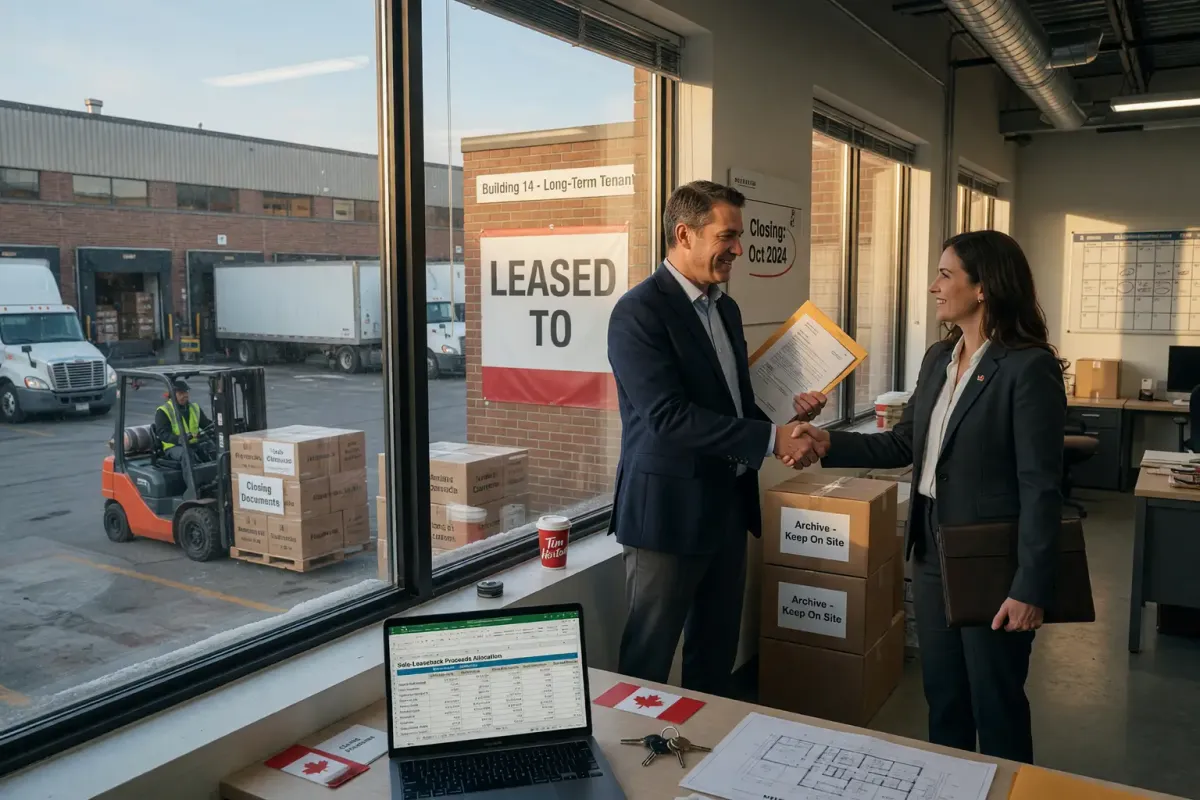
A sale-leaseback is a two-step transaction completed simultaneously:
- You sell your property to an investor or investment entity at fair market value
- You immediately lease it back from the new owner under a long-term lease agreement
After the transaction, nothing changes operationally. You’re still in the same space, running your business the same way. But financially, everything has changed. You’ve converted an illiquid real estate asset into cash, and you’ve converted a property ownership cost into a predictable lease expense.
The buyer gets a property with a built-in tenant (you) and a guaranteed income stream from day one. You get liquidity, balance sheet optimization, and continued use of the property. When structured correctly, both sides win.
How a Sale-Leaseback Works: Step by Step
Step 1: Property Valuation
The property needs a current market valuation, typically through a formal appraisal. The sale price is based on fair market value, which considers comparable sales, replacement cost, and the income approach using market cap rates.
The presence of a committed tenant (you) with a long-term lease actually supports the valuation because it provides income certainty. This is different from valuing a vacant property.
Step 2: Lease Negotiation
This happens in parallel with the sale negotiation. Key lease terms include:
- Lease term: Typically 10-25 years, often with renewal options
- Rent structure: Usually triple net (NNN), where you pay base rent plus property taxes, insurance, and maintenance
- Rent escalations: Annual increases, often tied to CPI or fixed at 1.5-3% per year
- Renewal options: One or more renewal periods at predetermined or market rents
- Tenant improvements: Responsibility for modifications and capital expenditures
- Right of first refusal: Whether you get first crack at repurchasing if the owner decides to sell
Step 3: Due Diligence
The buyer conducts standard commercial real estate due diligence:
- Environmental site assessment
- Building condition report
- Title search and survey review
- Zoning confirmation
- Lease analysis (including your proposed lease terms)
- Financial review of the tenant (your business)
Step 4: Closing
The sale and lease execute simultaneously. You receive the sale proceeds (minus any existing mortgage payoff), sign the lease, and continue operating. From the outside, nothing appears to change.
Step 5: Ongoing Relationship
You become a tenant in a property you used to own. Rent payments replace mortgage payments, property tax payments continue (typically through the NNN lease), and you maintain the property per the lease terms.
A $5 million building with $2 million on the mortgage leaves $3 million frozen — book a free strategy call with LendCity and we’ll walk you through structuring a sale-leaseback that pulls that equity out while you keep operating.
Why Companies Do Sale-Leasebacks
Unlock Trapped Equity
This is the primary motivation. A business that owns a $5 million property with a $2 million mortgage has $3 million in equity that’s effectively frozen. A sale-leaseback converts that $3 million into usable capital immediately.
That capital can fund:
- Business expansion or new locations
- Equipment purchases or technology upgrades
- Inventory growth for scaling businesses
- Debt reduction on higher-cost obligations
- Acquisitions of other businesses
- Working capital for operational needs
Improve Financial Ratios
Selling owned property removes both the asset and associated debt from your balance sheet. This can improve:
- Return on assets (ROA): Lower asset base means higher return percentage
- Debt-to-equity ratio: Eliminating the mortgage reduces reported debt
- Working capital ratios: Cash proceeds improve liquidity metrics
- Return on equity (ROE): Capital freed from real estate can generate higher returns in core business operations
Tax Efficiency
Lease payments are typically fully deductible as a business expense. Compare this to property ownership, where your tax deductions are limited to mortgage interest, depreciation, and operating expenses. The full deductibility of lease payments can create a meaningful tax advantage, though the specifics depend on your corporate tax situation and should be reviewed with your accountant.
Focus on Core Business
Most businesses aren’t in the real estate business. Owning property means managing maintenance, dealing with property tax assessments, handling insurance claims, budgeting for capital expenditures, and managing the risk of property value fluctuations. A sale-leaseback transfers all of those responsibilities to a party whose core business is property ownership.
Eliminate Property Risk
Real estate values fluctuate. Environmental issues can emerge. Zoning changes can affect property use. Major capital expenditures (roof replacement, HVAC overhaul, structural repairs) are unpredictable and expensive. As a tenant under a properly structured lease, many of these risks transfer to the new owner.
Tax Implications in Canada
Sale-leaseback tax treatment in Canada requires careful planning. Here are the main considerations:
Capital Gains on Sale
If the property has appreciated, you’ll realize a capital gain on the sale. In Canada, 50% of capital gains are included in taxable income for both individuals and corporations. You pay tax only on that included half—the effective rate on it varies by province and, for Canadian-controlled private corporations, by small business status.
Key tax factors:
- Adjusted cost base: Your original purchase price plus capital improvements minus CCA (capital cost allowance) claimed
- Recapture of CCA: If you’ve claimed depreciation on the building, the portion of the sale price attributable to recaptured CCA is taxable as ordinary income, not capital gains
- Land vs. building allocation: The sale price must be allocated between land and building, which affects both capital gains and CCA recapture calculations
Lease Payment Deductions
Rent payments under the leaseback are fully deductible as business expenses, subject to normal CRA requirements that the rent is reasonable and at fair market value. This deductibility can offset some of the tax cost of the capital gain realized on sale.
Section 13 and Related Party Rules
CRA has specific rules around sale-leasebacks between related parties. If the buyer is related to the seller (same ownership group, family members, affiliated corporations), the transaction may face additional scrutiny. The sale price must be at fair market value, the lease must be at market rates, and the transaction must have genuine business substance beyond tax planning.
GST/HST Considerations
Commercial real estate sales are generally subject to GST/HST. The buyer will typically be entitled to claim an input tax credit, but the cash flow impact needs to be managed. Self-supply rules may apply in certain situations.
The bottom line: Work with a tax advisor who understands commercial real estate transactions before committing to a sale-leaseback structure.
Sale-leaseback properties with long-term NNN leases finance at 65-75% LTV because lenders love the income certainty — schedule a free strategy session with us and we’ll connect you with commercial lenders who compete hard for these deals.
Lease Structure Considerations
The lease is the most important document in a sale-leaseback. Get it wrong, and you’ve sold your property and locked yourself into unfavorable terms. Get it right, and you’ve created a flexible, predictable occupancy arrangement.
Triple Net (NNN) vs. Gross Lease
Most sale-leasebacks use a triple net structure, where the tenant pays base rent plus all operating costs (property taxes, insurance, and maintenance). This is standard because:
- It aligns with how you were paying these costs as owner
- It gives the buyer a predictable net income stream
- It keeps your total occupancy cost similar to what you were paying before (minus debt service, plus the lease payment)
Gross lease structures are less common in sale-leasebacks but may be appropriate for smaller properties or where the tenant wants maximum cost predictability.
Lease Term
Longer lease terms generally produce better sale prices because they give the buyer more income certainty. A 20-year lease with a creditworthy tenant is worth significantly more than a 5-year lease on the same property.
However, longer terms also lock you in. Consider:
- Your business planning horizon: Don’t commit to a 25-year lease if your business model might change in 10 years
- Renewal options: Build in options rather than extending the initial term
- Early termination rights: Negotiate the ability to exit the lease under specific circumstances (with appropriate penalties)
- Assignment rights: Ensure you can assign or sublease if needed
Rent Escalation Structure
How rent increases over time matters enormously over a long-term lease:
| Escalation Type | Pros | Cons |
|---|---|---|
| Fixed annual increase (e.g., 2%) | Predictable, easy to budget | May not track inflation accurately |
| CPI-linked | Tracks actual inflation | Less predictable for budgeting |
| Market rent resets (e.g., every 5 years) | Keeps rent at market levels | Risk of large jumps at reset dates |
| Flat rent (no increases) | Maximum predictability | Below-market over time; buyer may discount sale price |
Most sale-leasebacks use fixed annual increases or CPI-linked escalations. Market rent resets are more common in shorter-term leases.
Valuation in Sale-Leaseback Transactions
Property valuation in a sale-leaseback is nuanced because the property comes with a built-in lease. The valuation depends on:
The property itself: Location, condition, age, functionality, and comparable sales in the area.
The lease terms: Longer leases with creditworthy tenants at market rents increase value. Below-market rents decrease value. Above-market rents may inflate value but create risk for the buyer.
The tenant credit: Your business’s financial strength directly affects the value. A publicly traded company with strong financials signing a 20-year lease creates more value than a small private company signing a 10-year lease.
Cap rate environment: Sale-leasebacks trade at cap rates that reflect the risk profile of the tenant and lease. Strong-credit tenants with long leases trade at lower cap rates (higher valuations). Weaker credits with shorter leases trade at higher cap rates (lower valuations).
| Tenant Credit Profile | Typical Cap Rate Range | Impact on Value |
|---|---|---|
| Investment-grade corporate | 4.5-6.0% | Highest valuation |
| Strong private company | 6.0-7.5% | Above-average valuation |
| Mid-market private company | 7.5-9.0% | Average valuation |
| Small business / weaker credit | 9.0-12.0% | Below-average valuation |
The Investor Perspective: Buying Sale-Leaseback Deals
Sale-leaseback properties are attractive investments because they offer:
Immediate stabilized income. No lease-up period, no tenant improvement costs, no vacancy risk at acquisition. The tenant is already in place with a signed long-term lease.
Known tenant quality. Unlike acquiring a property with an unknown tenant, sale-leaseback buyers can evaluate the tenant’s financial health before purchasing.
Predictable cash flows. Long-term leases with built-in escalations create highly predictable income streams that are ideal for conservative investors and institutional capital.
Reduced management burden. Under NNN leases, the tenant handles most property management and maintenance, minimizing the landlord’s operational involvement.
Financing Sale-Leaseback Acquisitions
Investors purchasing sale-leaseback properties typically finance through commercial mortgages at favorable terms because:
- Long-term leased properties with creditworthy tenants are considered lower risk by lenders
- The predictable income stream supports strong debt service coverage ratios
- Loan-to-value ratios of 65-75% are standard for well-leased commercial properties
- Interest rates tend to be at the lower end of the commercial mortgage spectrum
Risks for Both Parties
Risks for the Seller/Tenant
- Loss of appreciation: If the property continues to appreciate, those gains go to the new owner, not you
- Long-term cost: Lease payments over 20+ years may exceed what you would have paid in mortgage costs, especially if the property was nearly paid off
- Dependency on landlord: You’re now dependent on a landlord for lease renewals, property decisions, and maintenance standards
- Relocation risk: If the lease expires without renewal, you may need to relocate, which can be extremely expensive and disruptive
- Rent escalation risk: If escalations are tied to market rents, costs could increase substantially
Risks for the Buyer/Landlord
- Tenant credit risk: If the tenant’s business declines, rent collection becomes uncertain
- Property specialization risk: Properties custom-built for a specific tenant (manufacturing facilities, specialized warehouses) may be difficult to re-lease if the tenant leaves
- Above-market rent risk: If the initial rent was set above market, the property’s value will decline as the lease expires and rent resets to market levels
- Capital expenditure surprises: Even under NNN leases, structural and major building system issues can create disputes about maintenance responsibility
- Concentration risk: A single-tenant property with one lease creates binary risk—the investment is either fully occupied or completely vacant
Industries Where Sale-Leasebacks Are Common
Sale-leasebacks are particularly prevalent in industries where companies own significant real estate but need capital for core operations:
Retail chains frequently sell store locations and lease them back, freeing capital for inventory, technology, and expansion.
Industrial and logistics companies with warehouses and distribution centers use sale-leasebacks to fund fleet expansion, equipment upgrades, or acquisitions.
Healthcare providers sell medical office buildings and clinics, redirecting capital into equipment, technology, and practice growth.
Restaurant groups and hospitality companies monetize owned locations to fund new openings or renovations.
Manufacturing businesses with purpose-built facilities use sale-leasebacks to invest in equipment modernization or business acquisition.
Structuring a Sale-Leaseback for Success
For the Seller/Tenant
- Get an independent appraisal before entertaining offers. Know your property’s market value before negotiating.
- Negotiate the lease first, sell second. The lease terms define your occupancy cost for years. Don’t rush through lease negotiation to close the sale.
- Build in flexibility. Renewal options, early termination rights, expansion rights, and assignment rights protect your future interests.
- Understand the tax consequences fully before committing. Work with a tax advisor to model the capital gains impact and lease deduction benefits.
- Choose your buyer carefully. A well-capitalized, professional landlord who maintains properties and honors lease terms is worth more than a slightly higher sale price from an unknown buyer.
For the Buyer/Investor
- Underwrite the tenant, not just the property. The lease is only as good as the tenant behind it. Review financial statements, business trajectory, and industry outlook.
- Stress-test the lease structure. Model scenarios where the tenant vacates, rents need to reset, or capital expenditures exceed expectations.
- Understand the property’s re-lease potential. If the tenant leaves, can you re-lease the property at similar or better rents? Specialized properties carry higher risk.
- Secure appropriate financing. Commercial mortgage terms should align with the lease term and structure.
- Plan for the lease expiration. Whether through renewal negotiation, re-leasing, or sale, have a strategy for what happens when the current lease term ends.
Canadian Market Considerations
The Canadian sale-leaseback market has some characteristics worth noting:
Institutional appetite is strong. Canadian REITs, pension funds, and institutional investors actively seek sale-leaseback opportunities with creditworthy tenants. This competition among buyers generally favors sellers.
Regional variation matters. Cap rates vary significantly across Canadian markets. A sale-leaseback in downtown Toronto or Vancouver trades at very different cap rates than one in a secondary market. Location affects both valuation and the buyer pool.
Environmental due diligence is critical. Canadian environmental regulations are strict, and contaminated properties can create significant liability. Phase I environmental assessments are standard; Phase II may be triggered.
Provincial lease laws vary. Commercial tenancy legislation differs across provinces. Lease terms that work in Ontario may need adjustment for Alberta or British Columbia. Legal review in the relevant province is essential.
Frequently Asked Questions
Is a sale-leaseback right for my business?
A sale-leaseback makes sense when your business has significant equity in owned real estate, needs capital for growth or operations, and can benefit from the tax treatment of lease payments versus ownership costs. It’s most compelling when the capital freed up can generate returns higher than the effective cost of leasing. If your property is nearly paid off and you don’t have productive uses for the freed capital, the transaction may not make economic sense.
How is rent determined in a sale-leaseback?
Rent is typically set at market rates for comparable properties in the area. The rent must be at fair market value for both accounting and tax purposes. If the rent is set artificially high, the sale price may be inflated to compensate, creating problems with CRA and financial reporting. If rent is set too low, the sale price may not adequately compensate you for the property’s value. Your commercial mortgage broker and real estate advisor can help benchmark appropriate rent levels.
Can I buy the property back later?
You can negotiate a right of first refusal (ROFR) or a repurchase option in the lease. A ROFR gives you the right to match any third-party offer if the owner decides to sell. A repurchase option gives you the right to buy at a predetermined price or formula at a specific time. However, repurchase options can complicate the accounting treatment of the transaction, so discuss the implications with your accountant.
How long does a sale-leaseback transaction take?
A typical sale-leaseback takes 60-120 days from initial agreement to closing. The timeline includes property valuation (2-4 weeks), lease negotiation (2-4 weeks), buyer due diligence (4-6 weeks), and closing preparation (2-3 weeks). Transactions can move faster with motivated parties and clean properties, or slower if environmental issues, title problems, or complex lease negotiations arise.
What if I want to make improvements to the property after the sale?
Your ability to modify the property is governed by the lease. Most sale-leaseback leases allow the tenant to make non-structural modifications with landlord notice, and require landlord approval for structural changes. Negotiate clear tenant improvement rights in the lease, including who pays for improvements, whether they become landlord property at lease expiration, and what restoration obligations exist if you leave.
How does a sale-leaseback affect my financial statements?
Under IFRS 16 (which applies to most Canadian public companies), the leaseback creates a right-of-use asset and lease liability on your balance sheet. The accounting treatment depends on whether the sale qualifies as a sale under IFRS 15. Under ASPE (used by many private Canadian companies), operating leases may be treated differently. Work with your accountant to understand the financial statement impact before proceeding.
Is a Sale-Leaseback Right for You?
If you own commercial property with significant equity, a sale-leaseback deserves serious analysis. The decision comes down to whether the capital freed up can generate returns that exceed the long-term cost of leasing versus owning.
This isn’t a decision to make in isolation. You need input from your accountant (tax implications), your lawyer (lease terms and sale structure), and a commercial mortgage professional who understands how these transactions are structured and priced in the current market.
Book a Strategy Call to Explore Sale-Leaseback Options
Free download
Investor pre-approval readiness checklist
Documents and a portfolio summary to bring to a strategy call so the file is lender-ready.
By submitting, you agree to receive occasional emails from LendCity. You can unsubscribe at any time.
4.8/5 (116 Google reviews)
Disclaimer: LendCity Mortgages is a licensed mortgage brokerage. Content on this page is for educational purposes only and does not constitute legal, tax, investment, securities, or financial-planning advice. Rates, premiums, program terms, and regulations referenced are as of the page's last updated date and are subject to change. Any investment returns, rental yields, tax savings, or case-study figures shown are illustrative only — they are not guaranteed, not typical, and individual results will vary. Consult a licensed lawyer, Chartered Professional Accountant, or registered dealer before acting on any information above. Editorial standards.

Written by
Scott Dillingham
Published
July 24, 2026
Reading time
13 min read
Above-Market Rent
Rental rates higher than comparable properties in the same area. Above-market rents can inflate DSCR calculations artificially and may lead to higher vacancy or tenant turnover when leases expire.
Adjusted Cost Base
The original purchase price of a property plus qualifying capital improvements and acquisition costs, minus any CCA claimed. The adjusted cost base is subtracted from the sale price to determine the taxable capital gain.
Appraisal
A professional assessment of a property's market value, required by lenders to ensure the property is worth the loan amount.
Appreciation
The increase in a property's value over time, which builds [equity](/glossary/equity/) and wealth for the owner through market growth or [forced improvements](/glossary/forced-appreciation/).
Below-Market Rent
Rental rates lower than comparable properties in the same area. Below-market rents represent a value-add opportunity where an investor can increase property value by raising rents to market levels.
Business Acquisition Financing
Loans used to purchase an existing business, typically qualified based on the business's net operating income and historical financials. Some programs can cover up to 100% of the purchase price for qualified buyers.
Capital Expenditures
Major one-time expenses for property improvements that extend the useful life of the asset, such as roof replacement, foundation repairs, or new HVAC systems. CapEx differs from regular maintenance and is typically budgeted separately in investment property analysis.
Cap Rate
Capitalization Rate - the ratio of a property's [net operating income (NOI)](/glossary/noi/) to its current market value or purchase price. A 6% cap rate means the property generates $60,000 NOI annually on a $1,000,000 value. Used to compare investment properties regardless of financing. See also [DSCR](/glossary/dscr/) and [Cash-on-Cash Return](/glossary/cash-on-cash-return/).
Capital Cost Allowance
The Canadian tax deduction that allows property owners to write off the depreciation of a building over time, reducing taxable rental income. CCA cannot be used to create a rental loss and must be recaptured upon sale of the property.
Capital Gains Tax
Tax owed on the profit from selling an investment property, calculated as the difference between the sale price and the adjusted cost base. In Canada, 50% of capital gains are currently included in taxable income. A 2024 federal budget proposal to raise the inclusion rate to 66.67% on gains above $250,000 was deferred and has not been enacted; the 50% rate remains in effect. Tax outcomes depend on your specific situation — consult a Chartered Professional Accountant.
Hover over terms to see definitions. View the full glossary for all terms.