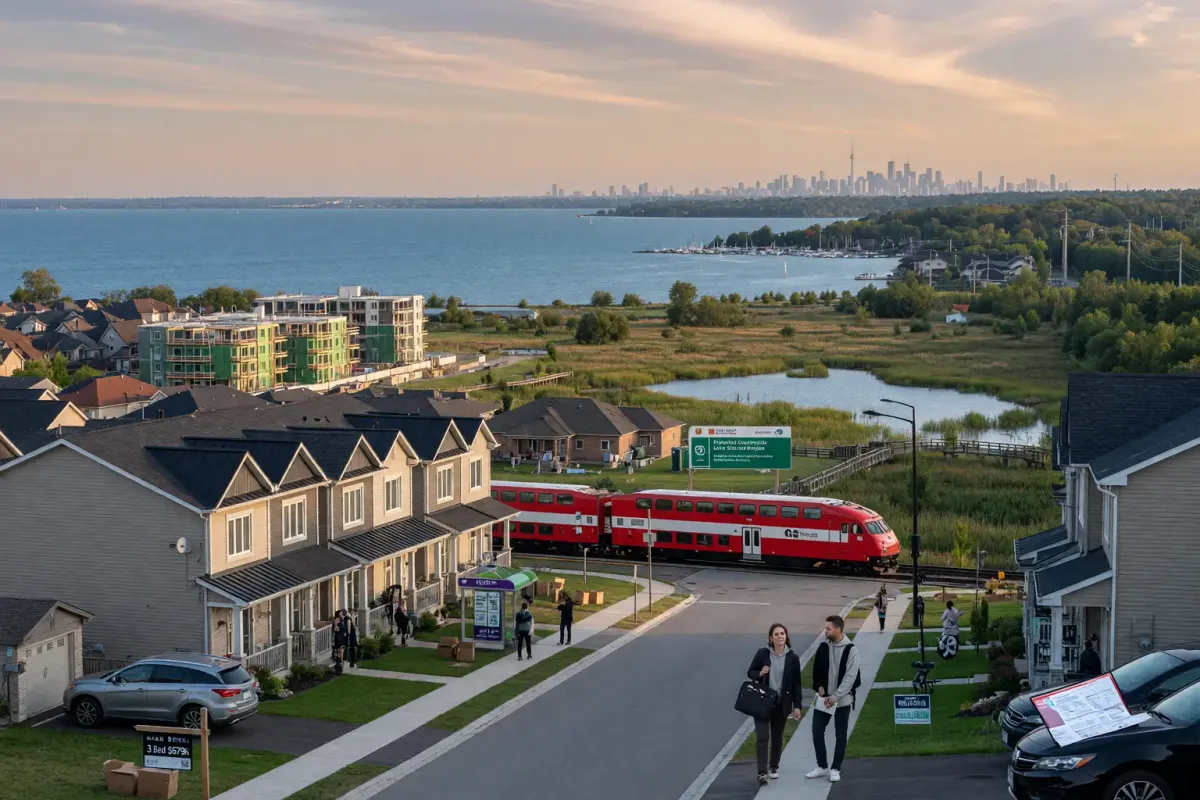
Barrie is what happens when Toronto gets too expensive for regular people.
Young professionals, growing families, anyone who wants to buy a house without selling a kidney—they’re flooding out of the GTA and landing in Barrie. It’s close enough to commute to Toronto jobs, affordable enough to actually buy, and growing fast enough to make investors pay attention.
Let me show you why Barrie deserves a spot on your radar.
The Barrie Story
Barrie sits at the northern edge of the Golden Horseshoe—that economically vibrant region around Lake Ontario that’s home to about one in five Canadians. It’s not Toronto, but it’s connected to Toronto in ways that matter.
GO Transit links Barrie directly to Toronto’s network. Highway access makes commuting doable. And prices? Significantly below what you’d pay in the GTA for comparable properties.
| Factor | What It Means |
|---|---|
| Population growth | Sustained rental demand |
| Toronto proximity | Commuter tenant pool |
| Relative affordability | Lower acquisition costs |
| Tourism activity | Short-term rental potential |
| Infrastructure investment | Long-term appreciation support |
This combination—accessibility plus affordability—creates the migration patterns that drive real estate markets. People move where they can afford to live while keeping their jobs.
Why Supply Constraints Matter
Here’s something most investors don’t realize about Barrie: it can’t just sprawl endlessly.
Lake Simcoe sits to the east. The Ontario Greenbelt—over two million protected acres that can’t be developed—wraps around to the west. These geographic constraints limit where new housing can go, concentrating growth within defined boundaries.
Limited land plus growing population equals property appreciation over time. Simple supply and demand.
Current investors have advantages that future investors won’t. As remaining development capacity fills, entry costs rise. That window doesn’t stay open forever.
The Tenant Base
Barrie attracts a specific demographic profile that works well for landlords.
Commuters form the backbone of the tenant pool. These are people with Toronto-area jobs who can’t afford Toronto-area housing. They have stable employment, decent incomes, and strong motivation to find quality rentals that reduce their commute.
Growing families seeking affordable communities with good schools. They’re putting down roots, which translates to longer tenancies and better property care.
Young professionals building careers and household formation. Educated, employed, quality tenants.
The median age skews younger than retirement, suggesting people in family-formation and career-building phases. This demographic creates demand for quality housing appropriate for growing households.
Beyond Commuting: Local Economy
While commuting defines much of Barrie’s housing demand, the city has developed its own economic base.
Healthcare, education, retail, and professional services all employ significant numbers. Georgian College brings students and creates related employment. The growing population attracts commercial development that creates more local jobs.
This diversification matters. If GTA economic conditions fluctuate, local employment provides stability. You’re not entirely dependent on Toronto’s economy—though you certainly benefit from proximity to it.
Tourism and Short-Term Rentals
Barrie’s natural setting creates opportunities beyond traditional rentals.
Lake Simcoe offers waterfront access. Ski resorts are nearby. Hiking and biking trails attract outdoor enthusiasts. Unlike pure seasonal destinations, Barrie’s diverse attractions generate visitor activity year-round.
Tourism Barrie actively promotes the area, marketing that benefits property investors positioning for short-term rentals.
Before pursuing short-term strategies:
- Research current regulations and licensing requirements
- Understand restrictions on rental periods and operational requirements
- Evaluate whether specific properties suit short-term use
- Compare management intensity to traditional rentals
Short-term rentals can outperform traditional rentals but require different operational approaches.
Transit and Transportation
GO Transit connections directly impact property values and rental demand.
Properties near transit stations command premium rents from commuters who rely on public transportation. A 15-minute walk to GO service versus a 45-minute bus ride significantly affects tenant appeal.
Highway access matters too for car-dependent commuters. Barrie’s position along major corridors provides options, though traffic congestion affects peak-hour commutes.
Watch for infrastructure announcements. Transit expansion, highway improvements, and development projects can significantly impact specific neighborhoods. Properties positioned to benefit from upcoming improvements may appreciate as development progresses.
Building Your Team
If you’re not local, you need local relationships.
Real estate agents familiar with investment priorities can identify neighborhoods that attract quality tenants and property types that perform well.
Mortgage brokers experienced with investor financing understand local property characteristics and lender preferences.
Property managers who know the Barrie market screen tenants effectively and maintain properties to local standards.
These relationships provide knowledge and operational capabilities that remote investors can’t easily replicate. Build them before you buy.
Frequently Asked Questions
Is Barrie more affordable than Toronto?
What property types work best in Barrie?
How does Barrie compare to other Ontario markets?
What are the risks of investing in Barrie?
Should I invest if I don't live in Barrie?
How does GO Transit access affect property values in Barrie?
Are short-term rentals a viable strategy in Barrie?
The Bottom Line
Ready to explore your financing options? Book a free strategy call with LendCity and let our team help you find the right path forward.
Barrie represents classic GTA spillover economics: Toronto’s prices push people outward, and Barrie catches the demand.
Young demographics, strong employment connections, geographic supply constraints, and continued Toronto migration support the investment thesis. Properties accessible to transit and employment centers attract quality tenants willing to pay reasonable premiums.
The market isn’t undiscovered—plenty of investors have noticed. But for those priced out of Toronto looking for Ontario exposure with genuine growth potential, Barrie continues to offer compelling opportunities.
Do your homework. Build local relationships. Buy properties that cash flow from day one.
The fundamentals are there if you know how to capture them.
Free tool
Build a property proforma
Fill in income and expenses, then export a Year-1 operating statement (NOI, cap rate, cash flow, DSCR).
Disclaimer: LendCity Mortgages is a licensed mortgage brokerage. Content on this page is for educational purposes only and does not constitute legal, tax, investment, securities, or financial-planning advice. Rates, premiums, program terms, and regulations referenced are as of the page's last updated date and are subject to change. Any investment returns, rental yields, tax savings, or case-study figures shown are illustrative only — they are not guaranteed, not typical, and individual results will vary. Consult a licensed lawyer, Chartered Professional Accountant, or registered dealer before acting on any information above. Editorial standards.

Written by
Scott Dillingham
Published
August 1, 2026
Reading time
5 min read
Appreciation
The increase in a property's value over time, which builds [equity](/glossary/equity/) and wealth for the owner through market growth or [forced improvements](/glossary/forced-appreciation/).
Cash Flow Optimization
Cash flow optimization is the strategic process of maximizing the net income generated from a rental property by increasing rental revenue and minimizing operating expenses, mortgage costs, and vacancies. For Canadian real estate investors, this often involves tactics such as selecting the right financing structure, leveraging rental income from multiple units, and managing expenses like property taxes and maintenance to ensure the property generates consistent positive monthly returns.
Cash Flow
The money left over after collecting rent and paying all expenses including mortgage, taxes, insurance, maintenance, and property management. Positive cash flow is the primary goal of buy-and-hold investors. See also [NOI](/glossary/noi/), [Cash-on-Cash Return](/glossary/cash-on-cash-return/), and [Vacancy Rate](/glossary/vacancy-rate/).
Comparable Properties
Similar properties in the same market area used to establish fair market value or rental rates through comparison of features, location, condition, and recent sale or rental prices. Analyzing comps is essential when determining offer prices and setting competitive rents.
Mortgage Broker
A licensed professional who shops multiple lenders to find the best mortgage rates and terms for borrowers. Unlike banks, brokers have access to dozens of lending options.
Property Manager
A property manager is a professional or company hired by a real estate investor to handle the day-to-day operations of a rental property, including tenant screening, rent collection, maintenance, and ensuring compliance with provincial landlord-tenant legislation. For Canadian investors, using a property manager is especially common when owning multiple properties or investing in markets outside their home province, with management fees typically ranging from 5% to 10% of collected rent.
Real Estate Agent
A licensed professional who represents buyers or sellers in real estate transactions, providing market expertise, negotiation skills, and access to the MLS. Working with an investor-friendly agent who understands rental property analysis and financing strategies can significantly impact deal quality.
Short-Term Rental
A furnished property rented for periods shorter than 30 days through platforms like Airbnb or VRBO. Short-term rentals generate higher gross revenue but carry higher operating costs and stricter municipal regulations.
Single Family
A detached home designed for one household, the most common property type for beginner real estate investors.
STR
Short-Term Rental - a furnished property rented for periods of less than 30 days, typically through platforms like Airbnb or VRBO. STRs can generate 2-3x the income of long-term rentals but require more active management, higher operating costs, and compliance with local short-term rental regulations.
Hover over terms to see definitions. View the full glossary for all terms.