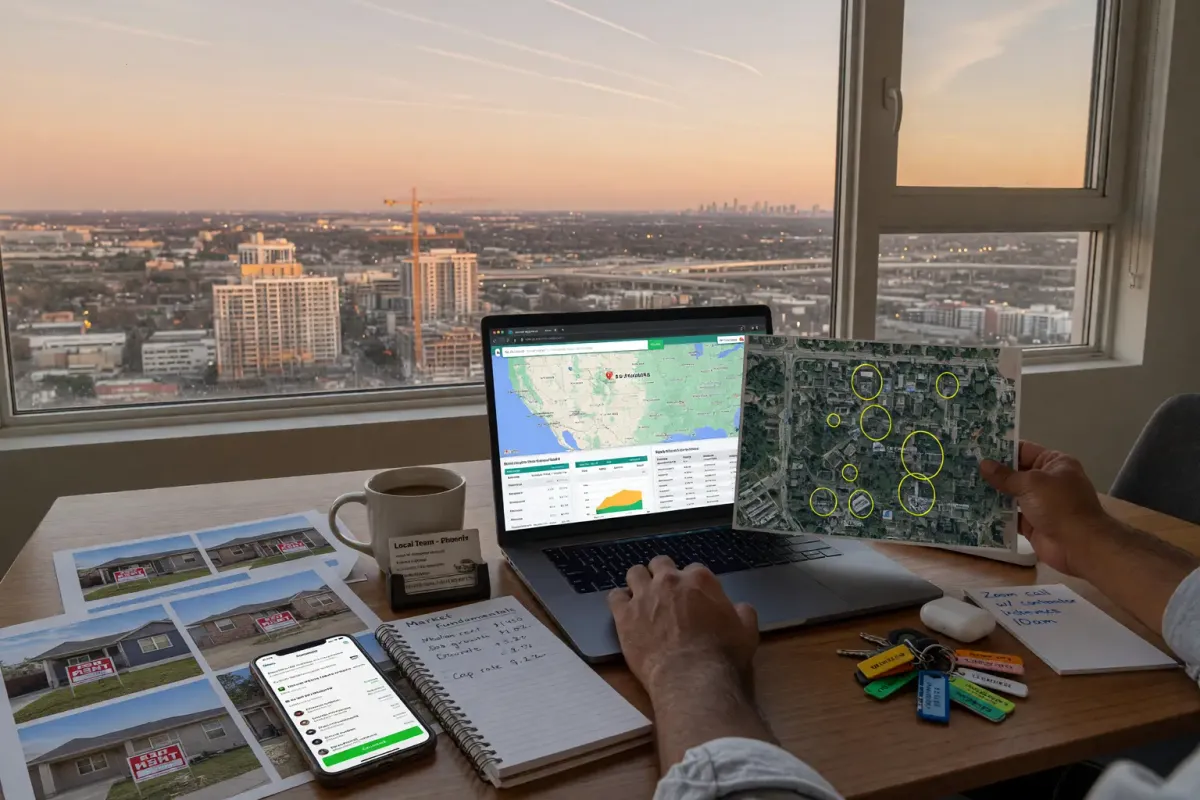
Investing in local real estate is a comfortable way to get started in the real estate investment market. However, depending on where you live, the potential to build strong, cash-flowing portfolios may be limited by property values and real estate conditions near you. Perhaps you have dreams of investing in major markets like Toronto or Vancouver from the comfort of home. This is where long distance real estate investing becomes relevant.
Long distance investing lets you buy in markets your local prices lock you out of. I’ve seen investors in Toronto and Vancouver pick up cash-flowing rentals in secondary cities they never could have touched at home—building passive income and equity without waiting for their backyard to become affordable.
Let’s look at how to successfully invest in properties located far from where you live.
Why Consider Long Distance Real Estate Investing?
Long distance investing opens doors that local-only approaches keep closed. Understanding the benefits helps evaluate whether this strategy suits your situation.
| Benefit | Description | Impact |
|---|---|---|
| Market Access | Buy in cities with stronger rents, jobs, and population growth than your own | You stop being stuck with whatever your postal code offers |
| Risk Management | Spread holdings across regions so one local downturn does not hit everything | A plant closure or housing slump in one city cannot wipe out your whole portfolio |
| Yield Gap | Use high home equity or cheap financing at home to buy higher-cap-rate properties elsewhere | Turn expensive-market equity into actual monthly cash flow |
| Scale | Tap larger inventory pools instead of fighting over the same three local listings | You can add doors faster without bidding wars against every neighbour |
Access New Markets and Opportunities
Your local market may not offer the best investment opportunities. High prices, low yields, or weak fundamentals might limit local investing success. Long distance investing enables accessing markets with better characteristics.
Investors in expensive coastal cities often find better cash flow in inland markets. Those in weak economic areas may find stronger appreciation potential elsewhere.
Managing Risk Through Diversification
Geographic concentration exposes portfolios to local economic risks. If your city’s major employer closes or your region experiences economic challenges, all locally-concentrated investments suffer simultaneously.
Spreading investments across multiple markets reduces exposure to any single region’s problems. This diversification provides portfolio stability.
Objectivity Is Easier From a Distance
Local investing can blur numbers with emotion—you drive past the house, know the neighbourhood personally, or stretch to “win” a familiar street. Distance forces you to lean on rent-to-price ratios, vacancy data, and your local team’s report instead of gut attachment. That discipline is one of the quiet advantages of out-of-town investing when competition at home is intense.
How to Invest in Long Distance Real Estate
Successful long distance investing requires systematic approaches that address the challenges of remote ownership.
Research Target Markets
Before investing anywhere, thoroughly research potential markets. Examine economic fundamentals including employment growth, population trends, major employers, and housing supply dynamics.
Analyze real estate specifics including price trends, rental rates, vacancy levels, and investor activity. Compare multiple markets to identify those offering the best combinations of yield and stability.
Connect with Local Professionals
Building relationships with local professionals is essential for long distance success. You cannot personally handle every task from hundreds of kilometers away.
Key relationships include:
- Real estate agents who understand investor needs
- Property managers who handle ongoing operations
- Contractors for repairs and renovations
- Lenders familiar with the target market
Begin Investing Strategically
Start with properties that match your remote management capabilities. Simpler properties with fewer maintenance needs suit remote ownership better than complex or troubled properties.
Consider beginning with a single property to test your systems and relationships before scaling. Learning lessons on one remote property is less costly than learning across many.
Some long-distance investors also weigh self-storage against residential rentals when testing a single remote asset. Understanding how storage unit investing compares to rentals for Canadians clarifies returns, management load, REITs, and demand drivers before scaling.
Building Your Remote Team
Your team becomes your eyes, ears, and hands in distant markets. Building strong teams enables successful long distance investing.
Property Managers
Property managers are critical for long distance investing. They handle tenant placement, rent collection, maintenance coordination, and problem resolution.
Select managers carefully based on experience, references, and communication quality. Poor management undermines investment success regardless of property quality.
Real Estate Agents
Agents provide market knowledge, property access, and transaction support. Work with agents who understand investor priorities rather than only serving homebuyers.
Investor-focused agents help identify deals, provide honest assessments, and support efficient transactions.
Contractors and Vendors
Reliable contractors handle maintenance and repairs when you cannot personally oversee work. Building vendor relationships through your property manager or directly ensures quality service.
Technology for Remote Management
Modern technology makes long distance investing more practical than ever.
Communication Tools
Video calls enable face-to-face meetings with team members regardless of location. Screen sharing facilitates document review and decision-making.
Property Management Software
Online portals provide real-time access to property performance data, maintenance requests, and financial reports. This visibility enables informed decisions without physical presence.
Documentation Systems
Digital document storage and electronic signatures streamline transactions and record-keeping. Cloud-based systems enable access from anywhere.
Frequently Asked Questions
Is long distance real estate investing risky?
How do I find good property managers in distant markets?
Should I visit properties before purchasing?
What markets work best for long distance investing?
How do I manage properties from far away?
How do I build trust with a remote team I have never met in person?
What technology tools are essential for managing properties remotely?
Building Your Long Distance Strategy
Ready to explore your financing options? Book a free strategy call with LendCity and let our team help you find the right path forward.
Long distance investing expands your opportunity set beyond local limitations. With proper preparation and team building, investors can successfully own properties they rarely or never see in person.
Start by identifying markets offering advantages your local area lacks. Research thoroughly before committing.
Build relationships with professionals who can represent your interests effectively. These relationships enable remote success.
Begin modestly to test your systems before scaling. Early lessons inform future expansion.
For investors who develop appropriate skills and relationships, long distance investing opens doors to opportunities that local-only approaches cannot access.
Free tool
Build a property proforma
Fill in income and expenses, then export a Year-1 operating statement (NOI, cap rate, cash flow, DSCR).
Disclaimer: LendCity Mortgages is a licensed mortgage brokerage. Content on this page is for educational purposes only and does not constitute legal, tax, investment, securities, or financial-planning advice. Rates, premiums, program terms, and regulations referenced are as of the page's last updated date and are subject to change. Any investment returns, rental yields, tax savings, or case-study figures shown are illustrative only — they are not guaranteed, not typical, and individual results will vary. Consult a licensed lawyer, Chartered Professional Accountant, or registered dealer before acting on any information above. Editorial standards.

Written by
Scott Dillingham
Published
July 28, 2026
· Updated August 2, 2026Reading time
6 min read
Appreciation
The increase in a property's value over time, which builds [equity](/glossary/equity/) and wealth for the owner through market growth or [forced improvements](/glossary/forced-appreciation/).
Cap Rate
Capitalization Rate - the ratio of a property's [net operating income (NOI)](/glossary/noi/) to its current market value or purchase price. A 6% cap rate means the property generates $60,000 NOI annually on a $1,000,000 value. Used to compare investment properties regardless of financing. See also [DSCR](/glossary/dscr/) and [Cash-on-Cash Return](/glossary/cash-on-cash-return/).
Cash Flow Optimization
Cash flow optimization is the strategic process of maximizing the net income generated from a rental property by increasing rental revenue and minimizing operating expenses, mortgage costs, and vacancies. For Canadian real estate investors, this often involves tactics such as selecting the right financing structure, leveraging rental income from multiple units, and managing expenses like property taxes and maintenance to ensure the property generates consistent positive monthly returns.
Cash Flow
The money left over after collecting rent and paying all expenses including mortgage, taxes, insurance, maintenance, and property management. Positive cash flow is the primary goal of buy-and-hold investors. See also [NOI](/glossary/noi/), [Cash-on-Cash Return](/glossary/cash-on-cash-return/), and [Vacancy Rate](/glossary/vacancy-rate/).
Contractor
A licensed professional hired to perform construction, renovation, or repair work on investment properties. Using licensed and insured contractors is essential for permitted work, as unlicensed contractors can result in voided insurance, property liens, and liability for injuries.
Equity
The difference between a property's current market value and the remaining mortgage balance. If your home is worth $500,000 and you owe $300,000, you have $200,000 in equity. Equity builds through mortgage payments, [appreciation](/glossary/appreciation/), and [forced appreciation](/glossary/forced-appreciation/). See also [LTV](/glossary/ltv/) and [Refinancing](/glossary/refinancing/).
Foundation
The structural base of a building that transfers loads to the ground. Foundation issues such as cracks, settling, or water intrusion are among the most expensive repairs in real estate and can significantly impact property value and financing eligibility.
ITIN
Individual Taxpayer Identification Number - a US tax ID for foreign nationals, required for Canadians to invest in US real estate and file US taxes.
Lien
A legal claim against a property used as security for a debt. Liens arise from unpaid mortgages, property taxes, contractor work, or court judgments. Undiscovered liens can eliminate an apparent purchase discount on distressed properties.
Passive Income
Earnings from rental properties or investments that require minimal day-to-day involvement. The goal of most real estate investors seeking financial freedom.
Hover over terms to see definitions. View the full glossary for all terms.