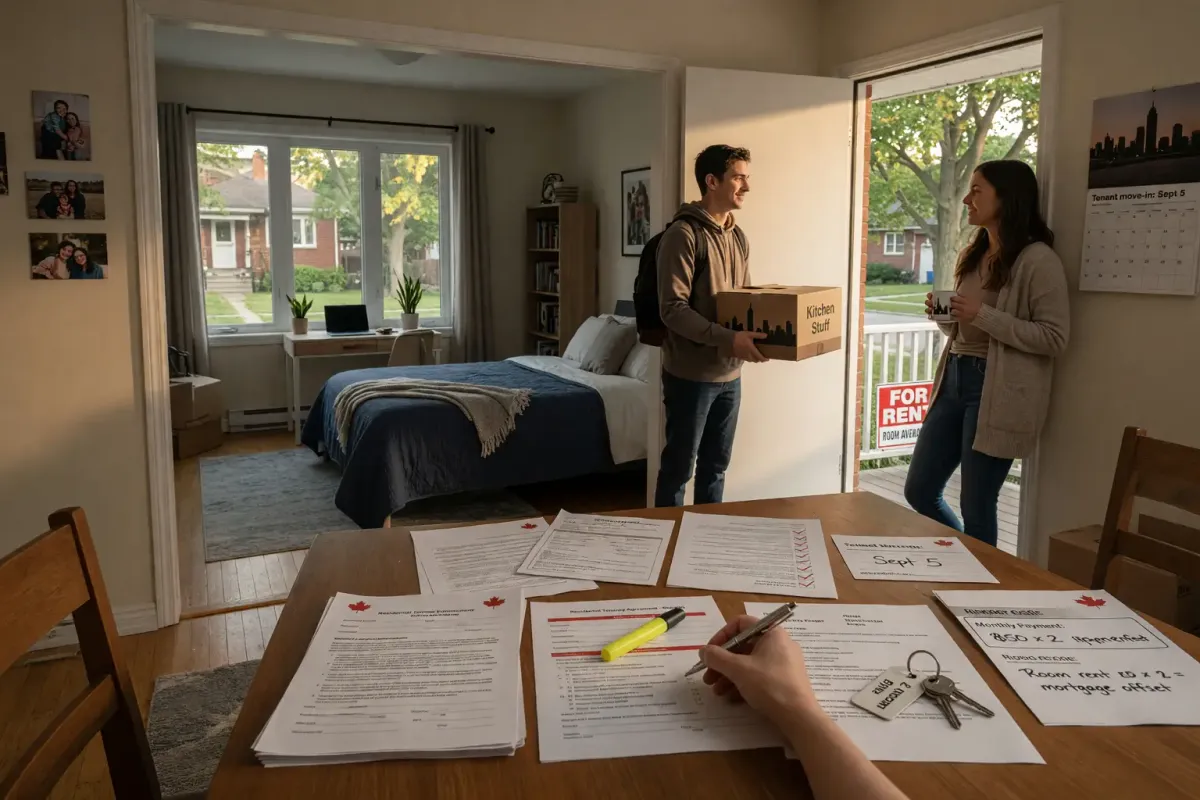
Renting rooms in your primary residence is one of the fastest ways to create supplemental income without buying another property. This is classic house hacking: you cut your personal housing costs and, in strong setups, turn housing from an expense into a break-even or cash-flow positive play. Here’s how to set up room rentals the right way—from Canadian legal rules to tenant management—so you capture the upside without unnecessary headaches.
The Room Rental Opportunity
Room rentals represent accessible entry points into real estate income generation.
Why Consider Room Rentals
Room rentals use existing assets without additional property acquisition. Your home already exists with space that may be underutilized. Converting unused rooms to income-producing spaces requires minimal additional investment.
Housing cost reduction is the primary benefit. Rental income offsets mortgage payments, utilities, and maintenance costs. Depending on local markets and available rooms, this income can substantially reduce or eliminate net housing costs.
Investment portfolio acceleration becomes possible when housing costs decrease. Money previously consumed by housing expenses can be redirected toward savings, debt reduction, or additional investments. Room rentals can accelerate financial goals that seemed distant.
| Benefit | Description | Potential Impact |
|---|---|---|
| Cost reduction | Offset housing expenses | Significant monthly savings |
| Income generation | Create new revenue stream | Additional monthly income |
| Investment acceleration | Free capital for other uses | Faster portfolio growth |
| Low barrier entry | No additional property needed | Immediate setup |
Understanding the Trade-offs
Room rentals involve sharing your living space with others. This basic reality creates trade-offs that not everyone can accept.
Privacy reduction is inherent in room rentals. Tenants occupy your home, use shared spaces, and are present during your personal time. That’s a fundamentally different experience from landlording a separate property down the street.
Lifestyle adjustments may be necessary. Your routines, guests, noise levels, and personal habits must accommodate housemates. Some find this easy; others find it intolerable.
Tenant quality matters more intensely when you share space with tenants. Problematic tenants in separate properties create management headaches; problematic housemates create daily living difficulties.
Legal and Regulatory Considerations
Room rentals in Canada are governed mainly at the provincial and municipal level. The rules you follow in Toronto are not the same as those in Vancouver or Calgary—so verify before you list a room.
Local Regulations
Research provincial residential tenancy rules and your city’s bylaws before you take a dime in rent.
In Ontario, the Residential Tenancies Act (RTA) often does not fully apply when you share a kitchen or bath with your tenant in your own home—but municipal licensing, occupancy, and zoning rules still can. In B.C., the Residential Tenancy Act has specific treatment for roommate-style arrangements, and cities like Vancouver add business-licence and secondary-suite requirements. Alberta, Quebec (where the Civil Code and the Tribunal administratif du logement matter), and other provinces each set their own landlord-tenant framework. Don’t assume “shared accommodation” means zero regulation.
Zoning and occupancy limits may restrict how many people can legally live in your home and whether room rentals are allowed on your lot. Some municipalities cap unrelated occupants or require a licence for any rental activity, including rooms in a primary residence.
Business licensing or landlord registration may apply even for a single room. Check your city’s website and provincial tenancy branch before you advertise.
Mortgage Implications
Mortgage agreements may address rental activities in your primary residence.
Owner-occupancy clauses on many Canadian uninsured and insured mortgages require you to live in the property as your primary residence. Renting rooms usually doesn’t break that—you’re still living there—but read your commitment letter and charge terms. Some lenders want written notice before any rental activity.
Tell your lender if your mortgage requires it. Surprises at renewal or after a claim are how good deals turn into expensive problems.
How Lenders Underwrite Room Rental Income
Room rentals are underwritten differently from a standard single-family or multi-family rental. Most major residential lenders will not count room-by-room income toward qualification. That leaves a narrower set of options: alternative/B lenders (usually higher rates), portfolio lenders who keep loans on their books, commercial products for larger rooming-house style assets, or private financing as a bridge.
Lenders are cautious because of higher turnover, shared-living complexity, regulatory uncertainty, valuation challenges, and weaker exit liquidity. Student rentals and formal rooming houses face even tighter acceptance than renting one or two rooms in an owner-occupied home.
If you need a lender to recognize room income, expect to document individual room leases, payment history, rental track record, and property condition—and assume they will use only a percentage of gross room rent with conservative vacancy. If room income will not count, qualify on personal income, keep debt ratios strong, and size the purchase so you do not depend on every bedroom staying full.
Call your insurance broker before the first tenant moves in. A standard homeowners policy (and many Canadian condo corp policies) may exclude or limit claims tied to rental activity. You may need a rental endorsement or a landlord-style rider. Skipping this step can mean a denied claim if a tenant or their guest causes damage or injury.
Lease Agreements
Formal agreements protect both parties regardless of relationship informality.
Written lease agreements establish clear terms, responsibilities, and expectations. Even for casual arrangements with friends or acquaintances, written agreements prevent misunderstandings.
Include essential terms: rent amount, payment timing, shared space usage, guest policies, termination provisions, and house rules. Clear agreements prevent conflicts arising from different assumptions.
Read your province’s residential tenancy rules and any roommate or shared-accommodation exemptions. In several provinces, full landlord-tenant protections apply differently when you share a kitchen or bathroom with the occupant—yet notice periods, deposit rules (where allowed), and human rights obligations can still bind you. When in doubt, check the provincial tenancy branch guidance or get a quick legal read before you sign anyone up.
Finding Suitable Tenants
Tenant selection requires particular care when sharing living space.
Screening Priorities
Standard tenant screening applies, but additional factors matter when sharing space.
Financial qualification remains essential. Tenants must be able to pay rent reliably. Verify income, check references, and assess financial stability.
Lifestyle compatibility matters more in room rentals than separate properties. Your schedules, cleanliness standards, noise tolerance, and social habits should be reasonably compatible.
Character assessment influences daily living quality. Trustworthy, respectful, communicative people make better housemates regardless of financial qualifications.
Finding Candidates
Multiple channels reach potential room renters.
Online platforms connect room seekers with available spaces. Major listing sites include room rental categories alongside full-property listings.
Personal networks often provide strong candidates. Friends, colleagues, and acquaintances who know potential renters can vouch for character in ways strangers cannot.
Local community connections—religious organizations, clubs, schools—may connect you with suitable candidates from shared communities.
Interview Process
In-person meetings help assess compatibility beyond paper qualifications.
Meet candidates in your home to see how they interact with the space. Their reactions and questions reveal whether they’d be comfortable living there.
Discuss lifestyle factors directly: schedules, guests, noise, cleanliness, pets, smoking. Honest conversations about potential friction points prevent later conflicts.
Financial qualification matters, but you’re also choosing a housemate. Someone you find personally difficult isn’t right regardless of their credit score.
Managing the Arrangement
Ongoing management ensures room rentals work smoothly.
Setting House Rules
Clear rules prevent conflicts over shared space usage.
Common area usage should be defined. Kitchen schedules, bathroom sharing, living room access, and similar issues benefit from explicit discussion and agreement.
Guest policies should be established. How many guests, how often, overnight visitors—these questions deserve clear answers before tenancy begins.
Quiet hours, cleanliness expectations, and shared responsibility allocation should be explicit rather than assumed.
Rent Collection
Establish clear payment procedures and enforce them consistently.
Payment timing, acceptable methods, and late fee policies should be defined in writing. Collect rent consistently according to these terms.
Informal arrangements can breed problems. Even friendly relationships benefit from business-like rent collection practices.
Conflict Resolution
Living together inevitably creates friction that requires management.
Address issues promptly rather than allowing resentment to build. Small problems grow when ignored; early discussion resolves most conflicts.
Keep perspective on the dual role. You’re both landlord and housemate—enforcing rent and rules while still sharing a kitchen takes a steady hand, not a power trip.
Know when the arrangement isn’t working. Not every room rental succeeds. If conflicts stay irreconcilable, end it cleanly under your written agreement and provincial notice rules rather than letting the household turn toxic.
Financial Optimization
Maximize room rental benefits through strategic approaches.
Pricing Strategy
Price the room so you attract solid tenants and still move the needle on your housing costs.
Start with comps. Search Kijiji, Facebook Marketplace, and local roommate boards for similar rooms in your neighbourhood—same rough size, bath setup, and transit access. In many Canadian cities, a furnished room with utilities included lands around 40–70% of a comparable studio rent. Use that band as a sanity check, then adjust for what you actually offer.
What moves price up: private ensuite, dedicated parking, in-suite laundry access, newer finishes, included utilities, and furnished setup. What pulls it down: shared bath only, longer commute to the core, strict guest rules, or an unfurnished bare room.
Run the math on your real goal. If the mortgage, taxes, and insurance total $2,800 and one room at $900 plus another at $850 gets you to near break-even, that may beat squeezing an extra $50 and sitting vacant for six weeks. Vacancy kills returns faster than a slightly lower rent.
Decide utilities up front and reflect them in the number. “Rent all-in” is simpler and often commands a premium; separate utility splits keep consumption honest but add admin. Put the structure in the lease so nobody debates it in month three.
Revisit pricing when a tenancy ends. Markets in centres like Toronto, Vancouver, Calgary, and Halifax shift with student cycles, employment, and seasonal demand—don’t leave last year’s rate on autopilot.
Tax Implications
Room rental income has tax implications requiring attention.
Rental income is generally taxable with the CRA. Report room rental income on your return—usually as rental income when you’re operating a boarding-style arrangement in your home.
Deductions may apply for the rental portion of your home. A reasonable share of mortgage interest, property taxes, utilities, insurance, and maintenance can often be claimed based on space (square footage) or another fair method. Keep clear records. If you only rent a room occasionally the tax treatment can differ, so confirm current CRA guidance or run it past your accountant before filing.
Expense Allocation
Determine how expenses are shared between you and tenants.
Utilities can be included in rent or billed separately. Including utilities simplifies management but creates consumption uncertainty; separate billing adds complexity but aligns incentives.
Shared supplies—cleaning products, paper goods, common food—need expense allocation agreement. Clear policies prevent disputes over who pays for what.
Frequently Asked Questions
Ready to explore your financing options? Book a free strategy call with LendCity and let our team help you find the right path forward.
How much can I charge for a room?
Do I need to report room rental income on my taxes?
What if my tenant doesn't pay rent?
Can I rent rooms if I have a mortgage?
How do I handle it if the arrangement isn't working?
How do I handle shared space conflicts between room tenants?
What insurance do I need when renting rooms in my primary residence?
Conclusion
Room rentals offer accessible income generation through existing assets. Converting unused space to income-producing space reduces housing costs and accelerates broader financial goals.
Success requires careful attention to legal requirements, thorough tenant screening emphasizing lifestyle compatibility, and clear agreements establishing expectations. The shared-living nature of room rentals demands different approaches than managing separate rental properties.
Not everyone will find room rentals suitable. Privacy trade-offs and lifestyle adjustments don’t suit all personalities or circumstances. For those who can embrace shared living, room rentals provide meaningful income while building real estate experience that may support future investment expansion.
Free tool
Build a property proforma
Fill in income and expenses, then export a Year-1 operating statement (NOI, cap rate, cash flow, DSCR).
Disclaimer: LendCity Mortgages is a licensed mortgage brokerage. Content on this page is for educational purposes only and does not constitute legal, tax, investment, securities, or financial-planning advice. Rates, premiums, program terms, and regulations referenced are as of the page's last updated date and are subject to change. Any investment returns, rental yields, tax savings, or case-study figures shown are illustrative only — they are not guaranteed, not typical, and individual results will vary. Consult a licensed lawyer, Chartered Professional Accountant, or registered dealer before acting on any information above. Editorial standards.

Written by
Scott Dillingham
Published
July 31, 2026
· Updated August 2, 2026Reading time
10 min read
Cash Flow
The money left over after collecting rent and paying all expenses including mortgage, taxes, insurance, maintenance, and property management. Positive cash flow is the primary goal of buy-and-hold investors. See also [NOI](/glossary/noi/), [Cash-on-Cash Return](/glossary/cash-on-cash-return/), and [Vacancy Rate](/glossary/vacancy-rate/).
Common Area Maintenance
Expenses for maintaining shared spaces in commercial properties, including lobbies, parking lots, landscaping, and hallways. CAM charges are typically passed through to tenants as part of net lease structures.
Credit Score
A numerical rating (300-900 in Canada) that represents your creditworthiness, affecting mortgage rates and approval. 680+ is typically needed for best rates.
House Hacking
Living in one unit of a multi-unit property while renting out the others to offset your mortgage payments and living expenses.
Insured Mortgage
A mortgage backed by mortgage default insurance from CMHC, Sagen, or Canada Guaranty, required when the down payment is less than 20% on owner-occupied properties. The insurance premium — which currently ranges from roughly 0.60% to 4.50% of the mortgage amount depending on loan-to-value band, and is higher for non-traditional down payments or extended amortization — is typically added to the loan balance. Insured mortgages often qualify for lower interest rates because the lender's risk is covered by the insurer. Confirm the current premium schedule with CMHC/Sagen/Canada Guaranty; rates and tiers are subject to change.
ITIN
Individual Taxpayer Identification Number - a US tax ID for foreign nationals, required for Canadians to invest in US real estate and file US taxes.
Lease Agreement
A legally binding contract between a landlord and tenant specifying rental terms including monthly rent, lease duration, responsibilities, rules, and termination conditions. Well-drafted lease agreements protect landlords' interests while complying with provincial residential tenancy legislation.
NOI
Net Operating Income - the total income a property generates minus all operating expenses, but before mortgage payments and income taxes. Calculated as gross rental income minus [vacancies](/glossary/vacancy-rate/), property taxes, insurance, maintenance, and property management fees. NOI is used to calculate both [Cap Rate](/glossary/cap-rate/) and [DSCR](/glossary/dscr/).
Property Tax Assessment
The process by which a municipality determines the value of a property for taxation purposes. Investors can appeal assessments they believe are too high, potentially reducing annual property tax expenses and improving cash flow.
Property Tax
Annual tax levied by municipalities on real estate based on the assessed value of the property. Property taxes fund local services and are a significant operating expense that investors must account for in cash flow projections.
Hover over terms to see definitions. View the full glossary for all terms.