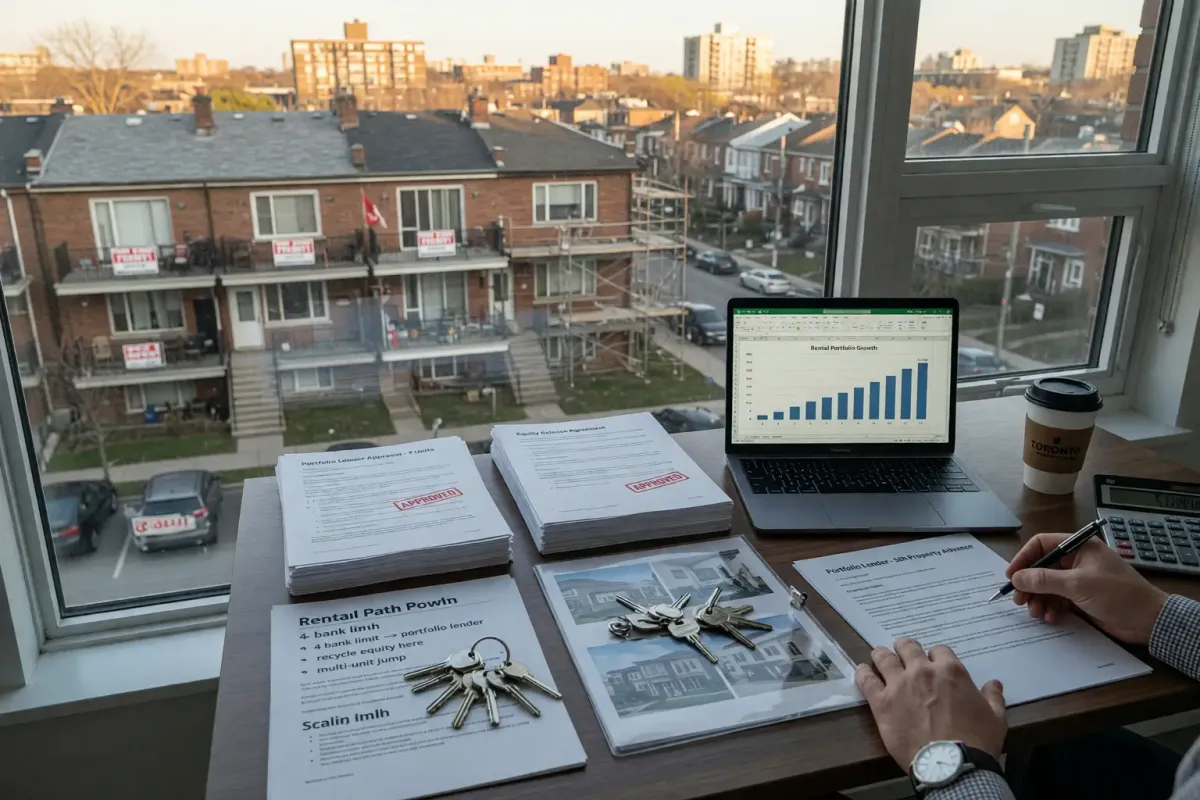
One rental property is nice. But it’s not going to change your life.
Real wealth through real estate comes from portfolios. Here’s what the numbers actually show: A single rental property in a Canadian market — depending on where you buy and how you finance it — might generate $300–$500/month in cash flow in more affordable markets like Edmonton or Halifax, though tighter markets may produce less. Ten properties? That’s $3,000–$5,000/month. Add equity growth across multiple assets in markets like Hamilton, Edmonton, or Halifax, and you’re building net worth on multiple fronts simultaneously. That’s when the math gets exciting. That’s when cash flow starts replacing your job income.
The question is: how do you get from one property to ten? Or twenty? Or more?
Let me walk you through what actually works.
The Financing Reality
Banks don’t want to lend you money on your seventh property.
In Canada, most traditional banks and monoline lenders cap conventional residential mortgages at 4 financed properties per borrower — and CMHC-insured financing for residential mortgages stops being available to you once you hit 4 units across your portfolio (as of 2026 guidelines — confirm current rules with your broker, as CMHC policy does evolve). Some lenders will stretch to 6 properties depending on your overall financial profile, but don’t count on it. After that, their conventional products aren’t available to you anymore. It’s a lender policy thing, not a legal requirement — and those policies can shift, so always confirm current guidelines directly with your lender.
| Portfolio Size | Lender Type | What to Expect |
|---|---|---|
| 1-4 properties | Traditional banks + CMHC-insured | Best rates, conventional products, CMHC insurance available |
| 7-23 properties | Portfolio lenders | Relationship-based, slightly higher rates |
| 24+ properties | Commercial/alternative | Creative structures, blanket mortgages |
The good news: portfolio lenders, B-lenders, and commercial lenders don’t have these arbitrary limits. They evaluate your overall borrower strength — your income, your equity, your track record — not just count your properties. In Canada, B-lenders — a category that includes trust companies and alternative mortgage lenders — specifically serve investors who’ve outgrown the big banks. Ask your broker which B-lenders are actively funding investor portfolios in 2026, as the roster shifts. Rates are slightly higher, but access is the point.
Start building lender relationships early. Get pre-approved before hunting for each property. Maintain good payment history. Show lenders you’re serious and capable. When you need financing for property seven, those relationships matter more than anything.
Starting Smart
Your first few properties set the foundation. Get them wrong and you stall out. Get them right and momentum builds.
First properties should:
- Generate positive cash flow from day one
- Require minimal immediate work
- Attract stable tenants in decent neighborhoods
- Teach you without overwhelming you
Don’t start with the complicated stuff. No major rehabs. No tenant nightmares. Learn the business on properties that perform while you figure out what you’re doing.
Success with early properties builds confidence, capital, and experience that later acquisitions leverage.
When you’re ready to structure the mortgage side of this strategy, our flip mortgage financing guide covers the programs that typically fit.
Scaling Up Property Size
Here’s something experienced investors figure out: managing ten single-family homes is harder than managing one ten-unit building.
Same number of units. Way less per-unit management effort. One roof instead of ten. One property manager instead of ten relationships. Concentrated maintenance instead of scattered.
As your portfolio grows, consider transitioning toward larger properties:
- Duplexes and triplexes
- Small apartment buildings
- Commercial multifamily
The math changes too. Single vacancy in a single-family home = 100% vacancy. Single vacancy in a ten-unit = 10% vacancy. That diversification within single assets provides stability that scattered single-families can’t match.
Managing the Growth
Your operations have to scale with your portfolio. What works for two properties doesn’t work for twenty.
When to hire property management:
- Time demands exceed your availability
- You’re expanding beyond convenient driving distance
- Complexity starts requiring professional capabilities
- You’d rather work ON your portfolio than IN it
Hiring professional management often marks the shift from hands-on landlord work to true portfolio scaling. The same growth pressures appear on the other side of that relationship, where proven networking and referral strategies for property managers shape how firms attract and retain investor clients.
Don’t wait until you’re drowning. Hire management before you need it.
Build systems for:
- Financial tracking (know exactly how each property performs)
- Maintenance coordination
- Tenant communication
- Legal compliance
Technology helps. Property management software beats spreadsheets once you’re past a few units.
For a closer look at the same decision, Closing Cost Negotiation Tactics for Canadian Investors breaks down how LendCity approaches it.
Borrowers comparing options often continue with Inbound Marketing for Real Estate Professionals: A Complete Guide before booking a strategy call.
Borrowers comparing options often continue with Affordable Rentals in a Recession: Why They Win before booking a strategy call.
Develop your team: Property managers. Maintenance contractors. Accountants. Attorneys. Build these relationships before you desperately need them.
Financing Strategies for Continued Growth
Creative financing enables portfolio growth beyond what single strategies allow.
Equity recycling: As properties appreciate and mortgages pay down, refinance and pull equity out. Redeploy that capital into additional acquisitions. Your existing properties fund your portfolio growth.
BRRRR method: Buy, Rehab, Rent, Refinance, Repeat. Systematically recycle the same capital through multiple acquisitions.
Blanket mortgages: Cover multiple properties under single financing. Simplifies management, potentially improves terms through aggregation.
Partnerships: Other investors can provide capital or capacity you lack. Joint ventures, syndications, and creative partnerships expand what’s possible beyond individual limits.
Avoiding the Common Traps
Portfolio growth creates problems that smaller operations avoid.
Overextension: Expanding faster than your management capacity, capital reserves, or market knowledge. Properties acquired during aggressive growth get inadequate attention and underperform. Scale at a sustainable pace.
Leverage vulnerability: Highly leveraged portfolios face vulnerability to rate changes, vacancy spikes, or economic downturns. Maintain conservative debt levels and adequate reserves.
Concentration risk: All your properties in one market, one property type, or one tenant category? Concentrated risks that diversification would reduce. Spread your bets as portfolios grow.
Frequently Asked Questions
How many properties can I finance?
When should I hire property management?
Should I focus on one market or diversify?
How fast should I grow my rental portfolio?
How much capital do I need to scale?
What is the BRRRR method and how does it help scale a portfolio?
Should I transition from single-family homes to multi-family buildings?
The Bottom Line
Ready to explore your financing options? Book a free strategy call with LendCity and let our team help you find the right path forward.
Building a rental portfolio is the path to real wealth through real estate. One property teaches you the game. Multiple properties change your financial life.
The keys: understand financing progression, start with manageable properties, scale your operations as portfolios grow, and avoid the traps that derail expanding investors.
It’s not fast. It’s not easy. But it works—for investors willing to build systematically over time.
Start with one. Stabilize it. Use it to fund the next. Repeat until cash flow replaces your job income.
That’s how portfolios get built.
Free download
MLI Select document checklist
Appraisals, rent rolls, environmental reports, and the CMHC package lenders expect before they underwrite.
By submitting, you agree to receive occasional emails from LendCity. You can unsubscribe at any time.
4.8/5 (116 Google reviews)
Disclaimer: LendCity Mortgages is a licensed mortgage brokerage. Content on this page is for educational purposes only and does not constitute legal, tax, investment, securities, or financial-planning advice. Rates, premiums, program terms, and regulations referenced are as of the page's last updated date and are subject to change. Any investment returns, rental yields, tax savings, or case-study figures shown are illustrative only — they are not guaranteed, not typical, and individual results will vary. Consult a licensed lawyer, Chartered Professional Accountant, or registered dealer before acting on any information above. Editorial standards.

Written by
Scott Dillingham
Published
April 15, 2026
· Updated June 29, 2026Reading time
6 min read
A Lender
A major bank or institutional lender offering the most competitive mortgage rates and terms but with the strictest qualification criteria, including full income verification and stress test compliance. Most investors use A lenders for their first four to six properties.
Appreciation
The increase in a property's value over time, which builds [equity](/glossary/equity/) and wealth for the owner through market growth or [forced improvements](/glossary/forced-appreciation/).
B Lender
Alternative lenders that serve borrowers who don't qualify with major banks, offering slightly higher rates with more flexible criteria.
Blanket Mortgage
A single mortgage that covers multiple properties, often used by investors to simplify financing for a portfolio. Allows release of individual properties as they're sold.
BRRRR
Buy, Rehab, Rent, Refinance, Repeat - a real estate investment strategy where you purchase a property below market value, renovate it to increase its [ARV](/glossary/after-repair-value-arv/), rent it out, [refinance](/glossary/refinancing/) to pull out your initial investment, and repeat the process with the recovered capital. Success depends on [forced appreciation](/glossary/forced-appreciation/) and strong [cash flow](/glossary/cash-flow/).
Cash Flow Optimization
Cash flow optimization is the strategic process of maximizing the net income generated from a rental property by increasing rental revenue and minimizing operating expenses, mortgage costs, and vacancies. For Canadian real estate investors, this often involves tactics such as selecting the right financing structure, leveraging rental income from multiple units, and managing expenses like property taxes and maintenance to ensure the property generates consistent positive monthly returns.
Cash Flow
The money left over after collecting rent and paying all expenses including mortgage, taxes, insurance, maintenance, and property management. Positive cash flow is the primary goal of buy-and-hold investors. See also [NOI](/glossary/noi/), [Cash-on-Cash Return](/glossary/cash-on-cash-return/), and [Vacancy Rate](/glossary/vacancy-rate/).
CMHC Insurance Premium
The cost of mortgage insurance provided by Canada Mortgage and Housing Corporation (CMHC), expressed as a percentage of the mortgage amount. Premium rates vary based on LTV, property type, and transaction type. For multifamily standard rental housing under the current schedule (as of July 14, 2025), term premiums range from 5.35% at ≤85% LTV to 6.15% at ≤95% LTV, with higher rates for construction financing and other housing types (student, seniors, SRO/supportive). MLI Select points tiers can reduce the premium by 10%–30%. Premiums are typically added to the mortgage balance and paid over the life of the loan.
CMHC Insurance
Mortgage default insurance from Canada Mortgage and Housing Corporation. For 1-4 unit investment properties, investors must put 20%+ down (no insurance available). However, CMHC offers MLI Select for 5+ unit multifamily properties, and house hackers can access insured mortgages with 5-10% down.
CMHC
CMHC (Canada Mortgage and Housing Corporation) is a federal Crown corporation that provides mortgage loan insurance to lenders when borrowers have less than a 20% down payment, enabling Canadians to purchase homes with as little as 5% down. For real estate investors, CMHC insurance is available on owner-occupied properties of up to four units, but is generally not available for non-owner-occupied investment properties, meaning investors typically need at least 20% down and must seek conventional financing.
Hover over terms to see definitions. View the full glossary for all terms.