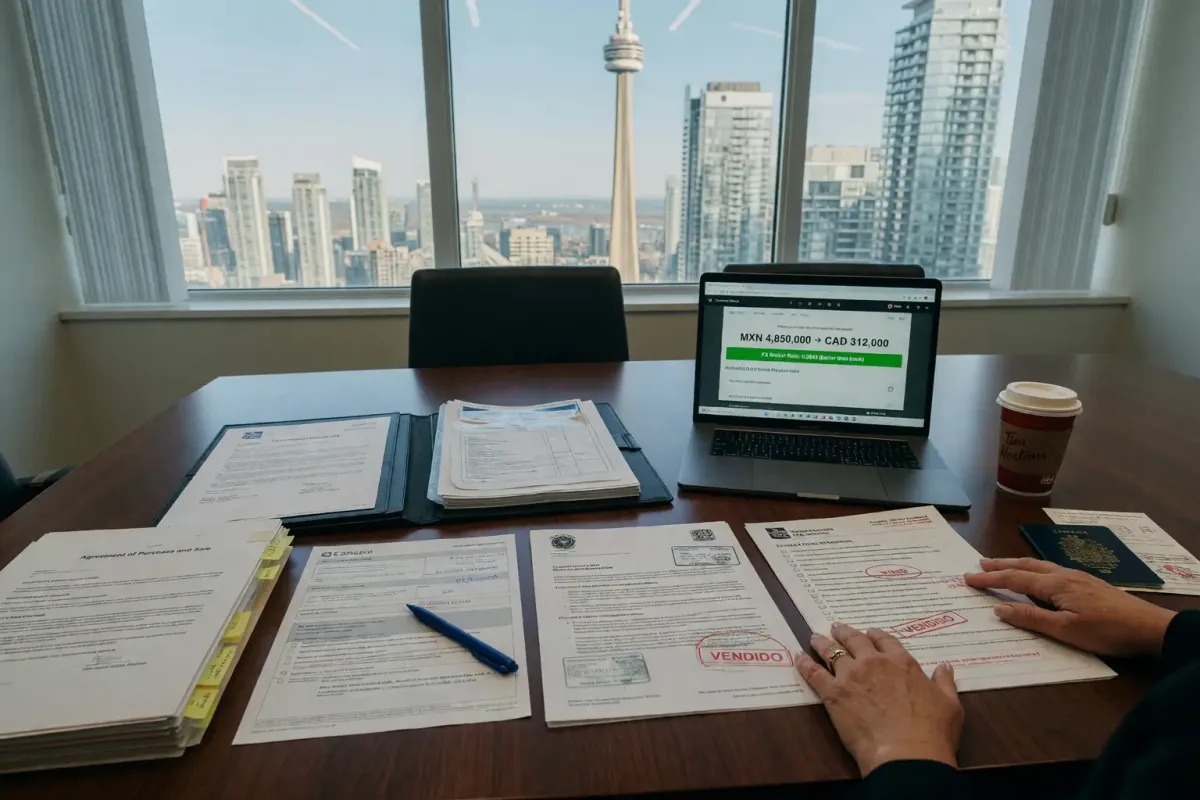
You built wealth in your home country. Maybe you own a property. Maybe you have significant savings. Maybe your family has been investing for years and there’s equity sitting in real estate overseas.
Now you’re in Canada, and you want to put that wealth to work in Canadian real estate. Makes total sense. But here’s where it gets tricky: moving money across borders into a Canadian mortgage isn’t as simple as wiring funds and writing a check.
Canada has strict rules about where your down payment comes from, how you document it, and how it enters the country. Miss a step and your mortgage application stalls. Or worse, your funds get flagged and frozen.
I’ve helped a lot of newcomers work through this process. Let me walk you through exactly how to get your foreign equity into Canadian real estate—the right way.
Selling Property Abroad to Fund Canadian Real Estate
If you own property in your home country and plan to sell it to generate a down payment, you’re starting from a strong position. Real estate equity is one of the most legitimate and well-documented sources of funds a lender can see.
But “I sold my house back home” isn’t enough. Lenders need a paper trail that tells the full story. Here’s what you need to collect:
Before the sale:
- Property ownership documents proving you own (or owned) the property
- A current or recent valuation or appraisal
At the time of sale:
- The signed purchase and sale agreement
- The closing statement showing the net proceeds
- Proof of payment received (bank deposit record)
After the sale:
- Bank statements from your foreign account showing the proceeds landing
- Wire transfer records showing the money moving from your foreign account to your Canadian account
- Your Canadian bank statement showing the funds arriving
Every single step in the chain needs documentation. If there’s a gap—say, the money went from the buyer to your uncle’s account before it came to you—that gap becomes a problem. Lenders and their compliance teams will ask questions, and “it’s just how we do things back home” isn’t an answer that works in Canada.
Currency Conversion: Getting It Right
When you move money from another currency into Canadian dollars, you’re going to deal with exchange rates and conversion fees. This is worth paying attention to because it can cost you thousands of dollars if you handle it carelessly.
Here are your main options for currency conversion:
Big banks: Your Canadian bank will happily convert your foreign currency. They’ll also charge you the worst exchange rate possible. The spread between the market rate and what the bank offers can be 2-3%, which on a $200,000 transfer means $4,000 to $6,000 gone. Just like that.
Foreign exchange brokers: Companies like Wise (formerly TransferWise), OFX, Knightsbridge FX, and others specialize in international transfers. Their rates are significantly better than banks—often within 0.5-1% of the mid-market rate. On large transfers, this saves you serious money.
Timing: Currency markets move every day. If you’re transferring a large sum, consider whether to move it all at once or in chunks over time. There’s no crystal ball for exchange rates, but spreading out your transfers can reduce the risk of converting everything at a bad rate.
One important note: regardless of how you convert the currency, keep records of every transaction. The conversion receipts become part of your mortgage documentation. The lender needs to see that the Canadian dollars in your account came from a legitimate source, and the conversion records are part of that chain.
Anti-Money Laundering: Why Canada Cares So Much About Your Money
Canada’s anti-money laundering (AML) rules are strict, and they apply to everyone—but newcomers feel them most because cross-border money movement triggers extra scrutiny.
Here’s what you need to know: every financial institution involved in your mortgage—the bank, the mortgage lender, the real estate lawyer—is legally required to verify the source of your funds. This isn’t optional for them. They can face massive fines and criminal penalties if they don’t do proper due diligence.
FINTRAC (the Financial Transactions and Reports Analysis Centre of Canada) monitors large transactions. Any cash transaction of $10,000 or more, or any electronic funds transfer of $10,000 or more coming into or going out of Canada, gets reported.
This isn’t something to be afraid of. It’s just something to be prepared for. If your money is clean—and I’m assuming it is—then the process is about documentation, not about suspicion.
What raises red flags:
- Large cash deposits with no clear source
- Money that bounces through multiple accounts before reaching yours
- Funds from countries on international sanctions lists
- Inconsistent stories about where the money came from
- Deposits that appear to be deliberately structured to stay under $10,000 (this is called “structuring” and it’s actually illegal)
What keeps things smooth:
- Direct wire transfers from your foreign bank to your Canadian bank
- Clear documentation at every step
- Consistent explanation that matches the paper trail
- Being upfront with your mortgage broker about where your money comes from
Gift Money vs Sale Proceeds: The Rules Are Different
Your down payment might come from a few different sources, and each one has its own documentation requirements. Two of the most common for newcomers are gift money from family and proceeds from a property sale. Let me break down both.
Sale Proceeds
If you sold property, a business, or other assets, the documentation path is what I described above—ownership proof, sale agreement, closing statement, bank records, wire transfer, Canadian deposit.
The key thing lenders want to see is that you owned the asset, you sold it legitimately, and the proceeds made it into your Canadian account through traceable channels.
Gift Money
Gift money is common in many cultures. Family helps family buy a home. Canadian lenders are totally fine with gifted down payments, but there are rules:
The gift letter: This is a signed letter from the person giving you the money. It must state:
- The gift amount
- That the money is a true gift and does not need to be repaid
- The relationship between the donor and the borrower
- The donor’s name, address, and contact information
The donor’s proof of funds: Most lenders want to see that the person giving you the money actually has it. A bank statement from the donor showing the funds is standard.
The transfer record: How did the money get from the donor to you? Wire transfer receipts, bank drafts, or direct account transfers all work. Cash does not.
Here’s the critical distinction: the money must be a genuine gift. If it’s actually a loan that you’ll pay back, it’s not a gift—it’s a liability. And undisclosed liabilities can blow up your mortgage application and potentially constitute fraud. If someone is lending you money for the down payment, disclose it. There may still be ways to make the deal work, but only if everyone’s honest about it.
What About Money from Multiple Sources?
Many newcomers piece together their down payment from several sources—some savings from their home country, some gift money from parents, some income earned in Canada. This is perfectly fine, but you need to document each source separately.
Think of it like a pie chart. The lender wants to see every slice labeled and documented. If 40% came from your foreign savings, 30% came from a property sale, and 30% came as a gift from your parents, each piece needs its own paper trail.
Down Payment Sourcing Rules: The 90-Day Window
Here’s a specific rule that trips people up: most lenders want to see 90 days of bank statements showing the accumulation of your down payment funds.
For newcomers, this creates a timing challenge. You might wire a large sum from overseas, and it shows up as a single large deposit in your Canadian account. That’s fine—as long as you can show where it came from with foreign bank statements that trace the money back at least 90 days.
The flow looks like this:
- Foreign bank statements (90 days) showing the funds in your account overseas
- Wire transfer or conversion record showing the money leaving your foreign account
- Canadian bank statement showing the money arriving
- Your Canadian bank statements (90 days) showing the funds sitting there until you need them for closing
If you can show all four pieces, you’re in good shape. Problems come when people can’t produce the foreign bank statements, or when the amounts don’t match up, or when there are unexplained deposits along the way.
How to Structure Your Move for Maximum Mortgage Readiness
If you haven’t moved to Canada yet—or if you’re in the early stages of your arrival—here’s the ideal timeline for getting your money mortgage-ready.
3-6 months before you need the mortgage:
- Start gathering foreign bank statements. Download or print them now. Some foreign banks make it hard to get historical statements after you close your account.
- If you’re selling property abroad, start the process early. Sales take time, and you want the proceeds settled in your Canadian account well before you need them.
- Open a Canadian bank account as soon as possible. Many banks let you open accounts before you arrive if you’re a confirmed immigrant.
When you move money:
- Use wire transfers through established banks or licensed foreign exchange brokers
- Keep conversion receipts, wire transfer confirmations, and every piece of paper the bank gives you
- Move the money in a way that creates a clear trail from your foreign account to your Canadian account
Once the money is in Canada:
- Let it sit in your account for as long as possible before you apply for a mortgage. The longer it’s been there, the less scrutiny it gets.
- Don’t move it around between accounts unnecessarily. Every additional transfer creates another step that needs documenting.
- If you receive additional funds (more gifts, more sale proceeds), document those separately.
Working With a Mortgage Broker Who Gets It
I can’t stress this enough: the right mortgage broker makes or breaks this process for newcomers.
A broker who works with newcomer clients regularly knows exactly which lenders accept foreign documentation, which programs are most flexible on sourcing requirements, and how to present your file so that the underwriter says yes instead of asking for more paperwork.
A broker who doesn’t work with newcomers often? They might not know that Lender A accepts foreign credit reports while Lender B doesn’t. They might not know that a specific B lender has a program designed for exactly your situation. They might waste your time applying to the wrong places.
At LendCity, we work with newcomers and immigrants all the time. We know the programs, we know the documentation requirements, and we know how to get deals done when the paperwork comes from three different countries.
The Bottom Line
Your foreign equity is real wealth. It took years of hard work to build. The process of bringing it into Canadian real estate has extra steps, but none of them are impossible.
Document everything. Use official banking channels. Work with professionals who understand cross-border transactions. And start the process earlier than you think you need to.
The sooner your money is settled in Canada with a clean paper trail, the easier your mortgage application will be. And the sooner you’ll be building wealth in Canadian real estate.
Frequently Asked Questions
Ready to explore your financing options? Book a free strategy call with LendCity and let our team help you find the right path forward.
Can I use equity from property I own in another country as a down payment in Canada?
How do I prove where my down payment money came from?
What's the best way to transfer large sums of money to Canada?
Will my money be flagged by FINTRAC when I transfer it to Canada?
Can my family send me money from overseas for a down payment?
How far in advance should I move my money to Canada before applying for a mortgage?
Do I need to pay taxes in my home country when I sell property to buy in Canada?
What if my foreign bank statements aren't in English or French?
Weekly Investor Insight
Sunday financing notes for investors
Market updates, rate moves, and deal structures — once a week. Unsubscribe anytime.
By submitting, you agree to receive occasional emails from LendCity. You can unsubscribe at any time.
Disclaimer: LendCity Mortgages is a licensed mortgage brokerage. Content on this page is for educational purposes only and does not constitute legal, tax, investment, securities, or financial-planning advice. Rates, premiums, program terms, and regulations referenced are as of the page's last updated date and are subject to change. Any investment returns, rental yields, tax savings, or case-study figures shown are illustrative only — they are not guaranteed, not typical, and individual results will vary. Consult a licensed lawyer, Chartered Professional Accountant, or registered dealer before acting on any information above. Editorial standards.

Written by
Scott Dillingham
Published
July 27, 2026
Reading time
11 min read
A Lender
A major bank or institutional lender offering the most competitive mortgage rates and terms but with the strictest qualification criteria, including full income verification and stress test compliance. Most investors use A lenders for their first four to six properties.
Appraisal
A professional assessment of a property's market value, required by lenders to ensure the property is worth the loan amount.
B Lender
Alternative lenders that serve borrowers who don't qualify with major banks, offering slightly higher rates with more flexible criteria.
Bank of Canada
Canada's central bank that sets the overnight lending rate, which influences prime rates and mortgage costs across the country. Rate decisions directly impact variable mortgage rates and overall borrowing costs for real estate investors.
Currency Conversion
Currency conversion in Canadian real estate refers to the process of exchanging one currency for another, which is particularly relevant for investors purchasing properties abroad or foreign buyers acquiring Canadian real estate. Fluctuations in exchange rates between the Canadian dollar and foreign currencies can significantly impact the true cost of a property, mortgage payments, and overall investment returns.
Down Payment
The upfront cash payment when purchasing a property. For 1-4 unit investment properties, minimum 20% down is required. 5+ unit multifamily can use CMHC MLI Select with lower down payments, and house hackers can put as little as 5% down on owner-occupied 2-4 plexes. Your down payment directly affects your [LTV](/glossary/ltv/) and the amount of [leverage](/glossary/leverage/) you use.
Due Diligence
The comprehensive investigation and analysis of a property before purchase, including financial review, physical inspection, title search, and market analysis.
Equity
The difference between a property's current market value and the remaining mortgage balance. If your home is worth $500,000 and you owe $300,000, you have $200,000 in equity. Equity builds through mortgage payments, [appreciation](/glossary/appreciation/), and [forced appreciation](/glossary/forced-appreciation/). See also [LTV](/glossary/ltv/) and [Refinancing](/glossary/refinancing/).
ITIN
Individual Taxpayer Identification Number - a US tax ID for foreign nationals, required for Canadians to invest in US real estate and file US taxes.
Lien
A legal claim against a property used as security for a debt. Liens arise from unpaid mortgages, property taxes, contractor work, or court judgments. Undiscovered liens can eliminate an apparent purchase discount on distressed properties.
Hover over terms to see definitions. View the full glossary for all terms.